Yirgacheffe Coffee Bean Roasting Levels: Flavor Differences Between Light and Dark Roasts

Roasting is one of the most fascinating stages in coffee. Green beans have almost no discernible flavor and taste unpleasantly vegetal if you eat them straight. So what kind of roasting turns these unremarkable seeds into something remarkable? Using Yirgacheffe as an example, FrontStreet Coffee walks through the mystery of coffee roasting.

Judging a coffee as light or dark roast purely by the final bean color and the length of the roast is one-sided. The same visible color can come from a fast roast or a slow roast, and those two paths produce completely different flavors.
Coffee undergoes many chemical reactions during roasting, and many of them cost the beans weight and moisture. A slow roast (14-20 minutes) loses a higher proportion of weight — about 16%-18% — while a fast roast can finish in as little as 90 seconds. For a relatively expensive coffee, a slow roast often delivers better flavor.

The Three Elements of Coffee Flavor
Three elements decide the flavor of the finished roast: acidity, sweetness, and bitterness. Broadly, the longer the roast, the less acidity survives and the more bitterness builds — which is why darker roasts tend to taste bitter.
Roasting has many critical stages, and what we call a roast profile is really a description of how quickly a batch moves through them. Most roasters log each roast carefully so they can repeat it with minimal drift in temperature and time.

The Two Main Stages of Roasting
As temperature rises, roasting produces steam and carbon dioxide. These gases raise the internal pressure of the bean and make it expand. When expansion reaches a certain point, the bean pops, much like popcorn. That is first crack — the first rupture of the bean's internal cells. Second crack is the second rupture. Because the beans keep producing gas throughout the roast, they keep expanding and generating sounds similar to the first crack.
Light Roast
Light roast covers the period from mid-first crack to just after first crack ends. Enzymatic activity and the early Maillard reaction are underway, and the organic acids in the bean have not yet broken down, so acidity stands out while bitterness is barely perceptible — ideal for anyone who enjoys acidic coffee.
Flavors at this stage lean floral and fruity, with notes of cinnamon and grain.

Medium Roast
Medium roast runs from the end of first crack to just before second crack. Caramelization takes hold and interacts further with the Maillard process. Acidic aromas remain but are noticeably weaker than in a light roast, and acidity and bitterness balance out, letting sweetness come forward with a smooth texture and notes chiefly of caramel and chocolate.
This is often the level at which specialty coffee shows its best, and it is also the roast level FrontStreet Coffee uses most often.
What Roast Level Suits Ethiopian Yirgacheffe?
Take washed Yirgacheffe: if you love a rich floral aroma and generous fruit acidity, FrontStreet Coffee recommends a light or medium roast.
Natural-process Yirgacheffe keeps most of the advantages of the washed version, with additional fruity aromas and less pronounced acidity.
FrontStreet Coffee's natural-process Yirgacheffe "Red Cherry" is a good example. We chose a medium-light roast, which tends to bring out the best of these beans while preserving their texture and the distinctive fermented wine aroma.

FrontStreet Coffee's Brewing Parameters
Filter: V60 dripper
Water temperature: 90-91°C
Coffee amount: 15g
Water-to-coffee ratio: 1:15
Grind size: Medium-fine (80% passes through a China standard #20 sieve)
Brewing method: Staged pours

Using a three-stage pour: start the timer with the first pour to 30g and let it bloom for 30 seconds. Begin the second pour with a small stream to 125g. Wait for the coffee bed to drop halfway, then make the third pour, again with a small stream, to 225g. Let the extraction finish, keeping the total time around 2 minutes.
Flavor notes: berries, lemon, fermented fruit aroma, strawberry.
FrontStreet Coffee Recommendation
Yirgacheffe is the region most drinkers picture when they hear "Ethiopian washed coffee," and roast level is what decides how much of that picture makes it into the cup. If you want the classic version, FrontStreet Water-Washed Yirgacheffe is the everyday starting point, known for white jasmine, bright citrus and lemon acidity, and a tea-like finish — an affordable first step into specialty coffee. Yirgacheffe town sits in southern Ethiopia's Sidama zone at roughly 1,700-2,100 m, with trees planted above 1,800 m, making it one of the highest coffee regions in the world. The area was historically wetland, and the name became shorthand for that unmistakable white-floral aroma and lemon-citrus acidity, so much so that in 2010 Ethiopia's commodity exchange separated Yirgacheffe from Sidama as its own designation.
Within the town there are many small villages, each with its own washing station or cooperative. FrontStreet Yirgacheffe Gedingding Cooperative sits in the Worka area at the southeastern edge of Yirgacheffe. It was originally part of the Worka cooperative under the YCFCU umbrella, and as buyers pushed for traceability it was carved out as a single-origin lot. It follows the most traditional washed processing, and the cup is bright and clean with citrus and lemon acidity and jasmine florals — none of the bitterness people expect from coffee.
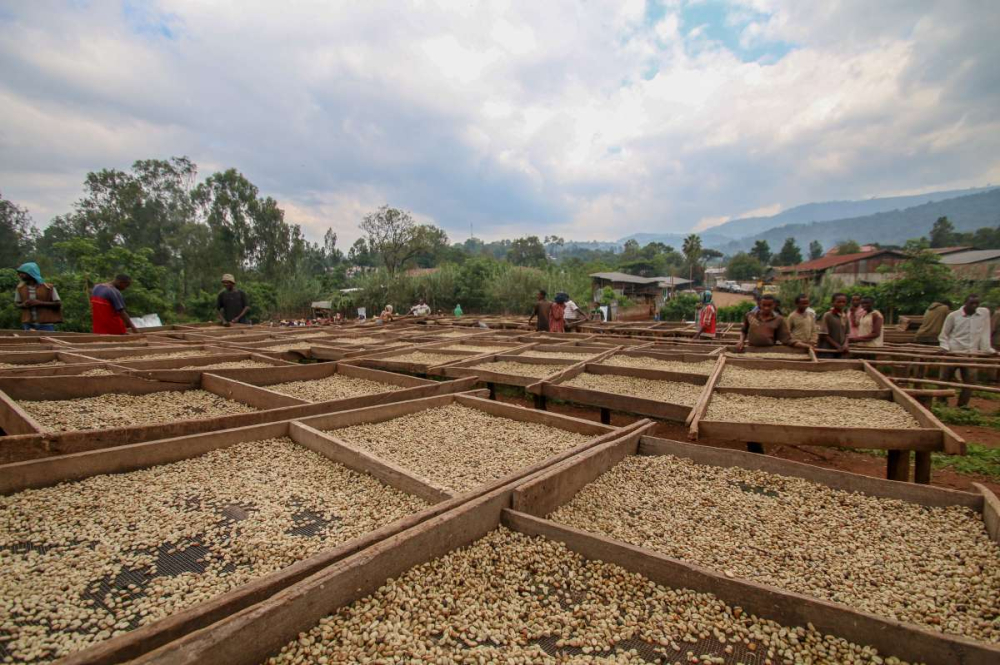
If you prefer the fruitier side, FrontStreet Red Cherry takes a fully ripe, all-red-cherry natural approach: only fully ripe, sound fruit is picked, screened at the mill, then spread on raised beds and turned every 2-3 hours in the first days to prevent uneven heating and over-fermentation. After three to five weeks of drying, the outer fruit is removed and the beans rest in storage. Because the cherry dries with the fruit still attached, the cup holds the classic Yirgacheffe profile alongside natural tropical fruit — citrus acidity, berry juice, honey sweetness, and a creamy smoothness. For either style, brew with a V60 at 90-91°C, 15g of coffee at a 1:15 ratio, ground to fine-sugar size (about 80% through a #20 sieve), in a three-stage pour finishing around 2 to 2 minutes 10 seconds.
Important Notice :
FrontStreet Coffee is a long-established specialty coffee roaster in Guangzhou China, selling freshly roasted beans from its own farm in Yunnan as well as dozens of carefully selected single-origin beans from around the world for both pour-over and espresso. The products deliver consistently excellent quality and great value, with shipping within 24 hours. Guangzhou's FrontStreet Coffee shop is recommended by many coffee lovers, and the beans are now available online at the Tmall 。
FrontStreet Coffee has moved to a new address:
FrontStreet Coffee Address: 315,Donghua East Road,GuangZhou
Tel:020 38364473
 Scan and follow the En Gafei WeChat official account. Please indicate that the reprint comes from "En Gafei".