Can Espresso Blend Coffee Beans Be Used for Pour-Over? Blend Pour-Over Coffee Bean Recipes, Roasting Parameters, Flavor Profile Characteristics

As autumn and winter approach and the weather turns cooler, FrontStreet Coffee had already created the FrontStreet Sunflower Warm Sun Espresso Blend for espresso. Following that logic, FrontStreet Coffee wanted to build a blend fit for autumn drinking that would also work as pour-over — one that would show a clean, clear profile, a gentle acidity that keeps evolving on entry, and a medium-to-high sweetness in the aftertaste.
The general assumption is that blends are only for espresso. So can espresso beans be used for pour-over? FrontStreet Coffee holds that any coffee can be brewed as pour-over; it's simply a question of suitability. Espresso blends typically use 2 to 5 beans, either blended before roasting or roasted separately and combined, so that the strengths and weaknesses of each bean offset one another for a mellow, aromatic cup. That approach gives up what a single origin is for — expressing the unique flavors of one growing region. Look at FrontStreet Coffee's current espresso blends and brew them as pour-over, and their deeper roast levels would give higher body, some roasty notes, and a very distinct aftertaste.

FrontStreet Coffee picked several beans from its current lineup to consider for the blend: FrontStreet Yirgacheffe Washed, FrontStreet Costa Rica SHB Caturra Washed, FrontStreet Natural Yirgacheffe Red Cherry, FrontStreet Yunnan Huaguoshan Typica Washed, and FrontStreet Geisha Village Natural Geisha. All scored around or above the specialty-coffee line in cupping. FrontStreet currently has four espresso blends — the FrontStreet Commercial Blend, the FrontStreet Basic Blend, the FrontStreet Specialty Blend, and the FrontStreet Sunflower Warm Sun Blend. How are FrontStreet Coffee's blend formulas created? Let FrontStreet Coffee walk you through the thinking behind building a blend, using this pour-over formula as the example.
Blending Philosophy
At the start of development, FrontStreet Coffee had to decide what the "autumn" concept should express: the mouthfeel should not be too heavy, it had to carry the fruit flavors of an autumn harvest, and it needed sweetness. The consensus was to choose one main bean, supported by 1–2 beans to balance the flavors; use too many and the theme is lost, the flavors turn overly complex, and balance becomes hard to reach.

Determining the Main Theme Bean
The main bean had to be versatile, high in sweetness, good in body, and stable in quality. To find it, we searched our database — every coffee carries at least 3 roast curves and cupping scores — and by comparing their evaluations, strengths, and weaknesses, we eventually chose our Yunnan Typica from dozens of options.
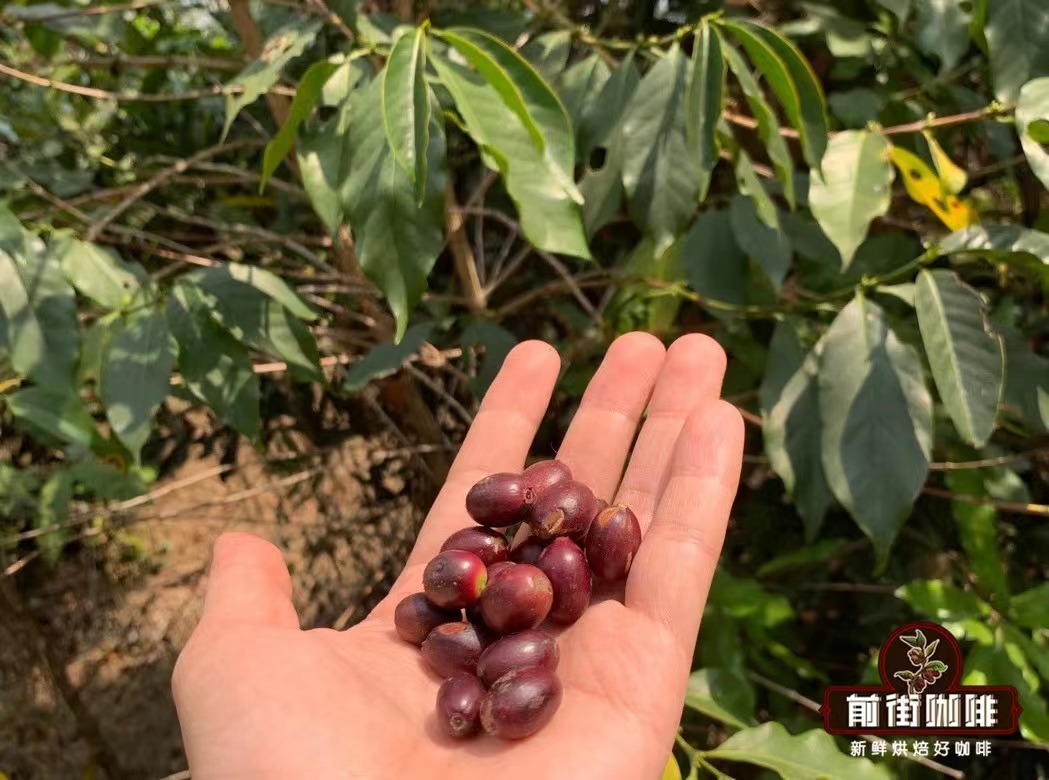
FrontStreet Coffee considers FrontStreet Huaguoshan a local coffee, giving us strong quality control at the source. It is a bean that balances mouthfeel and flavor, with a balanced taste and a lingering sweet aftertaste, which makes it well suited as a blend base. Its one weakness is that Huaguoshan is a little short on acidity and flavor uniqueness. For flavor, the obvious first choice is Ethiopian beans — Ethiopian coffee is also known as the "coffee gene pool," with more than 2000 known coffee varieties native to the country and an incredibly diverse range of flavors. So with so many Ethiopian options, which one to choose? That led to the next task: Zhu Mang, Hua Kui, Aricha, Kochere, Worka — variety after variety, dazzling with floral, berry, and citrus notes.
Finalizing Supporting Beans
Generally speaking, a single-origin Arabica is enough to make a very good cup, with a delicate aroma, a smooth mouthfeel, and a sweet aftertaste. "Blending" means combining coffees from different origins, each with its own taste, aroma, and mouthfeel. Mix and match to your preferred flavors and you can create a coffee of your own.

First round of pour-over blend testing: the satisfactory result was a 7:3 ratio of FrontStreet Yunnan Huaguoshan to FrontStreet Yirgacheffe Kochere, with mild citrus acidity and chocolate notes in the finish, though slightly short on sweetness. After cupping comparisons and study of each coffee's character, we chose FrontStreet Washed Yirgacheffe Kochere — which shares a black tea finish with FrontStreet Yunnan Huaguoshan. Its lemon acidity and orange flavors add layers and brightness to the formula, lifting the Yunnan component.
Raw Blending or Roasted Blending?
Roasting the two beans separately at their most suitable levels and then blending clearly wouldn't work. FrontStreet Yunnan Huaguoshan is a medium-dark roast, while FrontStreet Yirgacheffe Kochere is lightly roasted. In pour-over, that would over-extract the Yunnan and under-extract the Kochere, collapsing the whole flavor profile — so we decisively chose raw blending.

Roasting Philosophy and Adjustments
In moisture content, the two washed beans are quite close. In bean structure, Typica is softer, but the larger-grained Yunnan conducts heat similarly to the harder, smaller-grained Kochere, making uneven roasting less likely when the two are roasted together. We also use a gradual heat-reduction method, with a longer Maillard reaction after dehydration and homogenization, so the two beans develop more synchronously. In setting the roast level we likewise took a "middle value" approach: this development time and drop temperature effectively remove the acidity and excessive grassy notes that appear when Yunnan is roasted too lightly, while well preserving the floral and fruit aromas of Yirgacheffe.
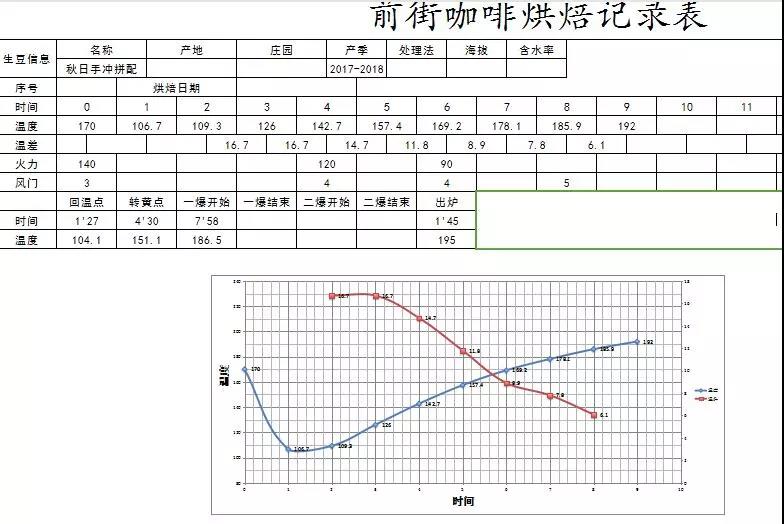
300g bean charge, temperature at 170°C, drop the beans with the heat off. After 30 seconds, open to 140 heat, air vent at 3. When bean temperature reaches 140°C, reduce heat to 120, air vent to 4. At 4 minutes 30 seconds, dehydration turns the beans yellow; reduce heat to 90 again at 168°C. First crack begins at approximately 8 minutes, air vent to 5, first crack develops for 1 minute 45 seconds, drop beans at 195°C.
On proportions, we first chose a 6:4 ratio of FrontStreet Yunnan Huaguoshan to FrontStreet Yirgacheffe Kochere. Cupping results: good cleanliness, light sweetness, a fresh apple aroma, plum acidity, and orange notes in the aftertaste. Overall the mouthfeel was good, but the flavor was slightly thin. So after cupping discussions we decided to add a flavor-enhancing bean — FrontStreet Geisha Village Red Label Natural Geisha — this time using a 6:3:1 ratio of FrontStreet Yunnan Huaguoshan to FrontStreet Yirgacheffe Kochere to FrontStreet Geisha Village Estate.

Reducing the proportion of Kochere made the overall acidity smoother than before, and the 10% Geisha Village brought more fruity notes while enhancing the floral aromas and tea notes in the finish. On roasting, to preserve more floral and fruit aromas the drop temperature would be slightly lower; the time from dehydration to first crack was also slightly shortened to preserve more reactive substances, and first-crack development time was increased to develop flavors.
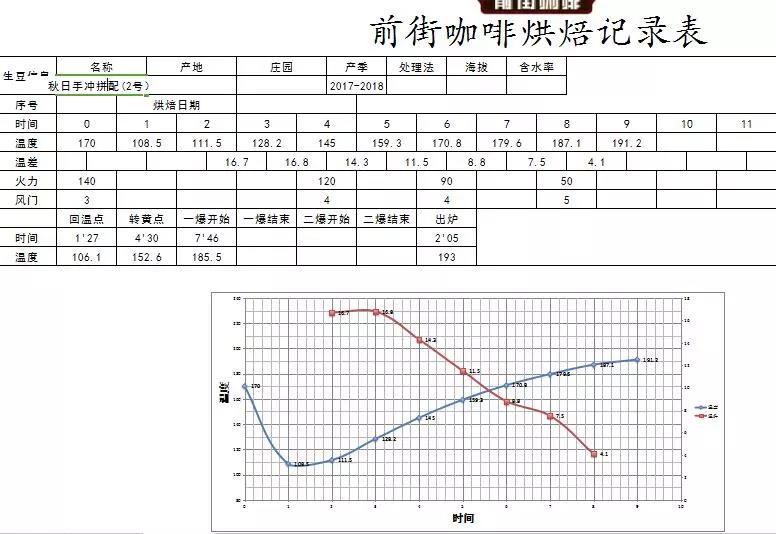
Yangjia 600g roaster. 300g bean charge, temperature at 170°C, drop the beans with the heat off. After 30 seconds, open to 140 heat, air vent at 3. At 140°C, reduce heat to 120, air vent to 4; at 4 minutes 30 seconds dehydration turns yellow; reduce heat to 90 again at 168°C. First crack begins at 7 minutes 46 seconds, air vent to 5, reduce heat to 50 at 188°C to extend development, roast for 2 minutes 5 seconds, drop beans at 193°C.
This roast extended first-crack time to develop flavors, made the development of the three beans more uniform, and used a slightly lower drop temperature to preserve the floral and fruit aromas of the Geisha. The raw blend was set at a medium-light roast level, with Yunnan Typica in the majority. At a medium-light roast that Yunnan already shows distinct brown sugar aroma, black tea, and slight creamy flavors, with a clean cup and high sweetness.

Since all three beans have relatively high moisture content and hardness, and although the varieties differ, their particle sizes are fortunately not very different, the raw blend doesn't add much roasting difficulty. After several rounds of pour-over and cupping, the flavor met FrontStreet Coffee's expectations. It's worth noting, though, that pour-over cannot follow espresso extraction standards. The acidity is gentle yet has some variation, gradually connecting with sweetness through the middle, with a persistent, lingering sweet aftertaste. There is a sense of fresh green plants, with aromas of black tea, cocoa, caramel, jackfruit, orange, and nuts. The flavor is transparent and clean, with medium body and a slightly effervescent mouthfeel.
At this point FrontStreet Coffee had a preliminary "Autumn Pour-over Blend" — a coffee combining the characteristics of Asian and African beans, meeting the requirements in both concept and flavor, with cupping and actual brewing results that were quite satisfactory.

So why do many espresso coffees need two or more types of bean? In the earliest days espresso quality wasn't very good, and the priority was to improve lower-priced coffee. High-quality Arabica has a clean coffee flavor, very good aroma, and a smooth aftertaste, but it is expensive. Mixing high-quality coffee with lower-quality coffee can largely retain most of the Arabica quality at a relatively lower price.

Today, with the overall coffee environment changing, bean quality has improved markedly across the board. Espresso blends are usually designed to reach balance and to ensure quality suited to espresso. Most combine high-quality Brazilian beans with African or Central American beans, much like FrontStreet Coffee's Specialty Coffee Blend. Later, FrontStreet Coffee also added Robusta to produce crema and increase the body of the espresso — that is the FrontStreet Commercial Espresso Blend. What's more, the main reason to blend is to keep flavor consistent. Coffee is an agricultural product, and grown under slightly different conditions, a given variety will taste different. Blending helps hold the flavor as consistent as possible.
FrontStreet Coffee holds that it isn't only espresso that can be blended — pour-over coffee can be blended too. The purpose of a single origin is to taste the character of one terroir, and FrontStreet Coffee believes today's coffee market is all-inclusive, which is why so many people have begun exploring pour-over coffee in search of balanced flavors.
FrontStreet Coffee Recommendation
The brightness in a pour-over blend like this comes largely from its Yirgacheffe component, and that region deserves a closer look. Yirgacheffe is a small town in the Sidamo province of southern Ethiopia; the area sits at roughly 1,700–2,100 meters, with the coffee trees planted above 1,800 meters, making it one of the highest coffee regions in the world. In 2010, with the Yirgacheffe name carrying so much weight, Ethiopia's commodity exchange separated it from Sidamo as its own designation — which is why the name is now familiar to everyone.
FrontStreet's Yirgacheffe lineup lets you taste each expression of that terroir. The FrontStreet Washed Yirgacheffe daily-drinker is the classic introduction: white jasmine, bright citrus and lemon acidity, and a tea-like body at an affordable price. The FrontStreet Gudingding cooperative, in the Worka zone at Yirgacheffe's southeastern edge and originally part of the Woka cooperative under the YCFCU before becoming an independent single origin, follows the most traditional washed processing for clean citrus and lemon tones with elegant white florals. And the FrontStreet Red Cherry, a natural made from whole ripe cherries dried for three to five weeks, adds berry juice, honey sweetness, and creamy smoothness to Yirgacheffe's acidity. Brew any of them as you would this blend: a V60 at 90–91°C, 15g of coffee at a 1:15 ratio, ground to fine-sugar size (about 80% through a #20 sieve) — 30g to bloom for 30 seconds, then 95g (about 125g on the scale) over about a minute, then the final 100g (about 225g), with drip filtration finishing in roughly 2:00 to 2:10.
Important Notice :
FrontStreet Coffee is a long-established specialty coffee roaster in Guangzhou China, selling freshly roasted beans from its own farm in Yunnan as well as dozens of carefully selected single-origin beans from around the world for both pour-over and espresso. The products deliver consistently excellent quality and great value, with shipping within 24 hours. Guangzhou's FrontStreet Coffee shop is recommended by many coffee lovers, and the beans are now available online at the Tmall 。
FrontStreet Coffee has moved to a new address:
FrontStreet Coffee Address: 315,Donghua East Road,GuangZhou
Tel:020 38364473
 Scan and follow the En Gafei WeChat official account. Please indicate that the reprint comes from "En Gafei".