Siphon Coffee Brewing Steps and Precautions_How to Use Electric Siphon Pot_What Coffee Beans to Use in Siphon

1. Choose the Right Size Pot
Most people buy a 3-cup pot, which can brew 1-2 cups of coffee. If you only brew one cup, a 2-cup pot is a better fit because less water is left behind in the lower pot. For those who are particular, learn to pour out the water from the lower pot first, and the size matters less. By extension, for 3-4 cups choose a 5-cup pot.
2. Correct Water Amount
The ideal water amount is one cup of coffee filled to 8/10 full. For one cup, pour about 1.3 cups of hot water; for two cups, pour about 1.5 cups. Excess water will be evaporated or absorbed by the coffee grounds. Remember to keep a wrung-out damp cloth ready to wipe the pot dry. If the pot has water on it when heated directly, there is a danger of cracking, so be careful.
A well-kept HARIO TCA-3 of the discontinued edition, with its beautiful handle base, has been with its owner for 14 years and is well on its way to becoming a family heirloom.
3. Alcohol Lamp Wick Setting
The flame intensity of an alcohol lamp depends on the wick. Viewed horizontally at eye level, the wick should extend about 1-2mm above the holder, with the tip spread evenly and then cut flat. This ensures a stable, uniform flame shape. The tail of the flame should partly touch the bottom of the pot; if it does not, adjust as needed.
Many people replace alcohol lamps with gas lamps, and each has its pros and cons. Gas lamps have a stronger flame, heat up faster, and allow adjustable intensity. The disadvantages are that refilling gas takes longer than alcohol and you need to let it sit overnight for the pressure to stabilize. You also cannot see the remaining amount, which can lead to the awkward situation of running out of gas mid-brew and ruining a pot of coffee.
Both are afraid of wind, so if possible make an L-shaped board to block it, or simply use an empty DVD case opened into an L shape.
4. Grinding Siphon Coffee Beans
If you are particular, first remove defective beans such as empty shells and deformed beans. According to personal preference, use 12-20 grams per cup; one level coffee spoon is about 10 grams. For two cups or more, start reducing toward about 20-30 grams, which is also related to the residual water in the lower pot.
5. Grinder Selection
Electric grinding methods divide into "blade cutting" and "burr grinding." Burr grinding can easily raise the temperature at high speed, prematurely extracting oils and aromas from the beans. So-called "bean chopper" blade cutting does not have that problem, though particle size consistency is difficult to adjust.
Correction: grinding 1-3 cups will not cause a temperature increase. If you cannot find a satisfactory manual grinder, electric is the only choice. You can compare options such as Little Feiying, Little Feima, Fuji, Kalita, flat burr, and conical burr.
By the way, the so-called "bean chopper" does not refer to those simple appliances with juicer blades at the bottom and cylindrical bodies. Those products have numerous disadvantages and cannot really be called grinders.
For someone who brews only one or two cups a week, a manual grinder is the best choice. It also uses the burr grinding principle, and because manual grinding is slow there is no temperature increase problem, while consistent rotation speed yields uniform particles.
Manual grinders come in various designs, but the key lies in the grinding cone. Remember to check whether there are guide vanes or guide slots inside, and request a trial grind before purchasing. One buyer once picked up a manual grinder that took forever to produce even a little powder; now that they brew two cups a day, the old grinder no longer keeps up.
If possible, choose dual-shaft, CNC-cut burrs, which wobble less and are more efficient.
Look closely and you can see the guide vanes; some designs integrate hook shapes above the cone.
6. Grind Coarseness
Manual grinders have no markings, so you can only assess by eye. For siphon, grind to roughly the same point; commercial grinders such as Feiying and Feima have settings around 2.5. If you want to brew longer or use more coffee, grind coarser to avoid over-extraction. One shop owner uses more grams with a coarse setting and brews for about 1 minute, on the reasoning that only the initial aromas are extracted.
7. Insert the Upper Pot
The principle is to minimize contact between the coffee grounds and moisture before brewing. It is best not to insert the upper pot while waiting for the water to boil; pour in the coffee grounds just before insertion. Some people pour the grounds after the water rises, but then the grounds are harder to mix into the water.
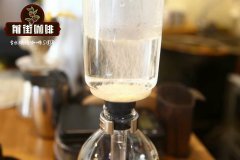
After continuous large bubbles appear in the lower pot, first insert the upper pot halfway at an angle to confirm that boiling water will not suddenly spray out, then you can fully insert it. With gas lamps, do not let the water boil too vigorously, otherwise boiling water will spray from the seams after insertion and wet the outer wall, which can be dangerous.
Insert at an angle first to avoid a "sudden boil."
8. First Stirring
When the water has risen halfway, you can perform the first stirring. Whether to use a circular or back-and-forth motion depends on personal preference. The key is to mix the grounds gently and smoothly, keeping the stirring rod close to the bottom but not scraping the filter cloth. If mixed well, when the grounds float back to the surface you can see them layered by particle size.
After the water has completely risen, reduce the flame. If using an alcohol lamp, you can move it slightly aside; it also does not matter if you leave it, since an alcohol flame is not as strong as a gas flame. At this point, if large bubbles emerge from the side, it is not only hard to observe but also risks creating burnt flavors through high heat. Press the edge of the filter cloth with the stirring rod, and if all goes well this should solve the large-bubble problem. Experience shows that wetting the filter cloth before installation reduces the likelihood of large bubbles.
Coffee powder that has been frozen for a month will not even produce good foam.
9. Timing and Second Stirring
Generally, beginners are taught to brew for one minute, but many experienced shop owners have their own ways of judging. At 50 seconds, perform the second stirring, using the same method as the first, then turn off the heat. People used to say success could be judged by whether the grounds formed a small hill shape, but experimentation shows this only relates to the stirring path and has nothing to do with success or failure.
Wrap the upper part of the lower pot with a damp cloth to cause rapid air contraction, drawing the coffee back into the lower pot. Hold the handle with one hand and the edge of the pot mouth with the other, then rock and rotate to remove the upper chamber. If it will not come out, do not use force; rocking and rotating will bring it down.
10. Warming Cups
Although one coffee shop owner has said in a magazine that he does not warm cups so the coffee can retain its aroma, most shops still warm them. It takes time for staff to bring coffee to the table, and nobody wants to drink lukewarm coffee.
11. Post-Brew Cleaning
Post-brew cleaning is very important, because rancid oils will affect the next batch of coffee. Soak the filter cloth in hot water, then wash it with cold water and let it dry. For the upper chamber, tea seed powder washes clean without odor residue and is natural.
Advanced Explanations
1. Stirring Methods
1. Back-and-forth stirring
2. One clockwise circle, one counterclockwise circle
3. Shaking method (suitable for 1-2 cups; ensure the upper chamber is tightly secured and the surface smooth, then remove from heat and shake)
4. Cover method (put on the lid, increase the heat to make the water boil and agitate the coffee grounds, then do one stir before finishing)
2. Brewing Duration
1. Observe the coffee grounds becoming still with foam rising
2. Simmer on very low heat for 3-5 minutes
3. Smell the aroma, and stop when sweetness appears
Coffee itself is affected by different climate conditions each year. Roast degree is determined by cupping results, so timing naturally is not fixed. You need to rely on experience and continuous experimentation to find flavors you love, and anyone using a timer should adjust the seconds themselves.
Every shop is a little different, and it is always interesting to see how each one approaches a brew.
3. Pouring Out Water from Lower Pot
Just as some people prefer fresh-squeezed juice over reconstituted concentrate, some do not like the brewed coffee from the upper chamber flowing back into the lower pot and being diluted by water. With a TCA-3 brewing 2 servings, there are at least two cups' worth of dilution water. If brewing one serving, the water amount is relatively more.
The right moment to pour water is after turning off the heat. Complete "remove upper chamber, pour water, reinsert upper chamber" within 2 seconds. This process carries the risk of being unable to remove the chamber, spilling coffee, or breaking the upper chamber, but practice makes perfect.
Siphon brewing is roughly like this. There are many variables to play with, like an artist conducting scientific experiments, somewhat humanistic yet research-oriented, and quite interesting.
FrontStreet Coffee Recommendation
Siphon brewing rewards a clean, well-structured single-origin, and FrontStreet Coffee's Yirgacheffe Gidding is a rewarding place to start. A washed Ethiopian Yirgacheffe with jasmine florals, bright citrus acidity, and green tea and honey notes, it holds up beautifully to the siphon's gentle, even extraction and stays clear from first sip to finish.
If you would rather brew a deeper, fuller-bodied profile in the siphon, FrontStreet Coffee's PWN Golden Mandheling is a strong choice. It is selected from 18-mesh-and-above beans, with fewer than 3 defects per 300g sample to meet the top G1 standard and three rounds of hand sorting; roasted medium-dark, it brings black chocolate, caramel, and a distinctive herbal note to the cup. Both coffees suit a range of methods, but a siphon at a 1:12 ratio shows them at their very best.
Important Notice :
FrontStreet Coffee is a long-established specialty coffee roaster in Guangzhou China, selling freshly roasted beans from its own farm in Yunnan as well as dozens of carefully selected single-origin beans from around the world for both pour-over and espresso. The products deliver consistently excellent quality and great value, with shipping within 24 hours. Guangzhou's FrontStreet Coffee shop is recommended by many coffee lovers, and the beans are now available online at the Tmall 。
FrontStreet Coffee has moved to a new address:
FrontStreet Coffee Address: 315,Donghua East Road,GuangZhou
Tel:020 38364473
 Scan and follow the En Gafei WeChat official account. Please indicate that the reprint comes from "En Gafei".