Indonesian PWN Golden Mandheling Coffee Beans Flavor Profile and Pour-Over Brewing Parameters

FrontStreet Coffee's Golden Mandheling beans are at once familiar and unfamiliar to many enthusiasts. Familiar, because coffee lovers often praise them; unfamiliar, because the market is flooded with counterfeit Golden Mandheling, making the real thing hard to find. What exactly are Golden Mandheling beans? Where do authentic FrontStreet Coffee Golden Mandheling beans come from? And as consumers, how can we tell real from fake? Let FrontStreet Coffee clear this up.
What Are Golden Mandheling Coffee Beans?
If you assume Golden Mandheling simply means large, uniform beans with few defects, you would be quite wrong. There is a story behind FrontStreet Coffee's Golden Mandheling. A group of Japanese merchants set out to buy a batch of high-quality Mandheling to take back to Japan and build a domestic market. Unfamiliar with Indonesia's producing regions, they chose to work with local people. That model is what established Golden Mandheling's reputation as a byword for high-quality Mandheling.
Later, for internal reasons, the "local" Pawani Company - the firm that traveled the North Sumatra producing regions - took the lead in registering the "Golden Mandheling" trademark. The Japanese were left to start over with "Top Mandheling."
Authentic FrontStreet Coffee Golden Mandheling therefore comes from Indonesia's PWN green bean company.

PWN is the abbreviation of the well-known Indonesian green bean merchant Pawani Coffee Company, and "Golden Mandheling" was registered as a trademark by PWN early on. The name became PWN's exclusive property. In the past, Golden Mandheling sold on the market rarely mentioned PWN (Pawani), using only large bean size and few defects as selling points. Most of those beans were not marked "PWN Golden Mandheling" - they merely referenced PWN's screening standard. Strictly speaking, they can at most be called "Mandheling G1 18 mesh."
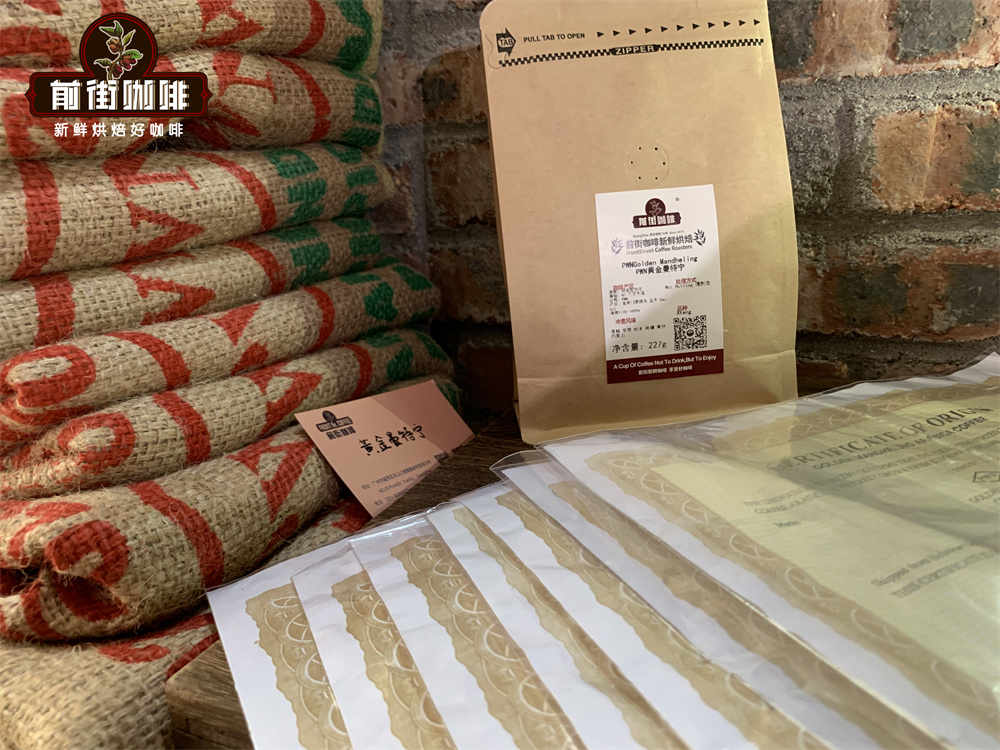
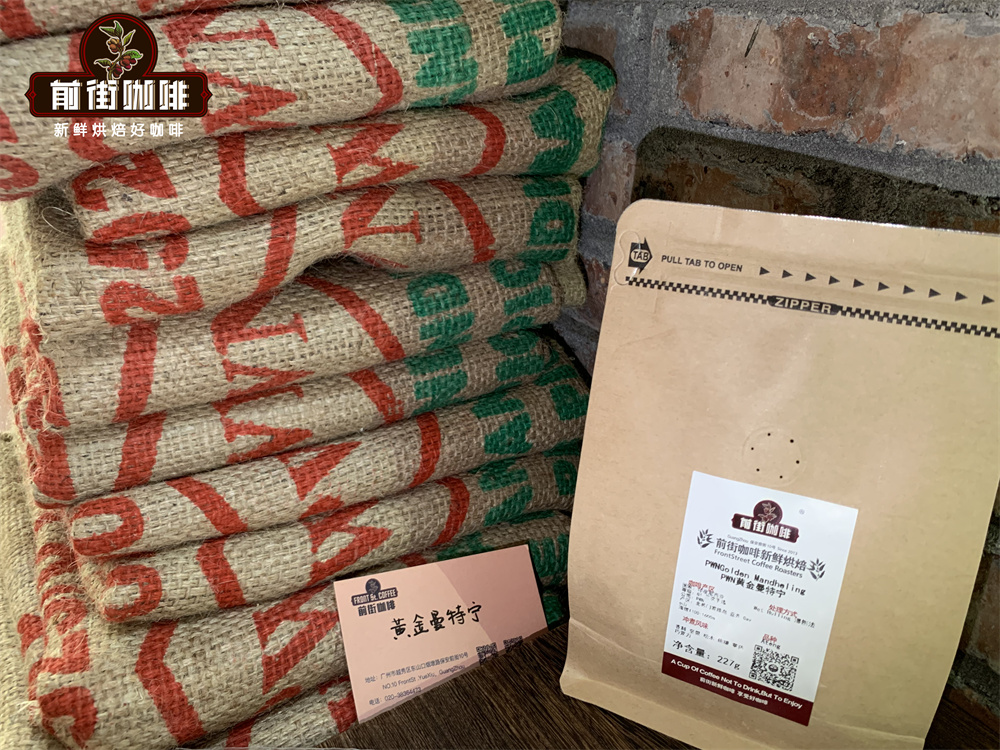
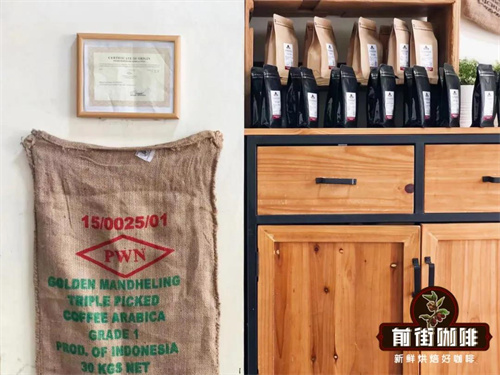
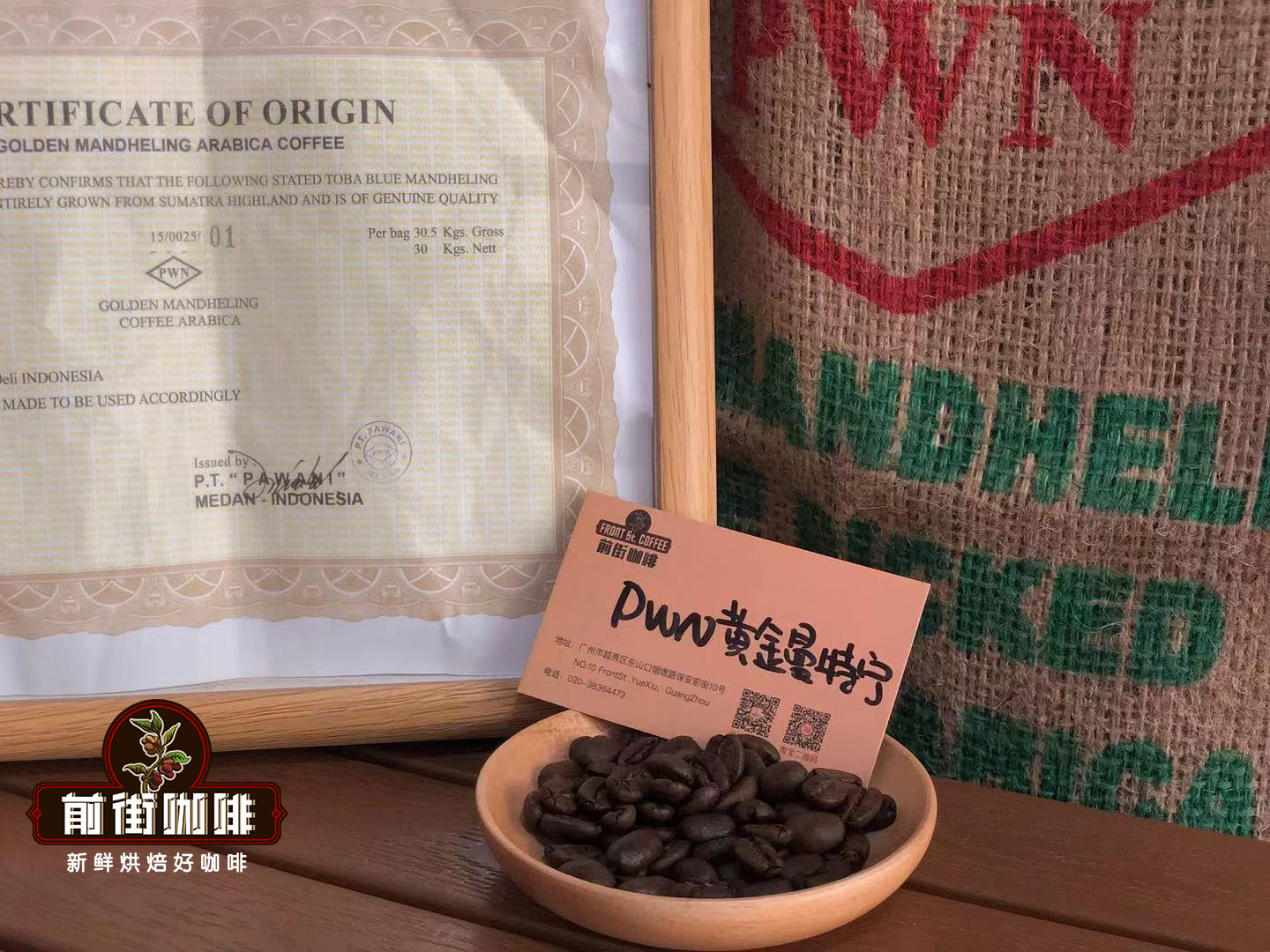
All the FrontStreet Coffee Golden Mandheling beans sold by FrontStreet Coffee come from PWN Coffee Company. Verifying authenticity is simple: every bag of Golden Mandheling comes with its own numbered burlap bag and a corresponding certificate. As long as the store can show those proofs, the coffee is authentic. (Golden Mandheling burlap bags come in only one specification: 30kg bags.)
How Does PWN Green Bean Company Screen Golden Mandheling Coffee Beans?
Indonesian green coffee is processed by the wet-hulled method. Because semi-hard, semi-soft moist green beans bruise easily when the pectin and parchment layers are removed, the beans crack open like goat hooves; these are commonly known as "goat hoof beans." They are not defective beans, but in PWN's view they look unappealing, so they are screened out to give the coffee a neat, uniform appearance.
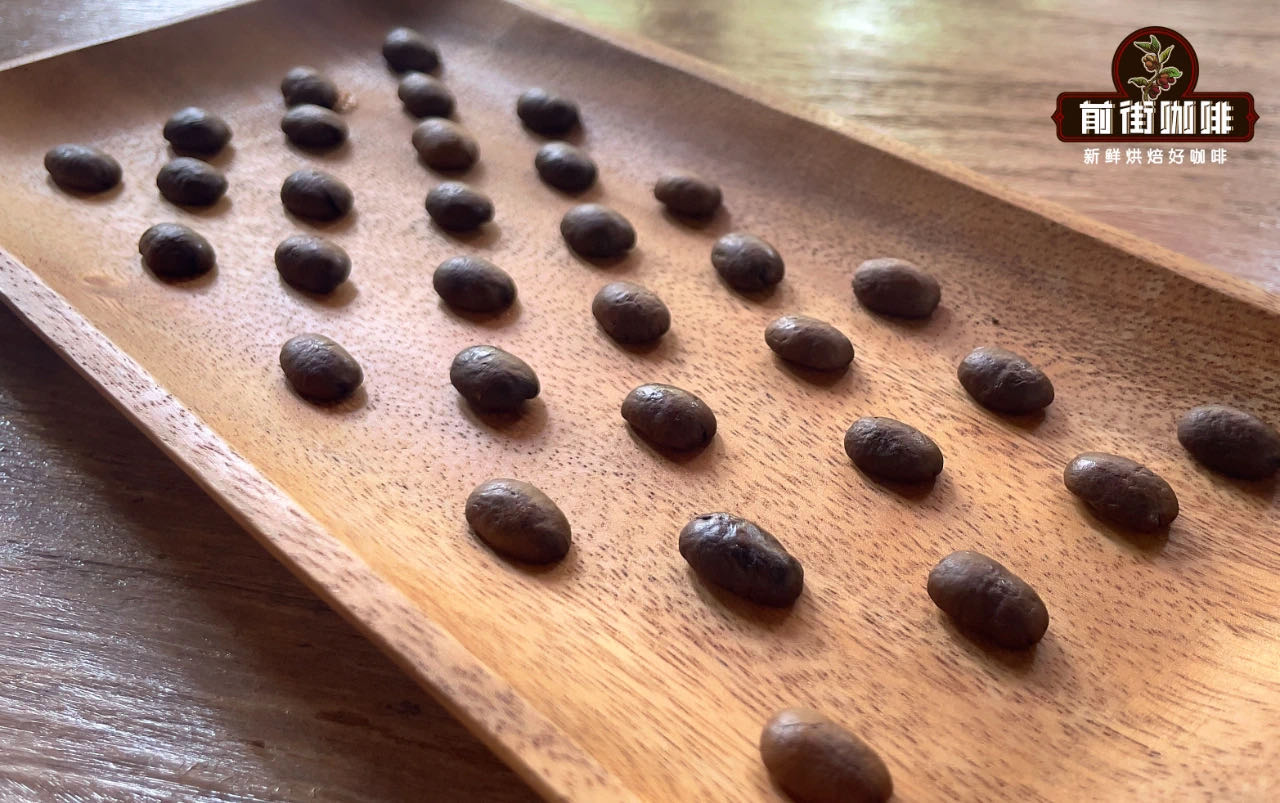
You might think that beans above 18 mesh with no more than 3 defective beans in 300g of green coffee, plus the removal of goat hoof beans, is already strict. PWN goes further: after four rounds of hand screening, the beans all pass through machines for density and color separation, finally yielding Mandheling with uniform color and consistent bean shape. In other words, PWN Green Bean Company performs 5 screenings to guarantee the outstanding quality of its Golden Mandheling.
What About Non-PWN Golden Mandheling Coffee on the Market?
Many Golden Mandheling beans on the market are sold by green bean merchants at a higher price after selecting Mandheling above 18 mesh from G1-grade Mandheling. Some even screen three times so that the appearance closely resembles PWN Golden Mandheling. Looks can indeed deceive, but what about taste? FrontStreet Coffee obtained several lots also called Golden Mandheling for blind testing, and every participating barista could identify FrontStreet Coffee's PWN Golden Mandheling: its cleanliness is something counterfeit Golden Mandheling cannot imitate.

How to Identify if Your Golden Mandheling Comes from PWN
Two key points: the factory certificate issued by PWN, and clear PWN logos on the green bean burlap bags. If you are unsure whether you have bought authentic PWN Mandheling, do not hesitate to ask the seller for the certificate or the burlap bags. The PWN Golden Mandheling burlap bags and certificates sold by FrontStreet Coffee can all be inspected at FrontStreet Coffee stores.
What Variety Are FrontStreet Coffee's PWN Golden Mandheling Beans?
FrontStreet Coffee's PWN Golden Mandheling uses the Ateng variety, which is what we commonly know as Catimor.
Catimor was created in 1959, when the Portuguese moved the Bourbon mutation Caturra from Brazil to East Timor to hybridize with Timor, which carries Robusta bloodlines. It has extremely high disease resistance and is 3 times more productive than Typica. During the leaf rust crisis the Indonesian government introduced not only Robusta (whose flavor is quite different from Arabica) but also Timor from East Timor, intending to replace Typica. Investigations later found that a batch of Timor seeds the Indonesian government introduced in 1980 was mixed with some Catimor seeds. Those seeds were planted in Aceh, northern Sumatra, and Catimor was first noticed in the central Aceh region - so locals also call it "Ateng," taken from Aceh Tengah (Central Aceh).
How Does FrontStreet Coffee Roast Its PWN Golden Mandheling?
On a Yangjia 800N with a 480g bean input: charge the beans at 200°C with the air vent at 3. After 1 minute, adjust the heat to 160°C, keeping the air vent unchanged. Roast until 5'40", when the temperature reaches 148°C, the bean surface turns yellow, the grassy smell disappears completely and dehydration is complete. Adjust the heat to 140°C and set the air vent to 4. At 9'40" the bean surface shows ugly wrinkles and black spots and the toast aroma clearly shifts into coffee aroma - the prelude to first crack. Listen carefully for the crack itself. At 9'54" first crack begins; reduce the heat to 60°C, set the air vent to 5, and discharge at 204.5°C.

How Should You Brew PWN Golden Mandheling for the Best Taste?
FrontStreet Coffee's approach to brewing Mandheling is to express a rich, clean mouthfeel, highlighting caramel and chocolate and its characteristic herbal aromatics, while avoiding any unpleasant bitterness in the black coffee. FrontStreet Coffee explains its equipment choice and key parameters below, using its PWN Golden Mandheling as the example.
FrontStreet Coffee recommends brewing with freshly roasted beans to get the fullest flavors. Everything FrontStreet Coffee ships is roasted within 5 days, because freshness has a major effect on flavor. The roasting philosophy is "freshly roasted good coffee," so that every customer receives the freshest coffee on arrival. The resting period is about 4-7 days, which means the beans are at their peak when the customer opens them.
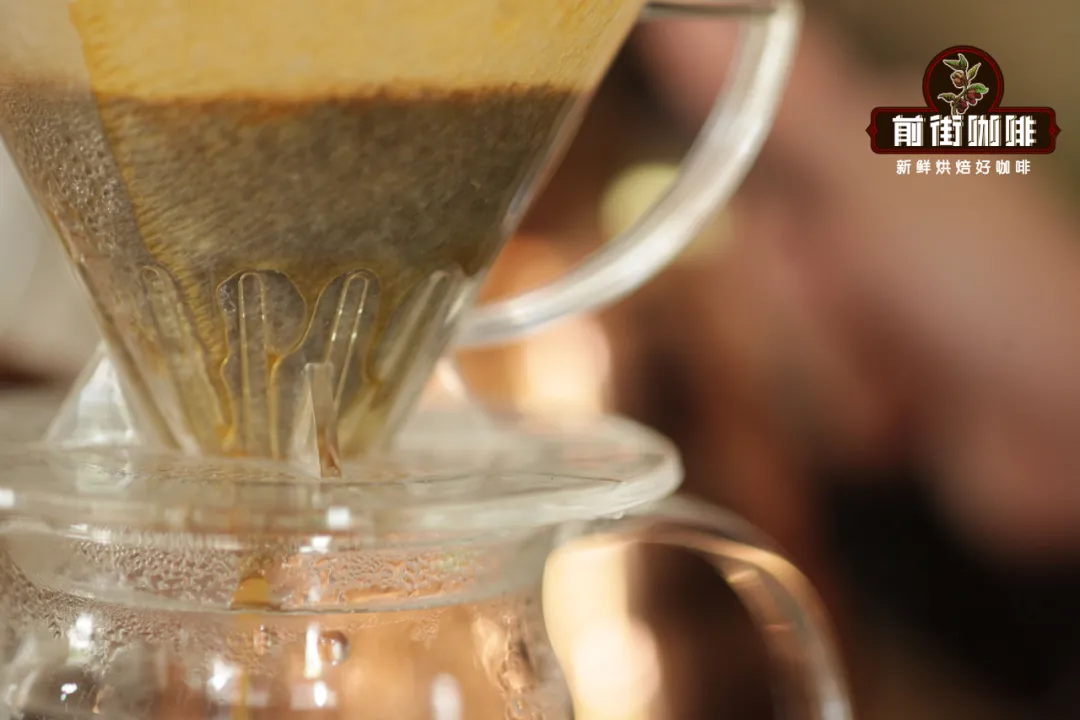
For the dripper, FrontStreet Coffee chose the Kono Meimon. Its defining feature is that the ribs extend only from the bottom to the middle, leaving the upper wall smooth. When the filter paper fits the cone, water cannot "sneak" around the coffee grounds, which improves the richness of the mouthfeel.
FrontStreet Coffee still uses 15g of grounds. More is not necessarily better, nor is less - it depends on the dripper. FrontStreet Coffee uses a 1-2 person cone, for which 15-20g is a reasonable brew amount; amounts outside that range make brewing somewhat difficult.

For the coffee-to-water ratio, FrontStreet Coffee recommends 1:15. Some suggest 1:13 or stronger, but as FrontStreet Coffee has noted before, concentration and richness are not necessarily linked, and overly strong coffee can cause discomfort. A 1:15 ratio can still express Mandheling's rich mouthfeel effectively.
For grind size, FrontStreet Coffee uses a 70% pass-through rate on a #20 sieve. The grind should be slightly coarser than for light-roast beans, because Golden Mandheling is dark-roasted, making its structure more porous and quicker to absorb water and release compounds. Ground as fine as a light roast, it easily brews bitter, burnt flavors; ground too coarse, the coffee turns thin, watery and tasteless.
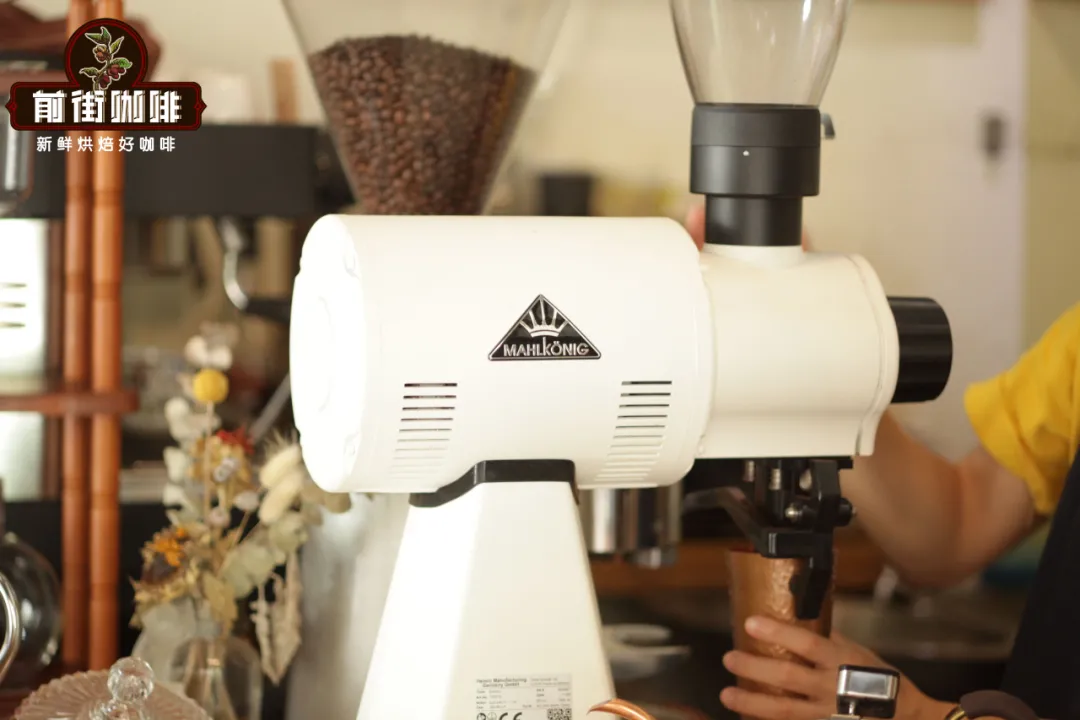
For water temperature, FrontStreet Coffee recommends 87-88°C. The principle mirrors grind size: too hot and the cup turns bitter and burnt, too cool and it goes flat, with unpleasant stale sour notes.
The brewing method is a three-stage pour. Splitting the pour into three stages better expresses the rich mouthfeel and caramel sweetness of FrontStreet Coffee's PWN Golden Mandheling. The water distribution is: a first-stage bloom of 30ml, fully wetting the grounds for degassing so that flavor compounds extract better later; a second stage of 100ml; and a final stage of 95ml to lift the sweetness. The result is a substantial, rich mouthfeel with caramel sweetness and chocolate, nut flavors.
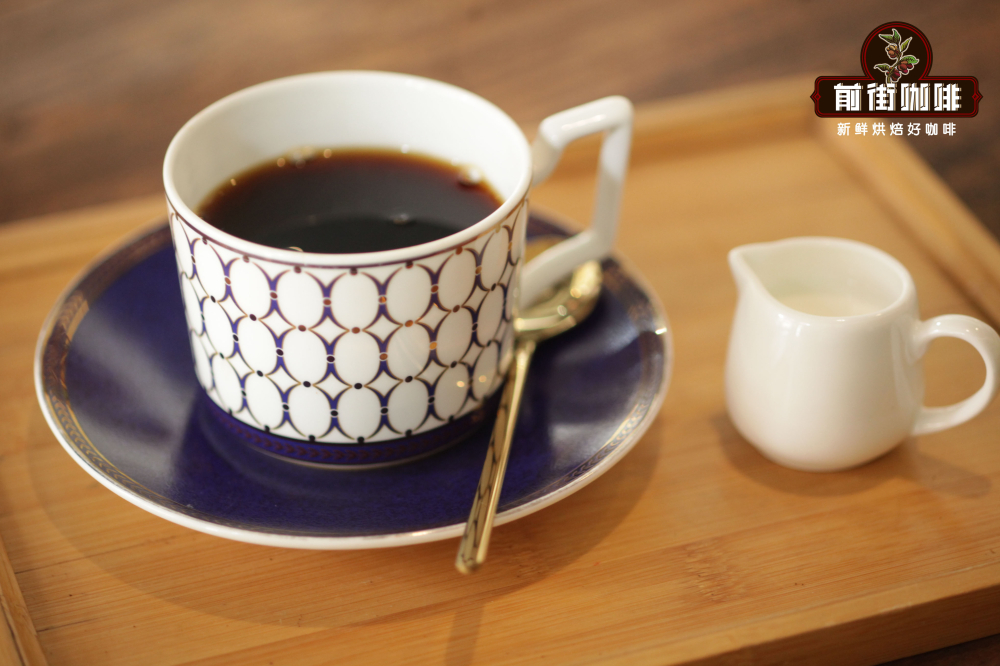
FrontStreet Coffee PWN Golden Mandheling Flavor and Mouthfeel
Sweet herbs and cinnamon-like spice, orange and citrus peel aromas, rich and intense sweetness, creamy walnut and chocolate. The fruit acidity is restrained and gentle, with a strong cantaloupe aroma in the fragrance. As the cup cools, herbal notes emerge with faint spices, building a rich mouthfeel with intense sweetness.
FrontStreet Coffee Recommendation
If the wet-hulled character of Sumatra is what you are after, FrontStreet Coffee's Mandheling range covers it from top to bottom. FrontStreet PWN Golden Mandheling is the benchmark: sourced from Indonesia's PWN company, it is built on beans above 18 mesh with fewer than 3 defective beans per 300g of green coffee, meeting the top G1 grade, and then put through three rounds of hand selection to remove every remaining defect and sharpen the cup's cleanliness and sweetness. That standard is exactly why its quality is so high and its supply so limited. If you want to see the proof for yourself, the certificate and the PWN-stamped burlap bags are shown in FrontStreet Coffee's product listings - that is the difference between PWN Golden Mandheling and everything else on the market.
The wet-hulled process is what produces a heavy body with distinctive earthy and herbal notes, the "mother nature" flavor that keeps so many experienced drinkers coming back. To taste that in a more everyday form, try FrontStreet Lintong Mandheling: rich and potent, sweet-bitter, with a strong, stimulating entry, clove and woody aromatics, and - at a medium-dark roast - low acidity, a spice-and-mint character and a long, substantial sweetness. And when you want Mandheling in a milk drink, FrontStreet Classic Blend adds medium-dark Mandheling to Brazilian creamy-nut coffee, with butter, roasted chestnut and caramel standing out; the Mandheling lifts the body and brings sandalwood, herbal and spice notes, while a touch of Robusta boosts the crema.
Important Notice :
FrontStreet Coffee is a long-established specialty coffee roaster in Guangzhou China, selling freshly roasted beans from its own farm in Yunnan as well as dozens of carefully selected single-origin beans from around the world for both pour-over and espresso. The products deliver consistently excellent quality and great value, with shipping within 24 hours. Guangzhou's FrontStreet Coffee shop is recommended by many coffee lovers, and the beans are now available online at the Tmall 。
FrontStreet Coffee has moved to a new address:
FrontStreet Coffee Address: 315,Donghua East Road,GuangZhou
Tel:020 38364473
 Scan and follow the En Gafei WeChat official account. Please indicate that the reprint comes from "En Gafei".