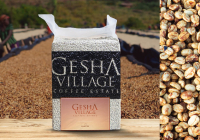
Gesha Village Coffee Estate Background Story_How Much Does a Cup of Gesha Village Coffee Cost
The Finest and Most Original Coffee: The Background Story of Gesha Village Estate
The journey to Gesha Village began in 2007, when Adam Overton and Rachel Samuel were producing a documentary about Ethiopian coffee for the Ethiopian government. During the project they were introduced to Dr. Girma, a coffee researcher specializing in coffee agronomy and farm management, who guided them through the KAFA coffee forests near Djimma. Filming brought Rachel Samuel back to her birth country of Ethiopia, and Adam Overton found himself captivated by the rich coffee history of coffee's birthplace.
By the end of that expedition, the couple felt compelled to start a coffee farm of their own. They saw vast unexplored potential in Ethiopia's wild coffee forests. Though the country's coffee trade was mature, its industry lagged far behind newer coffee origins in agricultural innovation, processing technology, and terroir distinction — precisely the two factors that separate specialty from commercial coffee. Leveraging Ethiopia's specialty market, they set out to build Gesha Village as a deliberate break from traditional practice.
From 2007 to 2010, the couple scoured the country for the perfect site. Their initial criteria included practical proximity to the capital, Addis Ababa — but the more important factors were:
- Altitude: 1800-2100 meters
- Large land area: over 100 hectares
- Abundant old trees and pristine forest
- Rich natural shade canopy
- Accessibility
- An adequate labor pool
- Stable labor resources that would not displace local residents
As their search progressed, they kept moving farther from Addis Ababa. Eventually, in the country's southwestern corner near the border with Sudan, they found Gesha town — and within its pristine forest, wild coffee growing naturally. This coffee paradise, along with their encounters with the indigenous Meanit community, convinced them they had found a place where something genuinely cutting-edge could happen.
In the autumn of 2011, the lease was signed for the 471 hectares that now make up Gesha Village Estate. Soon afterward, Akalu was hired as the estate's Farm Manager, and together with the newly assembled Gesha Village (GV) team he began exploring the forest, collecting wild seeds from the nearby Gori Gesha forest.
After a year in the nursery, those seedlings were planted across 30 hectares, while the team set about getting to know their Meanit neighbors. That first 30 hectares served as GV's "test plot" — the team wanted proof of cup quality before committing to more plantings. The first 1 kg sample was shipped in spring 2012 to Willem Boot, a friend of Adam and Rachel, even before the couple themselves had a chance to cup it.
Willem responded by organizing a Cupping Caravan across Ethiopia, where the coffee left the cuppers stunned. At that moment the GV team knew they were onto something special.
Before getting ahead of themselves, the team visited neighboring farms to study the morphology of more established trees — which, like their own, had grown from forest seeds — and to cup their neighbors' coffee for a fuller picture of what they were working with.
As exciting as cultivating forest coffee was, the team understood the risk of relying on a single variety. On the advice of Akalu and Dr. Girma, they decided to plant a substantial portion of GV with proven Ethiopian heirloom varieties released by the Jimma Agricultural Research Center (JARC). These released varieties descend from JARC's seed-collection expeditions, during which researchers select "good plants" by three criteria:
- a) Obvious disease resistance
- b) Excellent cup quality
- c) Good yield
GV chose to plant a variety originating in the highland coffee forests of Illubabor, which showed both strong disease resistance and excellent cup quality. Across the cupping of GV's different varieties, these research cultivars have produced some of the most exciting profiles the estate has ever yielded. With variety playing so decisive a role in quality, the team naturally sought research partners to conduct a methodical genetic study of the Gesha forest varieties — part of which investigates the possible connection between Panamanian geisha and the coffee of the Gori Gesha Forest.
FrontStreet Coffee Recommendation
As the birthplace of coffee, Ethiopia has an estate famous for the Gesha variety in its own right: Gesha Village, which applies a grading system even stricter than Panama's. The estate grows three Gesha varieties — Gori Gesha, Gesha 1931, and Illubabor Forest — tiered as Gold Label (RARITIES), Red Label (GROWERS RESERVE), Green Label (SINGLE-TERROIR), and the Chaka lot, with variety indicated as well. FrontStreet Coffee carries both the Gold Label and Red Label tiers: the Gold Label is Gesha 1931, just 10% of the estate's total production and its top coffee outside auction lots, frequently chosen by international competition baristas; FrontStreet's Gold Label lot is refined natural-processed, showing complex, layered aromatics from dry fragrance through to a lingering finish. The Red Label is Gori Gesha, 15% of production, scoring 88 points or higher on the SCA 100-point scale; as a single-terroir series, every batch number carries full traceability — farm block, variety, and processing date.
For a more approachable Ethiopian Gesha, FrontStreet Coffee's Granada (Genlana) Gesha comes from a washing station established in 2014 and run by Mr. Israel Degefa, at the border of the Kochere and Genlana Abaya areas, where coffee covers 700 hectares — most of it uncultivated, fertile land shaded by a dense canopy. Fully ripe cherries are hand-picked and dried on raised beds for 14 to 20 days depending on the weather. Roasted medium-light, it offers bright citrus acidity, elegant ginger-flower aromatics, and the full sweetness of ripe fruit in a silky cup with Gesha's signature refined finish; as a medium-roast SOE it extracts into apricot, caramel, and nut notes.
For brewing Gesha, FrontStreet recommends respecting its dense, hard bean structure — it tends to sink and clog the dripper, so grind medium-coarse (78% passing a Chinese-standard #20 sieve, roughly the texture of fine granulated sugar) and use water at 91°C. Dose 15 g into a small Hario V60 at a 1:16 ratio and brew in three pours: start your timer, pour to 30 g for a 30-second bloom, then pour gently in circles to 125 g; once the bed has drained to half, pour in circles again to 225 g, finishing with a total extraction time of about 2:10-2:20.
Important Notice :
FrontStreet Coffee is a long-established specialty coffee roaster in Guangzhou China, selling freshly roasted beans from its own farm in Yunnan as well as dozens of carefully selected single-origin beans from around the world for both pour-over and espresso. The products deliver consistently excellent quality and great value, with shipping within 24 hours. Guangzhou's FrontStreet Coffee shop is recommended by many coffee lovers, and the beans are now available online at the Tmall 。
FrontStreet Coffee has moved to a new address:
FrontStreet Coffee Address: 315,Donghua East Road,GuangZhou
Tel:020 38364473
 Scan and follow the En Gafei WeChat official account. Please indicate that the reprint comes from "En Gafei".