Why is Golden Mandheling Suitable for Medium-Dark Roast? What Makes Golden Mandheling Coffee Delicious?

Introduction
Lately, many of our readers have been asking for pour-over coffee with a gentler acidity. Beyond light-to-medium roasted options such as FrontStreet Coffee's Sun-Dried Red Cherry, Berry Orchard, and Sidamo Horse Champion, there are also medium-dark choices like FrontStreet Coffee's Brazil Queen, Honduras, Gold Mandheling, and Tiger Mandheling. If a rich, mellow cup is what you're after, FrontStreet Coffee points you toward the Mandheling series. Why is that? Can't light-to-medium roasts deliver richness too? Let's dig into it from several angles.

1. The Roasting Process
Roasting transforms the chemical and physical structure of green coffee into the finished roasted product. The process runs ten to twenty minutes at temperatures above 200 degrees Celsius, driving a cascade of chemical changes marked by the first and second cracks — which, fittingly, sound a lot like popcorn popping. Along the way the beans lose moisture, expand, and change in color, texture, aroma, and density, building the flavor profile we recognize as coffee.
Green and roasted beans contain similar levels of acids, protein, and caffeine, but green beans lack the appealing flavors roasting creates. Green coffee is loaded with chlorogenic acid, which gradually breaks down during roasting and releases the more familiar, pleasant fruit acids — acetic, citric, and malic acid, the same acids found in wine. Proper roasting presents these agreeable acids in moderation. Roasting also requires enough heat to drive the Maillard reaction and caramelization. As the bean color deepens, aromatic oils emerge and the texture turns crisp.
What Is Caramelization?

The sugars in coffee caramelize between 170-200°C — a range that overlaps with the melting point of sucrose (185°C) and with the temperature window of first crack. Caramelization is an oxidation, or "browning," reaction of sugars under heat, and it yields two families of products:
1. Dehydration products of the sugars — the caramel flavor and brown color
2. Decomposition products, mainly volatile aldehydes and ketones
In short, caramelization generates roasted aromas, caramel sweetness, and color, along with aromatic compounds such as maltol, cyclotene, and furans — the same compounds found in red wine, fruit juice, and cream.
Too much caramelization, however, is a problem: it pushes toward carbonization, leaving the coffee harshly bitter and astringent. Too little, and the aromas come out flat and one-dimensional, without complexity.

What Is the Maillard Reaction?
In simple terms, it is the reaction between sugars and the proteins or amino acids in the bean, which also deepens the color and creates distinctive aromas — the smoky smell of burning plant fiber, creamy sweetness, the toasty scent of brown bread. Many of coffee's richest flavors come from the Maillard reaction during roasting.
In the early stage, carbonyl-amine condensation and the Amadori rearrangement take place; in the middle stage, the Amadori products (fructosamines) dehydrate into HMF (hydroxymethylfurfural), fructosamine loses its amino group to form reductones, and amino acids react with dicarbonyl compounds; in the final stage, aldol condensation and polymerization build the melanoidins.

When sugars and proteins or amino acids cook together, the Maillard reaction occurs. Alongside caramelization, some sugars interact with amino compounds through a further series of reactions, producing an even broader range of compounds — in short, flavors richer than caramelization alone. Coffee beans aren't the only example: chocolate, maple syrup, and brewed beer are all products of the Maillard reaction too.
2. How Does Roast Level Shape Flavor?
Caramelization and the Maillard reaction each contribute their own aromas:
(1) Caramelization: sweet, sour, bitter, fruity, sherry-like, cream candy, caramel, and nutty notes
(2) Maillard reaction: savory, floral, onion and meat aromas, green vegetables, chocolate, potato and earthy notes, smoky, mellow, and pungent tones — plus all the caramelization aromas above
Both reactions run simultaneously, and their intricate interplay has not been fully mapped by science; many flavorful compounds still can't be completely identified. Different roast levels express different flavor families. Our "36 Aroma Bottle" kit covers the expressions of light, medium, and dark roasts, grouped into the "Enzymatic," "Caramel," "Dry Distillation," and "Defect" groups.
Light roasts mostly express the fruity, acidic "Enzymatic" group — lemon, coffee blossom, apricot. Medium roasts highlight the "Caramel" group — roasted almond, hazelnut, roasted peanut. Dark roasts reveal the pungent "Dry Distillation" group — cedar, pepper, clove.

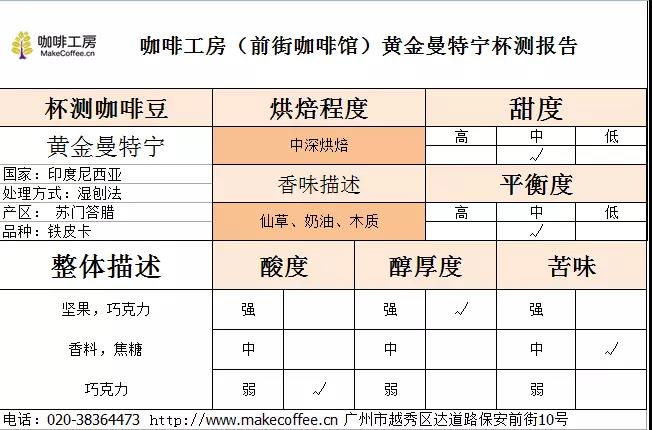
In medium-dark roasts, caramelization is nearly finished and the Maillard reaction takes over, producing resinous, spicy, and lightly carbonized notes. Our FrontStreet Coffee Gold Mandheling performs best here: it shows elegant woody aromas, cedar and pine scents, and a turpentine-like nuance, with a smooth mouthfeel and a substantial, weighty texture.
3. How Do We Roast FrontStreet Coffee Gold Mandheling to Its Best Advantage?
Before roasting FrontStreet Coffee Gold Mandheling, we set the roast direction from the cultivation data. FrontStreet's Gold Mandheling grows at 1100-1600 meters in the Lintong region of northern Sumatra, Indonesia. The climate is humid, so producers use the wet-hulled (giling basah) process to speed up drying. Fully ripe cherries are hand-picked one by one to secure the first stage of quality selection. They are then dry-fermented in buckets, letting the pectin sugars ferment fully to deepen flavor — typically 12-36 hours depending on conditions. Next the beans are sun-dried for 1-2 days until moisture falls to 35-40%, at which point the hulling machine strips off the parchment while the beans are still damp, and drying continues until moisture reaches roughly 12-15%.

These wet-hulled beans carry relatively high moisture, deviating noticeably from natural-dried beans in water content, so dehydration demands extra care. For high-moisture beans: after charging the drum, close the air damper and steam for 30 seconds, then open it to 3 until the beans turn pale green or white. Open the damper to 4, and after first crack open it fully to 5.

In short, FrontStreet Coffee Gold Mandheling needs to be roasted thoroughly "from the inside out" — full development first, then fine technique layered on top to express the bean's character. Caramelization is the single biggest factor shaping coffee flavor. After six to seven minutes of roasting, the beans have absorbed a large amount of thermal energy and enter pyrolysis, producing the first crack. Some sugars convert to carbon dioxide, moisture keeps evaporating, and new aromatic compounds gradually form — the so-called coffee oils — combining with hundreds of aromatic substances such as nicotinic, citric, quinic, malic, and acetic acids, along with caffeine.
Pyrolysis can continue into second crack. And while caramelization is essential for unlocking aromatics, extending the roast too far begins carbonizing components and creating harsh, bitter defects. The roaster's challenge is to maximize caramelization while minimizing carbonization — avoiding charcoal and rubbery defect flavors.

Roasting Profile:
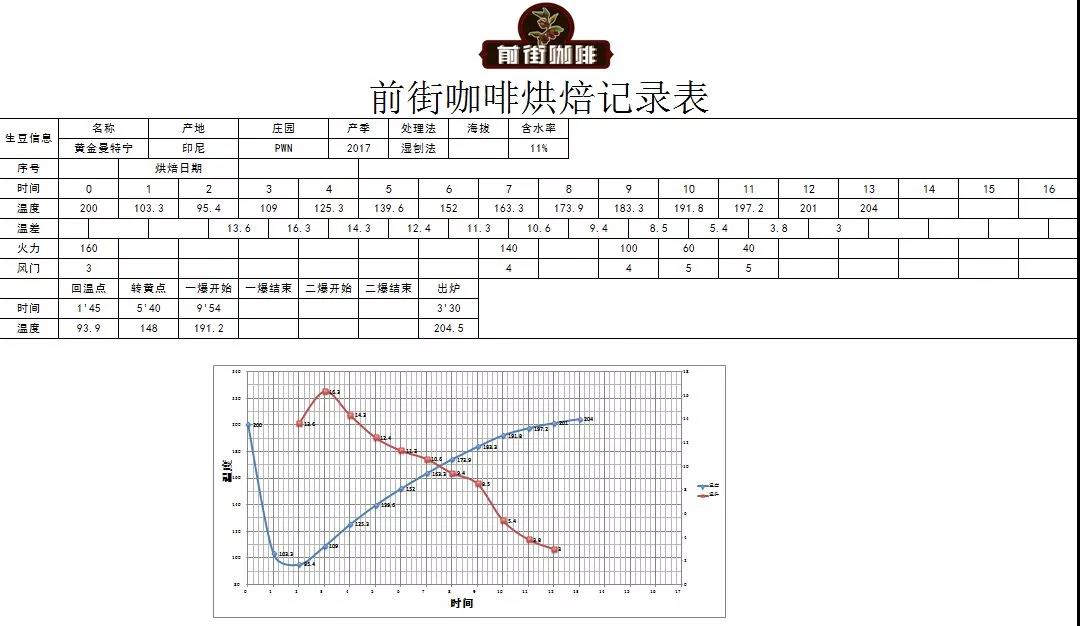
Preheat the roaster to 200°C and set the air damper to 3. After 1 minute, drop the heat to 160°C, damper unchanged. Roast until 5'40'', when the temperature reads 148°C, the bean surface turns yellow, the grassy smell has fully vanished, and dehydration is complete. Reduce heat to 140°C and open the damper to 4.
At 9'40'', ugly wrinkles and black spots appear on the bean surface and the toast aroma clearly shifts into coffee aroma — the prelude to first crack. Listen carefully from here. At 9'54'' first crack begins; lower the heat to 60°C and open the damper fully (ease the heat down gently — don't drop it so far that the cracks stall), then drop the batch at 204.5°C.

Flavor Characteristics:
FrontStreet Coffee Gold Mandheling shows fine herbal notes, stronger caramel sweetness, and a relatively calm, elegant fruit acidity. The cup delivers rich sweetness, a full body, and wild spice flavors. Generally, FrontStreet's Lintong Mandheling is roasted past second crack to reduce off-flavors — but Gold Mandheling already offers good clarity and sweetness even when dropped before second crack, giving the roaster a wider window for interpretation.
4. How to Brew FrontStreet Coffee Gold Mandheling?
Medium-dark roasted beans have a higher dehydration rate and weigh less, so the grounds don't settle compactly at the bottom of the bed. When water first hits, it's absorbed instantly, and the vigorous degassing forms bubbles around the grounds that create channels. With fresher beans those channels last longer and the water level drains quickly. I usually pour a fairly coarse stream, circling slowly.
First Brewing Method:

1. Dripper: KONO
2. Water temperature: 86-88°C
3. Grind size: coarse sugar granules
4. Roast level: medium-dark roast
5. Bloom time: 30 seconds
Flavor: layered and clean, well balanced, with persistent caramel sweetness in the aftertaste.
Technique: 17g of coffee ground at setting 4 on the Fujiyama ghost-tooth burr grinder, brewed in a KONO dripper at 86-88°C. Pour 30g of water first for a 30-second bloom, then keep pouring continuously without pause at full temperature. Water-to-coffee ratio 1:14, total extraction time about 1:50, stopping the brew at 238g.
Second Brewing Method:

Dripper: Hario V60
Water temperature: 86-88°C
Grind size: Fujiyama grinder setting 4
Technique: 1:15 water-to-coffee ratio with 15g of coffee. Pour 30g of water for a 30-second bloom. Second pour up to 120g, then stop. Once the water level in the bed drops to half, resume pouring slowly until you reach 225g. Total extraction time about 2:00.
Analysis: three-stage pouring separates the coffee's front, middle, and back-end flavors. Because the V60's many ribs drain quickly, pausing the pour stretches the extraction time and pulls out more of the nutty and chocolate flavors from the back end.

Flavor: multi-layered and clean overall, with a lighter body, persistent caramel sweetness in the aftertaste, and just a hint of bitterness.
Ultimately, only a medium-dark roast lets FrontStreet Coffee Gold Mandheling fully express its caramel, pine, and quality herbal notes with that slight spicy pungency — and the substantial mouthfeel that makes it so satisfying.
FrontStreet Coffee Recommendation
If you enjoy the direction of this roast, FrontStreet's PWN Golden Mandheling is the flagship expression of the style. Selected through strict screening for density, size, shape, and color, the beans are large, uniform, and clean, with reduced earthy and grassy notes. Freshly roasted, it offers sandalwood, herbal, spice, roasted hazelnut, caramel, and dark chocolate flavors with a clean, rich, and aromatic cup — well suited to daily drinking or as a gift.
Prefer a more classic take? FrontStreet's Lintong Mandheling, from the Lake Toba area, is medium-dark roasted for a low-acid, mellow body with caramel, dark chocolate, and toasted bread aromas and a long, sweet finish — an ideal choice for friends who love strong, full-bodied coffee.
Important Notice :
FrontStreet Coffee is a long-established specialty coffee roaster in Guangzhou China, selling freshly roasted beans from its own farm in Yunnan as well as dozens of carefully selected single-origin beans from around the world for both pour-over and espresso. The products deliver consistently excellent quality and great value, with shipping within 24 hours. Guangzhou's FrontStreet Coffee shop is recommended by many coffee lovers, and the beans are now available online at the Tmall 。
FrontStreet Coffee has moved to a new address:
FrontStreet Coffee Address: 315,Donghua East Road,GuangZhou
Tel:020 38364473
 Scan and follow the En Gafei WeChat official account. Please indicate that the reprint comes from "En Gafei".