Coffee Beginner Q&A Collection | How Much Circulation for Milk and Coffee Fusion? What's the Ideal Coffee Ground Layer State for Pour-Over
Coffee Q&A for Beginners
Hello everyone! It's been quite a while since we shared our beginner Q&A collection. Today the editor brings you several questions from beginners and novices, along with answers, so we can learn and exchange together.
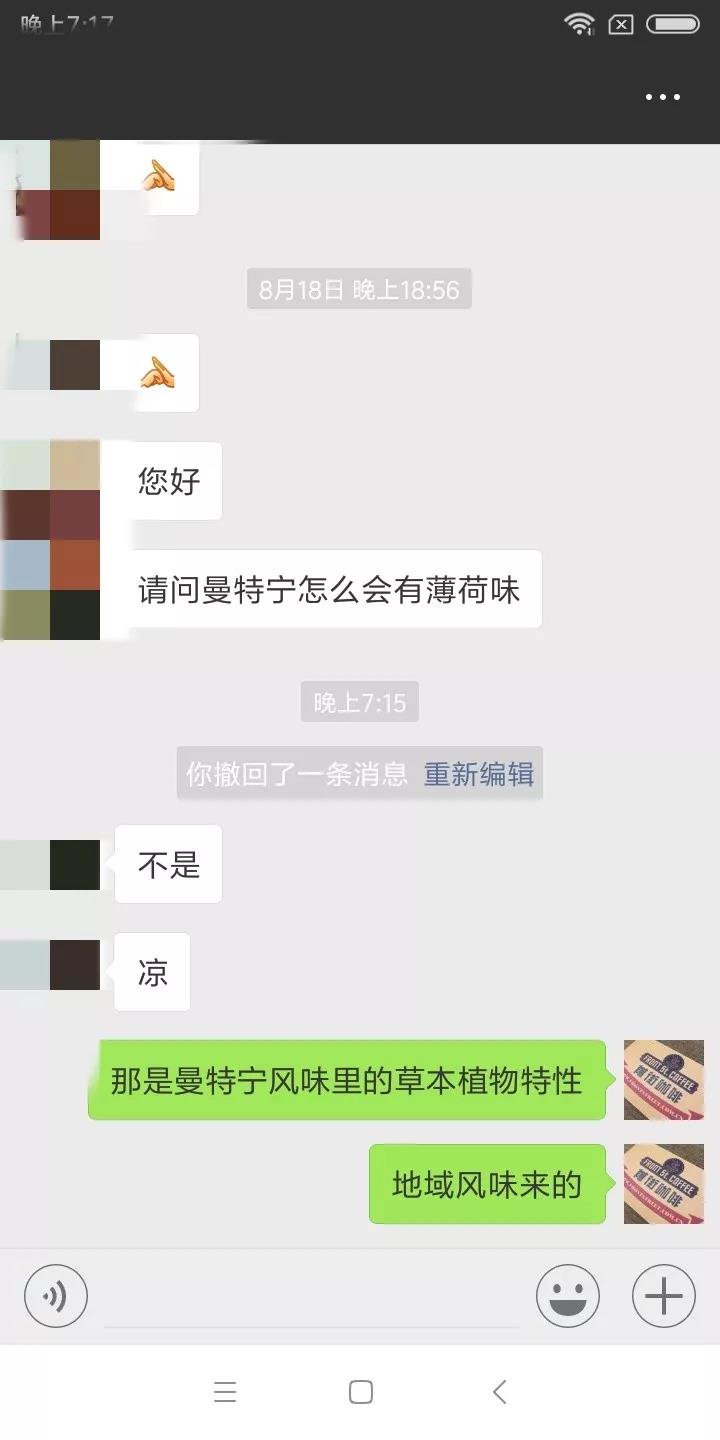
Why does Mandheling coffee have a minty flavor?
On the question of mintiness, this herbal plant aroma really does exist in Mandheling coffee, but it helps to break "minty" down into mint aroma and mint mouthfeel.
First, the aroma of mint. Those who have chewed mint leaves know that mint itself doesn't taste like much (sweet, sour or bitter) - what we actually perceive is the aroma. The cool sensation in the throat that we can truly taste in coffee is the mouthfeel of mint, or more precisely a cooling sensation similar to menthol components. Another famous coffee that produces this cooling throat sensation after drinking is civet coffee; the musk components in it also create a cooling effect, but only authentic Indonesian civet coffee that feeds on Mandheling coffee beans has it. The unique herbal aroma of Mandheling and the regional flavors of Indonesia combine to create this distinctive mouthfeel.

When making milk coffee, should you stir in large circles or small circles to integrate?
This question must first ask: is your milk foam steamed well?
First case: if the milk foam is too coarse and you haven't removed the excess thick foam, yet you still want to pour latte art, then to give the milk coffee fluidity you must stir in large circles and raise the height of the milk flow during integration. That, however, drags too much coffee crema into the milk coffee, making the surface color look paler.
Second case: if the milk foam is steamed very well, then during integration you basically just need to make small movements around a coin-sized area in the center of the milk coffee. Circles that are too large actually create turbulence that affects the subsequent latte art and damages the taste of the coffee.
As for how much strength to use and what posture to adopt, the editor believes you need both arm strength and wrist strength, plus fine adjustments with your fingers. Muscle movement is a set of dynamic, balanced actions - you can't say you must use strength from one part and not another. But if you're taught to move only your wrist or only your arm, you'll never integrate properly no matter how much you practice.

Should the coffee grounds bed be concave or flat after brewing?
This is a common question among pour-over enthusiasts.
In practice we more often encounter a concave grounds bed when brewing only around a coin-sized center area, while methods that fully extract the entire bed produce a flat one. The difference comes from pouring technique and range. The editor sees it this way: as long as you can extract a delicious cup, even a convex bed is acceptable. The prerequisite, though, is uniformity. Uniformity indicates an even water flow during pouring and even extraction; if the bed is high on one side and low on the other, or its surface is uneven, the water impact was uneven too, which means uneven extraction.
So how do you make the water flow even? One word: practice.
How do you practice?
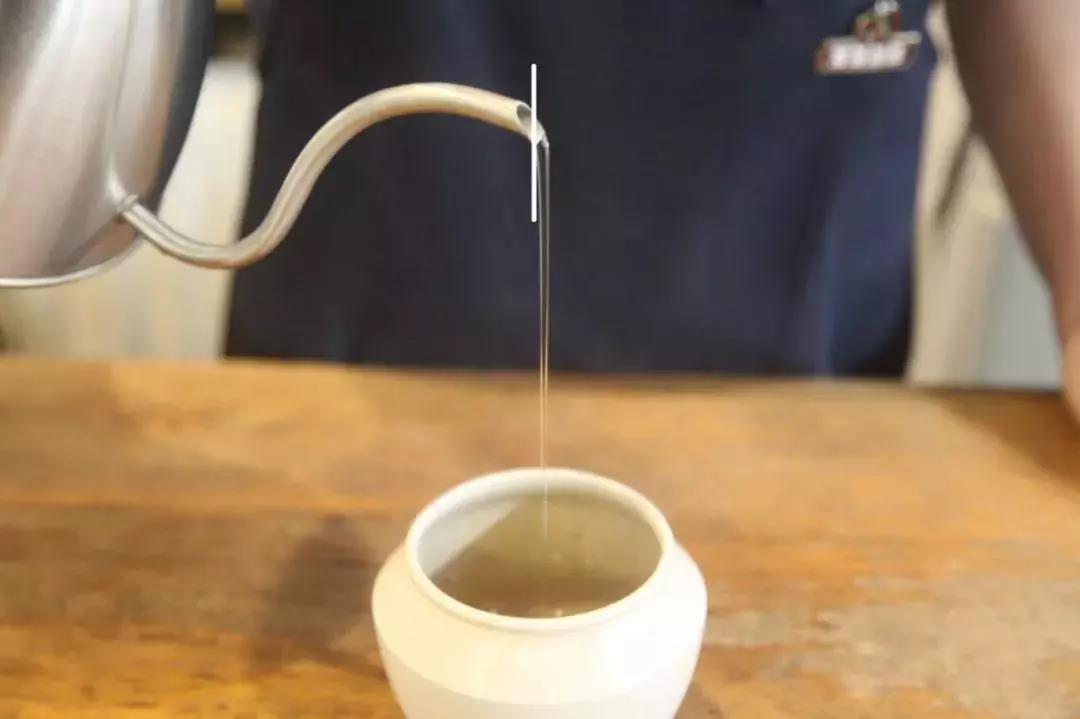
First, practice the stability of your water flow. Try to consistently fill a mug with a uniform-sized stream. Note that the water flow should be perpendicular to the desktop and must not form a parabola.
Then, building on the first step, practice pouring around a coin-sized area. Keep your circles parallel without sudden rises and dips, or you'll create uneven water pressure.
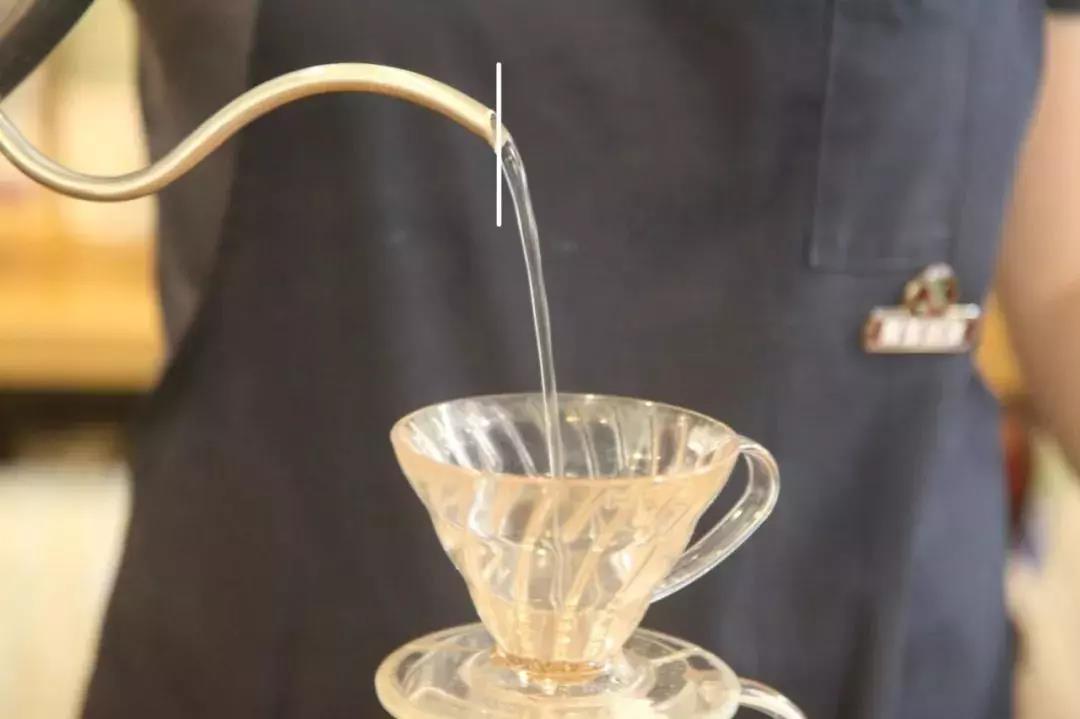
What if my pour-over kettle tends to "splash water" in a parabola?

As shown above, when a parabolic stream reaches the near side of the kettle, the lower flow is actually scouring roughly the middle layer; when you circle to the far side, it is almost hitting the filter paper. So if you've bought this type of pour-over kettle, or you're used to a parabolic stream, try to consciously pull back a little and keep the final landing point near the center. That way you won't end up with normal extraction on one side and filter-paper scouring on the other.
That's all for today's topic. Feel free to contact us with any questions and suggestions - FrontStreet Coffee will do our best to answer them.
FrontStreet Coffee is a Guangzhou roastery with a small shop but a diverse variety of beans, where you can find both famous and lesser-known varieties.
FrontStreet Coffee Recommendation
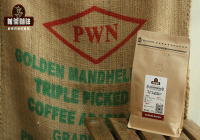
Since this article touches on Mandheling, the natural first recommendation is FrontStreet's PWN Golden Mandheling. Made by Indonesia's PWN company, it is selected from beans of screen size 18 and above, with a defect rate of fewer than 3 beans per 300 grams of green coffee to meet the top G1 standard, and then put through three rounds of hand sorting to remove defects entirely. That rigor lifts the cleanliness and intensity of its sweetness, and it's brewed through the traditional wet-hulled method that gives Mandheling its signature herbal, spice and woody character.
To get the most out of it as a pour-over, FrontStreet suggests 15 grams of coffee at a 1:15 ratio, water at 87-88°C, a coarse-sugar grind, and a three-stage pour: 30ml first to bloom and degas, then 100ml to lift the bed, and a gentle 95ml center pour to finish - bringing out a full body with caramel sweetness and chocolate and nut notes.
Important Notice :
FrontStreet Coffee is a long-established specialty coffee roaster in Guangzhou China, selling freshly roasted beans from its own farm in Yunnan as well as dozens of carefully selected single-origin beans from around the world for both pour-over and espresso. The products deliver consistently excellent quality and great value, with shipping within 24 hours. Guangzhou's FrontStreet Coffee shop is recommended by many coffee lovers, and the beans are now available online at the Tmall 。
FrontStreet Coffee has moved to a new address:
FrontStreet Coffee Address: 315,Donghua East Road,GuangZhou
Tel:020 38364473
 Scan and follow the En Gafei WeChat official account. Please indicate that the reprint comes from "En Gafei".