Introduction to Guji Coffee Region Characteristics - Guji Kaffa Coffee Beans Pour-over Flavor Profile

As one of Ethiopia's premium coffee regions, Guji has always been a key focus at FrontStreet Coffee. The terroir here is superb and the soil naturally fertile, and the quality shows. Take our natural-processed Guji: as soon as you grind it, the dry aroma lifts with rich florals and fruit — dried peach, honey, and lemon peel. During the brew, the wet aroma brings citrus and berry sweetness; the entry is juice-like, the texture full and lush, the sweetness prominent, and the berry acidity folds in so softly you'll want to drink the whole cup at once. Here's the story behind FrontStreet Coffee's natural Guji.

The Guji Region
Guji has drawn serious attention in recent years, delivering impressive results in both flavor expression and overall quality. Formerly part of Sidamo, it was established as an independent region by the Ethiopia Commodity Exchange (ECX) in 2010. It sits southeast of Yirgacheffe, bordering Sidamo and Gedeo, with complex terrain — towering mountains, highlands, plateaus, valleys, and plains. The geology is nutrient-rich Vertisol soil reaching nearly two meters deep, and the average altitude tops 1,800 meters. The wide day-night temperature swings these conditions create supply every element needed for premium specialty coffee. The region's greatest advantage, though, is soil vitality: fallen leaves, decaying forest matter, and plant root residues cycle back into the ground as natural fertilizer, keeping the soil alive without synthetic inputs.
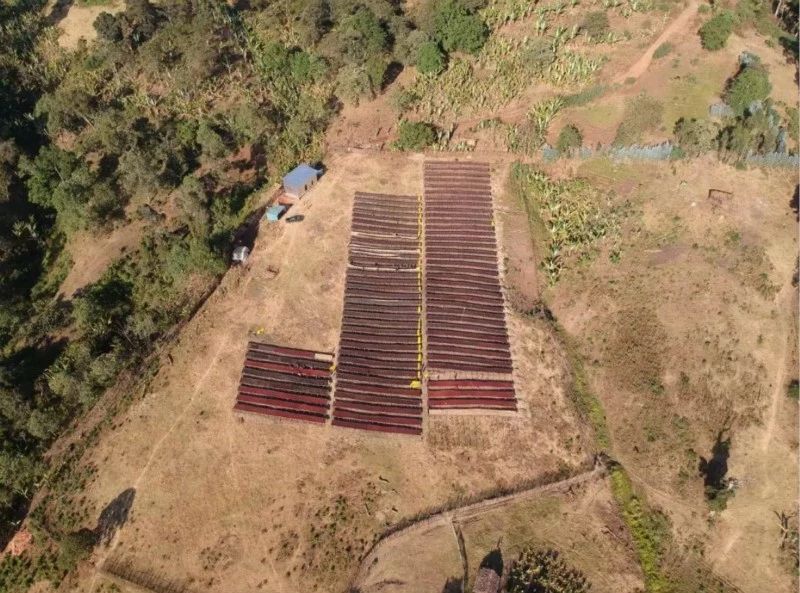
The Natural Process
The natural process is one of the oldest methods of green coffee preparation, and FrontStreet Coffee's Guji beans are fully natural.

1. Remove the Floaters
Harvested cherries are poured into large water tanks. Ripe, dense cherries sink; underdeveloped or overripe ones float — and the floaters must be discarded.
2. Sun Drying
Whole cherries, pulp and skin intact, are spread on drying patios until moisture falls to about 12%. Depending on the climate at the origin, this takes roughly two to four weeks.
3. Hulling
The fully dried cherries then run through hulling machines, which strip the hard dried skin, pulp, and parchment to reveal the green beans.
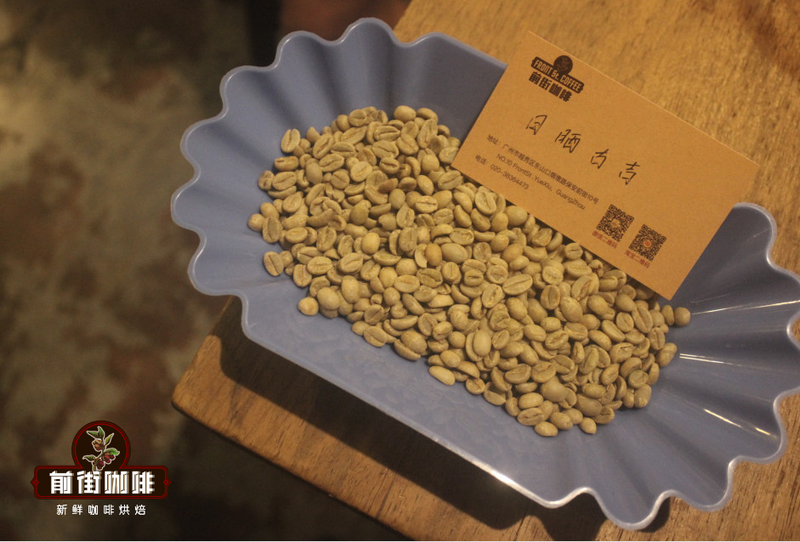
Local Heirloom Varieties
The variety behind FrontStreet Coffee's natural Guji is Ethiopia's local heirloom. It earns that name because Ethiopia holds so many varieties — a natural gene bank for Arabica. On one hand, the sheer number makes classification difficult; on the other, the Ethiopian government, mindful of protecting its genetic heritage, declines to release variety information. So the lot is simply labeled "Heirloom."
Roasting Profile for FrontStreet Coffee's Natural Guji
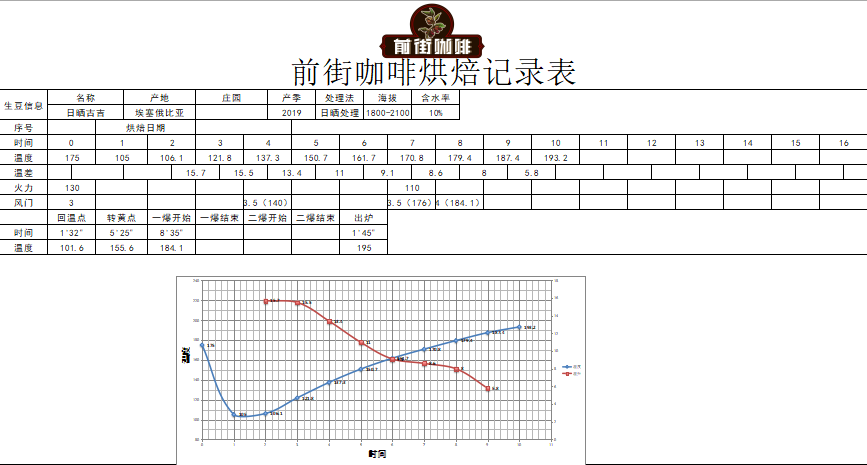
We charge the beans at 175°C drum temperature, with heat at 130 and the damper at 3. The turning point comes at 1'32". When the drum reaches 140°C, we open the damper to 3.5 and hold the heat. At 155.6°C the bean surface turns yellow, the grassy aroma fades completely, and the beans enter the drying stage. At 176°C, heat is trimmed to 110 with the damper unchanged.
At 7'28", wrinkles and dark mottling appear on the bean surface and the toast aroma shifts clearly into coffee — the prelude to first crack. We listen closely. First crack begins at 8'35", and the damper goes to 4. After first crack we develop for 1'45" and drop the beans at 195°C.

Agtron bean reading: 63.7 (left image); ground reading: 76.9 (right image); Roast Delta: 13.2.
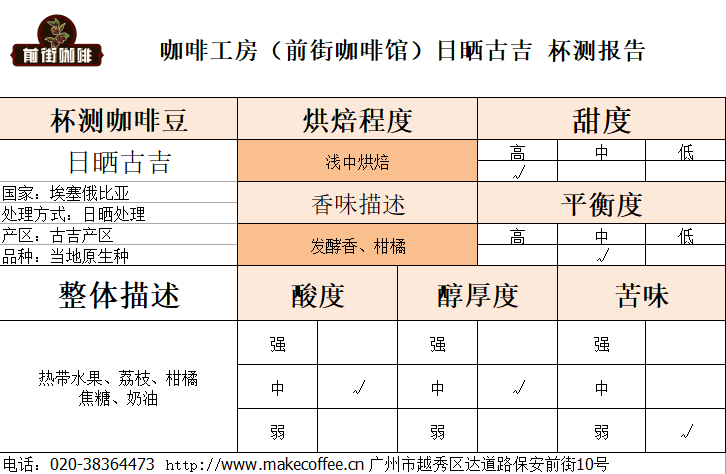
FrontStreet Coffee Natural Guji Coffee Beans
Country: Ethiopia
Region: Guji
Altitude: 1800–2100 meters
Processing: Natural
Variety: Local Heirloom
Flavor: Tropical fruits, lychee, citrus, cream, caramel
FrontStreet Coffee Brewing Recommendations
Dripper: V60
Water Temperature: 92–93°C
Coffee Dose: 15g
Coffee-to-Water Ratio: 1:15
Grind Size: Fine-sugar texture (78% through a #20 sieve)

Three-Pour Method: Start with twice the coffee's weight in water to saturate the bed into a dome and bloom for 30 seconds. Then, with a small stream, pour in circles from the center outward until the scale reads 125g, and pause. Once the coffee bed drops to half the dripper's height, resume the same fine stream for the third pour to reach 225g. Remove the dripper once all the liquid has drained — total brew time about 2 minutes.
FrontStreet Coffee Recommendation
If Guji has you hooked on Ethiopia's fruit-forward side, two more FrontStreet beans belong on your shelf:
FrontStreet Washed Yirgacheffe (House Bean) — the classic starting point for anyone exploring the region. From a small southern-Ethiopian town at 1700–2100 meters, where coffee grows above 1800 meters among the world's highest coffee farms, it offers the signature white jasmine florals, bright citrus and lemon acidity, and a tea-like finish — clean, elegant, and remarkably affordable, which is why it's the first bean so many specialty coffee drinkers ever buy.
FrontStreet Red Cherry Natural — also Yirgacheffe, but processed as a full-red-cherry natural: only perfectly ripe, defect-free cherries are picked, pre-sorted at the station, then dried on raised beds and turned every 2–3 hours in the early days to prevent uneven fermentation. After three to five weeks of drying, the outer pulp is machine-scraped away and the beans are stored. Because the fruit dries on the bean, you get classic Yirgacheffe character plus tropical natural aromatics: citrus acidity, berry-like juiciness, honeyed sweetness, and a cream-smooth body.
Important Notice :
FrontStreet Coffee is a long-established specialty coffee roaster in Guangzhou China, selling freshly roasted beans from its own farm in Yunnan as well as dozens of carefully selected single-origin beans from around the world for both pour-over and espresso. The products deliver consistently excellent quality and great value, with shipping within 24 hours. Guangzhou's FrontStreet Coffee shop is recommended by many coffee lovers, and the beans are now available online at the Tmall 。
FrontStreet Coffee has moved to a new address:
FrontStreet Coffee Address: 315,Donghua East Road,GuangZhou
Tel:020 38364473
 Scan and follow the En Gafei WeChat official account. Please indicate that the reprint comes from "En Gafei".