Japanese-Style Iced Pour-Over Coffee Butterfly Brew Tutorial | FrontStreet Coffee Butterfly Coffee Price Per Cup
For professional coffee knowledge exchange and more coffee bean information, please follow Coffee Workshop (WeChat public account: cafe_style).
The weather lately has been scorching, hot enough to melt a person in minutes. In this kind of heat, anyone still happy to meet up at a coffee shop qualifies as a friend for life.
But even in such heat, you cannot simply stop drinking coffee. So if you do not want to go out, cannot justify an ice-drip tower, and do not want to wait hours for cold brew, is there still a quick way to enjoy a refreshing glass of iced coffee and keep yourself going? Yes: Japanese-style iced pour-over, one of the simplest and fastest home methods.
1. Preparation
Ice cubes. This is the most important ingredient. Without ice, you might as well buy iced coffee at a shop.
Coffee beans. Light, medium, or dark roast all work. African, American, or Asian beans, whatever suits your taste. Natural, washed, and honey processing all work too. The key is to choose beans you know well and genuinely like.
A pour-over setup: V60 dripper and filter paper, serving pot, digital scale, thermometer, and pour-over kettle. Do not fuss over the filter; use whichever you are most comfortable with.
Ready to go.
2. The Brew
This time I chose the beans I know best: FrontStreet Coffee Flower Butterfly Coffee Beans. These are washed Panama beans with bergamot aroma, lemon-citrus acidity, and a black tea texture, clean and refreshing, well deserving of the "little Geisha" nickname, and in fact containing 70% Geisha. The layered flavors and sweet-sour balance are enough to make up for the body lost when iced pour-over extracts a little less.
1. I used 20g of coffee grounds, 150g of ice, and 150g of hot water. You need enough ice to keep it cold. Pre-rinse the filter and paper beforehand. For iced pour-over there is no need to preheat the cup or pot.
2. Temperature and grind. I went 1°C above the normal pour-over recommendation of 91°C, so 92°C. The normal grind is Fuji 3.5; for iced pour-over I made it half a notch finer, at Fuji 3.
This is why I suggested choosing familiar beans. Because the iced pour-over uses a coffee-to-water ratio of about 1:7.5, the extraction rate ends up slightly lower than a normal pour-over, though not by much. Use temperature and grind to compensate: higher water temperature plus a finer grind raises the extraction rate.
3. Bloom with 40g of water for 30 seconds. You could also stir or extend the bloom here, but since FrontStreet Coffee Flower Butterfly already gets the "higher temperature" and "finer grind" treatment, that is enough to lift the extraction to where I want it, so I kept the bloom at the normal amount and time.
4. Pour in stages. First pour 60g of water, then a second pour of 40g. I used a thin but tall stream and stirred firmly so the grounds tumbled fully, being careful not to let the water level rise too high or hit the edge of the filter paper.
5. Wait. Because the grind is on the finer side, filtration is a little slower. That is fine: at this coffee-to-water ratio it will not easily over-extract and turn harsh. The first compounds extracted are small molecules of fruit acids and floral aromas, followed by subtle bitterness, and since iced pour-over draws mostly from the early and middle stages, the cup stays fresh and bright as long as you do not keep pouring into one spot.
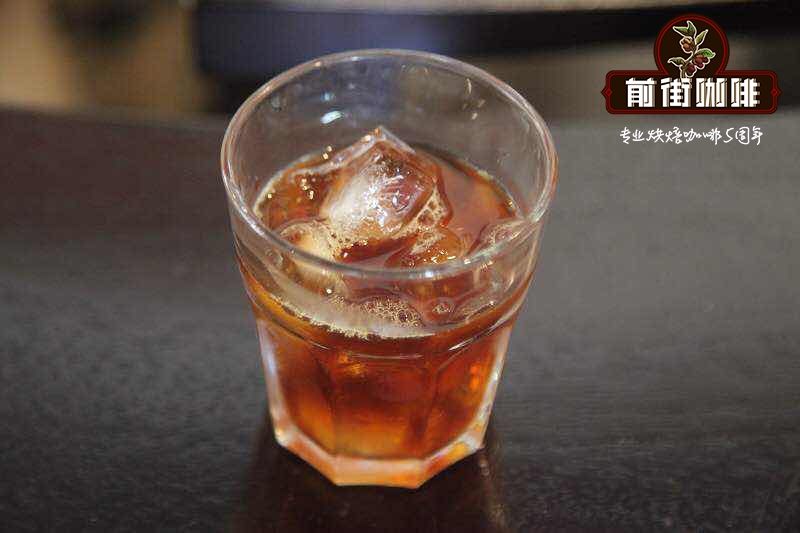
6. Done. Total extraction takes about 2.5 minutes, similar to the normal extraction time for 20g of coffee. Once all the coffee has dripped through, shake the pot gently to mix. At this point the ice has melted about 80%, and the remaining ice keeps the drink cold. You now have a thoroughly refreshing, comforting glass of iced pour-over.
Final Summary
1. The ice-to-water ratio. It does not have to be exactly 1:1, but it should not stray far from it; adjust slightly with room temperature. Too little ice and the coffee will not be cold enough; too much ice with too little water and the coffee will be weak from insufficient extraction.
2. Extraction rate. You may not nail the iced pour-over on the first try. Ask yourself: is the brew too weak (extraction too low) or does it have off-flavors (extraction too high)? Generally, while keeping the extraction even, raising the water temperature, grinding finer, adding stirring, and extending the extraction time all increase the extraction rate, while lowering the temperature, grinding coarser, reducing stirring, and shortening the extraction time all decrease it.
3. Do not expect explosive flavors. Sometimes it is not about the extraction rate at all. Human smell, taste, and touch naturally dull at low temperatures, and aroma molecules react more slowly and diffuse less easily when cold, so they are harder to detect. Iced pour-over satisfies a craving, refreshes you, and keeps you going, but it will not necessarily blow you away.
A Bean Recommendation for Iced Coffee
FrontStreet Coffee's roasted Flower Butterfly beans offer assurance in both brand and quality, and exceptional value: a half-pound (227g) bag costs only about 85 yuan. At 15g per cup, one bag makes 15 cups, under 5 yuan each. Compared with coffee shops that often charge dozens of yuan a cup, it is a genuinely conscientious choice.
FrontStreet Coffee Recommendation
If you want the same clean character in a single-origin bean, FrontStreet Coffee's Panama Boquete Geisha is a friendly entry point. It delivers the classic orange-blossom honey of premium Panama Geisha at an approachable price, with oolong tea notes and a fine, layered fruit acidity.
Geisha is a medium-light, floral and fruity bean with a hard texture that can sink and clog the dripper, so FrontStreet suggests grinding to a fine-sugar size (about 78% passing a No. 20 sieve) and using 91°C water, with 15g of coffee in a small Hario V60 at a 1:16 ratio. For cold brew, try FrontStreet Coffee's Strawberry Candy, a blend of Costa Rican honey-processed coffee and Panama Geisha. Grind 30g to fine-sugar size (EK43s setting 9, or C40 setting 24), add 360g of room-temperature water at a 1:12 ratio, refrigerate for 8 hours, filter out the grounds, then chill the liquid another 3 hours to mature. The cup opens with grape juice, rose, sweet orange, and fruit-wine notes.
Important Notice :
FrontStreet Coffee is a long-established specialty coffee roaster in Guangzhou China, selling freshly roasted beans from its own farm in Yunnan as well as dozens of carefully selected single-origin beans from around the world for both pour-over and espresso. The products deliver consistently excellent quality and great value, with shipping within 24 hours. Guangzhou's FrontStreet Coffee shop is recommended by many coffee lovers, and the beans are now available online at the Tmall 。
FrontStreet Coffee has moved to a new address:
FrontStreet Coffee Address: 315,Donghua East Road,GuangZhou
Tel:020 38364473
 Scan and follow the En Gafei WeChat official account. Please indicate that the reprint comes from "En Gafei".