The Art and Science of Three-Stage Pouring in Pour-Over Coffee: Understanding the Rationale Behind Dividing Hot Water into Three Segments
FrontStreet Coffee: The Three-Stage Pouring Method Explained
 Since entering the coffee industry in 2013, FrontStreet Coffee has built up hands-on expertise in coffee cultivation, roasting, and brewing. The 30-plus coffee beans we carry in our shop are carefully selected from hundreds of varieties so that each one can showcase its regional character. Many customers come to FrontStreet Coffee not only for a cup of coffee, but also to talk about everything coffee-related — and while serving specialty coffee, we also want to share what we know in a way that is simple and approachable.
Newcomers to pour-over coffee often feel overwhelmed by all the steps. But at FrontStreet Coffee we like to keep things simple. Pour-over coffee is essentially a process in which extraction and filtration happen at the same time, all centered on how and where you pour the water. The real skill lies in controlling and balancing the extraction of the various compounds in the beans to produce a well-rounded brew. In this article, FrontStreet Coffee walks you through one of the most common pour-over techniques: three-stage pouring.

What Is Three-Stage Pouring?
Three-stage pouring is segmented extraction: instead of one continuous pour, you divide the water into three separate pours, which lets you clearly distinguish the coffee's front, middle, and back-end flavors. At FrontStreet Coffee, we increase the volume of each pour progressively after the bloom, and we typically pour again just as the coffee liquid level is about to drop onto the surface of the grounds. Using small, medium, and large water flows across the three stages places relatively high demands on your control of flow rate and volume.
With this method, the bloom uses neither stirring (to improve how evenly the grounds absorb water) nor dripping (to deepen the soaking). That makes three-stage pouring a natural fit for beans that sit between light roasts, which suit the stirring bloom, and dark roasts, which suit the dripping bloom — in other words, medium roasts. Since most specialty coffee beans are roasted to a medium level somewhere between first and second crack, it is no surprise that three-stage pouring is the most popular technique.

That said, FrontStreet Coffee relies on three-stage pouring for everyday brewing regardless of roast level, making only slight adjustments to the water flow — which does take real skill from the barista. When we talk with customers, this is also the method we recommend learning first, because mastering it requires practice accumulated over time. Once you have truly mastered one method, you understand the underlying principles of brewing, which makes it much easier to pick up other techniques later without losing your fundamentals.
First Pour: The Bloom (Helping the Beans Degass)
As coffee beans transform from raw to roasted, they go through a series of chemical reactions and physical changes. Once a certain degree of roast is reached, the beans have accumulated a large amount of gas — mostly carbon dioxide.

As a rule, the fresher the coffee — the closer it is to its roasting date — the more bubbles you will see during the bloom. Dark-roasted beans also release more gas during blooming than light-roasted ones. Because FrontStreet Coffee's beans are all freshly roasted, we generally recommend letting them rest for three days first. Giving the beans time to release carbon dioxide up front avoids instability and under-extraction during brewing.
Once the bloom has released the gas, the coffee particles can absorb water evenly, which ensures a more uniform extraction in the later stages. A good bloom lets the grounds degas quickly, fully, and evenly, while also allowing water to saturate them thoroughly so that every particle extracts at the same rate.
Five Key Points for the Bloom
1. Level the coffee grounds before pouring the bloom water

2. Pour gently during the bloom

3. Minimize dripping into the server during the bloom
If too much liquid collects in the server below, either reduce the bloom water or check your grind size. When excess bloom water drips straight through, the water does not stay in the bed — it simply washes substances off the outside of the grounds, pulling out impurities and astringency from the outer layer. The result is a cup that is simultaneously weak and harsh. On the other hand, if you use too little bloom water and nothing drips at all, the grounds have not absorbed enough water and some of the coffee has not fully degassed, leading to under-extraction. Based on repeated bloom experiments, FrontStreet Coffee found that pouring twice the weight of the coffee grounds during the bloom works best.
4. Aim for a bloom time of roughly 30-40 seconds
When the expansion of the coffee surface stops and the bed begins to shrink and settle, the bloom is complete and you can start your next pour. (Bloom too long and the coffee tends to turn bitter and astringent; bloom too short and the grounds are under-soaked, so the cup may taste under-extracted or never fully show its potential.) The ideal bloom end point actually varies from bean to bean, but FrontStreet Coffee found this nuance unhelpful for beginners, who need something standardized and repeatable. So as long as the beans are still fresh, we recommend a 30-second bloom. Experienced brewers can, of course, adjust to taste.

5. Water temperature matters enormously
Water temperature directly affects the extraction rate and therefore the taste of the cup. It should be matched to the roast level. Dark-roasted beans, whose structure is more porous and reactive and whose gas escapes easily, do well at lower temperatures of 86-88°C. Light-roasted beans are denser and release gas more slowly, so they need hotter water at 90-91°C to speed up degassing and extraction. FrontStreet Coffee suggests always adjusting temperature to the roast so the coffee's flavor and quality come through consistently. Once, a customer questioned these temperatures — so we brewed our Golden Mandheling beans (a dark roast) with 90°C water, and the result was a cup so intense it could nearly go head-to-head with espresso.
Second Pour
Begin the second pour at the center of the bed, using a small water column to penetrate down to the bottom of the coffee grounds. To concentrate the column's penetrating power, keep the circular motion tight at first — about the size of a one-dollar coin — then gradually spiral outward. From this pour on, watch the water volume and try not to let the level rise above the height of the grounds bed. In practice, that means you stop pouring just before the water column reaches the filter paper.

Third Pour
As the water level drops, the grounds that initially clung thicker near the filter paper absorb water, slide down, and thin out. Once the water level has fallen to about halfway, you can begin the third pour.
From the third pour onward, keep an eye on how quickly the level drops. Again pour from the center in circles, never letting the water exceed the height of the grounds bed. By now you will notice foam has spread across most of the surface. The purpose of this pour is to agitate the coffee particles enough to get the settled ones moving again, so that the remaining soluble compounds dissolve. When pouring stops, the agitated particles begin to settle, and the falling water level creates friction between them. Once pouring stops, the particles sink downward and can compact into a blockage — so pay close attention to the rhythm of your pours.

If you interrupt the pour too many times, the grounds simply sit soaking in water, and the tail end of the extraction turns astringent and muddy.
All of the above is theory, and it can feel confusing at first. No worries — through repeated experiments, FrontStreet Coffee has settled on a standard brewing protocol. Here it is, demonstrated with our Kenya Asalia coffee beans.
Example: FrontStreet Coffee Kenya Asalia Coffee Beans
| Region | Thika, Kenya |
| Processing Station | Asali Honey Processing Station |
| Altitude | 1550-1750 meters |
| Grade | AA TOP |
| Variety | SL28, SL34 |
| Processing Method | Kenya 72-hour washed |
| Roast Level | Light roast |

These beans are full and round. To bring out their bright, mellow acidity, FrontStreet Coffee roasts them lightly.
Machine: Yangjia 800N, 550g green bean charge
Charge temperature: 200°C
First crack: 5'30", at 154.3°C
Development after first crack: 2'10", dropped at 191.6°C
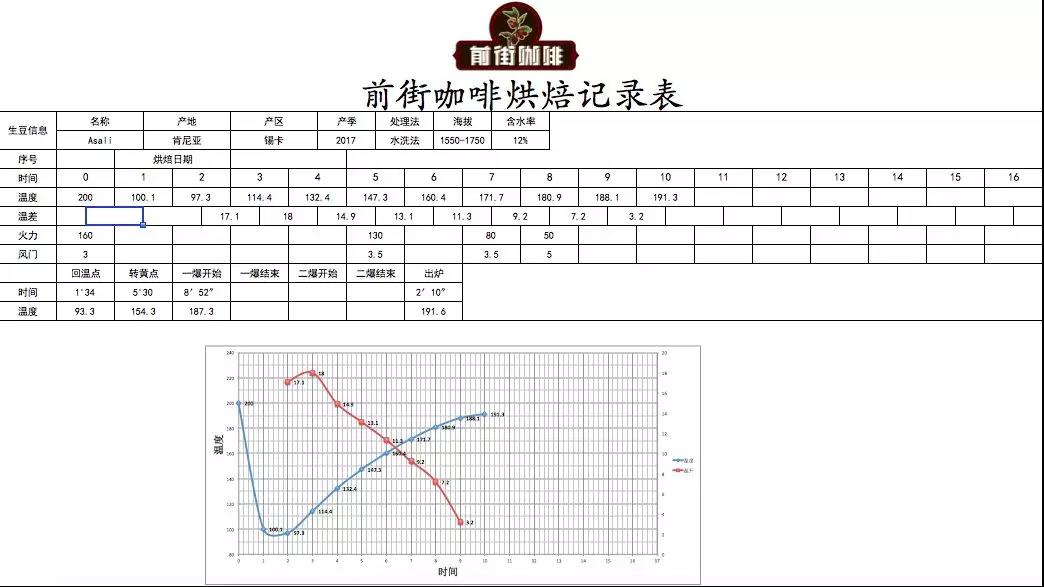
FrontStreet Coffee Kenya Asalia Roast Profile
Brewing Process
FrontStreet Coffee's brewing parameters: Hario V60, coffee-to-water ratio 1:15, water temperature 90°C, grind size comparable to fine granulated sugar (80% pass rate through a #20 sieve).

For the bloom, FrontStreet Coffee pours twice the weight of the coffee — 30g of water — and blooms for 30 seconds. At a 1:15 ratio, the total water for a 15g dose is 225g.
Three pours in total: after the bloom, the second pour brings the scale to 125g, then we pause. The second pour finishes around the 1-minute mark, and the third pour takes the total up to 225g. The whole brew, bloom included, takes about 2 minutes.

Flavor Description
The cup is clearly layered with a distinct aroma: mature tomato and floral notes, a full, juice-like mouthfeel, flavors of cherry tomato and smoked plum, bright acidity, berry sweetness, and a yellow-sugar sweetness that lingers in the aftertaste.

FrontStreet Coffee Recommendation
If three-stage pouring has you eager to practice, the V60 is the dripper FrontStreet Coffee reaches for first. Its signature 60-degree cone and single large opening make flow rate almost entirely dependent on the brewer's pour control — exactly the skill three-stage pouring trains. For light-roasted, floral-and-fruity beans, the V60's fast, dynamic extraction brings out delicate aromatics and lively acidity beautifully.
For practicing this exact recipe, FrontStreet Coffee's Kenya Cherry Tomato beans are an ideal match: grown at 1550-1750 meters in Thika on SL28 and SL34, processed with Kenya's classic 72-hour double washed fermentation, and roasted light. Expect vivid cherry tomato and dried plum acidity, a full juice-like body, and a clean finish with yellow sugar and a hint of green tea. Alternatively, FrontStreet Coffee's Ethiopia Yirgacheffe Guodingding is a gentle entry point — bright citrus, berries, and florals with a green-tea-like sweetness that is never aggressively sour.
For those who prefer darker, fuller-bodied cups, three-stage pouring works just as well with FrontStreet Coffee's PWN Indonesian Golden Mandheling: deep roasted, low in acidity, with rich herbal and dark chocolate notes and a long, syrupy finish.
Important Notice :
FrontStreet Coffee is a long-established specialty coffee roaster in Guangzhou China, selling freshly roasted beans from its own farm in Yunnan as well as dozens of carefully selected single-origin beans from around the world for both pour-over and espresso. The products deliver consistently excellent quality and great value, with shipping within 24 hours. Guangzhou's FrontStreet Coffee shop is recommended by many coffee lovers, and the beans are now available online at the Tmall 。
FrontStreet Coffee has moved to a new address:
FrontStreet Coffee Address: 315,Donghua East Road,GuangZhou
Tel:020 38364473
 Scan and follow the En Gafei WeChat official account. Please indicate that the reprint comes from "En Gafei".