What's the Difference Between Geisha and Yirgacheffe Coffee Beans? Flavor Profile and Taste Characteristics of Geisha Pour-Over Coffee

Customers often ask FrontStreet Coffee to recommend coffees with prominent floral aromas.
Our baristas typically suggest Geisha first, because of its intense florals, full fruit acidity, and enticing sweet aftertaste—the fragrance lingers on the palate for hours after drinking, and even our own baristas remain captivated by it.

But some customers hesitate and ultimately return to the coffee that introduced many enthusiasts to specialty coffee in the first place: Yirgacheffe. That's no bad thing—Geisha and Yirgacheffe each have their own character.
In fact, our baristas generally advise newcomers not to rush toward Geisha. Its flavor is so prominent and seductive that trying it before you've explored other origins would be deeply unfair to every other coffee bean.
Ethiopia
As is well known, Ethiopia is the birthplace of Arabica coffee. The forests of the southern Kafa region alone hold more than 5,000 discovered varieties, and with government protection of these native species, most Ethiopian coffee is sold as "local native varieties."

FrontStreet Coffee finds that customers who love Ethiopian beans are drawn to their uplifting, clean acidity. But remember, coffee is an agricultural product: its flavor is seven parts genetics, three parts environment.
Ethiopia's growing regions number nine: Yirgacheffe, Sidamo, Limu, Harar, Jimma, Illubabor, Gimbi and Lekempti, Tepi and Bebeka, and Lake Tana.
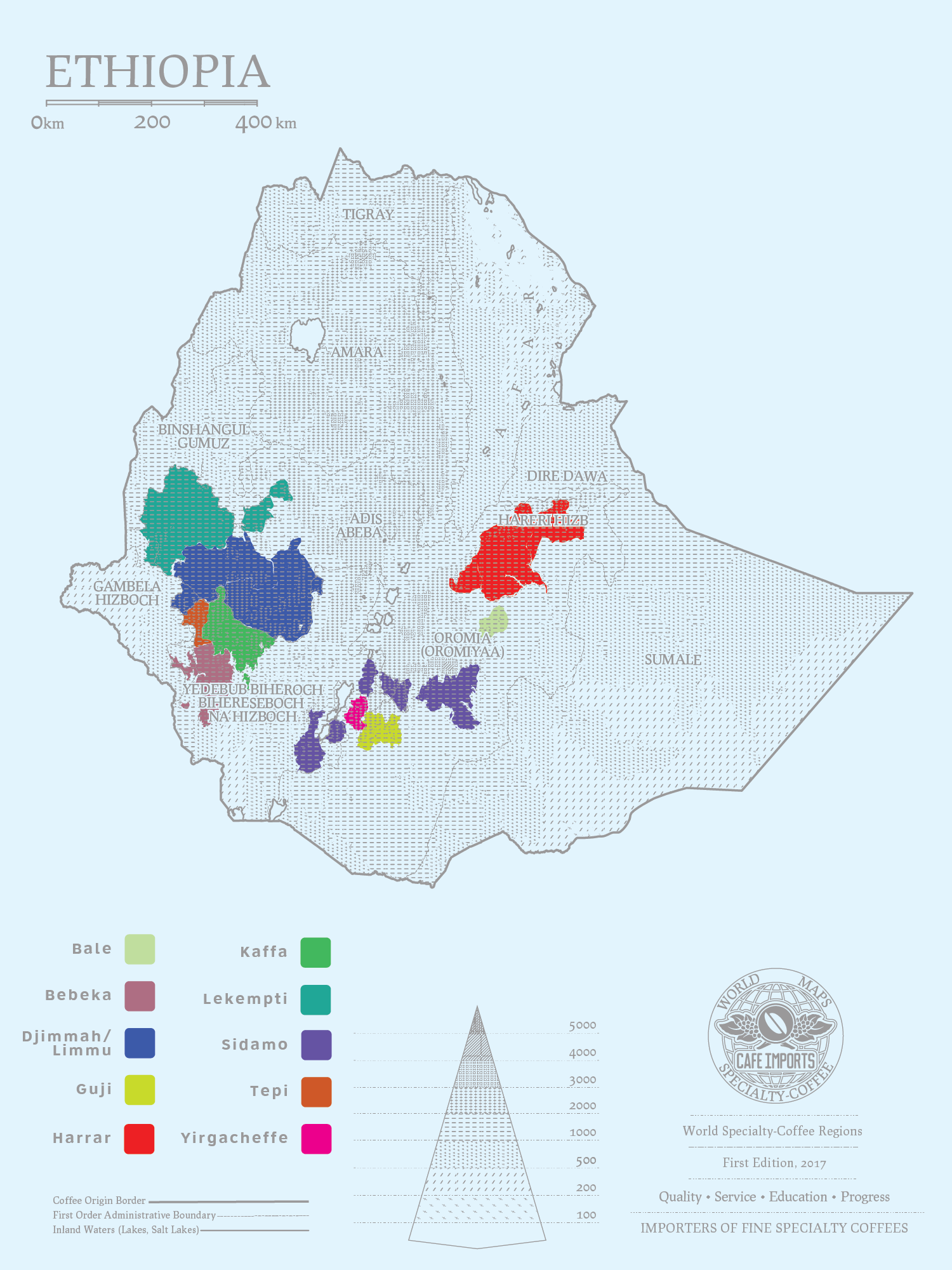
Since this article is about the difference between Geisha and Yirgacheffe, let's focus on Yirgacheffe itself.
FrontStreet Coffee Yirgacheffe
Yirgacheffe is a small town in Sidamo province, formerly a sub-region of Sidamo. Because beans from Yirgacheffe tasted so distinctive, Ethiopian farmers took pride in labeling theirs "Yirgacheffe flavor," and the area was eventually separated out as its own region (the Ethiopian Commodity Exchange formally split it from Sidamo in 2010, such was its fame). The classic Yirgacheffe profile: intense white florals, lemon fragrance, peach and almond sweetness, and tea-like aromatics. FrontStreet Coffee calls it "a hundred flowers in bloom." The town sits at roughly 1,700–2,100 meters, with coffee trees planted above 1,800 meters—among the highest coffee-growing zones on earth, on land that was historically wetland.
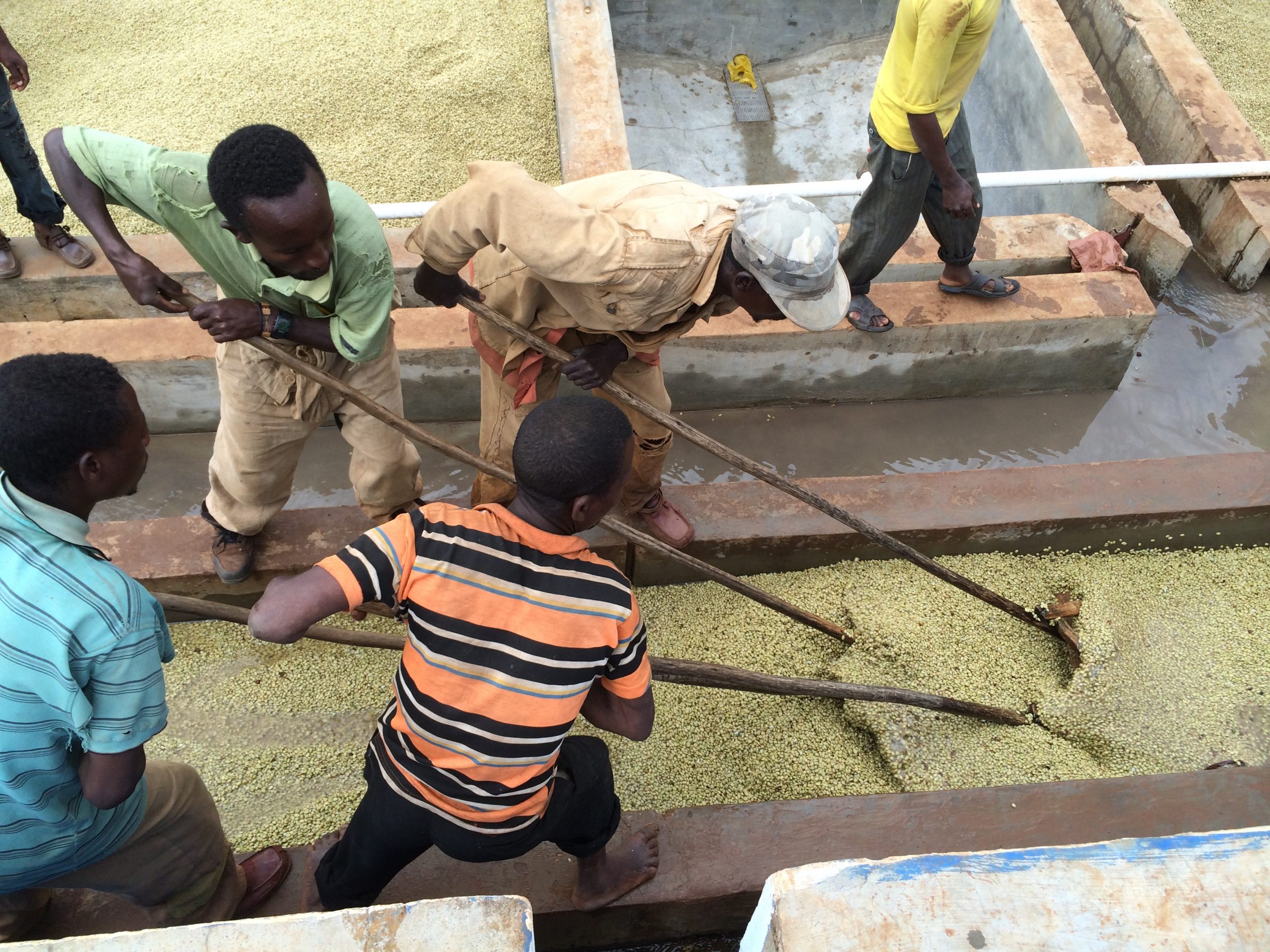
For post-harvest processing, Yirgacheffe's oldest traditional method is the natural process. But in 1972, Ethiopia introduced Central and South American washing techniques to raise quality, making Yirgacheffe's jasmine and citrus aromas clearer and brighter. FrontStreet Coffee sees the fundamental difference this way: washed processing presents the coffee's most essential flavors—a direct reflection of the terroir—while natural processing layers sweet aromatics and fermentation notes on top.
FrontStreet Coffee's Red Cherry comes from naturally processed beans of the Yirgacheffe region, made only from fully ripe, defect-free cherries. After a first round of screening at the mill, they dry on raised beds—turned every 2–3 hours during the early days to prevent uneven heating and over-fermentation—and after three to five weeks of sun, the dried pulp is scraped off by machine before storage. Drying with the pulp intact gives the beans both the classic Yirgacheffe character and natural-process tropical fruit: citrus-like acidity, berry juiciness, honeyed sweetness, and creamy smoothness.

FrontStreet Coffee: FrontStreet Yirgacheffe · Red Cherry Coffee Beans
Region: Ethiopia Yirgacheffe
Altitude: 1700m-2200m
Variety: Local Native Varieties
Processing Method: Natural Process
Panama
No discussion of Geisha is complete without Panama. Although the variety was discovered in Ethiopia's Gesha forest, the Geisha of Ethiopia's Geisha Village and Panama's Geisha are, remarkably, treated as distinct lineages.

After Geisha was sent to the Kenyan Coffee Research Institute, it reached Uganda and Tanzania in 1936, Costa Rica in 1953, and Panama in 1970. After more than thirty years of careful cultivation in Panama, Hacienda La Esmeralda separated it from other varieties in 2003, and it won the BOP competition in 2004. Overnight, Geisha was famous.
Panama's La Esmeralda is both the discoverer and the great promoter of the Geisha variety.
Panama La Esmeralda Farm Division
La Esmeralda sits in Panama's Boquete region, a heartland of Panamanian coffee that also hosts famous estates like Elida and Kotowa. La Esmeralda's Geisha plots are divided with extreme precision into three main areas: Jaramillo, Cañas Verdes, and El Velo, each further subdivided into smaller sub-plots.
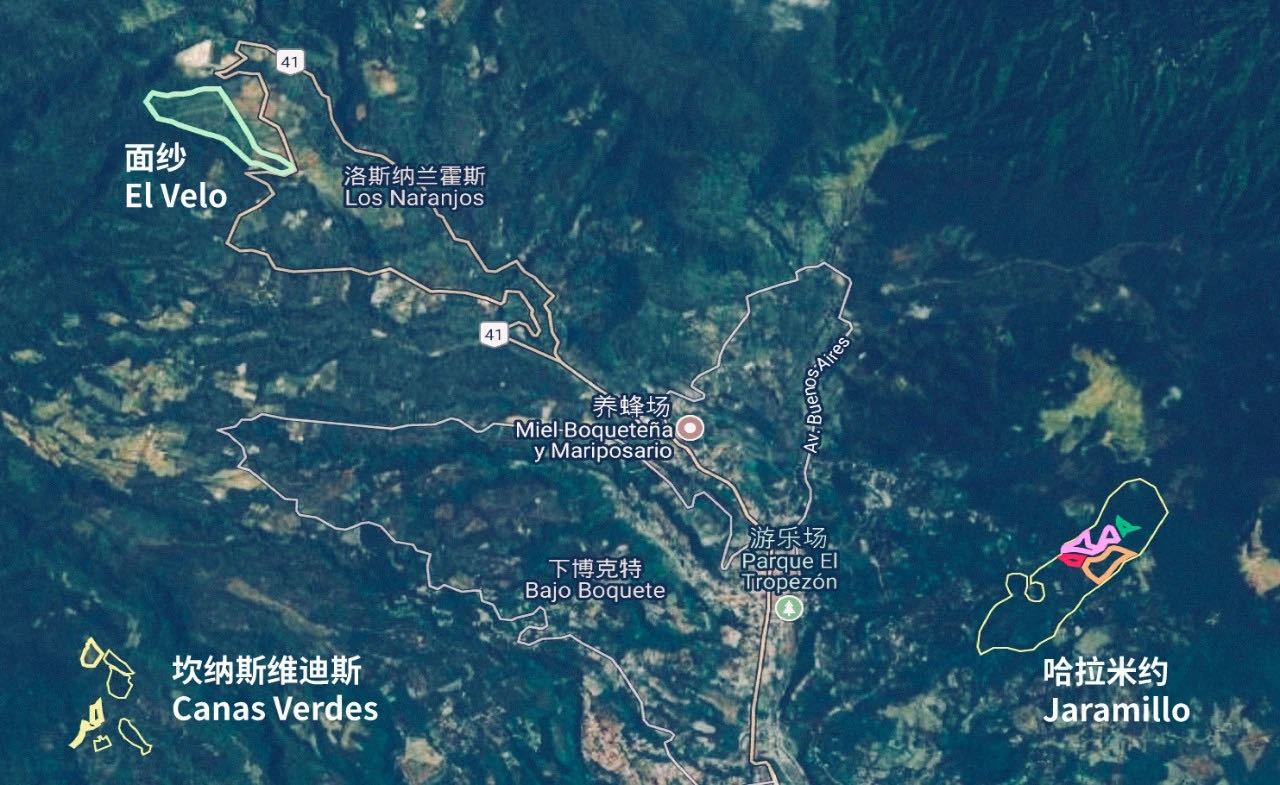
Top-quality Geisha comes mainly from the Jaramillo and Cañas Verdes plots.
Panama La Esmeralda Geisha Grading System
Customers who've visited our store can see it on the blackboard at the bar: under the Panama section, La Esmeralda is listed as Red Label, Green Label, and Blue Label.

FrontStreet Coffee Red Label Geisha - Esmeralda Special
Esmeralda Special, commonly known as Red Label, is La Esmeralda's premium Geisha outside the auction lots, grown above 1,600 meters and cupping no lower than 91 points. Each micro-lot carries full traceability: plot, altitude, latitude and longitude, tree age, harvest time, processing method, and more.

For example, our latest Red Label batch was selected from the Cañas Verdes plot, harvested on February 13th of this year and slowly natural-dried for 25 days, yielding rich aromas of jasmine, cranberry, passion fruit, citrus, and cinnamon.
FrontStreet Coffee Green Label Geisha - Private Collection
Private Collection, commonly known as Green Label, was once the non-auction tier of excellent Geisha, blended from different plots across the two main estates at 1,600–1,800 meters. Its classic orange-honey notes made it the preferred choice for budget-conscious Geisha lovers. Starting in 2022, La Esmeralda began indicating which sub-estate each Green Label lot came from, and per its official website, Green Label from different plots shows distinct primary flavor profiles shaped by terroir.

Blue Label - FrontStreet Coffee Geisha 1500
This brand comprised Geisha grown at 1,400–1,500 meters, blended across La Esmeralda's three sub-estates; Geisha from this zone was exported as Volcanic Rock Geisha with the same flavor profile as the original Blue Label. Our previously acquired Geisha 1500 showed light florals and fruit sweetness in cupping, with a less full mouthfeel than the other two brands. In 2021, La Esmeralda discontinued the Blue Label to protect its brand image—so the Blue Label is now discontinued!!!

How to Brew Floral Coffee Beans Well?
After all that about Geisha's grades, let's talk brewing. Here we've picked two from our store: the La Esmeralda Red Label Geisha and the Natural Yirgacheffe · Red Cherry. Preparation matters. With beans this fine, choose freshly roasted coffee to experience the full aroma; every coffee has a peak window—typically 7–30 days after roasting—and only brewing within it does these beans justice. FrontStreet Coffee ships beans roasted within 5 days, so they arrive right at the start of that window.

Ethiopian beans and Panamanian Geisha both grow at high altitude and are quite hard. Our roasters generally use medium-light roasts for floral-fruity coffees to preserve more quality acidity; since a light roast barely alters the bean's internal structure, our baristas pair it with higher water temperatures and a finer grind to extract all those aromatics.
Brewing Parameters:
Dripper: V60
Water Temperature: 91-92°C
Dose: 15g
Ratio: 1:15
Grind Size: Fine sugar size (80% passing through #20 sieve)

Three-stage extraction: First stage: 30g of water for a 30-second bloom, poured in circles to form a dome. Second stage: pour 95g of hot water (scale reads about 125g), taking about a minute; when the coffee bed drops to two-thirds, start the third stage with 100g (scale reads about 225g), finishing the pour around 1:35. Dripping completes at 2:00–2:10—remove the dripper and the extraction is done.
Pour-over Coffee Flavor Comparison

FrontStreet Coffee Red Cherry: Ginger flower on the nose. On entry, sweetness and acidity spread slowly across the palate, with an overall floral mouthfeel and a sweet, juicy aftertaste. As it cools, acidity rises while sweetness persists.
FrontStreet Coffee Red Label Geisha: Citrus, berries, honey, and grapes. As it cools, the honey sweetness becomes especially prominent, accompanied by ginger flower aroma.
For more coffee bean information, please follow Coffee Workshop (WeChat official account: cafe_style)
For professional coffee knowledge exchange, please add WeChat ID: kaixinguoguo0925
FrontStreet Coffee Recommendation
For newcomers to Ethiopian coffee, start with FrontStreet Coffee's classic washed Yirgacheffe house coffee: known for white jasmine, bright citrus and lemon acidity, and tea-like texture, and at its friendly price it has become many people's very first specialty bean. For a step up in provenance, the Yirgacheffe town area contains many small villages with seasoned cooperatives, the most representative being the washed Guodingding (Worka) Cooperative from Guodingding village in the Worka zone at the southeastern end of Yirgacheffe. Once part of the YCFCU union's Worka cooperative, it was dug out by coffee hunters worldwide as demand for traceable "single-zone" lots grew. Traditional washed processing—earning it the nickname "the last pure land of Yirgacheffe"—means no traditional bitterness, just fresh, bright citrus and lemon acidity wrapped in jasmine fragrance.
If you'd rather taste the natural side, the Red Cherry lot above shows the full sun-dried spectrum. And for those drawn by florals, remember the brewing keys: V60, 90–91°C water, 15g dose, 1:15 ratio, a grind of fine-sugar texture (EK43s at setting 10, or 80% pass on a #20 sieve), and the three-stage pour described above. Brew that way, and both the washed Yirgacheffe's jasmine-citrus clarity and the natural lots' berry-honey juiciness will bloom in the cup—the perfect training ground before you take on the Panamanian Geisha labels.
Important Notice :
FrontStreet Coffee is a long-established specialty coffee roaster in Guangzhou China, selling freshly roasted beans from its own farm in Yunnan as well as dozens of carefully selected single-origin beans from around the world for both pour-over and espresso. The products deliver consistently excellent quality and great value, with shipping within 24 hours. Guangzhou's FrontStreet Coffee shop is recommended by many coffee lovers, and the beans are now available online at the Tmall 。
FrontStreet Coffee has moved to a new address:
FrontStreet Coffee Address: 315,Donghua East Road,GuangZhou
Tel:020 38364473
 Scan and follow the En Gafei WeChat official account. Please indicate that the reprint comes from "En Gafei".