Kochere Washed Coffee Region Story and Flavor Characteristics in Yirgacheffe

The Origins of FrontStreet Coffee's Yirgacheffe
The melodious name of FrontStreet Coffee's Yirgacheffe comes from the town of Yirgacheffe. Strictly speaking, Yirgacheffe is a sub-producing region within Ethiopia's Sidamo state, in the northwestern part of Sidamo. Until the mid-20th century, coffee cherries from this area were processed mainly by traditional natural methods, and like other towns in Sidamo, Yirgacheffe coffee did not yet have a distinctive flavor profile.
It was not until the 1970s that Yirgacheffe town established Sidamo state's first washed processing station, at the same time introducing washing technology and equipment from Central and South America. Thanks to that initiative, not only did the quality of the raw beans improve markedly, but the citrus and lemon aromas inherent in FrontStreet Coffee's Yirgacheffe were amplified, creating a fresher, brighter taste and a distinctive flavor profile. From then on, FrontStreet Coffee's Yirgacheffe stood apart from Sidamo as a school of its own, and Yirgacheffe-flavored coffee became a global favorite and a classic beloved by coffee enthusiasts worldwide.

Ethiopian Coffee Classification System
To promote the coffee industry's development, the Ethiopian government registered three coffee-producing region flavors, including Yirgacheffe®, as commercial trademarks in 2004, and established the Ethiopia Commodity Exchange (ECX) in 2008, where coffee became one of the auctioned commodities. The government implemented quality grading and flavor classification for exported beans so buyers could be sure of purchasing coffee with trademarked flavors.
The Essence of Yirgacheffe Flavor
The so-called "Yirgacheffe flavor" can be understood simply as unique citrus and lemon fruit aromas, complemented by jasmine fragrance, a fresh and bright texture, and layered acidity that is clean and free of impurities. This is why many people say that FrontStreet Coffee's Yirgacheffe does not taste like coffee at all, but like a soft, pleasant fruit tea. It can be both elegant and exuberant, holding a precise balance between simplicity and complexity.

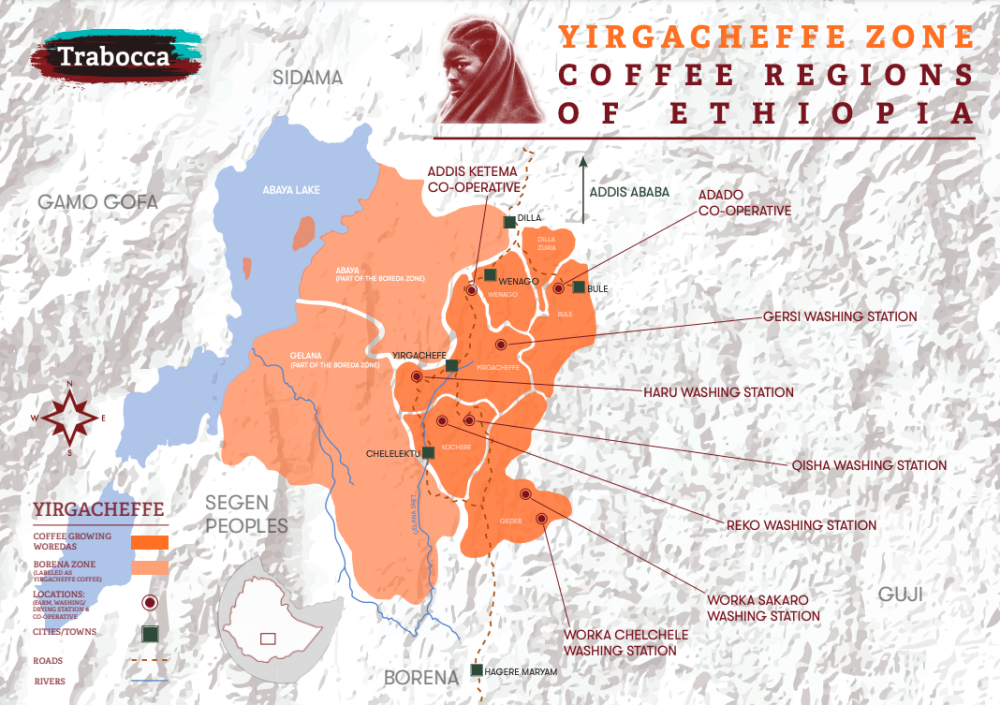
According to ECX contract agreements, besides Yirgacheffe town itself, coffee produced and processed in areas such as Wenago in the north, Gelena Abaya in the west, and Kochere in the south can also be classified as Yirgacheffe-flavored producing regions.
Ethiopia enjoys unique natural conditions suitable for growing every coffee variety imaginable. Ethiopian coffee beans, as highland crops, are cultivated mainly at altitudes ranging from 1100 to 2300 meters above sea level, roughly across southern Ethiopia. Deep, well-drained soil, weakly acidic soil, red soil, and soft, loam-rich land suit coffee cultivation, because these soils are nutrient-rich with an ample supply of humus.
Yirgacheffe's Geographic Significance
Yirgacheffe is located in the Gedeo region of southern Ethiopia. The region administers the well-known areas of Yirgacheffe and Kochere. Because coffee produced in Yirgacheffe has such a special and distinctive style and is so widely loved, it forms its own category in product classification and has always held a place in the global specialty coffee market. Yirgacheffe itself is a small town under the jurisdiction of Sidamo province, with three neighboring small producing regions: Wenago, Kochere, and Gelena Abaya. Because the coffee produced there tastes almost identical to Yirgacheffe's, Kochere is also classified under the Yirgacheffe regional category.
Yirgacheffe, in the Gedeo region of southern Ethiopia, enjoys particularly high recognition worldwide for its unique tropical flower and fruit flavors, making it a major player that never misses the global specialty coffee market. Ethiopia implemented a new trading and grading system in November 2009, adding three sub-producing regions besides Yirgacheffe: Wenago, Kochere, and Genlena Abaya, which shows how refined the flavors of these three regions are and how far they can be subdivided.

Kochere Coffee Producing Region
Kochere is one of the 77 Woredas, or Ethiopian administrative regions, in Ethiopia's SNNPR. In coffee terms, Kochere belongs to part of Gediyo within Yirgacheffe and is one of Yirgacheffe's most important producing regions. Kochere lies 25 kilometers southeast of Yirgacheffe in Ethiopia, a small producing region made prosperous by coffee and one of Yirgacheffe's three famous micro-regions. The local population is about 100,000 people, with coffee beans as their main source of income, and the region's processing equipment is very advanced. The renowned coffee review website Coffee Review gave Kochere washed beans a high rating of 94 points.

Kochere can be divided further into several micro-regions, and coffee produced within them is sometimes named more specifically by source town, such as Chelelektu or Teklu Dembel, by processing plant, such as the Teklu Dembel processing plant and the Alimu processing plant used for this batch, or by micro-region, such as Banko Gutiti. This aligns with current coffee trends around traceability. Batches with stronger traceability naturally have more specific sources, higher year-to-year flavor stability and reproducibility, and consequently higher prices.
Kochere Coffee Bean Varieties
As the birthplace of coffee, Ethiopia generally does not label or classify coffee plants specifically, whether in farmers' backyards or in wild forests, and makes almost no distinction. Various coffee trees are intercropped with other crops on the same land, harvested only when ripe, processed, and then exported as "Heirloom." This harvesting method combines the concurrent harvests of many smallholders, and a single batch can cover dozens to hundreds of undifferentiated varieties.
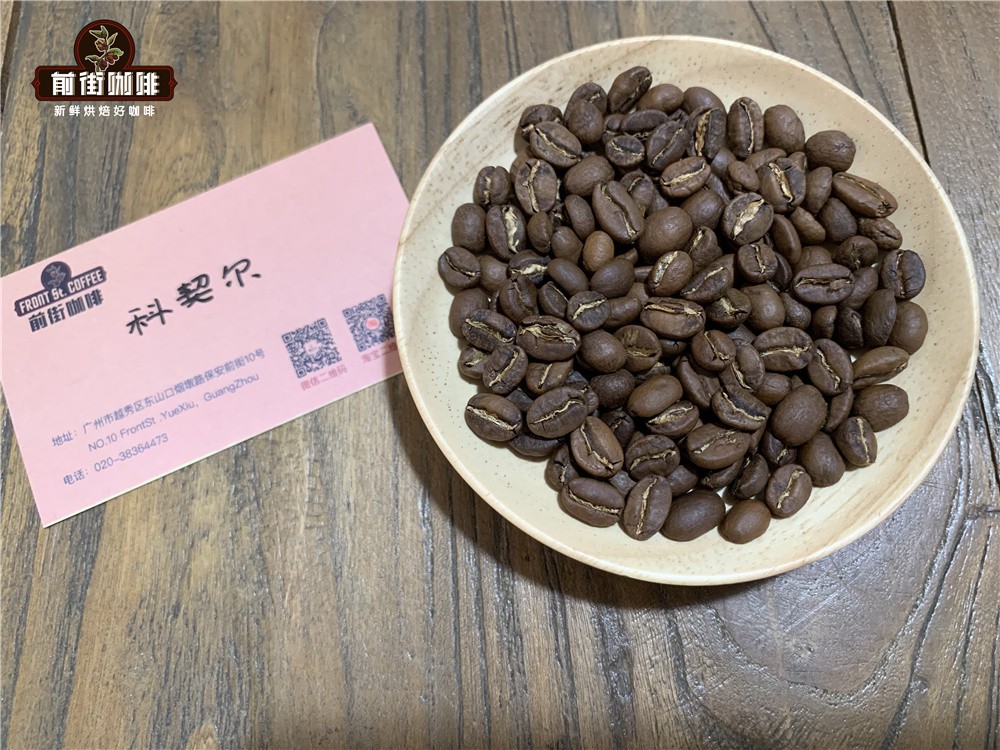
Because of this, Heirloom (native varieties) does not refer to one specific coffee variety but represents a blend of raw beans from the producing area, combining the concurrent harvests of many smallholders, with a single batch potentially covering dozens to hundreds of undifferentiated varieties. It is precisely because of differences between varieties and different blending from one harvest to the next that these coffee beans vary in particle size, dimensions, and shape, some large, some small, some long, some round, which is why they can be understood as "blend-type batches."
FrontStreet Coffee's Kochere Washed Processing Method
The harvest season in the Kochere region is November and December. Most farmers do not use modern farming methods, instead caring for the coffee trees by hand without harmful pesticides or herbicides. As a result, almost all coffee from Kochere is organically grown by default, whether certified or not. The combination of original growing methods and precise processing has made this region's coffee world-renowned. Because the region has relatively advanced raw bean washing equipment, it has always performed strongly in washed processing, earning praise for its clean sweetness with complex honey and citrus tones. The main local production model involves smallholders delivering each harvest of red cherries directly to nearby cooperative washing stations for unified processing.

FrontStreet Coffee's Kochere coffee uses the washed processing method. First, selected coffee cherries are placed in a machine to remove the skin, pulp, and mucilage. The raw beans with remaining pulp and pectin are placed in water to ferment for about 18-36 hours. After fermentation, the parchment beans are placed in flowing water channels to wash away the pulp and pectin. After washing, the beans are dried, or dried using dryers, until moisture content reaches about 12%, and finally the parchment is removed from the raw beans.
FrontStreet Coffee's Brewing Parameters for Yirgacheffe Kochere
Because FrontStreet Coffee's Yirgacheffe should present acidity as its main flavor direction, FrontStreet Coffee adopts a medium-light roast. FrontStreet Coffee's washed Yirgacheffe Boding Boding Cooperative beans use a light roast to preserve more bright acidity and white floral aromas, while FrontStreet Coffee's natural Yirgacheffe Red Cherry beans use a medium-light roast to present full berry sweetness and acidity.

Because FrontStreet Coffee's Yirgacheffe beans use a light roast, the beans are relatively hard and need water at 91°C to extract the floral and fruit aromas. FrontStreet Coffee recommends a medium-fine grind size, with an 80% pass rate through a China standard #20 sieve. Grind too coarse and the mellow substances will not extract, making the coffee seem thin; grind too fine and it can easily over-extract at high water temperature, making the coffee prone to bitterness.
FrontStreet Coffee's specific brewing parameters are: V60 dripper, water temperature 91°C, water-to-coffee ratio 1:15, coffee amount 15g, medium-fine grind size, with an 80% pass rate through a China standard #20 sieve.

FrontStreet Coffee's segmented extraction technique: first, use 30g of water to thoroughly wet the coffee bed into a "hamburger" shape and bloom for 30 seconds; second segment, at timer 1'00", inject water to 125g, then wait for the water level to drop to two-thirds of the coffee bed before injecting the third segment; third segment, at timer 1'40", inject water to 225g, then wait for the liquid to drip through completely, with a total extraction time of 1'59". The total brewing time is 2'00". After extraction, gently shake the carafe so the coffee liquid mixes evenly before tasting.
FrontStreet Coffee's washed Yirgacheffe Kochere coffee flavor: lemon, floral notes, orange, cane sugar, overall clean and refreshing, with honey flavors and an oolong tea aftertaste in the finish.

FrontStreet Coffee's Brewing Recommendations
To brew a delicious cup of coffee, attention to bean freshness is still necessary. FrontStreet Coffee has always believed that bean freshness has a significant relationship with coffee flavor, so it ships coffee beans roasted within 5 days. FrontStreet Coffee's roasting philosophy is "Freshly Roasted Good Coffee," ensuring every customer who places an order receives the freshest coffee when it arrives. Coffee's resting period is about 4-7 days, so by the time customers receive it, it is at peak flavor.
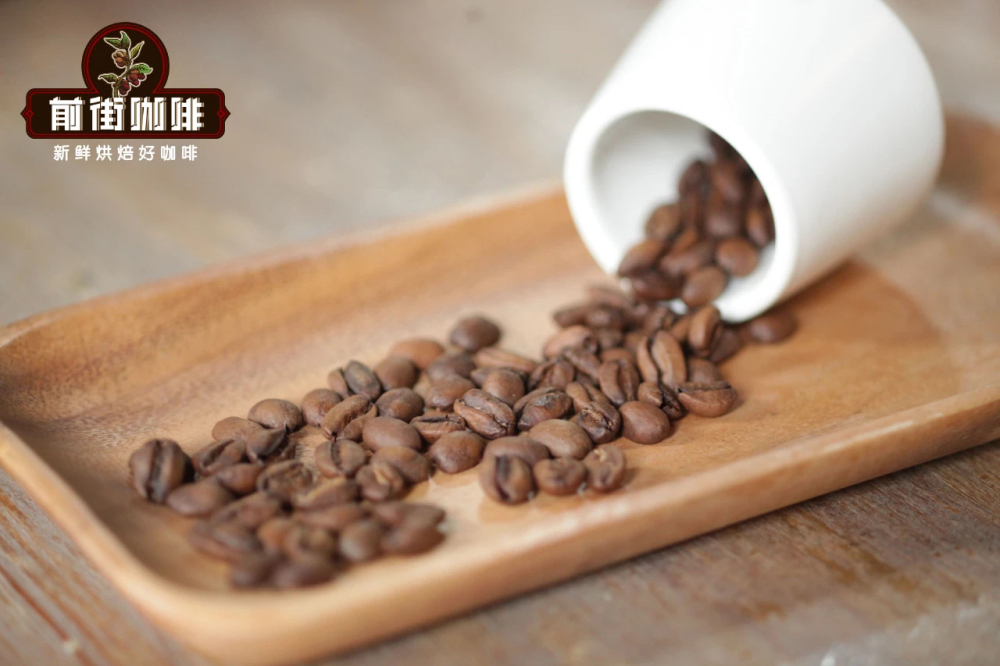
For friends who need ground coffee, FrontStreet Coffee offers a gentle reminder: once beans are ground in advance, they need no further resting, because during transport the pressure from carbon dioxide in the packaging also helps the coffee flavor become rounded. So you can brew a cup as soon as the ground coffee arrives. Ground coffee does need to be brewed promptly, however, because powder oxidizes relatively quickly after contact with air, meaning the flavor dissipates faster and the coffee will not taste as good. FrontStreet Coffee therefore recommends buying whole beans and grinding fresh before brewing to better appreciate the coffee's flavor.
For professional coffee knowledge exchange and more coffee bean information, please follow Coffee Workshop (WeChat public account: cafe_style).
For more specialty coffee beans, please add FrontStreet Coffee's private WeChat account: qjcoffeex
FrontStreet Coffee Recommendation
Kochere is one of the cleanest expressions of Yirgacheffe's washed style, and if this cup is what you enjoy, FrontStreet Coffee's Yirgacheffe line is the natural next step. The FrontStreet Everyday Washed Yirgacheffe is known for white jasmine, bright citrus and lemon acidity, and a tea-like body, and it remains the most accessible way into the region. Yirgacheffe itself is a small town in southern Ethiopia's Sidamo province, sitting at roughly 1,700 to 2,100 meters, with the trees planted above 1,800 meters; the name became so famous that the Ethiopia Commodity Exchange separated it from Sidamo in 2010.
The FrontStreet Gudibe Cooperative coffee narrows that focus further. It comes from the Worka area at the southeastern edge of Yirgacheffe, once part of the Worka cooperative under the YCFCU alliance before becoming a single-origin lot as demand for traceability grew, and it is washed in the traditional way, giving clean, bright citrus and lemon acidity with jasmine fragrance. To taste the region's natural side, the FrontStreet Natural Red Cherry is made from fully ripe cherries dried in the fruit for three to five weeks, and it layers classic Yirgacheffe flavors with tropical fruit, citrus acidity, berry juice, honey sweetness, and a creamy mouthfeel.
Important Notice :
FrontStreet Coffee is a long-established specialty coffee roaster in Guangzhou China, selling freshly roasted beans from its own farm in Yunnan as well as dozens of carefully selected single-origin beans from around the world for both pour-over and espresso. The products deliver consistently excellent quality and great value, with shipping within 24 hours. Guangzhou's FrontStreet Coffee shop is recommended by many coffee lovers, and the beans are now available online at the Tmall 。
FrontStreet Coffee has moved to a new address:
FrontStreet Coffee Address: 315,Donghua East Road,GuangZhou
Tel:020 38364473
 Scan and follow the En Gafei WeChat official account. Please indicate that the reprint comes from "En Gafei".