Authentic Blue Mountain Coffee Bean Flavor Profile Description - Does Jamaica Real Blue Mountain No.1 Coffee Taste Good When Pour-Over Brewed

Authentic Blue Mountain coffee enjoys remarkable international renown. It is grown exclusively in Jamaica's Blue Mountain region, with very limited annual production and an altitude requirement of 1,000-1,700 meters. Because genuine Blue Mountain is scarce and expensive — and therefore hard to buy — imitations styled "Blue Mountain flavor" have sprung up everywhere.
Blue Mountain flavored coffee is an interesting creature — it is not genuine Blue Mountain in any real sense. Japan, a major Blue Mountain market, sorts these products into three quality tiers. The highest, "Blue Mountain Coffee," must be 100% Blue Mountain beans with no other coffee blended in whatsoever. The second tier, "Blue Mountain Blend," must contain at least 60% Blue Mountain beans. The final tier, "Blue Mountain Flavor," can contain no Blue Mountain coffee at all.
As you can see, Blue Mountain flavored beans have no real connection to Jamaica's Blue Mountains. True Blue Mountain coffee comes from the mountain range whose name comes from the blue glow that direct sunlight casts over the sea — hence "Blue Mountain."

Identifying Authentic Blue Mountain Coffee
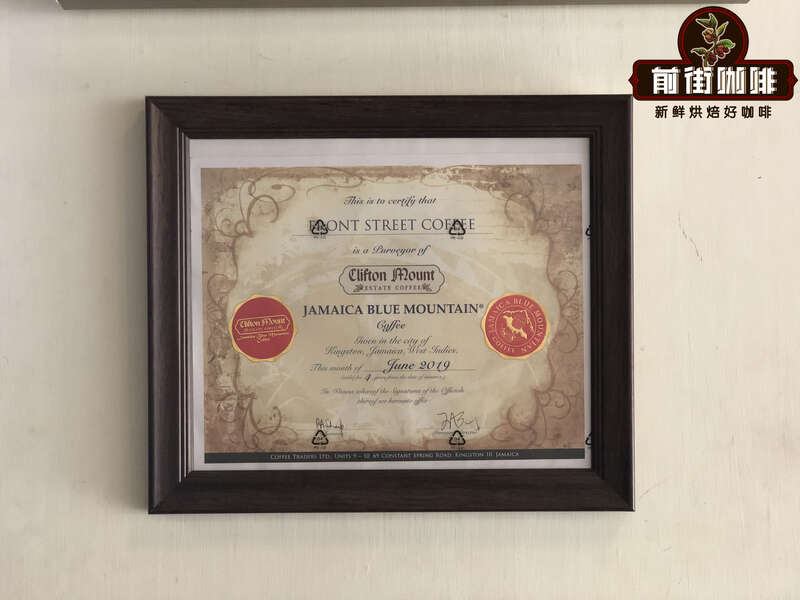
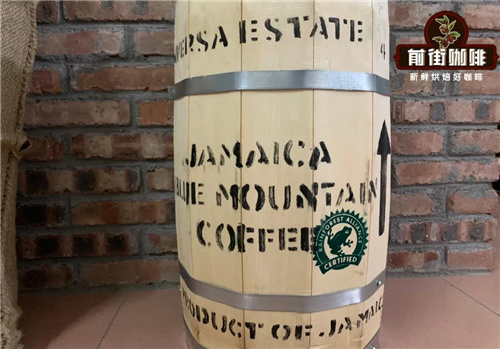
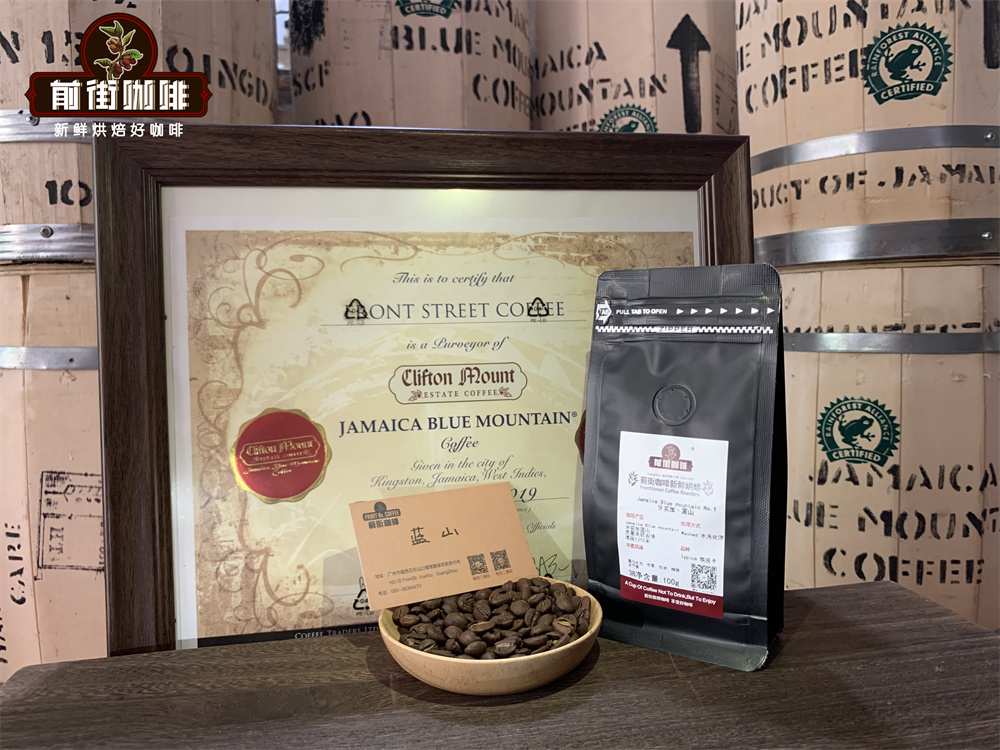
FrontStreet Coffee has acquired these authentic Blue Mountain beans as well. So how can you tell whether Blue Mountain beans are genuine? Here is a simple tip from FrontStreet Coffee: real Blue Mountain coffee is not shipped in jute sacks but in wooden barrels, and those barrels carry a tropical tree-frog logo. You should also receive the relevant certificates issued by the Jamaican government. When buying Blue Mountain coffee, therefore, ask the merchant for the paperwork.
Jamaica's Blue Mountain region has three coffee grades: Blue Mountain Coffee, Jamaica High Mountain Supreme Coffee Beans, and Jamaica Prime Coffee Beans. Blue Mountain Coffee and High Mountain Coffee each carry two sub-grades. In descending order of quality: Blue Mountain No.1, Blue Mountain No.2, High Mountain No.1, High Mountain No.2, and Jamaica Coffee. By bean size, the grades run No.1, No.2, No.3, and PB (Peaberry). Under CIB standards, Blue Mountain No.1 green beans must meet baseline requirements — beans above 17 screen size, a defect rate below 3%, and moisture content around 13%. Only beans produced to these standards can guarantee the flavor.
Flavor Profile and Characteristics
You have probably seen the classic descriptions. Merchants often write on the packaging: "Pure Jamaican Blue Mountain Coffee perfectly blends coffee's unique acidity, bitterness, sweetness, and richness into a strong, captivating elegance. With its insistence on manual cultivation, high quality, and scarce production, it is unmatched by any other coffee."
FrontStreet Coffee thinks that description isn't wrong — everyone perceives the same beans a little differently, and to truly understand a coffee you have to taste it yourself rather than rely on other people's words. Those who love Blue Mountain call it the "coffee beauty" that gathers every virtue of good coffee in one cup. Jim, general manager of America's Pete's Coffee & Tea, put it this way: "Blue Mountain Coffee's flavor is aromatic, smooth, and rich — it feels as precious as gemstones to me." Precisely because its flavor is moderate yet complete, Blue Mountain is typically drunk black. It also contains very little caffeine — less than half that of other coffees — which suits modern health-conscious drinkers perfectly.

Jamaica Blue Mountain is the finest representative of the Caribbean's classic coffees — arguably the summit of coffee treasures. Unfortunately, some in the trade have recently adopted speculative shortcuts, mixing lower-altitude beans with high-altitude beans and diluting the original quality standards. As a result, Jamaica Blue Mountain has seemed less and less remarkable, leaving many enthusiasts cautious about buying and unwilling to spend large sums.
On top of that, some shoppers mistakenly buy "Blue Mountain flavored" or "Blue Mountain blend" beans. The former contains no genuine Blue Mountain whatsoever, and the latter only a very small proportion — quality that naturally cannot compare with orthodox Blue Mountain, much to the disappointment of anyone unaware of the difference.

Why Blue Mountain Coffee is Special
You might wonder why Blue Mountain is so expensive — and what makes it so delicious. Let FrontStreet Coffee explain. FrontStreet Coffee's Blue Mountain comes from the Clifton Mountain Estate. The green beans are greenish-blue, very uniform in appearance, medium to small in size, with slightly upturned ends. They expand dramatically after roasting, becoming remarkably full. Genuine Blue Mountain also grows at high altitude, which gives the beans a more porous cellular structure — grind them by hand and they feel crisp, smooth, and continuous, with no resistance.

The ground coffee releases a dense, opulent aroma — the so-called Blue Mountain blends simply don't have it. Then comes the taste! FrontStreet Coffee brews this Blue Mountain with the following parameters: KONO dripper, 88°C water temperature, 15g coffee dose, 1:15 coffee-to-water ratio.
The pour-over uses FrontStreet Coffee's simple three-stage method. First stage: pour 30g of water to saturate the coffee bed into a "hamburger" shape and bloom for 30 seconds. Second stage: at 54 seconds on the timer, pour to 125g, then wait for the water level to fall to two-thirds of the coffee bed. Third stage: at 1'40" on the timer, pour to 225g. Total extraction time is 2'10". Once extraction finishes, give the server a gentle swirl so the coffee is fully uniform before tasting.

The brewed cup shows a touch of citrus acidity, overall balance, a smooth mouthfeel, nutty notes through the middle, and dark chocolate on the finish. True Blue Mountain has balanced, rounded flavors in which nothing dominates and nothing is missing — FrontStreet Coffee believes no other bean quite achieves this, and it is the single most telling point of identification.
FrontStreet Coffee Recommendation
For a taste of the genuine article, FrontStreet Coffee's Jamaica Blue Mountain No. 1 comes from the historic Clifton Estate, grown at an average of 4,300 feet (1,310.64 meters) where afternoon clouds, ample sun, and mineral-rich soil extend the cherries' ripening. Roasted medium-dark and shipped within five days of roasting, it opens into nuts, dark chocolate, cream caramel, and soft sweetness, with acidity, bitterness, aroma, and body in perfect accord. FrontStreet Coffee displays the complete origin certification and the traditional wooden shipping barrels — the surest proof of authenticity.
To brew it as the roasters do, rest the beans 4-7 days from the roast date, use a Kono dripper with 15g of coffee at a white-sugar coarseness, 87-88°C water, and a 1:15 ratio in three pours (30g bloom for 30 seconds, then to 120g, then to 225g) — a clean, gentle, subtly complex cup that shows why Blue Mountain has remained legendary for decades.
Important Notice :
FrontStreet Coffee is a long-established specialty coffee roaster in Guangzhou China, selling freshly roasted beans from its own farm in Yunnan as well as dozens of carefully selected single-origin beans from around the world for both pour-over and espresso. The products deliver consistently excellent quality and great value, with shipping within 24 hours. Guangzhou's FrontStreet Coffee shop is recommended by many coffee lovers, and the beans are now available online at the Tmall 。
FrontStreet Coffee has moved to a new address:
FrontStreet Coffee Address: 315,Donghua East Road,GuangZhou
Tel:020 38364473
 Scan and follow the En Gafei WeChat official account. Please indicate that the reprint comes from "En Gafei".