Hawaii Kona Coffee Growing Region Hawaii Coffee Planting History Information

For more premium coffee knowledge, please follow: FrontStreet Coffee
When it comes to Hawaii, FrontStreet Coffee believes any seasoned coffee enthusiast has heard of Hawaii Kona coffee. It is the world's second most expensive coffee: production is extremely limited, the flavor is exceptional, and the price is correspondingly steep. Buying authentic Kona is a real challenge - yet FrontStreet Coffee has actually brought authentic Hawaii Kona beans into our store. So in this article, FrontStreet Coffee will talk all about Hawaii coffee.
Hawaii Coffee Growing Conditions
As we all know, the United States is one of the countries with the highest coffee demand in the world, and Hawaii is the only island state in the U.S., composed of 132 islands in the central Pacific and therefore also called the Hawaiian Islands. The islands were formed by volcanic eruptions, and two active volcanoes still stand there, providing fertile volcanic soil for coffee cultivation. The location itself also delivers the altitude and climate that high-quality coffee requires.
According to FrontStreet Coffee's understanding, Hawaii is also the only U.S. state that grows coffee, and Hawaiian coffee is one of the state's finest agricultural products. Hawaii has a maritime climate and is frequently affected by tornadoes, yet its conditions suit coffee cultivation perfectly: ample rainfall and sunshine, and no frost to worry about. Hawaii even has a phenomenon all its own - on most days, around 2 PM, white clouds gather in the sky and provide the coffee trees with exactly the shade they need. FrontStreet Coffee believes it is precisely this growing environment that gives Kona coffee its distinctive flavor.
Kona coffee is expensive mainly because only about 1,400 hectares in Hawaii produce coffee, so output is inherently limited. Since the United States is itself a major coffee consumer, most Kona is sold domestically and little remains for export, which drives the price even higher. FrontStreet Coffee's research shows just how popular it is: even "Kona blends" (containing no more than 5% Kona beans) are on sale, and neighboring islands such as Maui, Kauai, and Molokai have begun commercial coffee cultivation too.

Hawaii Coffee Growing Regions
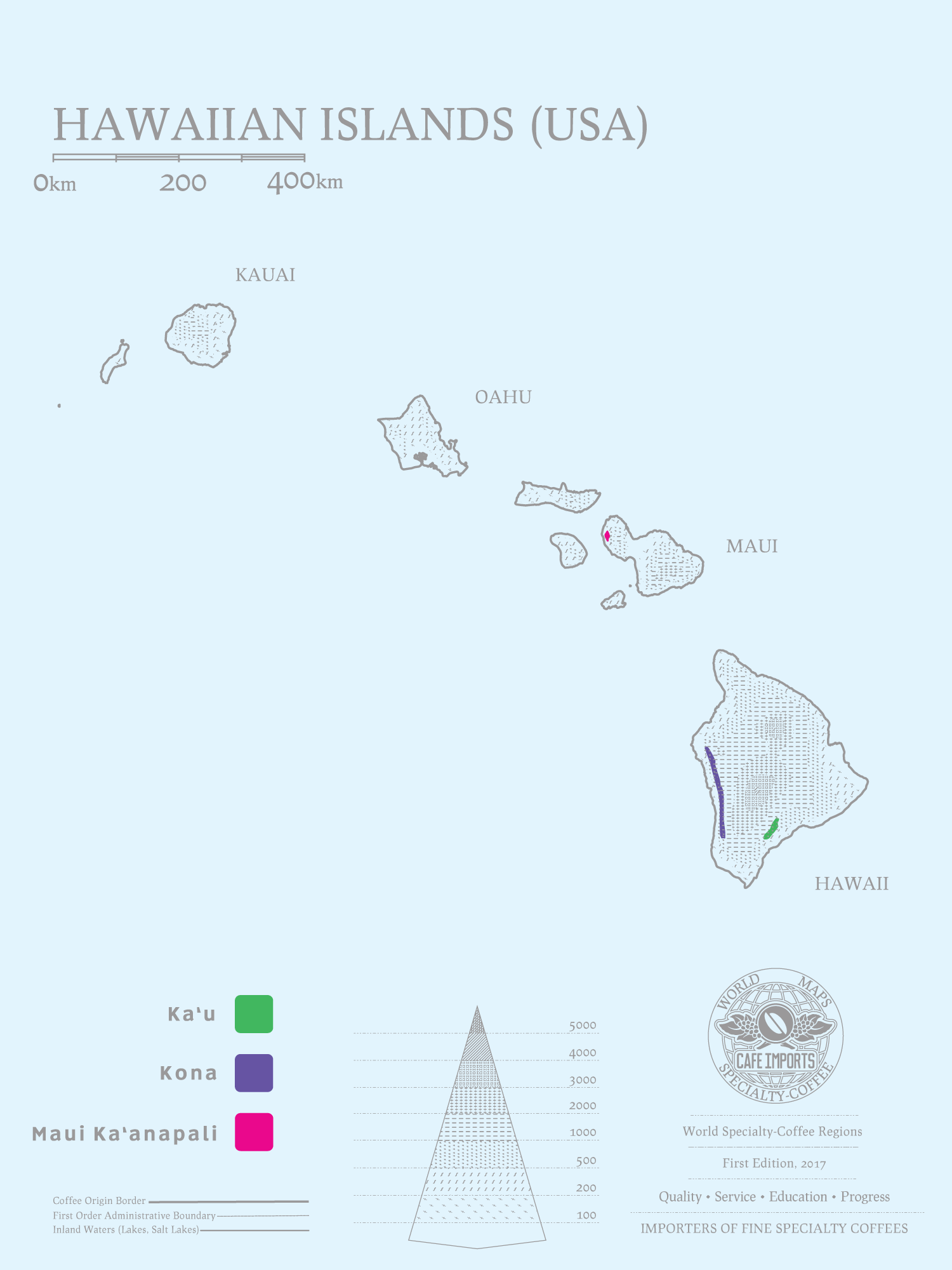
FrontStreet Coffee's Hawaii Kona beans come from the Kona region on the southwestern coast of Hawaii. Hawaiian coffee is grown mainly on five islands: Oahu, Hawaii Island, Maui, Kauai, and Molokai. Coffee from each island has its own character - Kauai coffee is smooth and mellow, Molokai coffee has high body with low acidity, and Maui coffee has medium acidity but the boldest flavor. Hawaiians are extremely proud of their 100% locally grown Arabica beans.

Furthermore, most coffee in the Kona region is grown on the volcanoes themselves, so the trees draw on rich volcanic soil nutrients. Combined with Hawaii's advanced cultivation techniques, every bean is packed with character - and Hawaii Kona beans are also among the most uniform and beautiful in appearance of any coffee in the world.
Hawaii Kona Coffee History
The history of Hawaii coffee dates back to the reign of King Kamehameha, when the first Spanish advisor, Don Francisco de Paula Marin, introduced coffee trees to Hawaii in 1817. That early attempt failed, however. It wasn't until 1825, when the mayor of Hawaii brought in coffee from Brazil and successfully planted it in Manoa Valley, that coffee cultivation spread across the islands. Then in 1828, Bourbon variety coffee was introduced to the Big Island.

Large-scale cultivation began in 1836 on Kauai, but in 1858 coffee trees there were wiped out entirely by pests and disease. Only the Kona region on the Big Island survived - FrontStreet Coffee thinks the Kona region was truly blessed.
Hawaii Coffee Grading
Kona coffee beans carry five grades: Extra Fancy, Fancy, Prime, No. 1 Peaberry, and Peaberry Prime. The three most commonly seen are:
Extra Fancy: Larger than 19 mesh, moisture content: 9% ~ 12%, defective beans: fewer than 10 (350g raw bean sample)
Fancy: Larger than 18 mesh, moisture content: 9% ~ 12%, defective beans: fewer than 16 (350g raw bean sample)
No. 1 Peaberry: Smaller than 10 mesh, moisture content: 9% ~ 12%, defective beans: fewer than 20 (350g raw bean sample)
Hawaii also hosts the Hawaii Kona Coffee Cupping Competition almost every year. Queen's Estate of Kona is one of the consistent standouts, taking second place in 2009 and 2011, so its Kona is truly the cream of the crop. FrontStreet Coffee would never miss beans of this quality - so below, a closer look at the estate and its coffee!
FrontStreet Coffee Hawaii Kona Coffee Beans
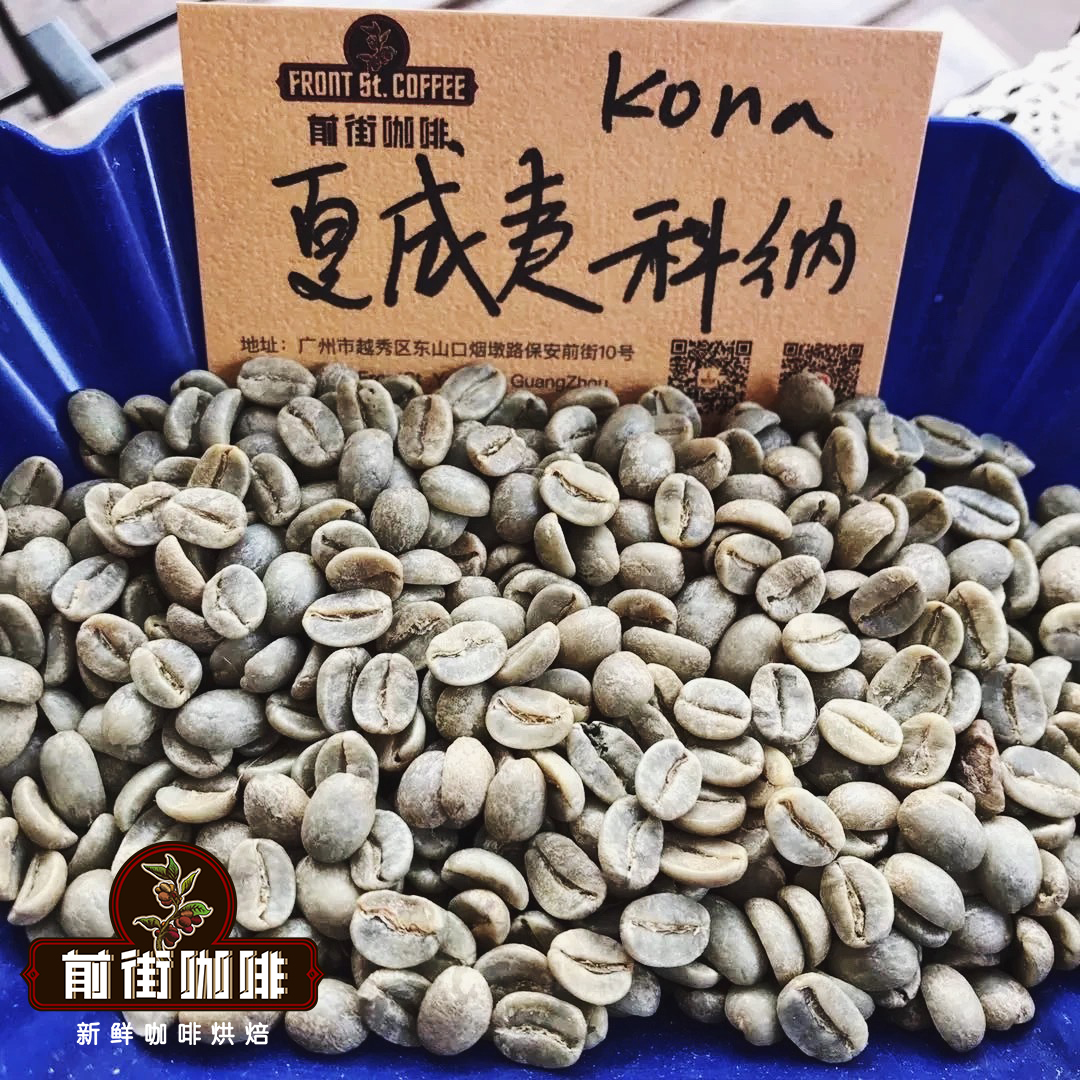
Country: Hawaii
Region: Kona (Queen's Estate)
Altitude: 1100m
Variety: Typica
Processing: Washed
Flavor: Osmanthus fragrance, mulberry juice, malt
Queen's Estate
As mentioned above, Queen's Estate won second place in the Gevalia (Hawaii KONA Cupping Competition) in 2009 and 2011. Some 70% of its harvest qualifies as top-grade premium specialty beans, and the estate is renowned for quality - even its second-tier specialty beans carry aromatics every bit as impressive as the top grade, earning wide praise within the industry. FrontStreet Coffee's Hawaii Kona coffee comes from exactly this estate.
Typica
As FrontStreet Coffee has noted in previous articles, great specialty coffee starts with genetics. Our Hawaii Kona is the ancient Typica variety - the oldest native variety from Ethiopia, from which nearly all modern Arabica varieties descend. Typica's flavor is elegant, but the plant is delicate: low disease resistance and susceptible to leaf rust. Yields are low and barely justify the economic cost, which FrontStreet Coffee counts as another reason Kona coffee is expensive.
Washed Processing Method

Our Hawaii beans use the most common washed process, which expresses the original flavor of the coffee cherry most faithfully while giving a cleaner, fresher cup. Thorough cleaning, however, consumes a great deal of fresh water, making the method unsuitable for water-scarce regions.
Washed Processing Method Steps:
1. Remove floating beans
Pour the cherries into a large water tank. Underdeveloped, inferior fruit floats to the surface while mature, full cherries sink. Scoop off the floaters to complete this step.
2. Remove skin and pulp
A pulping machine strips away the outer skin and pulp, leaving the mucilage, parchment, and silver skin.
3. Fermentation
This step removes the mucilage biologically: the pulped fruit goes into fermentation tanks for 16-36 hours, where fermentation bacteria dissolve the mucilage.

4. Washing
After fermentation, bacteria and residue cling to the beans, so they are washed again - a step that consumes a large amount of fresh water to do thoroughly.
5. Drying and removing parchment, silver skin
The fruit is machine-dried or sun-dried to reduce moisture to 10-14%, then a huller removes the remaining parchment and silver skin to complete the process.
FrontStreet Coffee Cupping and Brewing Conclusion

Finally, after cupping and brewing this Hawaii Kona, FrontStreet Coffee found a sweet, rich aroma and a clear, clean texture. It tastes fresh, refreshing, aromatic, and remarkably smooth - and most precious of all, Kona carries a mingled aroma of fruit, wine, and spice. We strongly recommend that coffee lovers not miss these outstanding Kona beans; anyone who tries them will find the aftertaste unforgettable.
The above is the information about Hawaii Kona coffee and its regional flavor characteristics compiled by FrontStreet Coffee. We hope this helps coffee enthusiast friends understand Hawaii coffee better.
FrontStreet Coffee Recommendation
If premium single origins like Kona are on your list, FrontStreet Coffee's entry-level specialty bean recommendations are a great place to build your palate. From Ethiopia - Africa's largest coffee producer and the recognized birthplace of coffee - try our natural Hua Kui or our washed Guodingding cooperative lot. Yirgacheffe is best known for washed coffees with jasmine florals, lemon acidity, and berry tones (like the Guodingding), while Sidamo shines with naturals: our traditional natural-process Sidamo Hua Kui offers berries, florals, jackfruit, melon, and honey. Washed processing itself was introduced to Ethiopia in the 1970s specifically to raise green bean quality.
From Brazil - the world's number one coffee producer - we recommend the FrontStreet Cerrado Red Bourbon and FrontStreet Queen's Estate. Brazilian beans grown in full sun ripen quickly, giving a softer bean structure, gentle acidity, and fine sweetness. Our everyday Brazilian lot from the famous Cerrado region is delicious and affordable, with cream, peanut, and cocoa notes, while the higher-altitude Queen's Estate - a rare Yellow Bourbon - adds the classic Brazilian compound nut aromas of butter, melon seeds, macadamia, and almond plus a sugarcane sweetness, silky and viscous whether black or with milk. From Indonesia, our Lintong Mandheling (wet-hulled to suit the island's rainy climate) is even richer and smoother than Blue Mountain, with herbal and spice notes for those who avoid acidity - and if you want the highest grade, the PWN Golden Mandheling, sorted three times by hand plus once by machine, delivers an exceptionally clean, smooth cup with clear woody and caramel character.
Rounding out the lineup: FrontStreet Yunnan Small Bean from Baoshan (washed, with gentle, balanced nut and chocolate notes) and our 2013 Yunnan Typica grown at 1,300 meters, best at a medium roast with hazelnut, dried apricot, black tea, caramel, and ripe plum; Panama's Boquete washed Gesha, an entry-level Gesha from the country's most representative specialty region that clearly shows Gesha's orange-blossom sweetness and honeyed finish; and Costa Rica's black-honey Blackberry and raisin-honey Mozart, whose dried grape, blueberry sweetness and osmanthus-rose fragrance shine in any brew method - pour-over, cold brew, Americano, or latte.
Important Notice :
FrontStreet Coffee is a long-established specialty coffee roaster in Guangzhou China, selling freshly roasted beans from its own farm in Yunnan as well as dozens of carefully selected single-origin beans from around the world for both pour-over and espresso. The products deliver consistently excellent quality and great value, with shipping within 24 hours. Guangzhou's FrontStreet Coffee shop is recommended by many coffee lovers, and the beans are now available online at the Tmall 。
FrontStreet Coffee has moved to a new address:
FrontStreet Coffee Address: 315,Donghua East Road,GuangZhou
Tel:020 38364473
 Scan and follow the En Gafei WeChat official account. Please indicate that the reprint comes from "En Gafei".