Honey Process Coffee Bean Flavor Profile: How to Brew Costa Rican Coffee Beans for the Best Taste

Costa Rican coffee is unforgettable for its honeyed sweetness. Customers visiting FrontStreet Coffee often ask the baristas for a sweet pour-over, and the answer usually begins with Costa Rica. Why is Costa Rican coffee sweet as honey? In this article, FrontStreet Coffee takes a close look at its Costa Rican beans.
Costa Rican Growing Regions
Costa Rica, in Central America, was the first country in the region to cultivate coffee, and it has a long history of doing so. The volcanic soil is extremely fertile and well drained, especially on the Central Plateau at 1200-1600 meters, where harvest runs from November to March. The Central Plateau contains three sub-regions - San Jose, Heredia, and Alajuela - and three high volcanoes, Irazu, Barva, and Poas, feed the surrounding coffee land with abundant nutrients. The excellent microclimate combined with two distinct volcanic soils gives beans here their signature traits: chocolate-cocoa flavors, bright fruit acidity, and elegant aromatics.
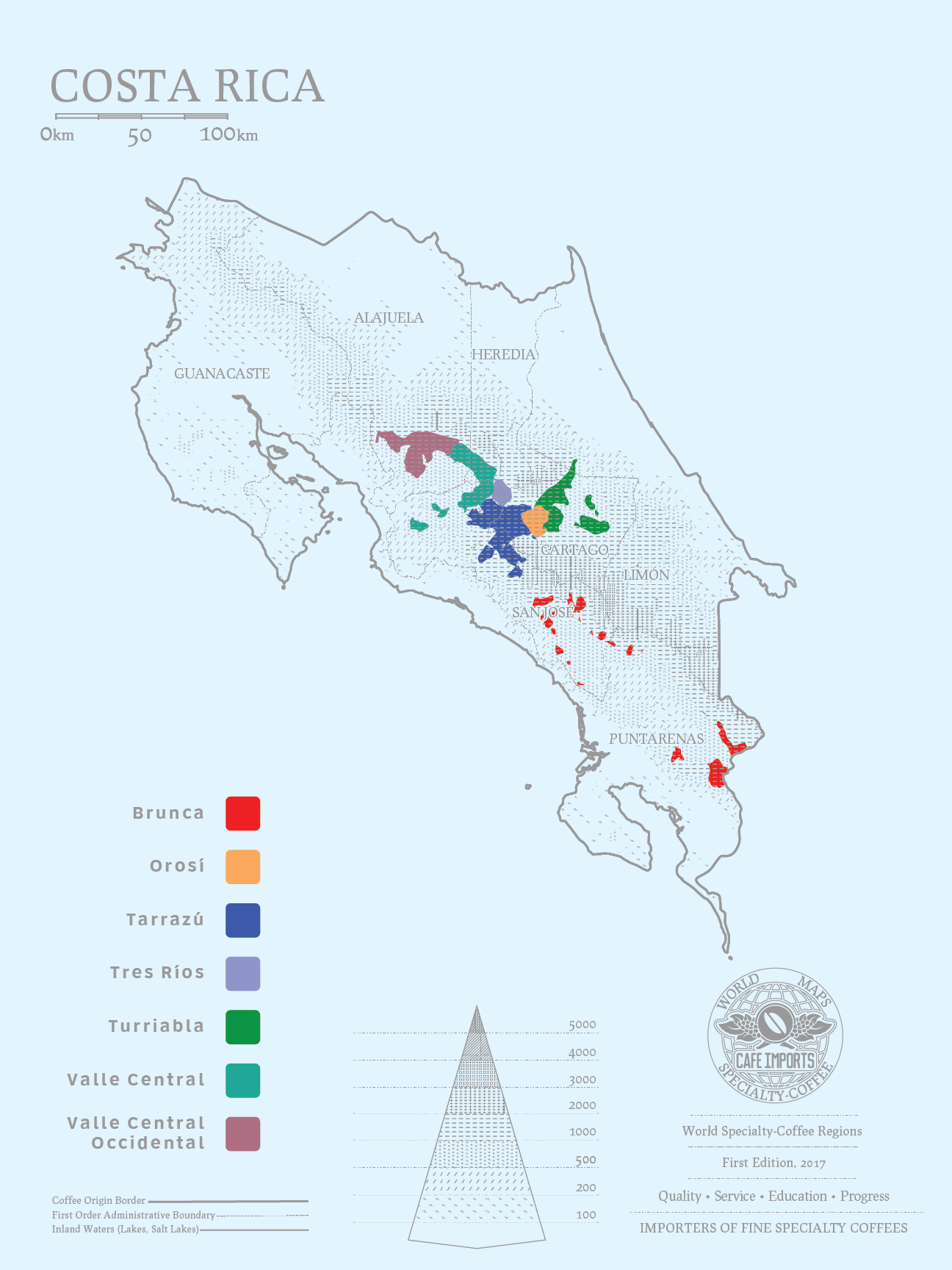
Costa Rica has eight major coffee growing regions, including the Western Valley, Central Valley, Tarrazu, Tres Rios, Orosi, Brunca, and Turrialba. Most Costa Rican specialty coffee comes from Tarrazu.
Tarrazu lies south of the capital, San Jose, and is among the most prized growing areas in the country. "La Minita Tarrazu" is a famous local product, with output capped at roughly 72,600 kilograms per year. It is grown on land called La Minita, owned by the British McAlpine family for three generations; the La Minita estate in Tarrazu produces only about 160,000 pounds annually. In fact, this land could yield more than 450 tons of coffee a year, but La Minita Tarrazu is grown without artificial fertilizers or pesticides, and all harvesting and sorting is done by hand - precisely to avoid the damage that air-jet sorting can inflict on the beans.

Costa Rican coffee has long been celebrated for its balance, rich chocolate, and smooth texture. FrontStreet Coffee finds Tarrazu beans full and dense, with a heavy body, smooth mouthfeel, rich chocolate and nut aromas, moderate acidity, and an enticing fragrance.
A Costa Rican Icon: FrontStreet Coffee Costa Rica Mirasu Estate "Strawberry Candy" Geisha Blend

- Country: Costa Rica
- Estate: Mirasu Estate
- Altitude: 1700m
- Processing: Raisin Honey Process
- Varieties: Geisha, ET47, SL28, MAICO
Mirasu Estate, Costa Rica
Mirasu is a very small estate run entirely by Esteban Sanches and his family. Sanches was originally part of the family at the neighboring Vela Blanca estate; driven by his devotion to coffee, he founded Mirasu. The small wet-mill machines at his processing plant were designed and assembled by Sanches himself.

Walking through the coffee garden, Sanches explains that quality starts with the trees. Machines can sort good beans from bad, he says, but if everything you grow is good, there is nothing for the machine to separate. "God gave us a beautiful environment, and we care for the coffee with love - that is giving back, and sharing." He is grateful to everyone who helped him realize his dream, and he happily shares his experience with other farmers so that their coffee dreams can come true too.
Coffee Bean Varieties
FrontStreet Coffee's current lot of the Costa Rica Strawberry Candy Geisha Blend consists of 50% Geisha and 50% mixed ET47, SL28, and MAICO varieties, all from the same estate and blended into this single lot.

It is worth dwelling on ET47 and SL28. ET47 is an Ethiopian landrace variety: in the 1990s, the Costa Rican Coffee Research Institute introduced many varieties as research material for rust resistance and handed them to farmers in Tarrazu for cultivation. SL28 was originally selected to produce large quantities of high-quality beans while resisting pests and disease - though in some regions yield was the main criterion, with disease resistance secondary. Thanks to its Bourbon genetics, SL28 never quite delivered the expected yields, but its copper-colored leaves and broad beans carry wonderful sweetness, balance, and complexity, with prominent citrus and dark-plum character.
Is the Strawberry Candy Geisha Blend Still Single Origin?
FrontStreet Coffee says yes, without hesitation. Every variety in this coffee comes from Mirasu Estate - one single origin - so it is single-origin coffee. Here is the reasoning: Ethiopian varieties are famously complex, and local trees are essentially harvested together as a mixed lot, which is why Ethiopian beans vary so much in size. As long as the beans come from one producing area, whether a single variety or a mix, the coffee is single origin. Ethiopian coffee is a natural blend, while the Strawberry Candy Geisha Blend is a deliberate, post-harvest blend.

Processing Method
The Raisin Honey Process retains 100% of the mucilage and uses zero water, which makes it one of the hardest honeys to pull off - strict timing is everything. On harvest day, the cherries are poured into large water tanks: ripe, dense fruit sinks, while underdeveloped or overripe fruit floats and must be skimmed off. The selected cherries dry on raised beds for at least three days; the cherry skin is then removed and the beans dry further with all the mucilage still attached.

At this stage, weather is the deciding factor. The cherries must be turned constantly to dry evenly, yet the turning frequency has to be tuned so they dry slowly enough to ferment properly - but not so slowly that they over-ferment. FrontStreet Coffee finds that this intensely sweet raisin honey method gives the coffee a white-wine texture, balanced acidity, and rich fermentation aromatics.
FrontStreet Coffee Green Bean Analysis
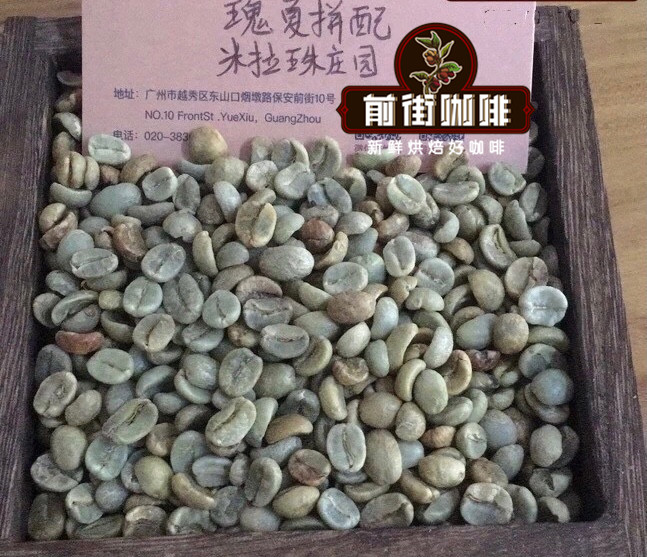
The lot FrontStreet Coffee purchased is 50% Geisha with the balance in ET47, SL28, and MAICO. The Geisha contributes jasmine florals, while the other varieties bring richer strawberry and berry flavors. The raisin honey process heightens the coffee's sweetness, and FrontStreet Coffee's roasters chose a medium-light roast to showcase both the florals and the fermented sweetness.
FrontStreet Coffee Roasting Recommendations
Yangjia 800N semi-direct-flame roaster, 300g batch.
Preheat the roaster to 200 degrees C, then drop to 175 degrees C for charging. Set heat to 120 with the damper at 3; turning point at 1'32", then hold the heat. At 114 degrees C keep the heat unchanged and open the damper to 4. At 6'15" the beans turn yellow, the grassy aroma fades, and the drying stage ends; at 140 degrees C reduce the heat to 100 and keep the damper at 4. At 9'00" drying is complete - the bean surface shows wrinkles and dark markings, the toast aroma gives way to coffee aroma, and first crack is imminent, so listen closely. First crack begins at 10'25"; open the damper fully to 5 and leave the heat unchanged. Develop 1'30" past first crack and drop the batch at 193.5 degrees C.
FrontStreet Coffee Cupping Report
FrontStreet Coffee cups samples within 8-24 hours of roasting. The baristas use 200ml ceramic cupping bowls marked at 150ml and 200ml. Following SCAA standards, the water TDS is around 150ppm - TDS that is too low encourages over-extraction, while TDS that is too high muddies the texture and can cause under-extraction. Cupping water temperature is 94 degrees C. The grind follows SCAA cupping standards, with 70%-75% of particles passing a #20 standard sieve (0.85mm). The ratio is 11g of coffee to 200ml of hot water - 1:18.18 - putting extraction strength within the Golden Cup range of 1.15%-1.35%. Steeping time: 4 minutes.

- Dry aroma: dried fruit, berries
- Wet aroma: florals, berries
- Flavor: raisins, berries, nuts, creamy texture
FrontStreet Coffee Brewing Tips
- Water temperature: 90-91 degrees C
- Grind size: EK43s at setting 10 (fine-sugar texture)
- Coffee-to-water ratio: 1:15
- Coffee dose: 15g
*On grind size: FrontStreet Coffee calibrates by sieving. Following the SCA's pour-over grind guidelines and verifying in practice, FrontStreet has brewed this coffee at different grind settings and found the results differ significantly - and every coffee has its own ideal setting. That is exactly why sieving matters. If you don't own a sieve at home, judge by flow rate instead: water running too fast means the grind is too coarse; running too slowly means it is too fine.

FrontStreet's brew: pour 30g of water for a 30-second bloom, then pour to 95g (scale reading around 125g) over about 1 minute. Once the water level drops to two-thirds of the coffee bed, pour the remaining 100g (scale reading around 225g) over about 1 minute 40 seconds. Let the drawdown finish between 1'55" and 2'00", remove the cone, and the extraction is complete.

In the cup: jasmine florals up front, strawberry and raisin on entry, a finish of strawberry candy and nuts, and a creamy texture throughout.
FrontStreet Coffee Recommendation
If the raisin-honey sweetness of the Strawberry Candy blend wins you over, the V60 is the ideal companion for this style of coffee: its 60-degree cone and single large opening favor fast, even extraction, which brings out florals, bright fruit acidity, and delicate sweetness rather than heavy roast tones.
- FrontStreet Mozart (Musician Series) - another Costa Rican raisin-honey coffee. The slow fermentation of the raisin honey process gives it the sweetness of Kyoho grapes plus distinct pineapple and osmanthus aromatics; at a medium-light roast it shows intense raisin, rose, and fermented wine-like flavors. A natural next step from Strawberry Candy.
- FrontStreet Yirgacheffe Guodingding - a classic washed Ethiopian for V60 brewing, with vivid citrus, berries, and florals and a green-tea-like sweet finish. Its gentle, bright acidity makes it one of the easiest coffees to love, and it is a bargain for daily brewing.
Brew both at 1:15 with water around 90-91 degrees C, just as you would the Strawberry Candy, and the same technique will translate directly.
Important Notice :
FrontStreet Coffee is a long-established specialty coffee roaster in Guangzhou China, selling freshly roasted beans from its own farm in Yunnan as well as dozens of carefully selected single-origin beans from around the world for both pour-over and espresso. The products deliver consistently excellent quality and great value, with shipping within 24 hours. Guangzhou's FrontStreet Coffee shop is recommended by many coffee lovers, and the beans are now available online at the Tmall 。
FrontStreet Coffee has moved to a new address:
FrontStreet Coffee Address: 315,Donghua East Road,GuangZhou
Tel:020 38364473
 Scan and follow the En Gafei WeChat official account. Please indicate that the reprint comes from "En Gafei".