Ethiopian Coffee Story: Which Brand of Ethiopian Coffee Beans is Best
The Rich Coffee Heritage of Ethiopia

Ethiopia is Africa's largest coffee-producing nation, yet only 60% of its beans go to export; the rest is used for ceremonial purposes. At weddings, for instance, people combine beans and coffee pulp with honey and various herbs to make remedies for warding off bad luck. Coffee is woven into daily life here. FrontStreet Coffee's Ethiopian Yirgacheffe is widely treated as shorthand for Ethiopian specialty coffee, and among FrontStreet Coffee's everyday beans there is a washed Yirgacheffe that captures the most typical flavor profile of the Yirgacheffe region. The everyday series exists both to showcase the fundamental characteristics of a growing region and build recognition, and to offer a high-quality, cost-effective option.
In 2003 Starbucks introduced its Commitment to Origins (CTO) program and launched "Fair Trade Coffee," making care for coffee farmers a central part of its brand image. The reality was rather different.
Starbucks made much of Ethiopia as the birthplace of coffee. From March 2006, the Ethiopian government began applying to the United States Patent and Trademark Office to register geographic trademarks for three Ethiopian coffee origins - Sidamo, Harar and Yirgacheffe - hoping to gain more control over how its coffee was marketed and promoted, and to secure better prices for farmers. Starbucks and other coffee retail giants opposed the move.
Ethiopian farmers received only seventy-five cents per pound when selling beans to Starbucks, while Starbucks sold them for thirteen dollars per pound - a price gap of thirty-four times.
The Legal Battle Between Ethiopia and Starbucks
To grow Ethiopia's coffee export revenue and improve the lives of the fifteen million people working in the industry, the Ethiopian government launched the Fine Coffee Trade Marking and Licensing Initiative. A crucial step was securing trademark protection for the country's specialty coffee varieties. Starbucks initially denied every accusation, arguing that registering trademarks was not the best way to help farmers and proposing instead a regional certification system similar to France's model for quality wines. On May 9, 2007, however, the American coffee chain signed an agreement with the Ethiopian government, undertaking to respect Ethiopia's trademark rights for its distinctive coffee varieties on Starbucks product labels and ending their long-running dispute.

The success of this trademark case is expected to help lift thousands of Ethiopian coffee-farming families out of poverty, so that their children can go to school and receive better healthcare.
FrontStreet Coffee has observed that Starbucks roasts almost all of its beans to a medium level. Ethiopian coffee is defined above all by floral and citrus notes, and a medium roast masks those original flavors. FrontStreet Coffee has recently sourced beans from a range of growing regions, Ethiopia among them, for cupping and evaluation. Cupping has always been part of the work here. FrontStreet Coffee's aim was never simply to sell beans but to taste coffee from around the world - to understand every growing region, the different varieties within a region, and the different ways the same variety is processed, building databases accordingly and drawing comparisons between regions. The hope is to help more coffee lovers understand the world of coffee.

Coffee Cultivation in Ethiopia
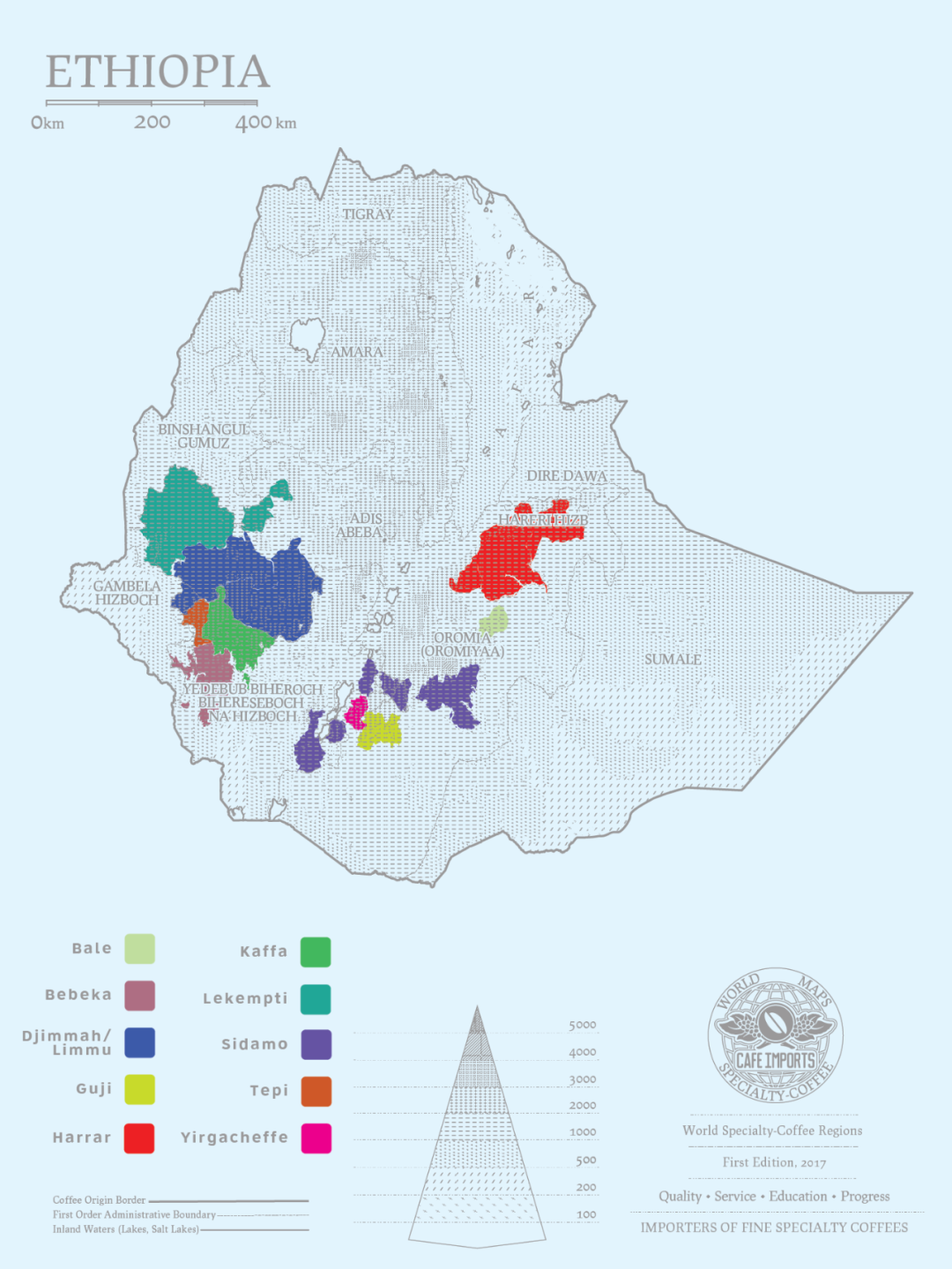
Around 1995 Ethiopia redrew its administrative regions, with major consequences for coffee-growing areas. The former Sidamo province was split into the new Sidama region (a small portion) and largely folded into the Oromia region. Yirgacheffe, which had belonged to Sidamo province, was placed in the new Gedeo zone. As a result, Ethiopian coffees on the market may appear under either the old or the new regional names. Here we follow the new divisions to map Ethiopia's coffee cultivation.

Ethiopian coffee is grown mainly in the west and the south, with smallholder family farms accounting for 90% of total cultivation. Nearly 1.2 million smallholder families depend on coffee for their livelihood. Each farm cultivates less than 4 hectares, at an average altitude of 1,000-2,300 meters, with a planting density of 1,000-1,800 trees per hectare and an output of roughly 600kg per hectare.
By scale and pattern, Ethiopian coffee cultivation falls into four categories:
- Forest Coffee (8-10%): coffee trees grow alongside other crops in natural forest with no artificial management; farmers harvest the cherries regularly.
- Semi-Forest Coffee (30-35%): cultivation areas sit between the forest and where farmers live. The trees are the same natural varieties as forest coffee, but farmers manage the plots and plant other cash crops.
- Garden Coffee (50-55%): trees are planted around the places where farmers live and are mostly tended by the farmers themselves.
- Plantation Coffee (5-6%): large private growers with more processing facilities and production capacity.
Ethiopia's Nine Major Coffee Growing Regions
1. Yirgacheffe (Specialty Region): Altitude 1,800-2,000 meters (Garden Coffee System)
Yirgacheffe belongs to the Sidamo region but was separated out for its unique flavor. Besides the town of Yirgacheffe itself, it also takes in three sub-regions: Wenago, Kochere and Gelena/Abaya. In the new Yirgacheffe grading system, Yirgacheffe A, Wenago A, Kochere A and Gelena/Abaya A therefore command higher prices than their B-grade equivalents.
So-called Yirgacheffe flavor means rich jasmine fragrance, lemon aroma, peach and almond sweetness and tea notes. FrontStreet Coffee finds "a hundred flowers blooming" the most fitting description.
Yirgacheffe traditionally used the oldest natural processing. In 1972, however, Ethiopia introduced washed processing technology from Central and South America to improve quality, which made the region's jasmine fragrance and citrus notes clearer and brighter. FrontStreet Coffee holds that the fundamental difference between washed and natural processing is this: washed processing presents the coffee's basic flavors and reflects the growing region directly, while natural processing adds sweetness and fermentation notes on top of those basics.
Thanks to washed processing, Yirgacheffe quickly became representative of world specialty coffee. After the 1970s the region concentrated on washing and became Ethiopia's most popular washed-bean region. In the 21st century, natural processing has gradually improved and now regularly produces impressive beans. Credit goes to the Yirgacheffe coffee trader Bagoch, who missed the traditional natural flavors and did not want to see the method displaced by washing. He refined natural processing, improved flavors and reduced defect rates, and introduced three extremely famous Yirgacheffe naturals: Idido Misty Valley, Beloya and Aricha.

Beyond washed and natural, there are other methods such as red honey and anaerobic. FrontStreet Coffee has cupped a FrontStreet red honey Yirgacheffe that keeps the basic flavor profile while adding complexity: compared with FrontStreet's natural Yirgacheffe it has a lighter body, and compared with FrontStreet's washed Yirgacheffe a fuller one.

2. Sidamo (Specialty Region): Altitude 1,400-2,200 meters (Garden Coffee System)
A fine washed or natural Sidamo usually has noticeable sweetness, with strawberry and berry flavors that many enthusiasts favor, giving it a standing as high as Yirgacheffe's. Sidamo and Yirgacheffe share similar varieties, with medium-sized beans but also dwarf small-grain types that farmers often sell separately. Today the most notable Sidamo bean is FrontStreet Coffee's natural Flower Queen. After its debut at the Ethiopian green bean competition TOH in 2017 it made a stunning impression, breaking Geisha's monopoly in brewing competitions and becoming the only coffee capable of challenging it. Flower Queen comes from Hambela, a sub-region under the Guji zone. Like Yirgacheffe, Guji was originally part of Sidamo but became independent for its outstanding flavor; even so, people who mention Guji today still generally treat it as part of the Sidamo region.

FrontStreet Coffee's Flower Queen has now evolved to version 4.0, the original Flower Queen being folded into versions 2.0 and 3.0. FrontStreet Coffee found the flavors of those two batches very close to the original, but their body and aftertaste did not match the 2017 original. Surprisingly, FrontStreet Coffee could still identify green beans identical to the original Flower Queen batch within them. As for Flower Queen 3.1, cupping showed it to be quite different from Flower Queen and closer to Geisha flavors (not Panamanian Geisha, but similar to the Geisha profile of Geisha Village - a completely different style). FrontStreet Coffee confirmed the change with the green bean importer. It is rare to see several flavor profiles in the same bean from the same year and batch. Understanding where Flower Queen came from and how it developed after winning gives some explanation for these inconsistencies, and it is why FrontStreet Coffee keeps exploring beans from around the world: only through constant tasting can these changes be understood.

3. Limu (Specialty Region): Altitude 1,200-2,000 meters (Garden, Forest, Semi-Forest, Plantation Coffee Systems)
Production is lower, and the coffee is mostly exported to Europe and America; it is hard to find in Taiwan but very popular in Europe and America. It comes in washed, natural and semi-washed forms. Limu has noticeably lower body viscosity, and its floral and citrus notes are inferior to Yirgacheffe's and Sidamo's, but it offers grassy notes and a brown sugar aroma with bright fruit acidity.

4. Harar (Specialty Region): Altitude 1,500-2,400 meters (Garden Coffee System)
Harar uses natural processing exclusively. It is an ancient eastern city, but coffee is not grown inside the urban area. So-called Harar coffee comes from the Harar Jegol highlands of the greater Harar region. With annual rainfall of only 1,000mm, all the coffee is naturally processed. In flavor terms Harar is famous for its distinctive "mixed aromas," typical of ancient, early flavors. It stands alongside Yirgacheffe as one of the "twin stars." If Harar's defective beans are carefully sorted out, you can easily detect berry aromas with pleasant fermented mixed notes. For various reasons, however, Harar quality has been unstable in recent years and its grading system is not reliable, so cupping or tasting before purchase is essential.
5. Jimma (Commercial Bean Region): Altitude 1,350-1,850 meters (Forest/Semi-Forest System)
Jimma is the capital of the Kaffa forest, or Kaffa province, and its English spelling is chaotic - maps mostly show "jimma," while coffee burlap bags often use "Djimmah." This is Ethiopia's largest coffee-producing region, accounting for one-third of exports. The Kaffa forest is famous for original wild varieties, and Jimma is the collection center for the region's Kaffa coffee. Farmers habitually bring forest-harvested coffee to Jimma, where hundreds of varieties are mixed and sold as commercial beans, masking the flavors of many good ones. Washed specialty Jimma lacks Yirgacheffe's citrus and floral notes but has a quite clean, transparent profile similar to Central American specialty coffee. Commercial-grade specialty Jimma is common in Taiwan, and with luck you can find a high-quality, reasonably priced Jimma with a clear lemon-peel aroma, comparable to Sidamo. Overall Jimma tastes better than Brazil's commercial Santos and makes an excellent component in mid-to-low-price blends.

6. Illubabor (Commercial Bean Region): Altitude 1,350-1,850 meters (Forest/Semi-Forest Coffee System)
This region lies in western Ethiopia on the border with Sudan, making it the westernmost growing region. Its coffee genetic diversity is second only to the Kaffa forest. Beans are noticeably larger than Yirgacheffe's and Sidamo's, with lower fruit acidity, good viscosity and balanced flavor. Most coffee from here is trucked to Jimma for blending and rarely sold on its own.
7. Gimbi, Lekempti (Commercial Bean Region): Altitude 1,500-1,800 meters (Forest/Semi-Forest Coffee System)
This region produces both natural and washed beans, with varieties similar to Harar's long beans and small quantities of specialty-grade coffee popular in Europe and America. It is mostly known as "the poor man's Harar," with fruit acidity and fruit flavors superior to Illubabor's and a bright overall character.

8. Tepi, Bebeka (Commercial Bean Region): Altitude 500-1,900 meters (Garden/Forest/Semi-Forest Coffee System)
The two regions are close together, with Tepi north of Bebeka. Tepi has enterprise-managed coffee plantations and has recently promoted the garden system to raise farmer incomes, with annual production of about 3,000 tons. Both areas have wild coffee with low production but flavors distinctly different from Harar's and Yirgacheffe's. Low fruit acidity is the defining trait, making the coffee suitable for blends; both natural and washed processing are available.
9. Lake Tana Shore (Alternative Region): Altitude 1,840 meters (Forest System)
Monastery coffee: the surrounding forest yields a very small quantity, less than 10 tons a year. It is hardly a coffee region at all. The area's many Eastern Orthodox monasteries, churches, religious murals and myths create what may be the world's most "divine" coffee. European monks established local coffee cultivation, later managed by coffee communities or cooperatives in the villages around the town. There are no dedicated plantations - coffee trees grow scattered naturally through forests and gardens. During harvest, the Ethiopian Coffee Trading Corporation comes to town to buy the beans farmers have collected.
The Red Cherry Project
The so-called Red Cherry refers to the Red Cherry Project, jointly initiated by the Dutch trader Trabocca and local farmers to improve the quality of smallholder farms. Harvesting coffee cherries requires picking fully red, ripe fruit and doing so entirely by hand - those are only the most basic requirements. There are corresponding requirements for processing as well.

The Red Cherry Project is also a way of encouraging farms to invest more effort in selection, and these coffees command relatively higher prices. It is implemented mainly in Yirgacheffe, Sidamo, Bench Maji (Bonga Forest), Lekempti, Kembata, Illubabor, Harar and Limu - all regions with distinctive flavors that fully display Ethiopian coffee's character. FrontStreet Coffee notes that specialty coffee operations today essentially follow the Red Cherry approach anyway, but the exclusive term "Red Cherry Coffee" remains tied to Ethiopia. Red Cherry Project coffees carry Trabocca's mark on their burlap bags.

Ethiopian Coffee Varieties
Ethiopia has nearly 2,000 recorded coffee varieties (1,927 indigenous and 128 introduced). Cultivation does not separate varieties, so beans are harvested mixed together and sizes are noticeably uneven. Varieties are usually labeled simply as "local indigenous varieties."

FrontStreet Coffee has observed, however, that this year's COE (Cup of Excellence) in Ethiopia no longer describes varieties as "local indigenous varieties" but uses numerical designations such as 74158 and 74110, along with names like KURUME and TYPICA. FrontStreet Coffee bought the 22nd-ranked beans, a Typica variety from the West Arsi region of Sidamo. The region's reputation does not yet match Yirgacheffe's or Guji's, but of the 28 award-winning beans at this year's COE, 9 came from West Arsi.
Ethiopian Coffee Bean Processing Methods
Ethiopian coffee processing is dominated by the natural and washed methods, with washing taking the larger share. The biggest difference between them lies in what happens to the pulp. In washed processing, ripe cherries are selected and then skinned and pulped for washed fermentation, before drying to 12% moisture content. Natural processing skips the washed fermentation step, drying the selected ripe cherries straight to 12% moisture content before the skin and pulp are removed.
If you are trying Ethiopian beans for the first time, FrontStreet Coffee recommends starting with washed coffee: it better represents Ethiopia's original flavors - clear acidity and elegant floral and fruit notes. Natural beans build on that foundation with extra aroma concentration and sweetness.

Ethiopian Coffee Bean Grading
The ECX (Ethiopian Commodity Exchange) defines grading by defect rate: G1 and G2. G1 allows no more than 3 defective beans per 300g of green beans, while G2 allows 4-12 per 300g.
There is also flavor-based grading. G1 and G2 beans are assessed using SCA (Specialty Coffee Association) cupping methods. Beans scoring 85 points or above receive Q1 grade, while those scoring 80-84.75 points receive Q2 grade.
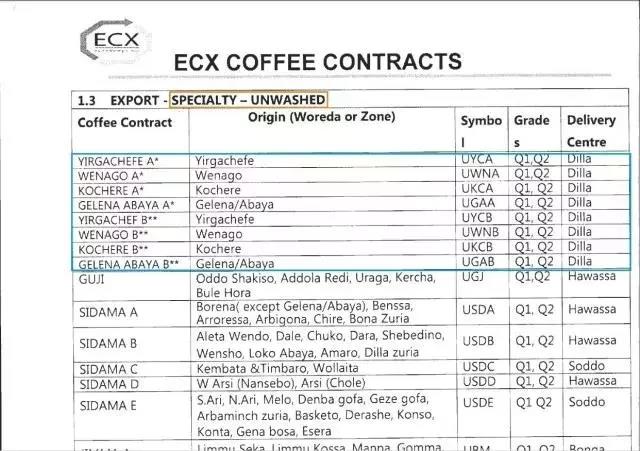
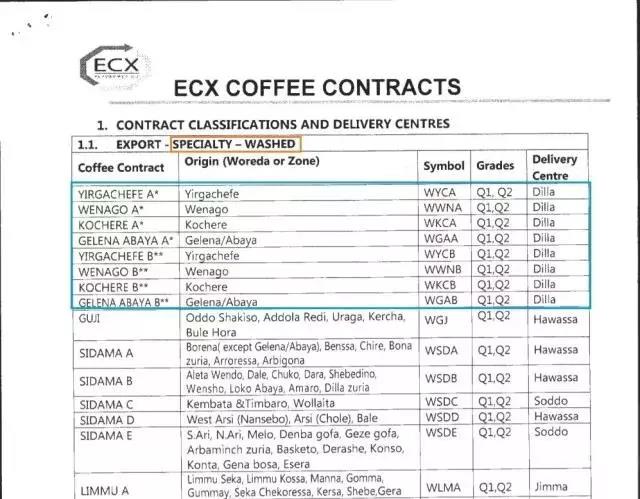
Ethiopian Yirgacheffe Coffee Beans
FrontStreet Coffee's Yirgacheffe Coffee Roasting Recommendations
The most distinctive flavors of Yirgacheffe are its refined acidity and rich floral and fruit notes. To make the most of them, FrontStreet Coffee believes a light roast is best. Whether the beans are natural or washed, light roasting maximizes their special character. Medium to dark roasted Yirgacheffe does exist on the market, slightly weakening the acidity while boosting body; the choice comes down to personal preference, though light roast remains the mainstream.

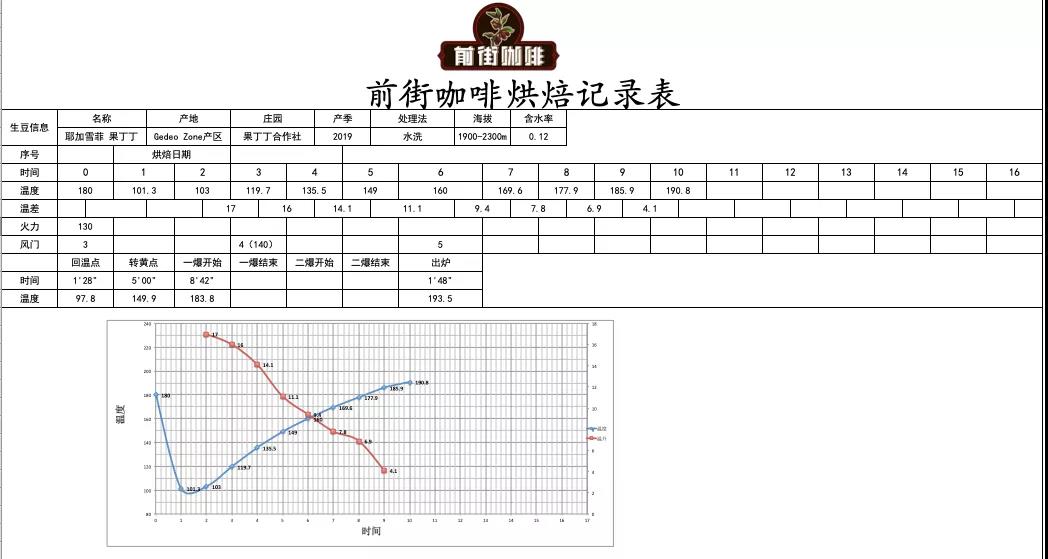
FrontStreet Coffee Washed Yirgacheffe Coffee Bean Roasting Curve

FrontStreet Coffee Natural Yirgacheffe Coffee Bean Roasting Curve
Yirgacheffe Coffee Brewing Recommendations
FrontStreet Coffee recommends a V60 dripper for light-roasted beans, with water at around 90°C, a coffee-to-water ratio of 1:15, a 15g dose, and a grind size similar to fine sugar (80% pass-through rate on a China #20 standard sieve).
FrontStreet Coffee uses a segmented pour. The bloom water is twice the coffee dose - 30g of water for 30 seconds. After blooming, pour in a small circular flow to 125g, then continue to 225g once the water level drops to just expose the coffee bed. Total extraction time is 2 minutes.

Flavor Descriptions
FrontStreet Coffee Natural Yirgacheffe Coffee: a light fermented wine aroma, rich intensity, with citrus, honey sweetness and cocoa notes, and a long aftertaste.
FrontStreet Coffee Washed Yirgacheffe Coffee: brighter, livelier acidity led by lemon, with citrus aroma, a clean cup and some black tea in the finish.
Overall, natural and washed Yirgacheffe both have fruit acidity with a pronounced juice-like quality, reminiscent of citrus fruits such as lemon and orange.
Ethiopian Sidamo Coffee Beans
FrontStreet Coffee's Sidamo Coffee Roasting Recommendations
Sidamo's roasting philosophy is in fact similar to Yirgacheffe's - both aim to highlight bright berry character, and FrontStreet Coffee believes a light roast suits it best. The example below uses FrontStreet Coffee's natural Flower Queen 4.0.
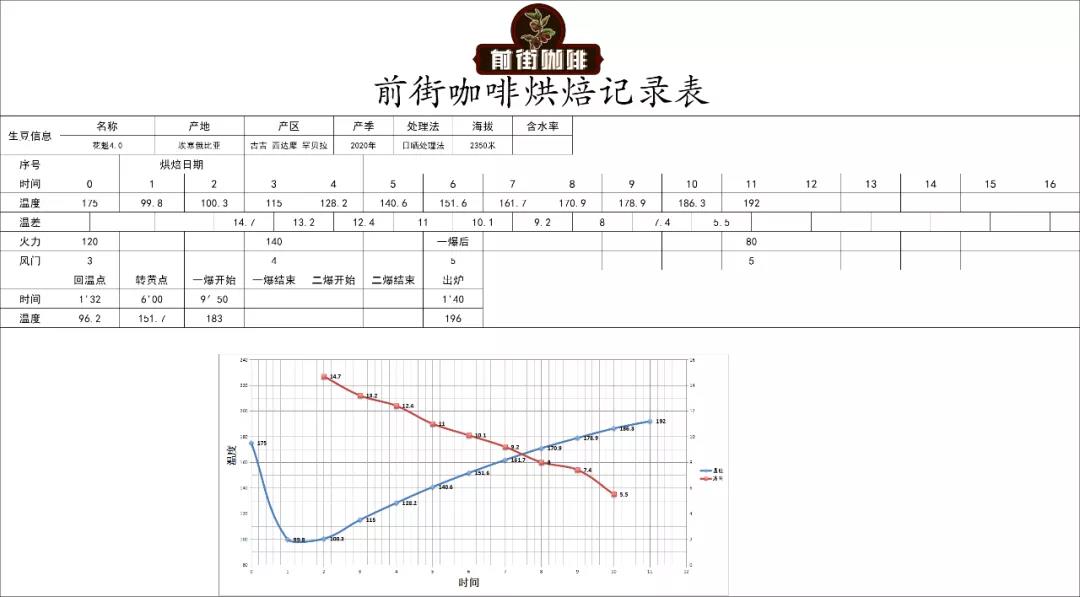
FrontStreet Coffee Sidamo Flower Queen 4.0 Coffee Bean Roasting Curve
Sidamo Coffee Brewing Recommendations
FrontStreet Coffee recommends a V60 dripper for light-roasted beans, with water at around 90°C, a coffee-to-water ratio of 1:15, a 15g dose, and a grind size similar to fine sugar (80% pass-through rate on a China #20 standard sieve).
Sharp-eyed readers will notice that the grind for this Sidamo bean differs from the Yirgacheffe above. Every bean has its own optimal grind, shaped by variety, altitude, processing method and roast. That is why, when FrontStreet Coffee receives a newly roasted bean, it first sieves it to determine the right pour-over grind.

FrontStreet Coffee uses a segmented pour. The bloom water is twice the coffee dose - 30g of water for 30 seconds. After blooming, pour in a small circular flow to 125g, then continue to 225g once the water level drops to just expose the coffee bed. Total extraction time is 2 minutes.

Flavor Description
Citrus acidity, a full berry-juice sensation, strawberry, cream and lemon black tea notes, with long-lasting sweetness.
FrontStreet Coffee Recommendation
If Ethiopia is the region you want to explore, Yirgacheffe is the natural starting point, and FrontStreet's everyday range is built around exactly that. FrontStreet Washed Yirgacheffe is the classic introduction: white jasmine, bright citrus and lemon acidity and a tea-like body, at a price that makes it many drinkers' first specialty bean. Yirgacheffe takes its name from a small town in southern Ethiopia, inside the former Sidamo province, at roughly 1700-2100 meters, with the coffee trees planted above 1800 meters - among the highest growing regions in the world. The area's misty, cool, humid climate and its thousands of coffee trees are what produce the region's signature interweaving of floral aroma and fruit acidity.
FrontStreet Yirgacheffe Gedingding goes a step further. Gedingding is a cooperative in the Woka area at the southeastern edge of Yirgacheffe, once part of the Woka cooperative under the Yirgacheffe union YCFCU, later established as a single origin in its own right as demand for traceability grew. It follows the most traditional washed processing, and the cup is clean and bright with citrus and lemon acidity and elegant white florals. For the natural side of the region, FrontStreet Yirgacheffe Natural Red Cherry selects only fully ripe, sound fruit, screens it once more at the mill and dries it on raised beds, turning the cherries every 2-3 hours over the first days to prevent uneven heat and over-fermentation; after three to five weeks the dried fruit is machine-scraped and the beans are stored. Dried with the fruit still on, it keeps the typical Yirgacheffe character while adding tropical fruit, with citrus acidity, a berry-juice body, honeyed sweetness and a creamy smoothness.
Important Notice :
FrontStreet Coffee is a long-established specialty coffee roaster in Guangzhou China, selling freshly roasted beans from its own farm in Yunnan as well as dozens of carefully selected single-origin beans from around the world for both pour-over and espresso. The products deliver consistently excellent quality and great value, with shipping within 24 hours. Guangzhou's FrontStreet Coffee shop is recommended by many coffee lovers, and the beans are now available online at the Tmall 。
FrontStreet Coffee has moved to a new address:
FrontStreet Coffee Address: 315,Donghua East Road,GuangZhou
Tel:020 38364473
 Scan and follow the En Gafei WeChat official account. Please indicate that the reprint comes from "En Gafei".