Who is Yirgacheffe Coffee Suitable For? The Correct Way to Drink Yirgacheffe - Flavor Characteristics of Natural and Washed Yirgacheffe

Yirgacheffe hardly needs an introduction among coffee lovers. Unlike the traditional coffee flavor most people grew up with, Yirgacheffe is defined by bright acidity and a clean, refreshing cup, which is exactly why it is so often the first stop for people entering specialty pour-over coffee. If you want it in milk instead, FrontStreet Coffee's in-store espresso blend—30% FrontStreet sun-dried Yirgacheffe and 70% FrontStreet Honduras Sherry—uses the Yirgacheffe to layer in soft fruit acidity while the Sherry bean supplies body and aroma.
The Yirgacheffe Coffee Region
Yirgacheffe sits on the eastern edge of the East African Rift Valley, with complex terrain and an altitude of 1800–2000m, making it one of Ethiopia's highest coffee regions. Lake Abaya lies to the west, and the area's wetland history and abundant water resources have long supplied its washing stations.

Strictly speaking, Yirgacheffe began as a small town in Ethiopia's Sidamo administrative region; it was the quality of the coffee produced there that made the name world-famous. At 1700–2100 meters, the town enjoys cool, foggy, spring-like weather year-round—an environment that could hardly be better suited to specialty coffee. Although administratively part of Sidamo, Yirgacheffe's flavor identity is so distinctive that it was eventually separated out, and today it stands as one of Africa's most renowned regions in its own right.

Washed Processing
The washed method removes impurities and defective beans at every step, so the finished green coffee looks uniform and is generally treated as premium, often fetching higher prices than naturally dried beans. That said, more process divisions mean more procedures to manage and more hygiene risk along the way—washed does not automatically mean better. FrontStreet Coffee's take: washed coffee shows more prominent acidity, better cleanliness, and a medium body, with the most consistent green quality from lot to lot.
The process itself is straightforward to describe. Selected cherries go into a pulper to strip skin and pulp; beans that still carry some mucilage ferment underwater for roughly 24 hours; after fermentation they are washed through channels to remove the remaining pulp and mucilage; then they are sun- or machine-dried to about 12% moisture, and finally hulled out of their parchment.

Natural Processing
Natural processing is the oldest method there is: cherries are dried whole, in the sun, straight after harvest. It thrives where sunshine is abundant or water is scarce—roughly 70% of Ethiopian coffee is processed this way. Compared with washed lots, FrontStreet Coffee finds naturals slightly lower in acidity, higher in sweetness, and fuller in mouthfeel, though a touch less clean; on the flavor side they bring out more berry notes and greater complexity.
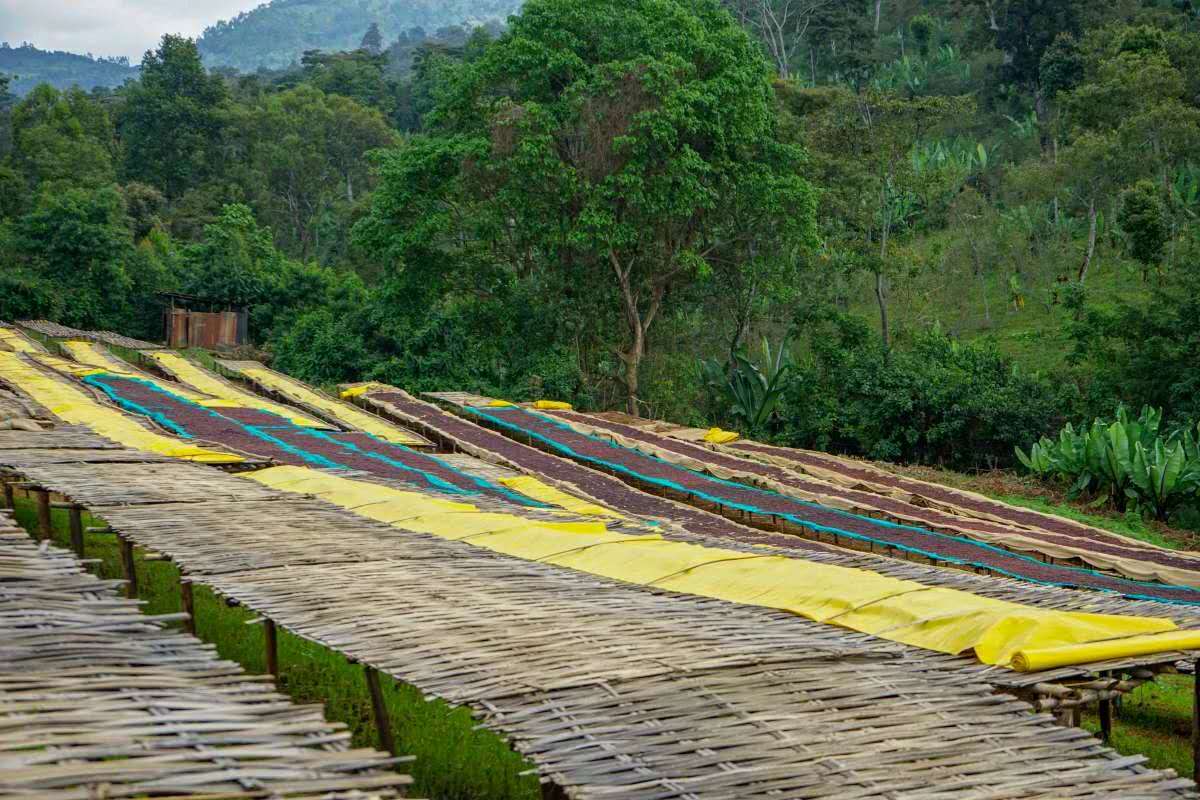
In Yirgacheffe, natural processing means hand-selecting sound cherries and drying them on raised beds with the pulp and skin intact. This labor-intensive approach keeps the fruit off the ground, preventing earthy taints and producing exceptionally clean fruit flavors. After more than two weeks of drying, the dark brown cherries are stored to rest and mature; the beans are only hulled shortly before shipping, which is why the sweetness is so pronounced.
To show what these differences mean in the cup, FrontStreet Coffee roasted, cupped, and brewed a matched pair: the natural Red Cherry and the washed Gedeb.
FrontStreet Coffee · Yirgacheffe Natural Red Cherry Coffee Beans
Region: Ethiopia Yirgacheffe
Estate: Arertelan Estate
Altitude: 1700-2200m
Variety: Local Landraces
Processing: Natural Processing
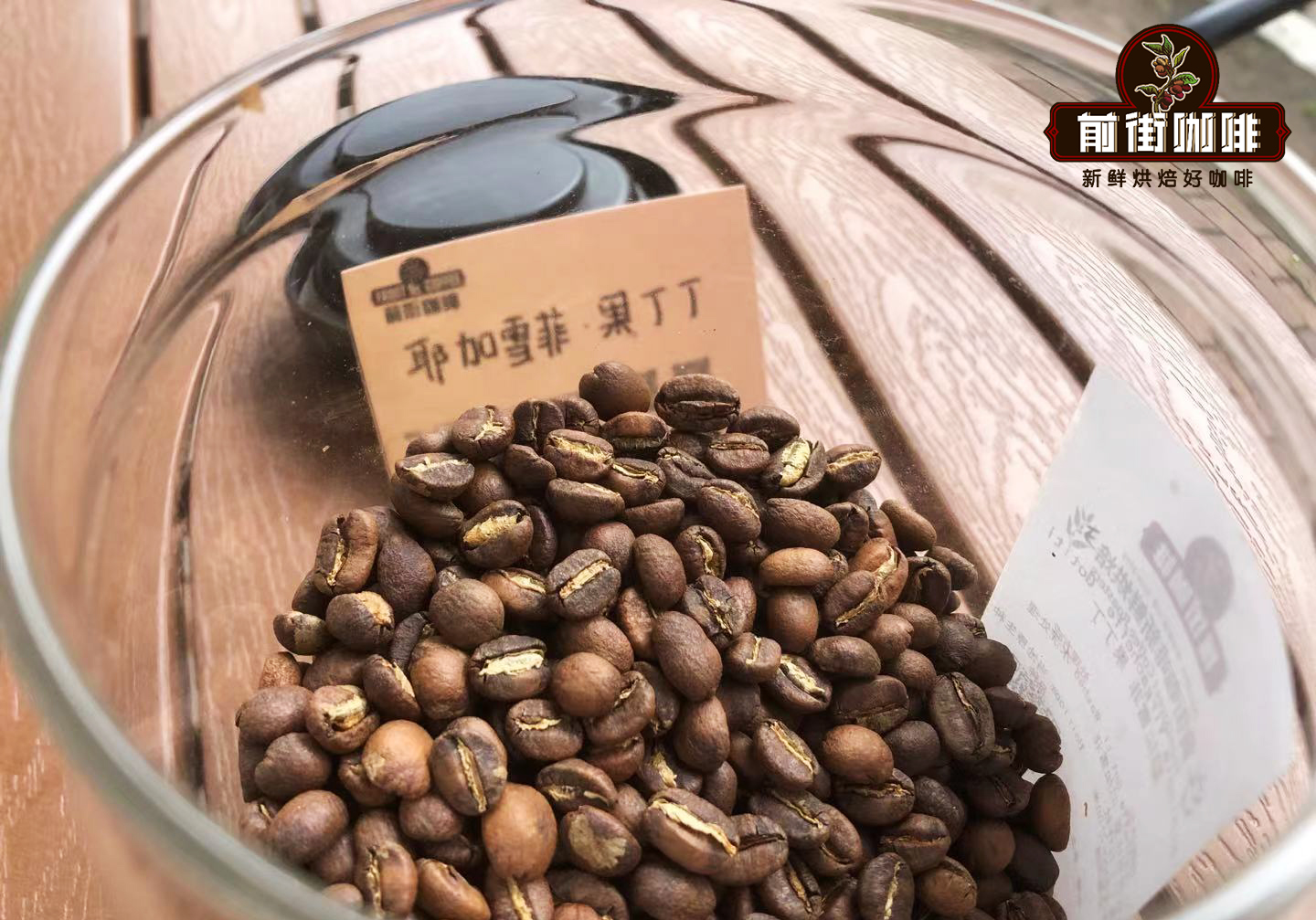
FrontStreet Coffee · Yirgacheffe Gedeb Coffee Beans
Region: Ethiopia Yirgacheffe
Producer: Gedeb Cooperative
Altitude: 2000-2100m
Variety: Local Landraces
Processing: Washed Processing
These two beans are, in FrontStreet Coffee's view, the clearest expressions of Yirgacheffe specialty coffee. The natural Red Cherry comes from the "Red Cherry Project," launched in 2007 by the Dutch green coffee trader Trabocca to raise the quality of natural-processed coffee. The washed Gedeb is the pride of the Gedeb Cooperative, which was once part of the larger Woka Cooperative until buyers from around the world spotted this dark horse and helped it build its own washing station, allowing it to split off and sell under the Gedeb name. In FrontStreet Coffee's washed Gedeb you regularly find the classic Yirgacheffe florals, clean fresh citrus, and a tea-like aftertaste.

So which is better? FrontStreet Coffee believes both processing methods have their strengths: the washed Gedeb brings a fresh, clean cup with bright acidity, while the natural Red Cherry delivers juiciness and more pronounced sweetness. Which tastes better simply depends on the drinker.
FrontStreet Coffee Raw Bean Comparison
In their raw state, natural beans look yellow-green with more silver skin, while washed beans are blue-green with very little. The reason is that prolonged soaking during washing makes the silver skin separate from the bean, so when the parchment is hulled off, most of the silver skin goes with it. Notice, too, that Yirgacheffe beans vary noticeably in size: Ethiopia, as the birthplace of Arabica coffee, still harbors many unnamed varieties, and with so much genetic diversity it is impractical to classify them finely—hence the uneven particle sizes.

FrontStreet Coffee Roasted Bean Comparison
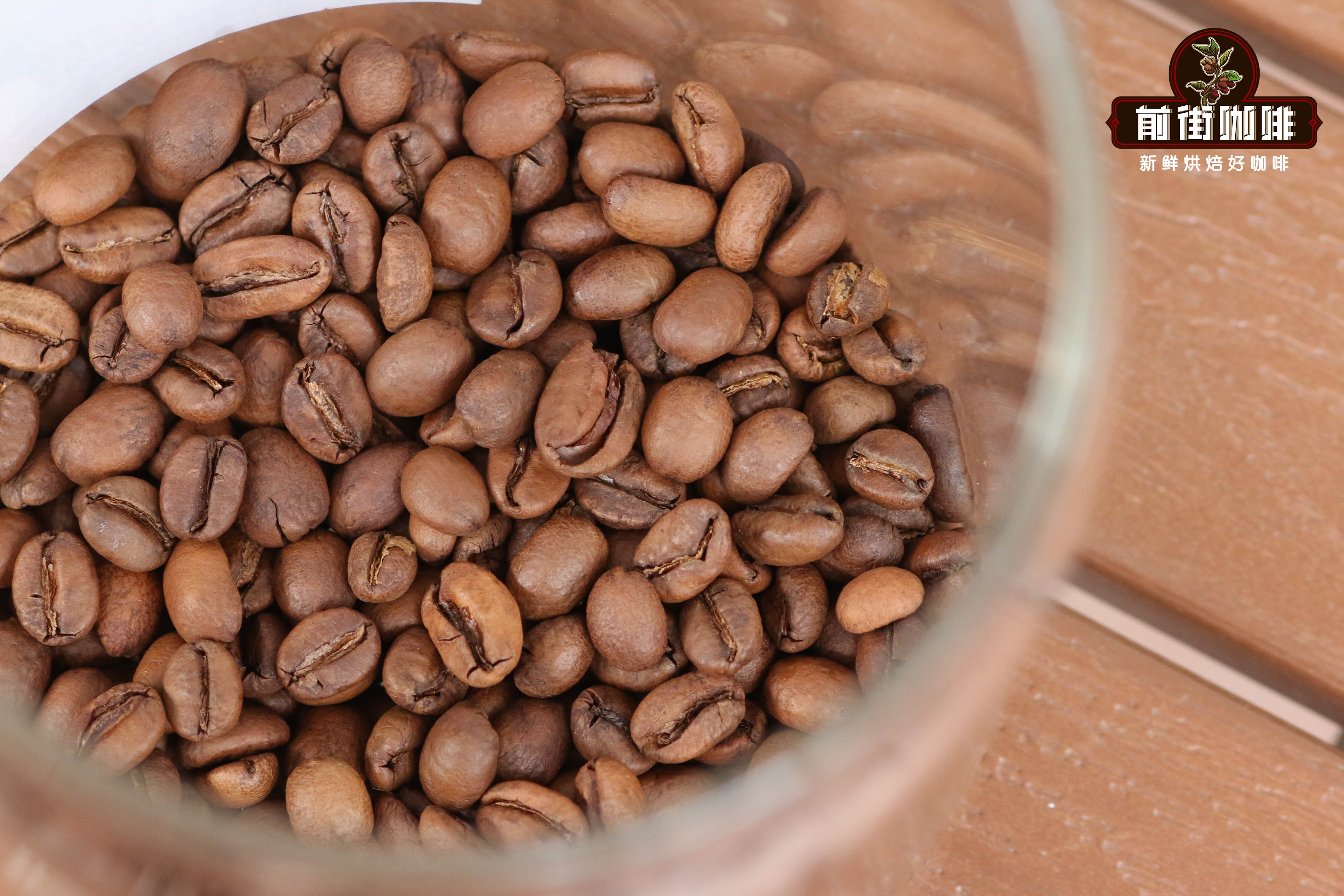
Counterintuitively, the situation flips after roasting. On washed beans the silver skin along the center crack is the hardest to remove; since almost none of the outer skin is connected, the center-line chaff stays trapped, so roasted washed beans show more silver skin. On natural beans the outer silver skin is attached in larger connected pieces, so it lifts away together with the center-line chaff, leaving the roasted beans much cleaner.

FrontStreet Coffee Roasting Recommendations
For FrontStreet Coffee's Yirgacheffe natural Red Cherry, on a Yangjia 800N with 600g batch size: preheat the drum to 200°C and open the damper to 3.5. After 1 minute, reduce heat to 160°C, keeping the damper unchanged. Adjust heat to 130°C at 148°C. Roast to 5'03''—temperature 151°C, bean surface yellow, grassy smell gone, dehydration complete. Drop the heat to 105°C and open the damper to 4. At 8 minutes, wrinkles and black spots appear on the bean surface and the toast aroma shifts clearly to coffee aroma—the prelude to first crack; listen carefully from here. First crack begins at 9'07''; reduce heat to 70°C and open the damper fully (ease off the heat gently—don't stall the crack), and drop at 194°C.

For the washed Gedeb, on a Yangjia 800N with 480g batch size: preheat to 175°C, damper at 3, heat set to 120. Charge at 1'32" with drum temperature at 140°C; hold the heat and open the damper to 4. When the beans yellow and the grassy smell disappears, they enter the drying stage. Reduce heat to 100 at 166°C and to 80 at 176°C, damper unchanged. At 8'28" the wrinkles and black spots appear and toast gives way to coffee aroma—first crack is near. It begins at 9'38"; adjust the damper to 5 (again, reduce heat carefully), then develop for 1'30'' after crack and drop at 193.5°C.
FrontStreet Coffee Cupping Report
The natural Red Cherry shows a dry aroma of strong fruit fragrance—strawberry, mango, and apricot jam among rich dried-fruit notes. The wet aroma is like sweet syrup, closer still to thick apricot nectar wrapped in rustic honey and chocolate. On entry it is not intense: medium body, almost like a fruit tea.

The washed Gedeb opens with fresh passion fruit, citrus, and berry acidity in the dry fragrance, and citrus and berries in the wet aroma. In the cup: citrus acidity, berry sweetness, almond, a tea-like sensation, and a honey-sweet finish—light body, bright acidity, clean and refreshing.
FrontStreet Coffee Brewing Recommendations
Dripper: V60 #01
Water Temperature: 91-93°C
Coffee Dose: 15g
Coffee-to-Water Ratio: 1:15
Grind Size: fine pour-over grind (80% pass-through on a #20 standard sieve)

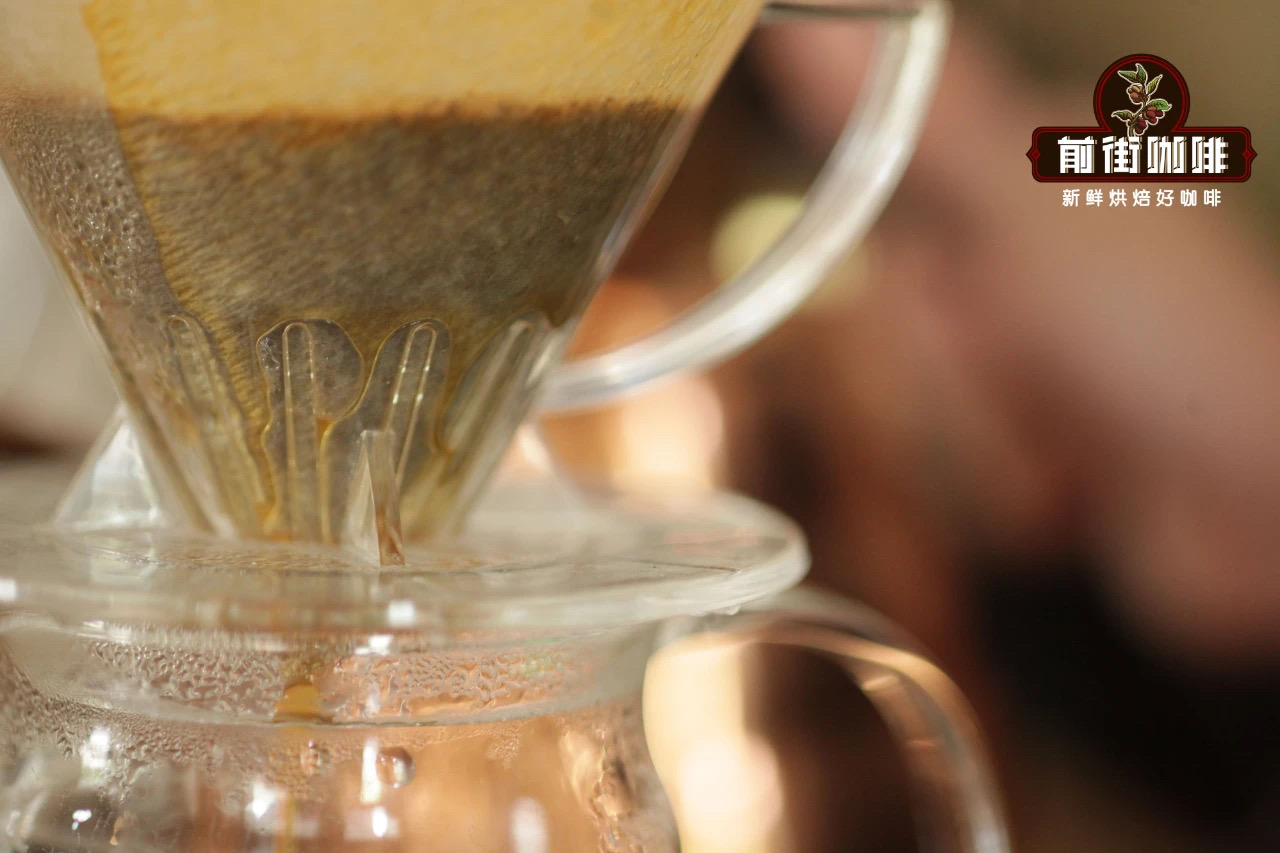
FrontStreet Coffee's brewing method: pour 30g of water for a 30-second bloom, then add 95g more (scale reads about 125g), finishing the pour within about 1 minute. When the water level drops to two-thirds of the coffee bed, pour the remaining 100g (scale reads about 225g), finishing at about 1'35". Dripping completes around 2 minutes; remove the dripper and the extraction is done.
Washed Gedeb in the cup: citrus and black tea on entry, with cream, caramel, and almond emerging as it cools, a clear sweet aftertaste, and a clean, sweet mouthfeel.
Natural Red Cherry in the cup: lemon, licorice, citrus, berries, and sweet orange, with higher overall sweetness, caramel and cream in the aftertaste, and a black tea finish.
FrontStreet Coffee Recommendation
Whether you lean washed or natural, a good way to anchor your palate is to start with the most classic expression of the region: FrontStreet's washed Yirgacheffe daily bean, loved for its white jasmine florals, bright citrus and lemon acidity, and tea-like finish—and its friendly price makes it the first bag many people buy when entering specialty coffee. From there, step up to FrontStreet's washed Gedeb Cooperative coffee, processed by one of Yirgacheffe's most experienced washing stations and prized for its clear citrus and lemon acidity, jasmine fragrance, and the fact that it carries none of the traditional bitterness. If sun-dried fruit is more your style, the FrontStreet Red Cherry Project natural offers citrus-like acidity, berry juiciness, honeyed sweetness, and cream-like smoothness.
Important Notice :
FrontStreet Coffee is a long-established specialty coffee roaster in Guangzhou China, selling freshly roasted beans from its own farm in Yunnan as well as dozens of carefully selected single-origin beans from around the world for both pour-over and espresso. The products deliver consistently excellent quality and great value, with shipping within 24 hours. Guangzhou's FrontStreet Coffee shop is recommended by many coffee lovers, and the beans are now available online at the Tmall 。
FrontStreet Coffee has moved to a new address:
FrontStreet Coffee Address: 315,Donghua East Road,GuangZhou
Tel:020 38364473
 Scan and follow the En Gafei WeChat official account. Please indicate that the reprint comes from "En Gafei".