Mandheling Coffee Bean Flavor and Taste Characteristics Differences - Indonesian Sumatra Coffee Bean Story

Sumatra is one of Indonesia's largest islands, while Indonesia itself is a country composed of thousands of smaller islands. Ninety percent of the coffee grown in Indonesia comes from small, independent farms. Sumatran coffee beans are characterized by low acidity and high concentration, with grass-like aromas, offering a rich and intense coffee flavor. If you're someone who avoids high-acidity coffee, choosing Sumatran coffee beans is an opportunity you shouldn't miss.
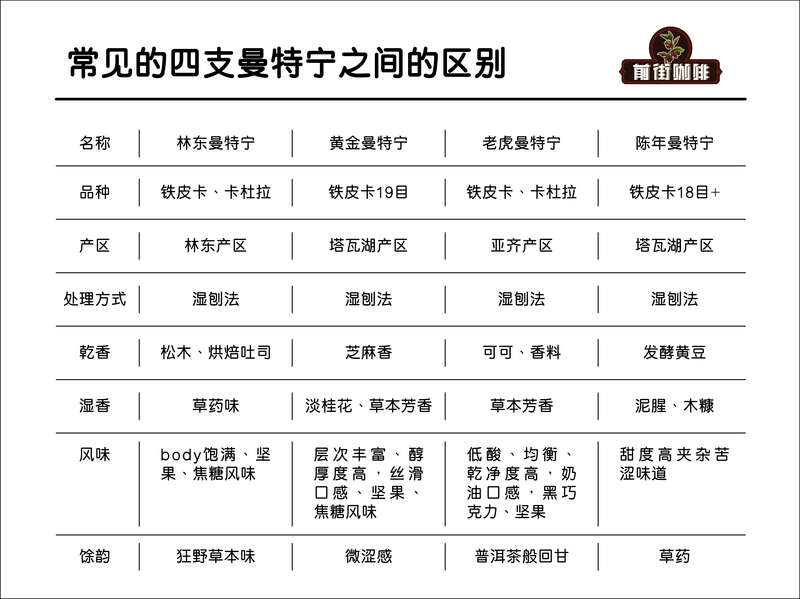
When it comes to Sumatran coffee, Mandheling is inevitably mentioned. FrontStreet Coffee commonly offers several varieties of Mandheling coffee: FrontStreet Coffee's Lintong Mandheling, FrontStreet Coffee's Gold Mandheling, FrontStreet Coffee's Aged Mandheling, and FrontStreet Coffee's Tiger Mandheling. So what exactly are the differences between these four common types of Mandheling coffee? FrontStreet Coffee has provided us with some summary.
Sumatra Island Coffee Profile
Sumatra Island has three main growing regions: the northern Aceh region, the area slightly south around Lake Toba, and the recently emerged islands near Mangkuraja. Smaller areas can also be traced to the following regions: Takengon, Bener Mariah in Aceh province, Lintong, Sidikalang, Dolok Sanggul, and Seribu Dolok surrounding Lake Toba. Previously, coffee beans from this region were generally sold as "Sumatran Mandheling," but in reality there is no place called Mandheling - the name comes from the local islanders' ethnic name. Typically, Mandheling is graded as Grade 1 or Grade 2. The grading method is undoubtedly based on cupping quality rather than the green beans themselves, as is commonly believed. Sumatran coffee beans are exported through the port of Medan, but prolonged lingering at the port before export is detrimental to coffee quality because of the hot and humid climate.
Altitude: Aceh 1100-1300m, Lake Toba 1100-1600m, Mangkuraja 1100-1300m
Harvest: September to December
Varieties: Typica (including Bergandal, Sidikalang, Djember), Timtim, Ateng, Onan Gajang

Three Major Sumatra Growing Regions
Aceh Gayo Region
Aceh, at an altitude of 1110 to 1300 meters, is located at the northernmost tip of Sumatra Island. In the Aceh province on the northern side of Sumatra, the Gayo growing region surrounds the scenic Lake Tawar, boasting abundant annual rainfall averaging 2200mm, an excellent average altitude of approximately 1100-1400 meters, and volcanic soil conducive to coffee cultivation. This region typically engages in coffee cultivation through independent small farmers, who use shade trees to enhance coffee quality.

Unlike the Lintong Mandheling from another Indonesian specialty coffee origin, Gayo region coffee exhibits more reserved and introverted characteristics, typically featuring a very full body and rich chocolate and dried fruit flavors.
Lintong Region
Lake Toba is currently the world's largest and deepest volcanic lake, with a depth of nearly 500 meters. The entire Lake Toba stretches 100 kilometers long and 30 kilometers wide, surrounded by a unique geographical environment above 900 meters altitude. The mineral-rich soil left by volcanic eruptions provides perfect soil and climate conditions for coffee cultivation around Lake Toba. The Lake Toba area is vast, with most coffee trees growing on undulating highlands covered in ferns, mostly cultivated without shade. The coffee produced here - the main area for the world-famous Mandheling - is located in the Lintong region southwest of Lake Toba. Until the 1990s, cultivation gradually moved to higher-altitude areas. Currently, the well-known Lintong region coffee cultivation averages between 1200 and 1500 meters, with coffee grown by small tenant farmers under shade trees, using the wet-hulled processing method to express unique flavors and low, lively intensity.

Bengkulu Province Mangkuraja
The estate is located on the cool and pristine western slopes of the Bukit Barisan mountains in the South Sumatra highlands of Indonesia, at altitudes between 1100 and 1300 meters. The tranquil and vivid landscape completely encompasses the Mangkuraja estate, coexisting with lush tropical rainforests, flowing rivers, and natural springs. This full-bodied, moderately acidic Mangkuraja coffee is renowned among discerning coffee connoisseurs for its unique rich aroma and flavor, with delicate leather and fruit notes. It will certainly provide a vibrant and unforgettable coffee experience.
Sumatra Wet-Hulling Method
Wet-Hulling is the traditional processing method for Indonesian Sumatran coffee, where the parchment hull is removed when the green beans are only halfway dried, still at 30%-50% moisture content, before continuing to dry. This addresses the challenge of overly long drying times. Since the drying time is shortened to two to four days, the fermentation period of the coffee beans is reduced, acidity decreases significantly, while body increases, with distinct caramel and fruit aromas, even carrying herbal or grassy scents and woody notes - these are the unique regional special fragrances of Sumatra.

However, the impact of early hull removal means that green beans dried halfway lose their final two protective layers (note: coffee beans have four protective layers: pulp, mucilage, parchment, silver skin), equivalent to drying naked in the sun. While wet-hulling solves the drying time problem, it significantly increases the probability of green beans being contaminated by mold, fungi, and yeast. Paradoxically, these factors actually become key elements in creating Mandheling's special aroma.
Another characteristic brought by wet-hulling is the higher probability of what are called "elephant beans" or "sheep's hoof beans." Because the green beans are hulled while still moist and in a semi-soft stage, the fragile, soft, wet beans are very susceptible to mechanical pressure, causing them to crack, break, or get scratched, forming what are known as sheep's hoof beans or scratched beans, resulting in a poorer appearance of the green beans.

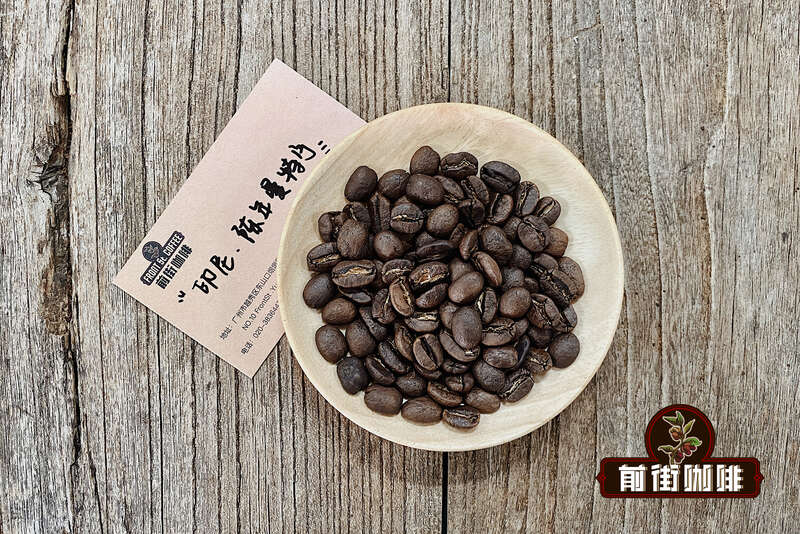
FrontStreet Coffee - Indonesia Lintong Mandheling Coffee Beans
Region: Indonesia, Sumatra
Grade: G1
Altitude: 1100m-1600m
Variety: Ateng TimTim
Processing Method: Wet-Hulling
Since Mandheling coffee presents nutty and chocolate flavor profiles, FrontStreet Coffee's roaster chooses a medium-dark roast. The darker the roast, the more porous the coffee bean's texture becomes, making it easier to extract during brewing. Therefore, FrontStreet Coffee uses a lower water temperature to avoid over-extraction that would produce negative bitterness.

Dripper: KONO dripper
Water Temperature: 87°C
Coffee Dose: 15 grams
Coffee-to-Water Ratio: 1:15
Grind Size: Medium-coarse grind (Chinese standard No. 20 sieve pass rate 70%)
Wet the KONO dripper to ensure a better fit between the filter paper and the dripper. Pour out the water from the sharing pot and add 15g of ground coffee powder. After blooming with 30g of water for 30s, start a center circular small-flow pour until reaching 125g, then pause. Wait for the coffee powder layer to drop to half the dripper's position, then inject the second segment using the same technique until reaching 225g. Once all dripping is complete, remove the dripper.

The ground FrontStreet Coffee Lintong Mandheling coffee powder has aromas of caramel, dark chocolate, and toasted bread. During brewing, you can smell the sweet fragrance of caramel. The brewed FrontStreet Coffee Lintong Mandheling coffee enters with spice and dark chocolate flavors, featuring a full-bodied and clean taste with an obvious aftertaste and a persistent finish.
FrontStreet Coffee Recommendation
To taste wet-hulled coffee at its best, FrontStreet Coffee recommends its highest-grade Mandheling, the PWN Golden Mandheling. PWN mainly buys high-quality Mandheling green beans and then sorts them, using only beans of 18 screen size or larger and requiring that a 300-gram green sample contain fewer than 3 defective beans, before three rounds of hand-sorting remove any remaining defects - all of which lifts the cup's cleanliness and intensifies its sweetness. The beans are large, uniform, and translucent, and after a medium-dark roast they carry rich roasting aromas; the brewed black coffee has a clean texture and a full, thick body, which makes it perfect for anyone who dislikes acidic coffee. FrontStreet Coffee's Lintong Mandheling is the everyday counterpart, mellow and bittersweet with distinct clove and woody aromas and a low-acid, spice-and-mint character.
Golden Mandheling shows its best side as a pour-over. FrontStreet Coffee suggests 87-88°C water, 15g of coffee, a 1:15 ratio, and a coarse granulated-sugar grind, poured in three stages to express the thick body and caramel sweetness: a 30ml bloom to wet all the grounds and release gas, then 100ml to build the golden foam and lift the bed, and finally a gentle 95ml center pour. The result is a heavy, mellow cup with caramel sweetness alongside chocolate and nutty notes.
Important Notice :
FrontStreet Coffee is a long-established specialty coffee roaster in Guangzhou China, selling freshly roasted beans from its own farm in Yunnan as well as dozens of carefully selected single-origin beans from around the world for both pour-over and espresso. The products deliver consistently excellent quality and great value, with shipping within 24 hours. Guangzhou's FrontStreet Coffee shop is recommended by many coffee lovers, and the beans are now available online at the Tmall 。
FrontStreet Coffee has moved to a new address:
FrontStreet Coffee Address: 315,Donghua East Road,GuangZhou
Tel:020 38364473
 Scan and follow the En Gafei WeChat official account. Please indicate that the reprint comes from "En Gafei".