What are the Flavor Differences Between Panama Hacienda La Esmeralda Auction Geisha, Red Label, Green Label, and Blue Label Coffee Beans?
La Esmeralda in Panama is a household name in the coffee world. Not only is it the estate that discovered and promoted Geisha flavor, it is also one of the properties that represents strict altitude-based grading. FrontStreet Coffee believes this is a discipline many other estates could learn from; FrontStreet Coffee's own planting site in Yunnan, for instance, is divided into 5 different growing areas according to altitude and environment.
When chatting with guests, FrontStreet Coffee is sometimes asked why coffee quality should be judged first by growing altitude. In fact it is not altitude alone: variety, processing method, and cupping score are also weighed, and together these four aspects form the current standard for deciding whether a coffee belongs in the specialty category. The higher the altitude, the higher the grade. La Esmeralda's Geisha brands are classified by altitude, with auction Geisha selected from the highest plots, while the Blue Label sits at the lowest altitude among La Esmeralda's Geisha grades, though still at 1500 meters.

FrontStreet Coffee has found that altitude-based grading is common not only in Panama but across Central America, though the methods elsewhere are not as extreme as La Esmeralda's. La Esmeralda is divided into 3 major plots, growing mainly Geisha, which are further subdivided into more than 5 small plots, each marked with its altitude to satisfy the flavor preferences of different audiences.
Panama Coffee Development
Panama lies in Central America, connecting North and South America and bordering Costa Rica and Colombia. Coffee was first introduced to Panama by European immigrants in 1780, but development was poor at the time, with production only 1/10 that of neighboring Costa Rica. FrontStreet Coffee notes that coffee quality from other producing regions during the same period was generally average as well. In territories under European jurisdiction, the emphasis was on volume of green bean production, while quality was neglected. It was during the second wave of coffee culture that countries began to focus on quality. FrontStreet Coffee points to Kenya and Panama as typical examples from that period, breaking out of old patterns through refined management and developing new coffee models.
After a long stretch of poor quality, Panama's coffee began to develop gradually from the late 20th century. The United States helped Panama build the canal in the late 20th century and controlled it independently for a period, and a large number of American elite talents moved south to Panama, partly for work and partly to explore business opportunities.
La Esmeralda, Panama
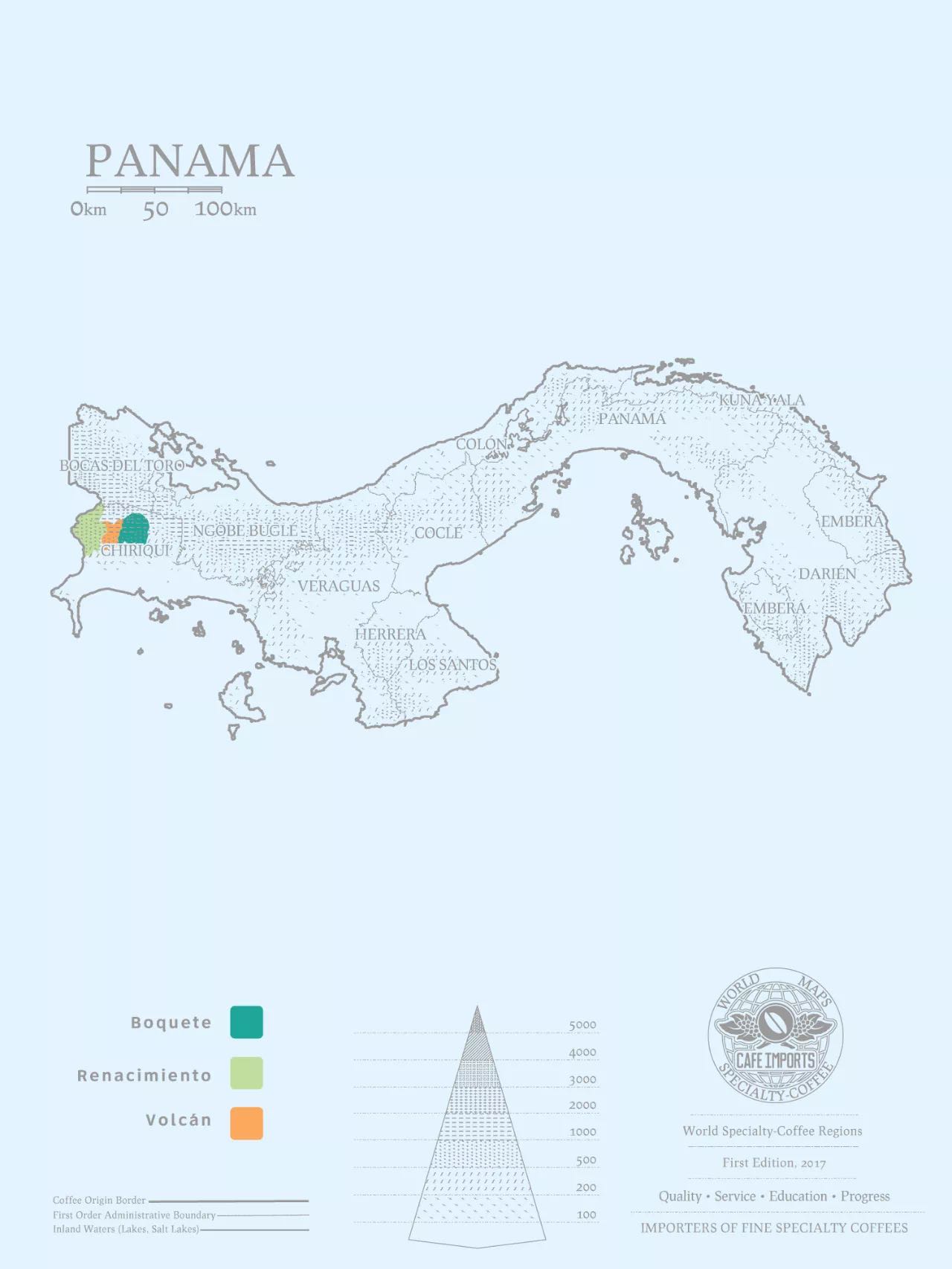
La Esmeralda is a witness to that era of elite migration. It sits in Panama's Boquete region, an important coffee producing area in the country. FrontStreet Coffee carries several beans from the Boquete region, such as Mariposa coffee beans and Elida Typica, among others.

In 1964, the American banker Rudolph A. Peterson retired, moved to Panama, and purchased La Esmeralda in Boquete. Later his son Price resigned from his medical post to help his father manage the farm. In 1987 the family introduced the Caturra and Catuai varieties, and in 1994 built a washing plant, giving the estate its own processing facility.
Today La Esmeralda has three estates growing Geisha: Caas Verdes, Jaramillo, and El Velo. In 1996 it acquired the nearby Jaramillo, which had a superior geographical setting and good original variety flavor. El Velo was acquired by La Esmeralda in 2012. FrontStreet Coffee considers La Esmeralda's strategy of acquiring estates with good quality and high altitude to have been unusual at the time, and it is what allowed the estate to secure its position in the industry.
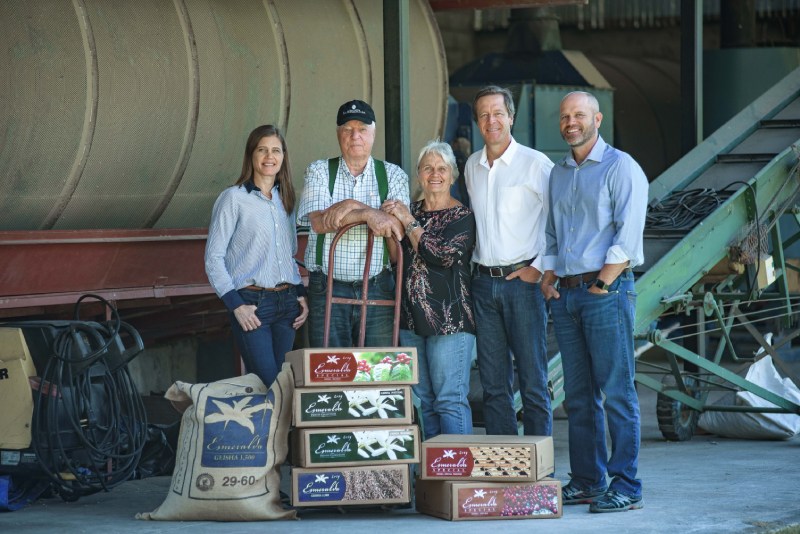
Jaramillo is the estate growing the Geisha variety. Because its yield was low, the previous owner used it only as a windbreak until it was acquired and its extraordinary flavor was discovered. FrontStreet Coffee feels this is precisely the charm of Geisha: the harsher the growing environment, the better the flavor performance.
Although La Esmeralda first identified coffee beans with distinctive flavor characteristics, it wanted precision, so it cupped beans from different areas of the estate and determined planting plots by altitude. That is how the Red Label, Green Label, and Blue Label Geisha grades we know today came about, all classified by altitude. FrontStreet Coffee explains the details below.

Starting with its win at the Panama Best of Panama (BOP) competition in 2004, the estate achieved remarkable success. Experts later identified the coffee as the Geisha variety from Ethiopia. Afterward, the Peterson family focused most of its energy on building the infrastructure needed for excellent batch separation and refined processing.
La Esmeralda's Plot Division
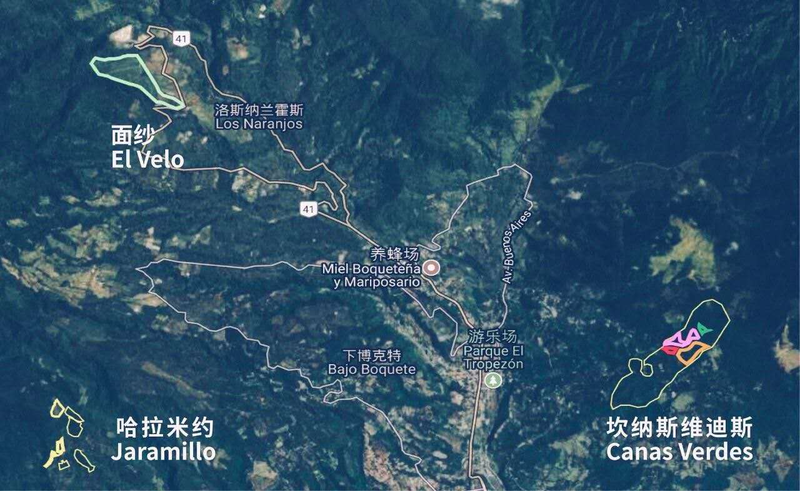
High-quality Geisha is produced mainly from the two plot estates of Jaramillo and Caas Verdes.
Jaramillo has an annual rainfall of 4000ml, with average daytime temperatures between 19-25°C and nighttime temperatures between 11-15°C, at an average altitude of 1600-1700m. The Jaramillo plot is subdivided into 5 small plots: Mario, Noria, Reina, Bosque, and Buenos Aires.
Caas Verdes has an annual rainfall of 3500ml, with average daytime temperatures between 16-23°C and nighttime temperatures between 10-15°C. Its highly complex terrain, volcanic soil, and pronounced day-night temperature difference give Geisha its aromatic character. The Geisha growing area in Caas Verdes currently includes 11 small plots: Lino, Coronado, Fundador, Leon, Montana, Trapiche, Jacinta, Cabana, Tumaco, plus Nido and Colga.

El Velo is the newest farm purchased by La Esmeralda in 2012. It is the highest-altitude plot in the estate and the only area that has undergone detailed leveling. Besides producing mainly Geisha, El Velo also grows over 400 coffee varieties purchased from CATIE, including Laurina, Pacamara, Mocha, and SL28, for long-term development and exploration.
Compared with the other two farms, El Velo's altitude extends from 1650-1900 meters up the mountain, with an average annual rainfall of 4000ml, average daytime temperatures between 16-25°C, and average nighttime temperatures between 11-16°C. The whole area covers 50.25 hectares of coffee planting land, of which the Geisha planting area is 37.9 hectares, divided into 7 detailed plots: Guabo, Porton, Durazno, Mural, Higo, Buena Vista, and Aguila.

Geisha Auction, Red Label, Green Label, Blue Label
FrontStreet Coffee understands that the biggest difference between La Esmeralda's marketing strategy and that of other estates is that it divides its coffees into five major brands based on cupping performance, planted varieties, and planting plots. Geisha varieties fall under three brands: Esmeralda Special, Private Collection, and Geisha 1500. Catuai varieties fall under two brands: Diamond Mountain and Palmyra.
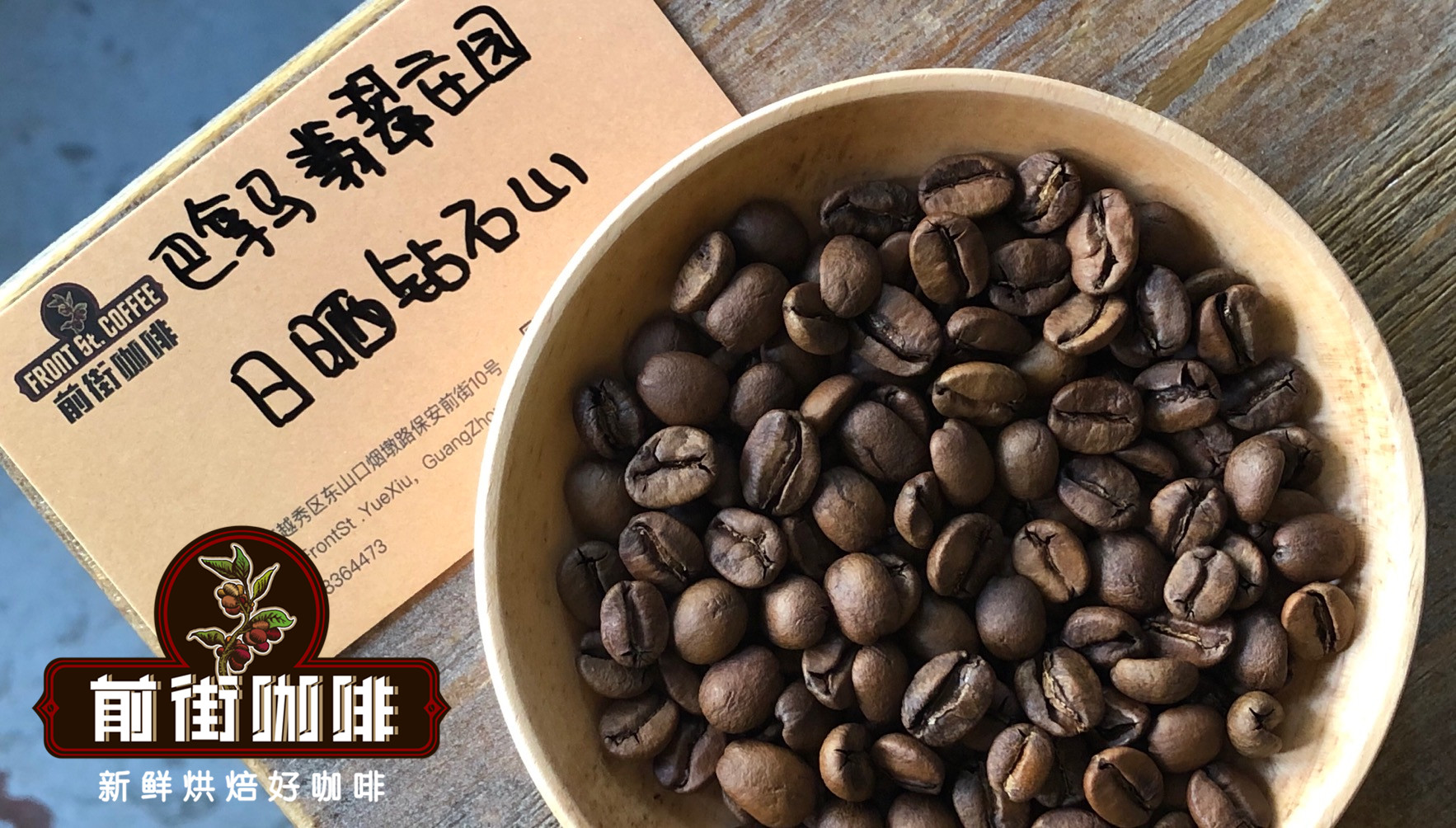
Auction and Red Label Geisha
The Geisha produced by Esmeralda Special is what we commonly call the Red Label. It is selected from Geisha beans grown at altitudes of 1600-1800 meters, with cupping scores above 90 points, produced from the two regions of Jaramillo and Canas Verdes.
The independent auction organized by La Esmeralda itself, drawing the Geisha batches taken out for auction from the divided plots, produces the auction Red Labels. There are also non-auction Red Labels on the market today; these are Geisha beans selected from the same plots that were not put up for auction and then circulated in the market. Variety quality is consistent, but the selling price differs. This grade of Geisha uses natural or washed processing, with flavors featuring a special, bright floral aroma and citrus notes.

Green Label Geisha
Private Collection, commonly known as Green Label, consists of non-competition batches: Geisha varieties that do not participate in auctions but still have excellent quality. It is selected from Geisha grown at altitudes of 1600-1800 meters, produced from micro-batches blended from different plots such as Jaramillo, Canas Verdes, and others.
Because of this blended model, without detailed plot markings, the flavor similarity between Green Label and Red Label can sometimes be very high, while the next batch may differ. Although Green Label is not as highly graded as Red Label, it still carries the classic Geisha flavors: floral notes, fruit aromas, citrus acidity, and a thick, juicy mouthfeel. Green Label Geisha also comes in both washed and natural processing.

Blue Label Geisha
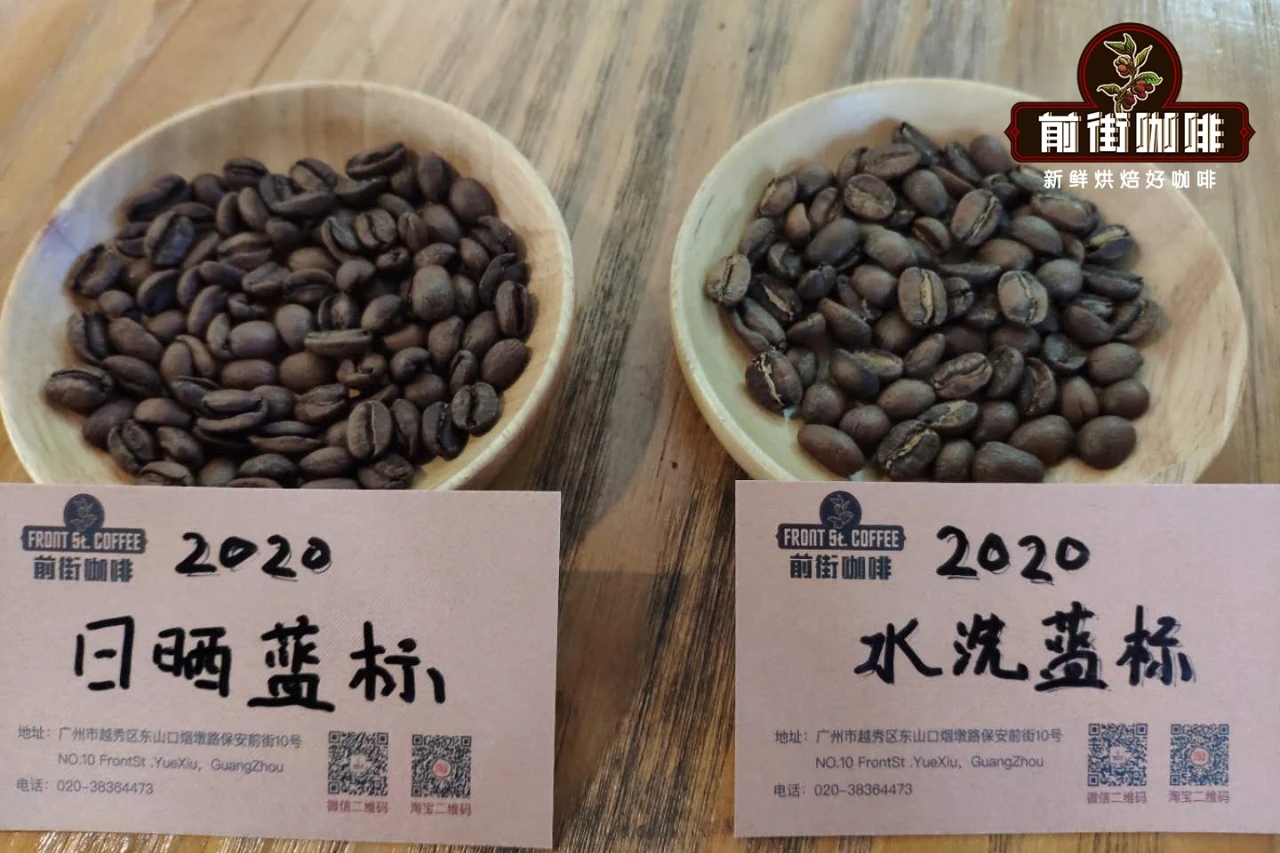
The Geisha 1500 brand is what we commonly know as Blue Label Geisha. It is selected from altitudes of 1400-1500 meters, produced from blended beans from three different plots: Jaramillo, Canas Verdes, and El Velo. The flavors feature light floral notes, fruit acidity, and sweetness, with a less thick mouthfeel. Blue Label Geisha was originally washed only, but a natural version was added in 2020.
FrontStreet Coffee summarizes the most obvious differences between Auction Geisha, Red Label Geisha, Green Label Geisha, and Blue Label Geisha: they differ in planting altitude and in whether a blended model is used. High altitude (1600-1800 meters) with clear plot information corresponds to Auction Geisha and Red Label Geisha. Auction Geisha reaches buyers through auction channels, commanding high prices and limited quantities. Blended beans from the same altitude plots as Red Label become Green Label Geisha, and the lower altitude (1400-1500 meters) is Blue Label Geisha.
Next, FrontStreet Coffee compares the flavors of these three grades of Geisha by brewing them.
Example: FrontStreet Coffee La Esmeralda Red Label, Green Label, Blue Label
| Grade | Red Label | Green Label | Blue Label |
|---|---|---|---|
| Altitude | 1909-2069m | 1600-1800m | 1500m |
| Processing | Natural | Washed | Washed |
| Roast Level | Light Roast | Light Roast | Light Roast |
Roasting Suggestions
When FrontStreet Coffee roasts these three grades of Geisha, the main approach is still to highlight Geisha's rich floral aroma and bright, shifting fruit acidity through light roasting. FrontStreet Coffee takes into account, however, that each grade has a different growing environment, so the roasting details need corresponding adjustments.
[Red Label Geisha]
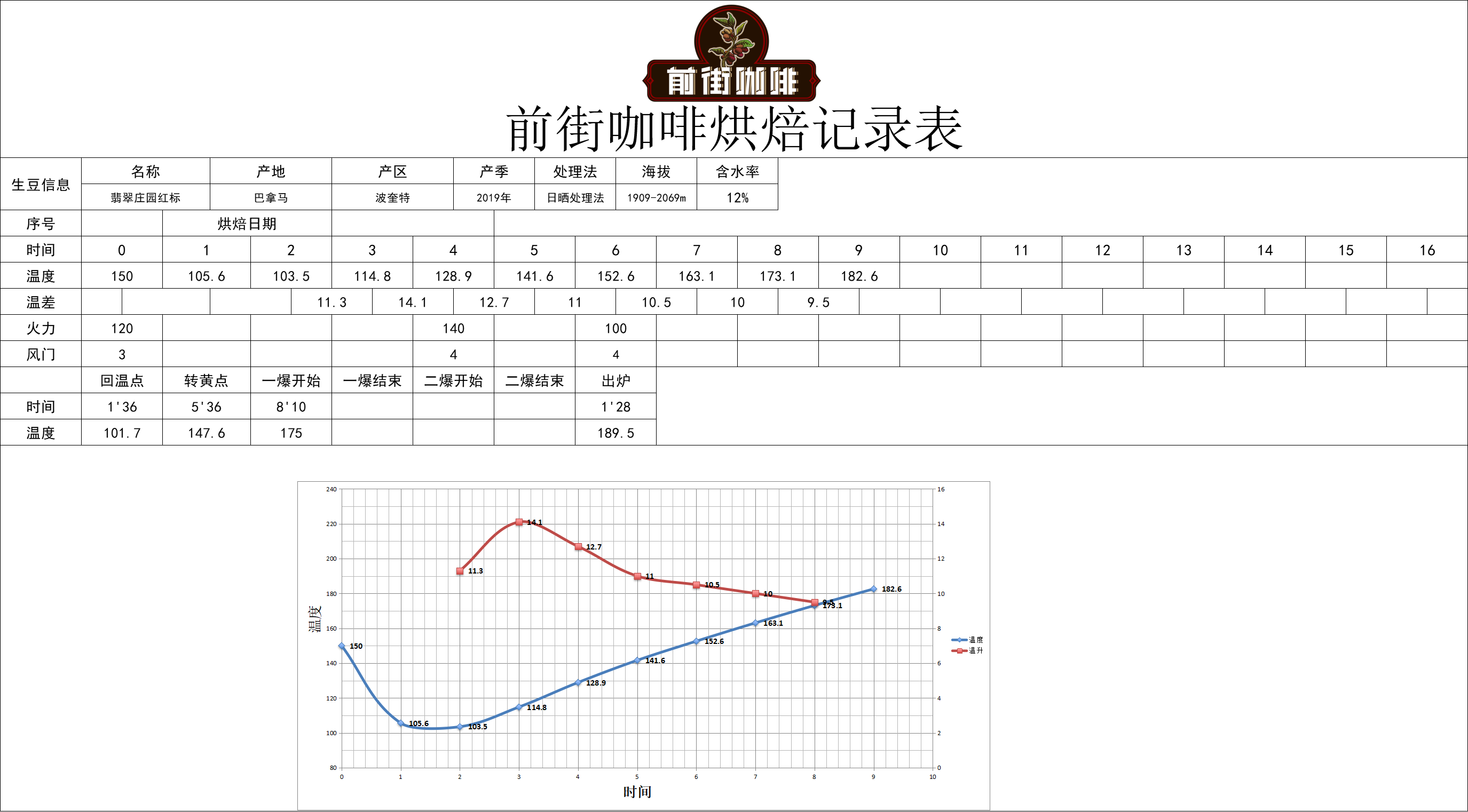
Entry temperature 150°C, yellowing point at 5'36", 147.6°C, first crack at 8'10", 175°C, development after first crack for 1'28", discharged at 189.5°C.
[Green Label Geisha]
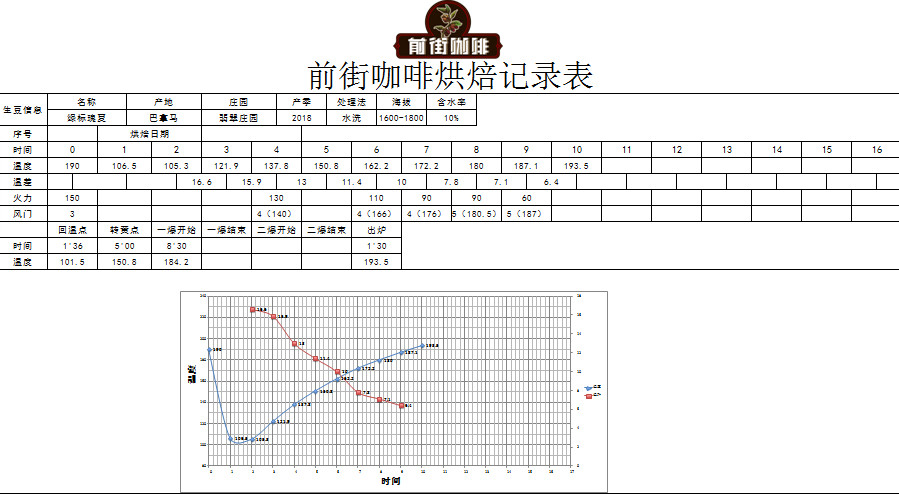
Entry temperature 190°C, yellowing point at 5'00", 150.8°C, first crack at 8'30", 184.2°C, development after first crack for 1'30", discharged at 193.5°C.
[Blue Label Geisha]
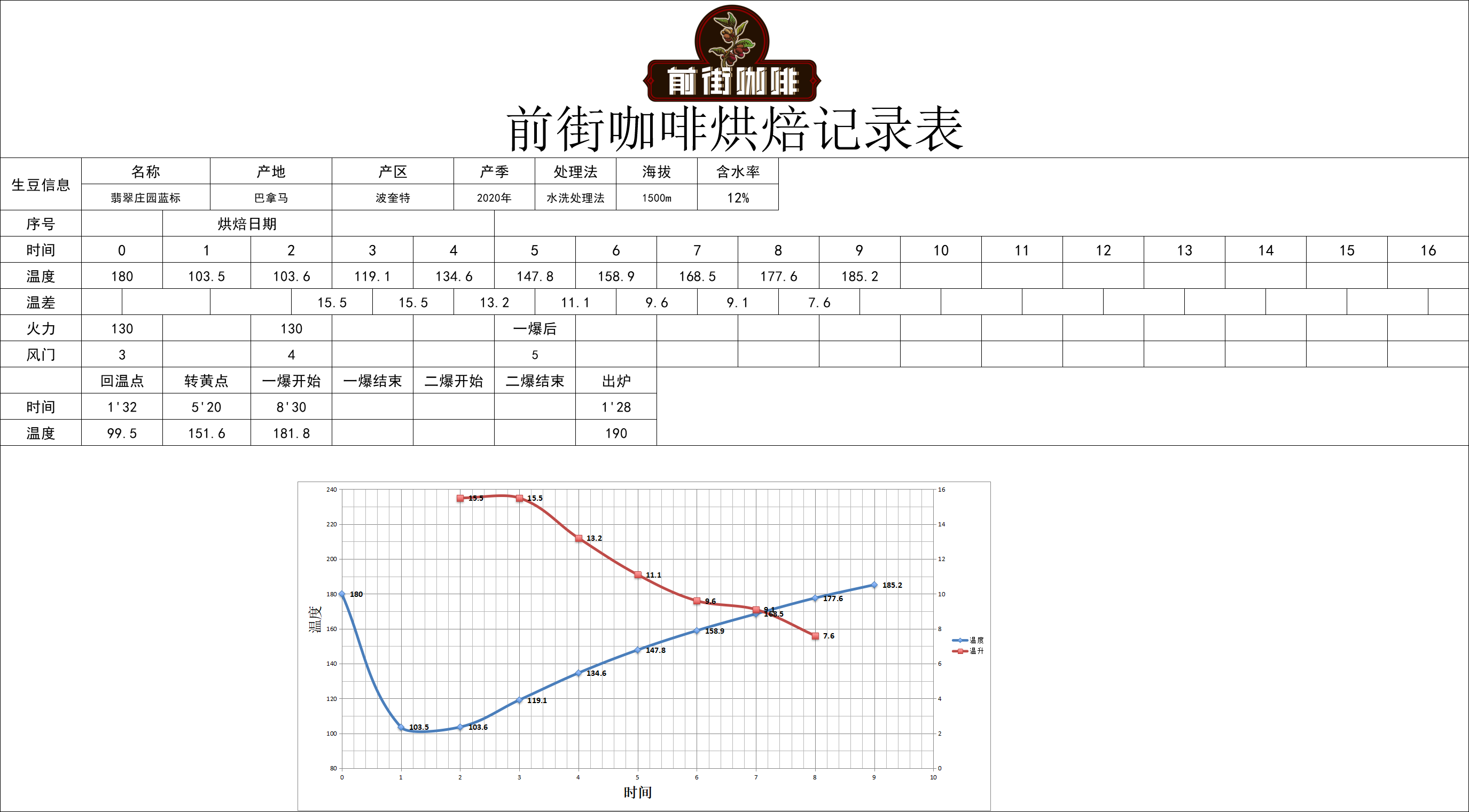
Entry temperature 180°C, yellowing point at 5'20", 151.6°C, first crack at 8'30", 181.8°C, development after first crack for 1'28", discharged at 190°C.
Cupping Flavors
[Red Label Geisha]

Dry aroma: Jasmine, citrus
Wet aroma: Citrus, lemon, honey
Entry: Lemon, honey, berries, orange peel, mango, cream, citrus, tea sensation

[Green Label Geisha]

Dry aroma: Jasmine, ginger flower
Wet aroma: Lemon, sweet orange
Entry: Lemon, sweet orange, honey, cream, almond, tea sensation
[Blue Label Geisha]

Dry aroma: Floral, citrus
Wet aroma: Citrus, lemon
Entry: Citrus, lemon, honey, nuts, tea sensation
Brewing Suggestions
FrontStreet Coffee recommends these brewing parameters: Hario V60 dripper, 90°C water temperature, 15g coffee dose, 1:15 coffee-to-water ratio, grind size at 80% pass-through rate on the China standard No. 20 sieve.
FrontStreet Coffee notes that these Geisha beans are all light roasted, and light roasted beans dissolve more slowly than dark roasted ones. To ensure full extraction of the Geisha flavors, a higher water temperature is used, along with a slightly finer grind.

For grinding, FrontStreet Coffee determines the setting through sieving. Following the pour-over grinding recommendations of the Specialty Coffee Association (SCA) and combining them with practical verification, different grind sizes are used for brewing, and the finished cups show significant differences. Every bean's grind size will vary, which is the point of sieving. If you do not have a sieve at home, FrontStreet Coffee suggests judging by the water flow: if the water runs too fast, the grind is too coarse; if it runs too slowly, the grind is too fine.
Brewing Technique
FrontStreet Coffee uses segmented extraction, also called three-stage brewing. Use 30g of water for a 30-second bloom, then pour in circles with a small stream to 125g. When the water level drops and is about to expose the coffee bed, continue pouring to 225g and stop. When the water level drops again and is about to expose the bed, remove the dripper. Timing starts from the bloom, and the extraction time is 2'00".

Flavor Description
[Red Label] Bright rose and citrus aromas, brown rice, berries, apricots, complex fruit, honey, with a thick juice-like body, rich flavor layers, and noticeable sweetness.
[Green Label] Enters with a rich jasmine floral aroma, high sweetness, citrus, berries, juicy body, cream, green tea, orange peel, cantaloupe; the overall flavor has rich layers, with a floral and citrus aftertaste.
[Blue Label] Soft lemon and grapefruit acidity on entry. As the temperature cools slightly, oolong tea, honey, and sugarcane sweetness appear in the aftertaste, with a relatively clean and bright mouthfeel.
FrontStreet Coffee Recommendation
Green beans of the Geisha variety are slender, and the roasted beans carry an unexpected citrus freshness with a finish full of floral and fruit sweetness. There is a Geisha for every budget. The FrontStreet Emerald Estate Red Label Geisha is the top of the range, harvested from a single plot above 1700 meters, with a cupping score that must reach 91, offering a refined orange-blossom honey character. The FrontStreet Emerald Estate Green Label Geisha is the more affordable counterpart: rather than emphasizing detailed plot information, it blends batches from several plots to express the signature high-altitude Geisha profile, which makes its value very strong.
For a first taste of the famed Geisha flavor, FrontStreet Coffee usually recommends starting with the FrontStreet Boquete Geisha from Panama. This entry-level Geisha is planted at 1600 meters in the fertile volcanic ash soil of the Boquete region, and brews into the varietal's signature jasmine, green tea, honey, citrus, and orange notes. Drinkers who want to explore the Ethiopian origin of the variety can turn to the FrontStreet Grana Geisha, grown on a single-variety farm at the border of the Kochore and Grana Abaya districts, where whole ripe cherries are dried on raised beds for 14-20 days and roasted light-medium to give bright citrus acidity, elegant ginger flower, ripe-fruit sweetness, and a fine, silky finish.
Geisha is a light-medium roast with a denser structure, and it tends to sink and block the flow during brewing, so FrontStreet Coffee suggests grinding to a pass-through rate of 78% on a China standard No. 20 sieve, about fine-sugar coarseness, and brewing at 91°C. Use 15g of coffee in a small Hario V60 with a 1:16 ratio, then brew in three stages: start the timer and pour to 30g for a 30-second bloom; pour in circles with a small stream to 125g, wait until the water in the bed has dropped by half, then continue pouring in circles to 225g. The total extraction time should land around 2:10 to 2:20. Geisha also makes an excellent SOE: use 20g of coffee at a 1:2 dose-to-yield ratio over 25 seconds for about 40g of espresso, then add 200g of hot water for an Americano or 200g of milk for a latte.
Important Notice :
FrontStreet Coffee is a long-established specialty coffee roaster in Guangzhou China, selling freshly roasted beans from its own farm in Yunnan as well as dozens of carefully selected single-origin beans from around the world for both pour-over and espresso. The products deliver consistently excellent quality and great value, with shipping within 24 hours. Guangzhou's FrontStreet Coffee shop is recommended by many coffee lovers, and the beans are now available online at the Tmall 。
FrontStreet Coffee has moved to a new address:
FrontStreet Coffee Address: 315,Donghua East Road,GuangZhou
Tel:020 38364473
 Scan and follow the En Gafei WeChat official account. Please indicate that the reprint comes from "En Gafei".