Breakfast Blend Coffee Beans Tasting Experience - Personal Test to Find the Best Coffee
For professional coffee knowledge exchange and more coffee bean information, follow Coffee Workshop on WeChat (official account: cafe_style).
Latin American Coffee Overview
Latin American coffee is renowned for its balanced flavor profile, and the widespread use of washed processing is one of its defining traits. This excellent method produces more uniform bean sizes and lower defect rates than we typically see in African coffees. The region has also gradually begun experimenting with post-processing methods. FrontStreet Coffee's Honduras Sherry Coffee is a case in point: it uses whiskey barrel fermentation, which produces rich whiskey flavors when brewed. One drawback of such post-processing methods is that the flavors tend to fade quickly, so FrontStreet Coffee recommends drinking it soon after brewing.
The Breakfast Blend showcases a medium roast profile. In day-to-day roasting, coffees from the Americas often use a medium roast to express their light acidity and rich body. Below is FrontStreet Coffee's comparison of regional characteristics across Latin American coffee beans:
Representative Latin American Countries
Brazil (Flavor Profile: Low acidity, prominent nutty and chocolate notes, excellent body)
Brazil is the world's largest coffee producer and the second-largest coffee consumer. Although Brazil faces natural disasters several times more severe than other regions, its vast plantable area more than compensates for them.
In 2020, because of the COVID-19 pandemic, Brazil's coffee harvest was delayed. Analysis nevertheless suggests that this year's export volume is expected to set a new record. (This information comes from Coffee Finance Network reports.)
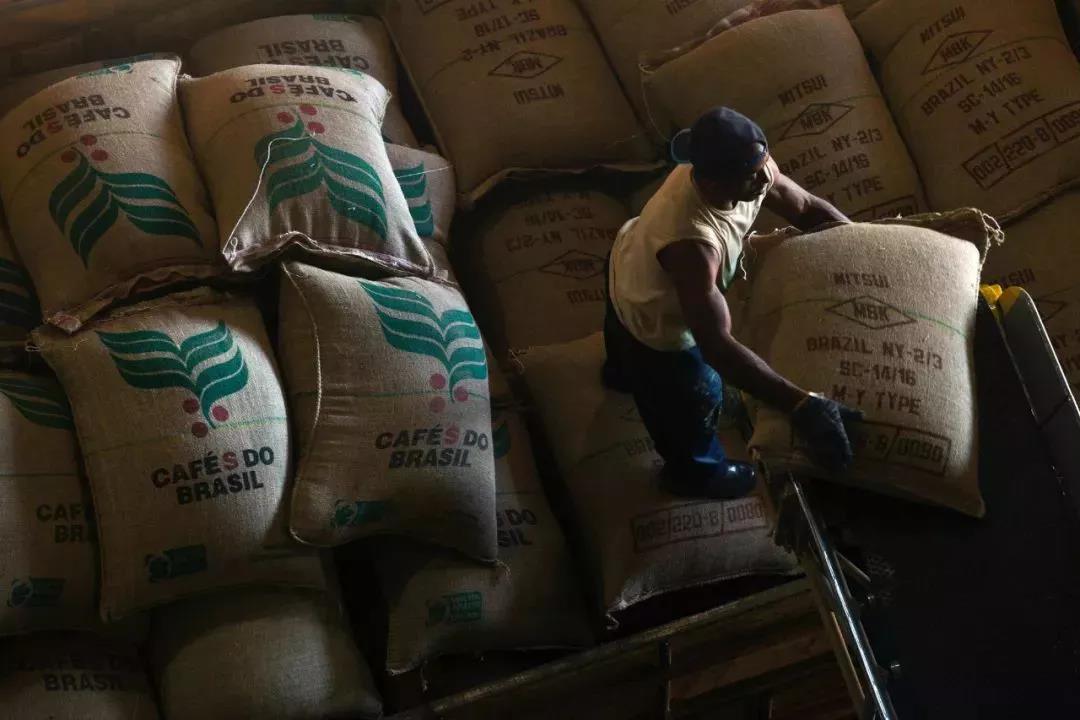
Brazil Coffee Bean Processing Methods
Compared with other Latin American countries, Brazil sits at a significantly lower altitude, lacks microclimates, and traditionally grows coffee trees without shade. As a result, Brazilian beans can taste somewhat plain and unremarkable. There is even a saying in the coffee world that Brazil has no good beans, which is also tied to Brazil's past industrialization, when bean quality was not a priority.
Brazil has worked hard to improve quality, though, continuously cultivating and refining Arabica varieties. It adjusts processing methods to local dry and wet conditions to bring out the best regional flavors. Common methods include natural, pulped natural, and washed. Generally, high-humidity regions use washed processing, while low-humidity regions use natural or pulped natural methods.
Brazil Growing Regions
Brazil has 21 states, 17 of which produce coffee. Seven states account for 98% of total production: São Paulo, Paraná, Bahia, Espírito Santo, Minas Gerais, Rondônia, and Rio de Janeiro.
Brazil Coffee Bean Grading
1. Grading by defect rate: seven levels from No.2 to No.8, from high to low. Grades are distinguished by the number of defective beans per 300 g using a deduction system. A deduction below 4 can be classified as No.2 (No.1, with no defective beans, is rare and cannot be supplied consistently).
2. Grading by bean size: 17 and 18 screen sizes are the highest grades.
3. Cup quality grading, from high to low: Fine Cup, Fine, Good Cup, Fair Cup, Poor Cup, Bad Cup. FC (Fine Cup) and GC (Good Cup) are the most common.
4. Flavor grade classification, from high to low: Strictly Soft (very smooth), Soft (smooth), Softish (somewhat smooth), Hardish (harsh), Rioy (iodine taste).
Queen Manor Yellow Bourbon beans are located in Mogiana, São Paulo State, and feature the distinctive Yellow Bourbon variety processed by the natural method.
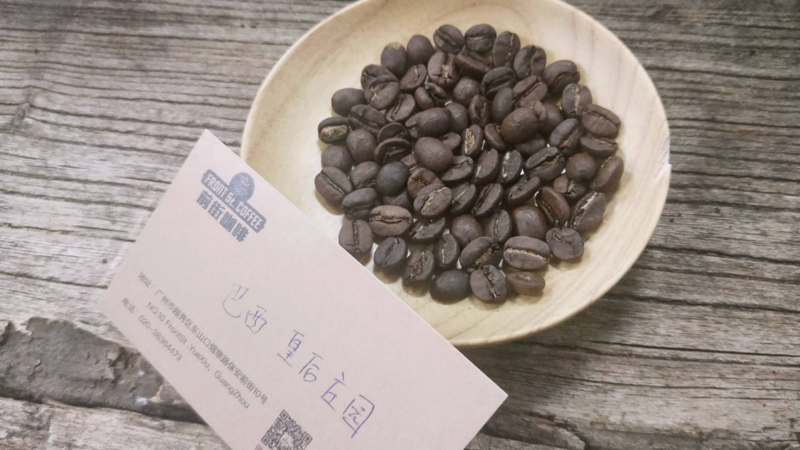
Brewing parameters: Kono dripper, 88°C water temperature, 15 g coffee dose, 1:15 coffee-to-water ratio, medium-fine grind (BG#6W).
Brewing method: using segmented extraction, bloom with 30 g of water for 30 seconds. When the pour reaches 125 g, pause to segment. Continue pouring to 225 g once the water level drops to just expose the coffee bed. Extraction time is 2 minutes, timed from the start of blooming.
Flavor description: noticeable sweetness with a hint of lemon aroma, rich nutty flavors, and distinct dark chocolate notes in the finish. The overall impression is well-rounded.

Colombia (Flavor Profile: Rich, thick aroma, bright acidity, nutty flavors, excellent balance)
Colombia is the world's third-largest coffee producer, located in northwestern South America, with a climate that varies by terrain. The southern plains and the Pacific coast have a tropical rainforest climate, mountainous areas at 1,000-2,000 m have a subtropical climate, and the northwest has a tropical savanna climate.
Colombian coffee does not have the intense body of Brazilian coffee, nor the bright acidity of African coffee, but it offers excellent balance with both nutty and fruit-acidity characteristics.
This year, affected by the COVID-19 pandemic, Colombia's coffee production fell 17% in the first four months of 2020 compared with the same period the year before. Although the government ordered coffee operations to remain economically stable, the pandemic's impact, in the form of fewer farm workers and transport restrictions, was unavoidable.
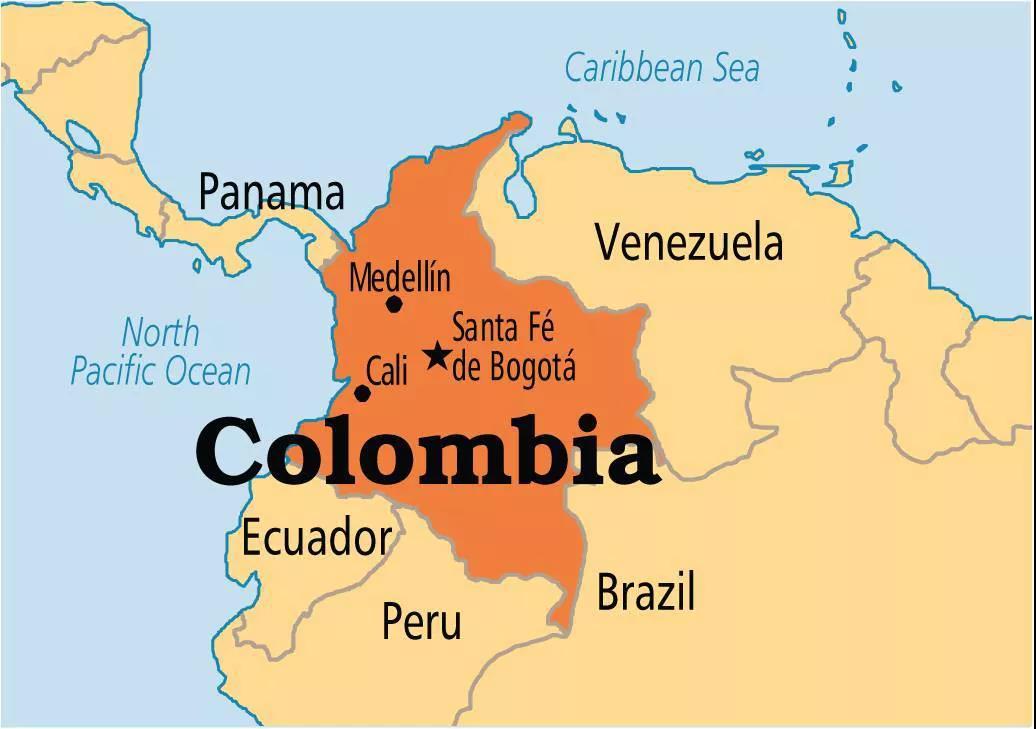
Colombia Coffee Bean Processing Methods
Colombian beans primarily use washed processing. Unlike other Latin American countries, Colombia relies on a family-operated model in which most growers have their own washing facilities, giving them complete control over coffee quality.
Colombian coffee is often compared with Brazilian coffee because both are American beans from major producing countries. In fact, you can tell them apart by appearance without tasting. This comes down to completely different processing methods: Colombian beans tend to carry more silver skin, while Brazilian beans have almost none. They may be similar in size and shape, but the processing difference makes them easy to distinguish.
As the coffee market has developed, various processing methods have emerged. Colombia's Rose Valley Coffee and Flower Moon Night Coffee use anaerobic double enzyme washed and anaerobic natural processing, respectively.
Colombia Growing Regions
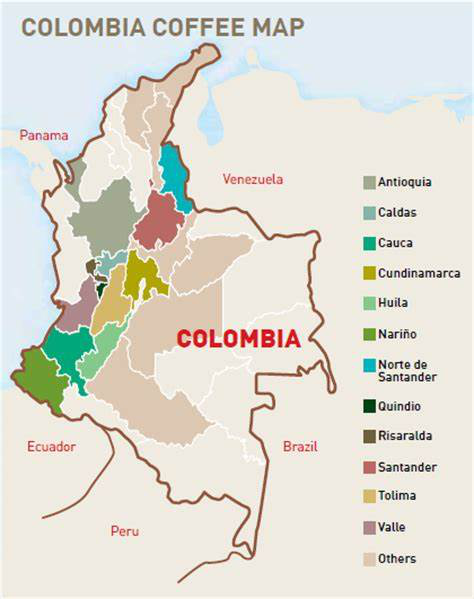
Colombian coffee cultivation follows the Andes Mountains. From south to north, the coffee regions are divided into four major areas: Northern, Central, Southern, and Eastern.
Northern Coffee Region
This region has only one dry season (December to March) and one rainy season (April to November). Coffee flowers in March, followed by the approaching rainy season, and is harvested in October and November. The Northern region is further divided into micro-regions including Santander, Norte de Santander, La Guajira, Magdalena, and Cesar.
Central Coffee Region
This region has two dry seasons and two rainy seasons each year. December to February and June to September are dry, while March to May and September to November are rainy, resulting in two coffee harvest seasons per year. Micro-regions include southern Antioquia, Boyacá, Caldas, Chocó, Risaralda, northern Quindío, northern Valle del Cauca, Cundinamarca, and northern Tolima.
Eastern Coffee Region
Coffee cultivation here is much smaller in scale, with a climate similar to the north but higher rainfall and humidity. It includes only Arauca, Casanare, Meta, and Caquetá. The Eastern region suffered from armed conflict in the past and urgently needs coffee production to drive economic recovery. The Colombian National Federation of Coffee Growers is investing to help the region plant varieties better suited to its environment and to help farmers expand their farm sizes.
Southern Coffee Region
Near the equator, coffee grows at higher mountain elevations. Like the north, the south has only one wet season and one dry season. The dry season runs June to September, with the rainy season arriving in October and potentially lasting until May. Unlike the north, which harvests in autumn, the southern harvest typically begins in April and continues through June, allowing green bean suppliers to provide Colombian coffee almost year-round. The south focuses mainly on specialty coffee varieties, including Huila, Cauca, Narino, and Tolima provinces.
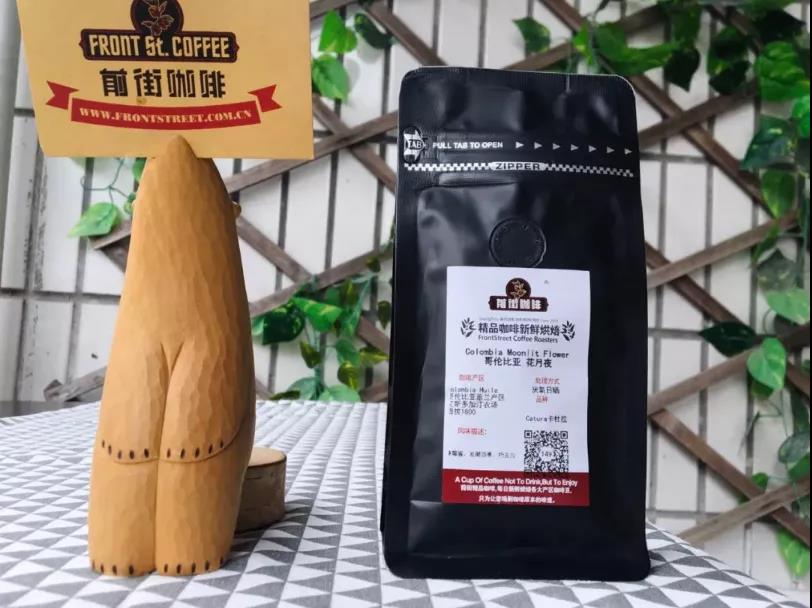
Colombia Flower Moon Night coffee comes from El Esvedor Manor in Huila, using a special anaerobic natural process. The flavors of specially processed coffee fade very quickly, so once brewed it should be drunk promptly.
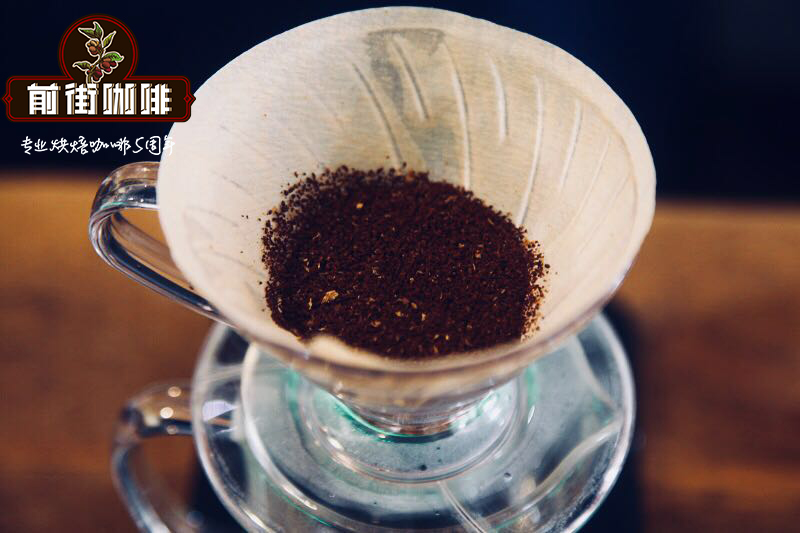
Brewing parameters: Hario V60 dripper, 90°C water temperature, 15 g coffee dose, 1:15 coffee-to-water ratio, medium-fine grind (BG#6S).
Brewing method: using segmented extraction, bloom with 30 g of water for 30 seconds. When the pour reaches 125 g with a small circular water flow, pause to segment. Continue pouring to 225 g once the water level drops to just expose the coffee bed. Extraction time is 2 minutes, timed from the start of blooming.
Flavor description: balanced mouthfeel with floral strawberry notes and a black cocoa aftertaste, plus creamy and fermented sensations.
Panama (Flavor Profile: Represented by Geisha, featuring unique floral aromas and bright acidity)
Panama coffee became world-famous thanks to Geisha, primarily because of its unique natural geography and a specialized, fine-management model. Panama has volcanic ash soil, sufficient air humidity, and abundant solar energy. After the canal opened in the late 20th century, many American elites moved south, partly for work and partly to explore business opportunities. During that period, coffee developed rapidly and Panama established its position in specialty coffee.
Panama Coffee Bean Processing Methods
When it comes to Panamanian coffee, most of it is Geisha. Processing Geisha commonly uses washed and natural methods. Washed brings out Geisha's original floral and fruit-acidity flavors, while natural adds richness and sweetness. Hartman Manor's wine processing is quite distinctive, inspired by winemaking techniques and adjusting bean quality by controlling pH, temperature, and humidity.
Panama Growing Regions
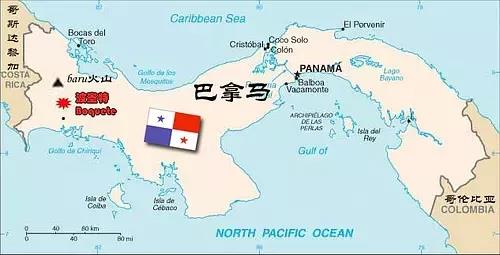
Panama has four main coffee growing regions: Boquete, Volcan, Santa Clara, and Piedra de Candela.
Boquete, with an average altitude of 1,450 m, produces the most coffee and the highest quality in Panama. Famous estates such as La Esmeralda, Elida, and Kotowa are located here.
Volcan, with an average altitude of 2,000 m, produces coffee with relatively mild and balanced characteristics.
Santa Clara, at an average altitude of 1,500 m, lies near the Panama Canal, making coffee transport very convenient.
Piedra de Candela, at an average altitude of 1,200 m, is a region that has gradually gained attention in recent years. The industry believes it has potential for developing high-quality specialty coffee.
Panama Hartman Coffee comes from Hartman Manor in Volcan. Hartman's unique wine processing creates wine-like flavors in the cup.
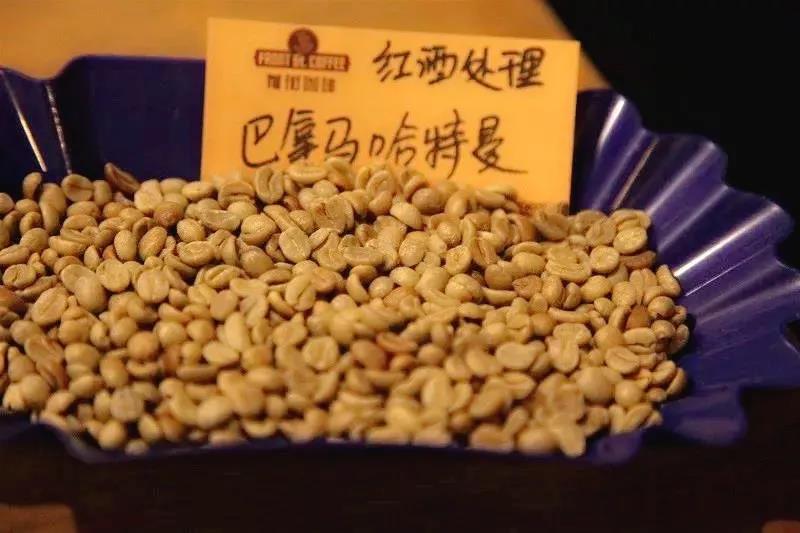
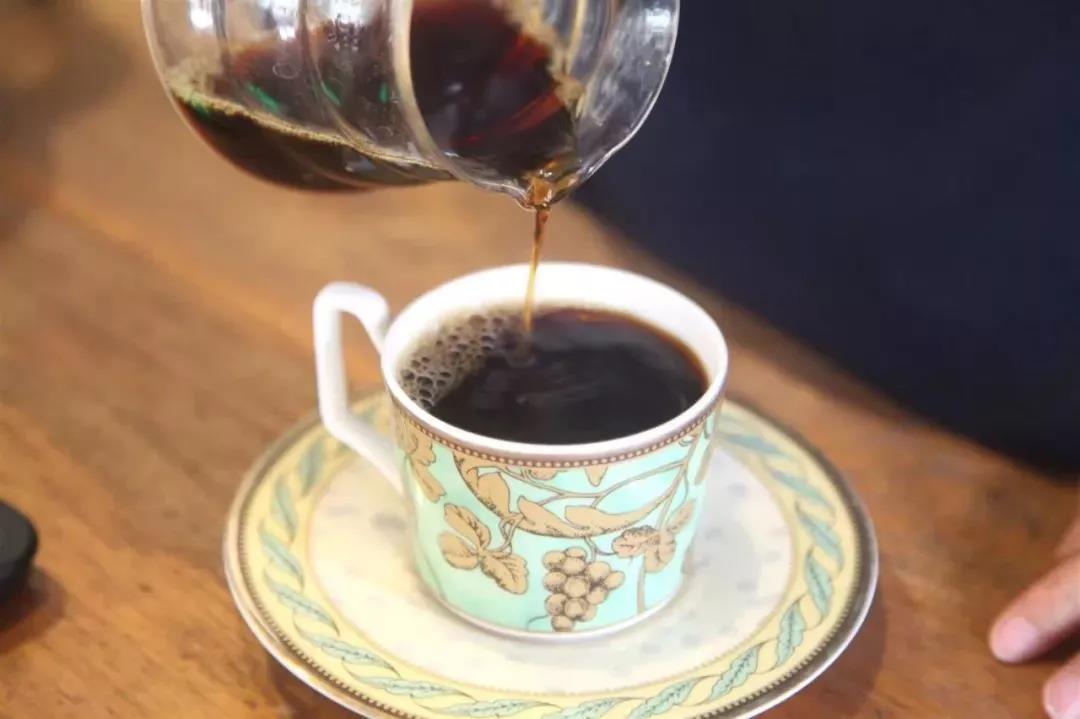
Brewing parameters: Hario V60 dripper, 90°C water temperature, 15 g coffee dose, 1:15 coffee-to-water ratio, medium-fine grind (BG#6S).
Brewing method: using segmented extraction, bloom with 30 g of water for 30 seconds. When the pour reaches 125 g with a small water flow, pause to segment. Continue pouring to 225 g and stop. Extraction time is 2 minutes, timed from the start of blooming.
Flavor description: a relatively thick texture with noticeable sweet and sour sensations. Smooth on entry with rich red wine flavor, high sweetness, bright and lively acidity, and rich layers; tropical fruit, nuts, red wine aftertaste, honey, and sucrose are prominent. After it cools completely, brown sugar flavors emerge.
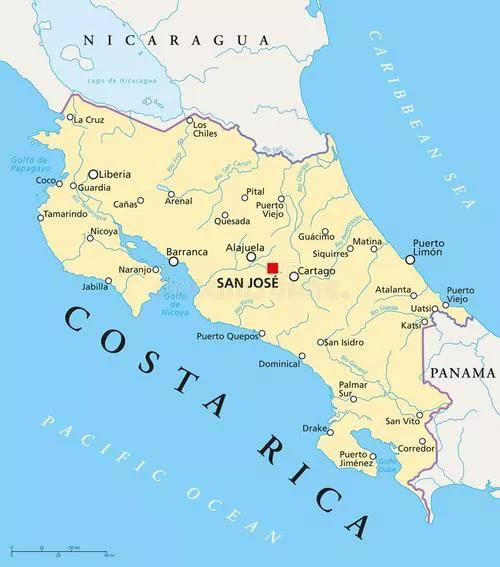
Costa Rica (Flavor Profile: Nuts, floral toffee flavors, moderate sweet and sour, aromatic and mellow)
Costa Rica's coffee cultivation started early, and it was the first country in Central America to grow coffee. As early as 1820, coffee was exported to Europe and became an instant success, once praised by British nobility as "golden beans." Later, after Costa Rica freed itself from Spanish colonial rule, the government began implementing policies to strongly support the coffee industry and promote the development of private estates. As coffee farmers grew wealthy, many sent their children to Europe for advanced studies, and they returned as doctors and engineers, a sign of how highly coffee farmers were regarded in Costa Rica. Costa Rica also has laws allowing only Arabica cultivation; Robusta beans are "prohibited" within its borders, a unique initiative worldwide.
Costa Rica Coffee Bean Processing Methods
Costa Rican beans mostly use washed processing, but their most representative method is honey processing, which yields higher sweetness than washed. Honey processing retains mucilage during drying, resulting in honey-like sweet flavors. Depending on how much mucilage is retained, it is further divided into white honey, yellow honey, red honey, and black honey.
Building on honey processing, raisin honey processing has also been developed. This involves not depulping first and instead placing the cherries directly on drying beds overnight, causing the skin and pulp to contract until they resemble raisins. Subsequent steps follow conventional honey processing.
Costa Rica Growing Regions
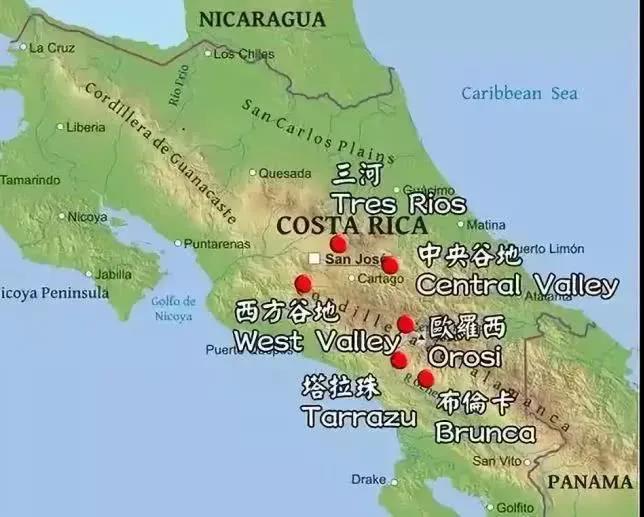
Costa Rica has eight main coffee growing regions: West Valley, Central Valley, Tarrazu, Tres Rios, Orosi, Brunca, Turrialba, and Guanacaste. Among these, Central Valley, Tarrazu, and Tres Rios are the most famous.
Tarrazu, located south of the capital San José at 1,200-1,700 m, has fertile, well-drained soil. The harvest season runs December to March. Its main characteristic is the unmatched, perfect taste created by high-altitude cultivation: a smooth mouthfeel, hard and full beans, and a rich aroma.
Central Valley, at 1,200-1,600 m, has a harvest season from November to March. The region contains three high-altitude volcanoes, Irazu, Barva, and Poas, which provide rich nutrients to the surrounding coffee areas. A superior microclimate combined with volcanic, fertile soil gives Central Valley beans chocolate and cocoa flavors and elegant aromas. The region has three sub-regions: San José, Heredia, and Alajuela.
Tres Rios, near the Irazu volcano east of the capital at 1,200-1,650 m, has a harvest season from December to March. In recent years, urban expansion into the suburbs has led farmers to sell land to developers, causing a sharp decline in Tres Rios coffee production. Most production is now contracted by Starbucks, making it hard for the industry to purchase. The well-known Aquiares estate in Tres Rios has operated since 1857 and has a long history. Tres Rios has good climatic conditions and produces beans with excellent balance.
Costa Rica Bach Musician Series coffee comes from Canet Estate in Tarrazu, using Costa Rica's famous raisin honey processing. Canet Estate produces four Musician Series coffees, and Bach is one of them.
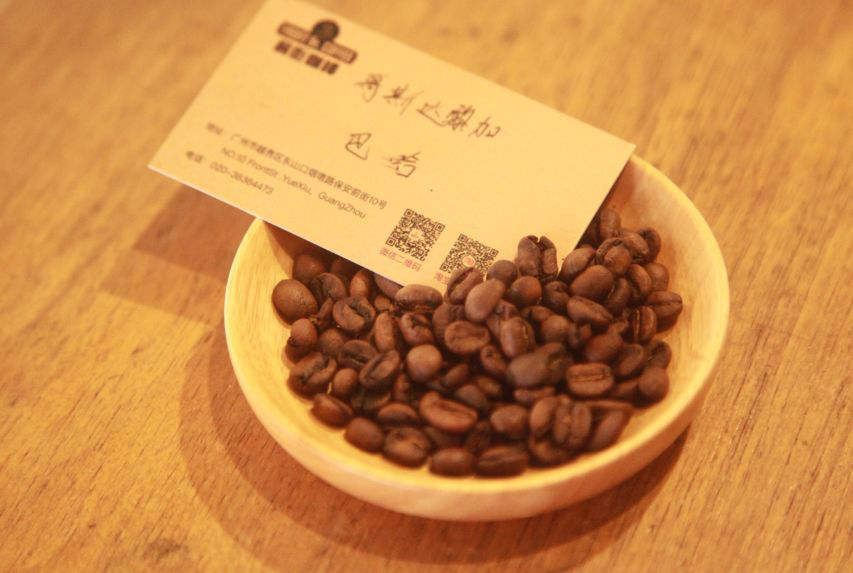
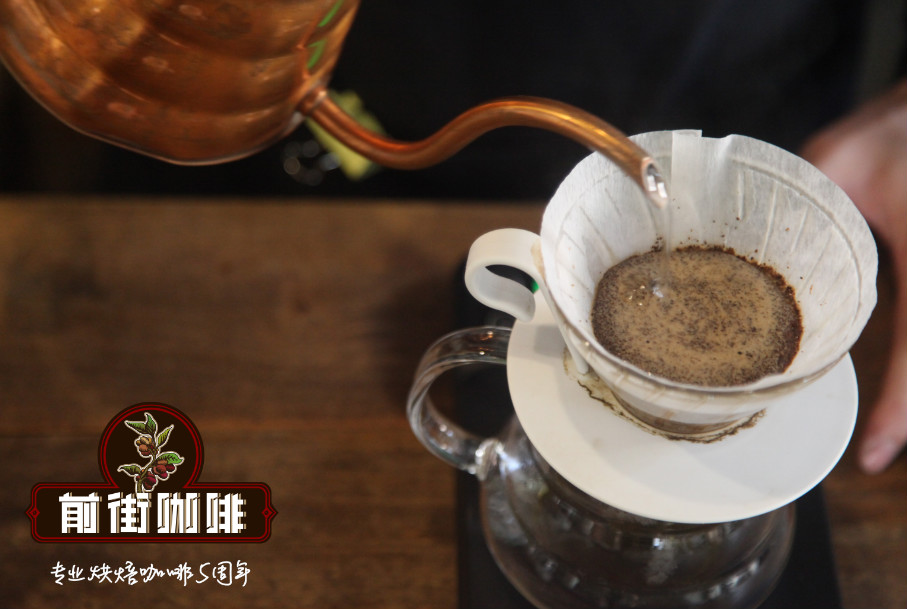
Brewing parameters: Hario V60 dripper, 90°C water temperature, 15 g coffee dose, 1:15 coffee-to-water ratio, medium-fine grind (BG#6S).
Brewing method: using segmented extraction, bloom with 30 g of water for 30 seconds. When the pour reaches 125 g with a small circular water flow, pause to segment. Continue pouring to 225 g once the water level drops to just expose the coffee bed. Extraction time is 2 minutes, timed from the start of blooming.
Flavor description: rice wine fermentation aroma, with sweet and sour sensations of ripe tropical fruits and berries on entry, nut and cream flavors, a caramel aftertaste, and subtle floral notes in the finish.
Honduras (Flavor Profile: Balanced and smooth, acidic with slight sweetness, high body and aroma)
Honduras's coffee industry developed relatively late, well behind most neighboring Central American countries. With strong government support and by learning from Brazil's development model, it gradually grew. In particular, in 2010, Japanese specialty coffee involvement and cooperation gave Honduras the potential to become a major player. Since 2011, Honduras's coffee production has surpassed Guatemala's, making it the largest coffee producer in Central America and one of the top ten worldwide.
Most Honduran coffee is exported to Europe, with Germany the main destination, importing nearly 40 million kilograms annually. Some Honduran coffee also goes to the US and Japan, but those volumes are not as significant as Europe's.
Honduras has 280,000 hectares of coffee plantations, predominantly small farms. Most are smaller than 3.5 hectares, and together they account for 60% of Honduras's total coffee production.
Honduras Coffee Bean Processing Methods
High-quality Honduran coffee mostly uses washed processing, which preserves the coffee's original flavors. Building on washed processing, barrel-fermentation washed methods have also been developed. The recently popular Sherry coffee uses refined washed whiskey-sherry barrel fermentation: freshly picked cherries are refined-washed, then placed in sherry wine barrels for low-temperature fermentation for 30-40 days at approximately 15-20°C, followed by shade drying.
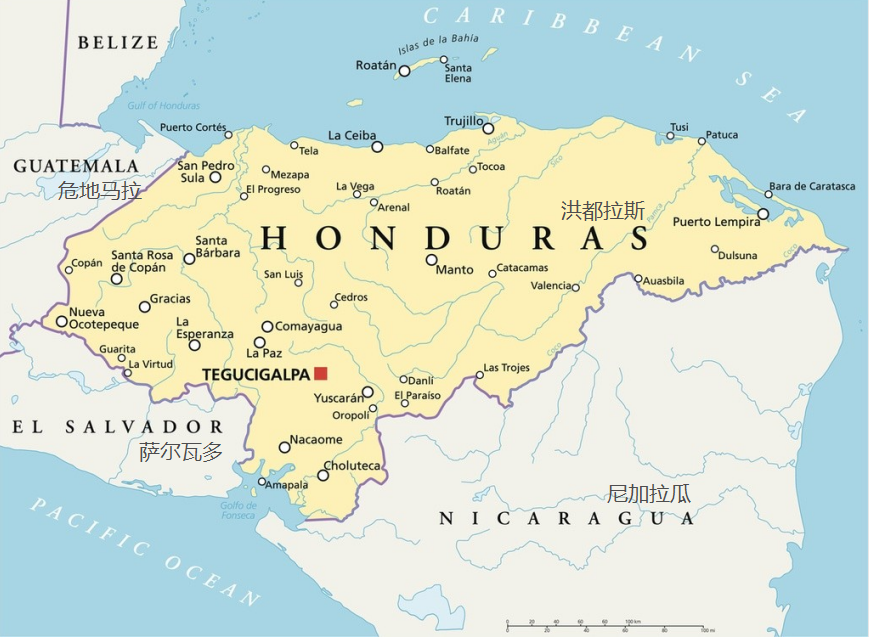
Honduran coffee can be divided into six major regions, mainly in the west and south: Copan, Opalaca, Montecillos, Comayagua, Agalta Tropical, and El Paraiso. Three are main regions:
Montecillos: the highest-altitude region in Honduras, producing coffee with bright, complex flavors, rich fruit and sweet aromas, and citrus notes.
Copan: beans from this region have chocolate flavors, a rich body, and high sweetness.
Agalta: beans here have balanced honey sweetness and acidity, with chocolate notes.
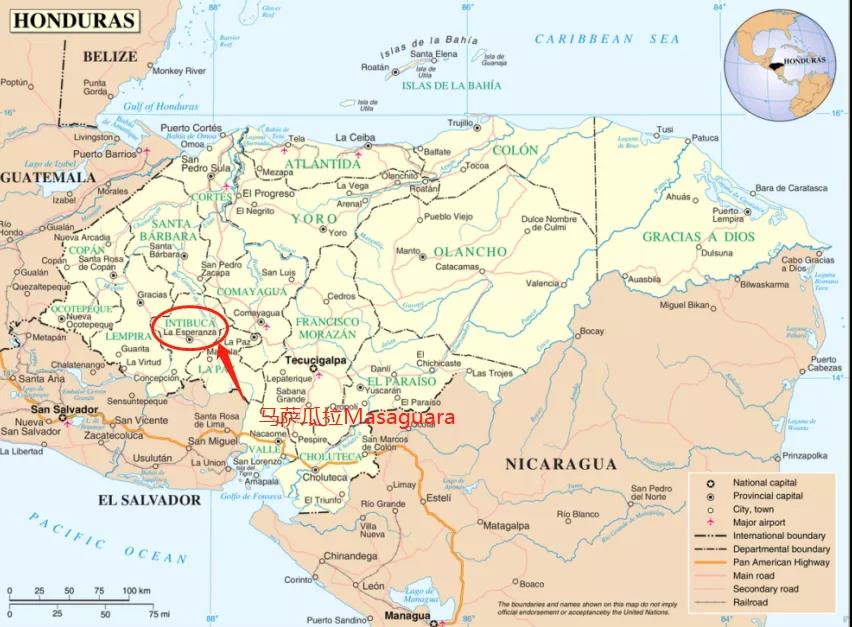
The recently popular Sherry coffee and Lychee Lan coffee, however, do not come from these six major regions. They come from Masaguara, a city in the Intibucá province of southwestern Honduras.
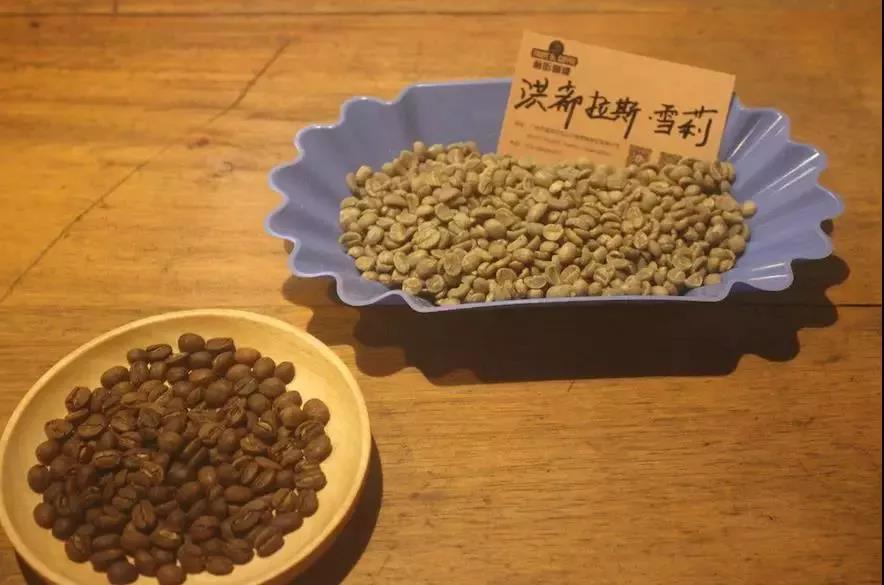
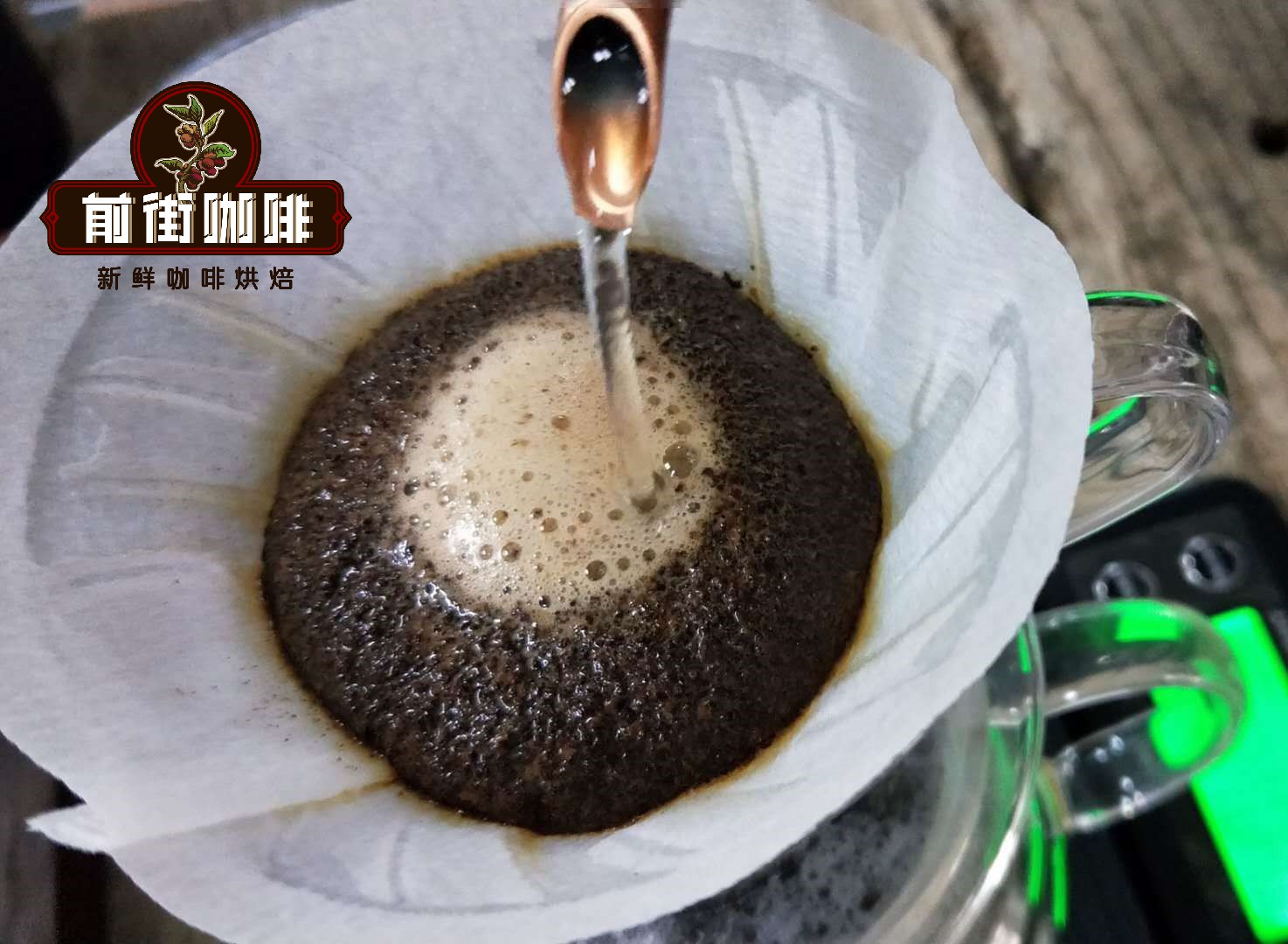
Brewing parameters: Hario V60 dripper, 90°C water temperature, 15 g coffee dose, 1:15 coffee-to-water ratio, medium-fine grind (BG#6S).
Brewing method: using segmented extraction, bloom with 30 g of water for 30 seconds. When the pour reaches 125 g with a small circular water flow, pause to segment. Continue pouring to 225 g once the water level drops to just expose the coffee bed. Extraction time is 2 minutes, timed from the start of blooming.
Flavor description: vanilla and cream aromas on entry, citrus and berry acidity, almond and dark chocolate flavors in the middle, maple sweetness in the finish, and a vanilla aftertaste. Distinct flavors with a smooth mouthfeel. The flavors remain stable from hot to cold, with no off-flavors appearing.
Jamaica Blue Mountain (Flavor Profile: Rich and mellow, perfect balance of sweet, sour, and bitter)
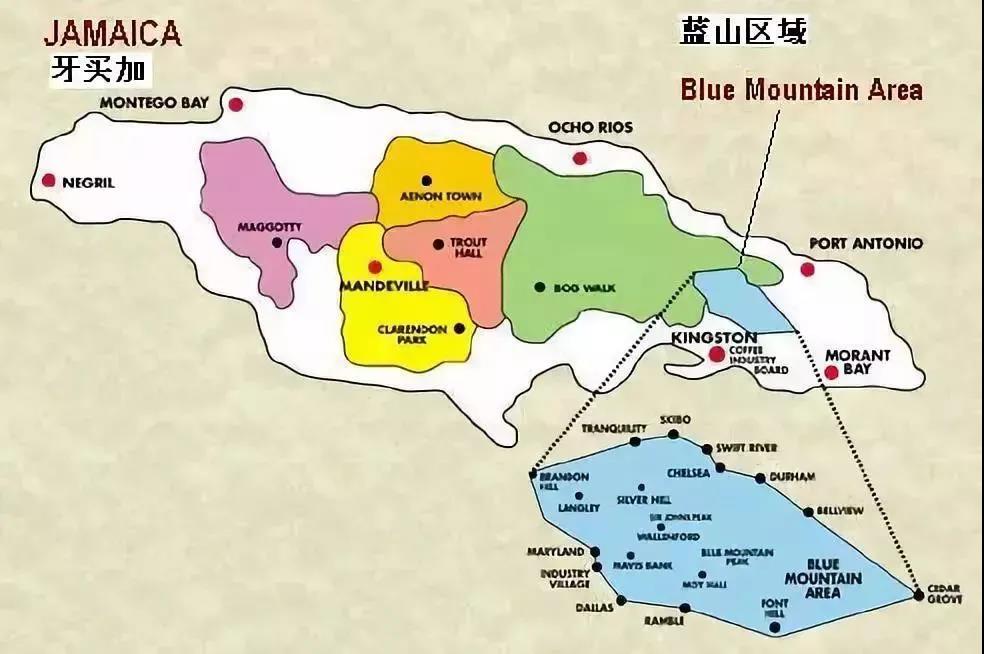
Jamaica is an island in the Caribbean Sea. Its Blue Mountains are the highest in the western Caribbean (peak altitude 2,256 m, with coffee grown only below 1,700 m; above that is protected forest). The Blue Mountains lie at 25° north latitude in the coffee belt, with fertile volcanic soil, fresh air, year-round rainfall, high humidity, large day-night temperature differences, regular rainfall, and misty cloud cover that shields the coffee trees from direct sun.
Jamaica Blue Mountain Coffee Bean Processing Methods
Jamaica Blue Mountain beans mainly use washed processing, which ensures the standard Blue Mountain flavor profile. Coffee enthusiasts had something to celebrate this year, though: natural processed Blue Mountain coffee has been successfully produced. This natural Blue Mountain represents an unprecedented, innovative attempt. The development team faced numerous challenges, needing not only permission from Jamaica's Ministry of Agriculture to export non-washed green beans but also conducting multiple investigations and learning from excellent estates to adjust processing methods.
Jamaica Blue Mountain Coffee Bean Grading
Coffee from the Jamaica Blue Mountain region has three grades: Blue Mountain Coffee, Jamaica High Mountain Supreme Coffee Beans, and Jamaica Prime Coffee Beans.
Blue Mountain Coffee is further divided into grades. From high to low: Blue Mountain No.1, Blue Mountain No.2, Blue Mountain No.3, and PB (also called peaberries or round beans).
Blue Mountain No.1: 96% of green beans are 17/18 screen size, with a defect rate below 2%.
Blue Mountain No.2: 96% of green beans are 16/17 screen size, with a defect rate below 2%.
Blue Mountain No.3: 96% of green beans are 15/16 screen size, with a defect rate below 2%.
PB: 96% of green beans are PB, with a defect rate below 2%.
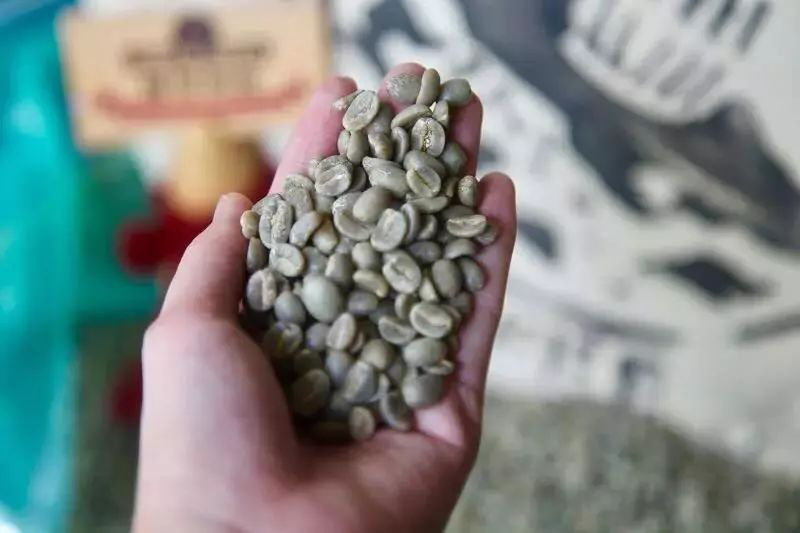
As mentioned earlier, not all Blue Mountain coffee beans are genuine Blue Mountain. FrontStreet Coffee's beans come from Jamaica's oldest Clifton Manor, which holds Rainforest Alliance certification.
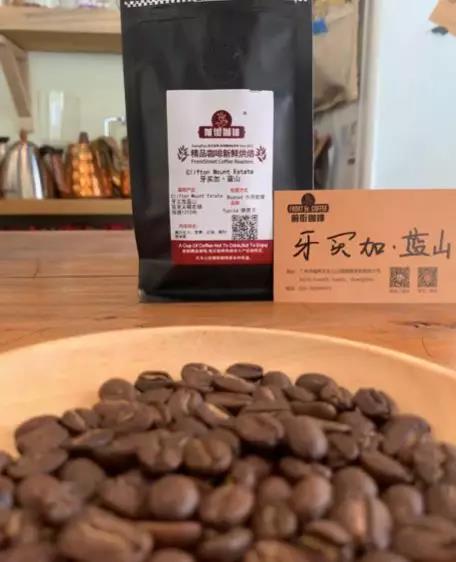
Brewing parameters: Kono dripper, 88°C water temperature, 15 g coffee dose, 1:15 coffee-to-water ratio, medium-fine grind (BG#6W).
Brewing method: using segmented extraction, bloom with 30 g of water for 30 seconds. When the pour reaches 125 g with a small circular water flow, pause to segment. Continue pouring to 225 g once the water level drops to just expose the coffee bed. Extraction time is 2 minutes, timed from the start of blooming.
Flavor description: a clean and gentle mouthfeel, rich and mellow, with dark chocolate, nuts, cream, and a balanced sweet, sour, and bitter profile.
Guatemala (Flavor Profile: Rich fruit aroma, balanced sweet and sour)
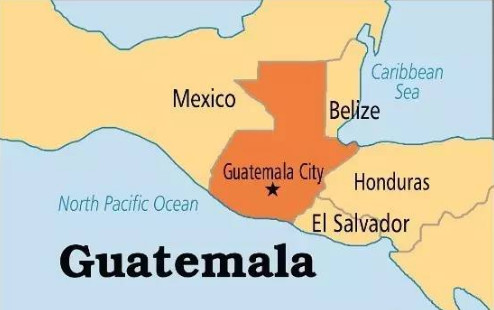
Although Guatemala has a small land area, it uniquely encompasses both mountains and sea, featuring tropical rainforests, volcanic geology, highland valleys, and varied microclimates. These diverse geographical factors create Guatemala's unique coffee flavors.
Guatemala has a high average altitude, with coffee belts distributed above 1,500 m, ideal for growing extremely hard beans. The specialty-grade proportion is high, and the country mainly cultivates Bourbon, Typica, Caturra, and Catuai.
Guatemala Coffee Bean Processing Methods
Guatemalan beans primarily use washed processing, supplemented by natural. Washed processing ensures the fruity flavors of Guatemalan coffee, while natural processing adds richness and complexity.
Guatemala Growing Regions
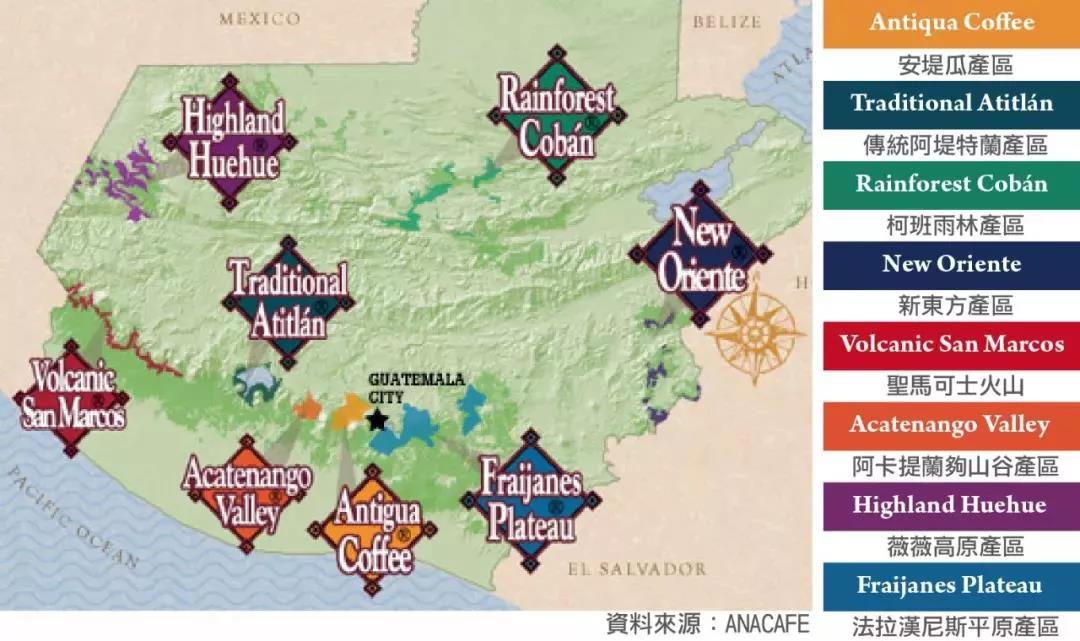
Guatemala is divided into eight growing regions, five volcanic and three non-volcanic: Antigua, Traditional Atitlán, Cobán Rainforest, Nuevo Oriente, San Marcos Volcano, Acatenango Valley, Huehuetenango Highlands, and Fraijanes Plateau.
Even within the same region, flavors can vary. In Huehuetenango Highlands, for example, crossing a single mountain ridge can immediately produce a significant flavor change. Combined with increasingly diverse varieties and processing methods, coffee flavors present a flourishing diversity.
Non-Volcanic Regions
Huehuetenango Highlands has the driest climate and highest altitude among Guatemala's three non-volcanic coffee regions. Its beans show high acidity, bitter and aromatic character, a wine-like aftertaste, and an excellent mouthfeel.
Cobán Rainforest's main feature is its rainforest, with two seasons annually, a heavy rainy season and a light one. This tropical rainforest brings high humidity and abundant nutrients. The coffee's main characteristic is intense fruity flavors, closely related to the local high humidity.
Nuevo Oriente, in easternmost Guatemala, has the most recently developed coffee cultivation and was once the country's most remote and poorest area. Its rainy and foggy character makes it somewhat similar to Cobán Rainforest, but with slightly less humidity and rainfall. The soil is rich in minerals with balanced nutrition. Its beans show a balanced mouthfeel, full body, and chocolate notes, but the lowest fruit acidity among Guatemala's eight regions. Chocolate aroma is Nuevo Oriente's main characteristic.
Volcanic Regions
Antigua is one of Guatemala's most renowned coffee regions and has the highest award frequency, crowned as "Classic." Its main features are rich volcanic soil, low humidity, abundant sunlight, and large day-night temperature differences. The region is surrounded by three volcanoes: Agua, Fuego, and Acatenango. Fuego is one of Guatemala's three most active volcanoes. Frequent local volcanic activity provides pumice that retains moisture and continuously supplies volcanic ash and minerals to the soil, overcoming Antigua's low rainfall and creating perfectly balanced sweet, sour, bitter, and aromatic characteristics.
Acatenango Valley, with altitudes up to 2,000 m, has dense shade and a unique ecology. Nearby volcanic eruptions continuously enrich the soil with fertile minerals, the best natural fertilizer. Coffee processing mainly uses traditional family methods. Its beans resemble Antigua but with slightly lower fruit acidity, prominent and pleasant dry and wet aromas, a full body, a clear aftertaste, and a refreshing aroma.
Traditional Atitlán has the most abundant organic components in its soil among the five volcanic regions. This area has accumulated excellent cultivation and processing techniques over time. Ninety percent of the coffee is grown on steep volcanic slopes around Lake Atitlán at altitudes between 1,300 and 2,000 meters. Its beans show mild acidity, a bright citrus peel aroma, and an excellent body.
Fraijanes Plateau is volcanic, with high altitude and mineral-rich soil. Its coffee tends toward balance but has more unique aromas and flavors than Antigua.
Antigua Flora coffee comes from La Minita Manor in Antigua, using washed processing. Because it is grown near volcanoes, the coffee carries Guatemala's characteristic smoky notes.

Brewing parameters: Hario V60 dripper, 90°C water temperature, 15 g coffee dose, 1:15 coffee-to-water ratio, medium-fine grind (BG#6S).
Brewing method: using segmented extraction, bloom with 30 g of water for 30 seconds. When the pour reaches 125 g with a small circular water flow, pause to segment. Continue pouring to 225 g once the water level drops to just expose the coffee bed. Extraction time is 2 minutes, timed from the start of blooming.
Flavor description: citrus acidity is quite prominent with rich floral notes, a pleasant sweetness, medium body, and slight caramel sensations in the finish. Overall balanced and clean, with a smooth texture.
For more specialty coffee beans, please add FrontStreet Coffee on WeChat: kaixinguoguo0925
FrontStreet Coffee Recommendation
If this tasting tour made you want to start with Brazil, FrontStreet's Brazil Cerrado Red Bourbon is an excellent classic single-origin. Cerrado is a well-known Brazilian region celebrated for high-quality beans, and this Red Bourbon is medium roasted to bring out creamy peanut, toasted bread, caramel, and hazelnut aromas with a rounded, smooth body, no acidity, and a gentle bitterness. It works as a pour-over and also suits a moka pot, espresso SOE, siphon, or French press.
For a more distinctive Brazilian cup, FrontStreet Brazil Queen Estate comes from Mogiana, where fertile red volcanic soil helps the fruit develop concentrated aromatics. Its rare Yellow Bourbon variety, a natural mutation of Red Bourbon, offers a cleaner fruity character and a sugarcane sweetness that other regions rarely match, along with soft fruit and chocolate notes in a pour-over, moka pot, or home espresso machine.
Important Notice :
FrontStreet Coffee is a long-established specialty coffee roaster in Guangzhou China, selling freshly roasted beans from its own farm in Yunnan as well as dozens of carefully selected single-origin beans from around the world for both pour-over and espresso. The products deliver consistently excellent quality and great value, with shipping within 24 hours. Guangzhou's FrontStreet Coffee shop is recommended by many coffee lovers, and the beans are now available online at the Tmall 。
FrontStreet Coffee has moved to a new address:
FrontStreet Coffee Address: 315,Donghua East Road,GuangZhou
Tel:020 38364473
 Scan and follow the En Gafei WeChat official account. Please indicate that the reprint comes from "En Gafei".