Introduction to Single-Origin Coffee Varieties and Processing Methods at Imni Estate, West Java, Indonesia
Indonesia, officially the Republic of Indonesia, is a well-known coffee-producing nation in Asia and one of the countries of Southeast Asia. It earned the nickname "Thousand Islands" for a simple reason: it is made up of as many as 17,508 islands, part of the Malay Archipelago and the largest archipelagic nation on Earth. It is, quite literally, an island country. Its coffee-growing neighbors include Papua New Guinea and East Timor, and it also shares borders with countries such as Malaysia.
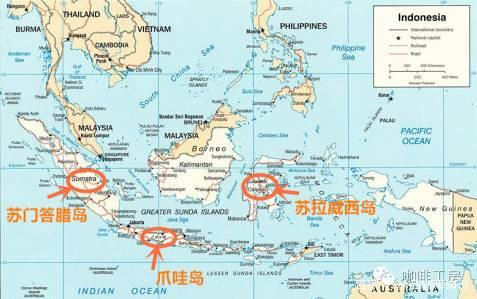
SUMATRA
Sumatra has three main growing regions: the northern Aceh region, the area just south of Lake Toba, and the more recently established islands near Mangkuraja. On a finer scale, sub-regions trace back to Takengon and Bener Meriah in Aceh Province, and to Lintong, Sidikalang, Dolok Sanggul, and Seribu Dolok around Lake Toba. Beans sold from this region were once commonly labeled "Sumatra Mandheling," even though no place called Mandheling exists; the name actually comes from a local island tribe. Mandheling is typically graded Grade 1 or Grade 2, and the grading is based on cupping quality rather than the raw-bean quality many people assume. Even so, the value of recommending Grade 1 is debatable, since the grade has become almost universal. Separating varieties into different lots seems strange, so most Sumatra beans are blends of unidentified varieties. Sumatra coffee is exported through the port of Medan, but a long wait at port before export, in that hot and humid climate, works against bean quality.
Altitude: Aceh 1100-1300m, Lake Toba 1100-1600m, Mangkuraja 1100-1300m
Harvest: September—December
Varieties: Typica (including Bergandal, Sidikalang, Djember), Timtim, Ateng, Onan Gajang
JAVA
This region inherited Dutch colonial practices and customs, which is why it has more large plantations. The four major coffee estates, covering 4000 hectares, were once government-owned plantations. In those days beans from this region enjoyed an excellent reputation, though not long afterward many of the blends in "Mocha-Java" were replaced by other varieties. Java coffee held high prices for a long time before falling sharply in the 20th century. Today the growing areas cover the vicinity of the Ijen volcano in eastern Java and the western part of the island.
Altitude: 900-1800m
Harvest: September—September
Varieties: Typicas, Ateng, USDA
FLORES
Flores is a small island roughly 320 kilometers (200 miles) east of Bali, one of the islands of the Indonesian archipelago. It joined the coffee industry relatively late but has since built a solid reputation for cultivation. In the past, much of Flores's production was consumed domestically or blended into other coffees for export, and it was rarely sold directly as "Flores coffee." The island has both active and dormant volcanoes, and the mixture from Bajawa volcano has a strong positive influence on the main growing areas. Semi-washed processing is the most common method here, though some beans are still fully washed.
Altitude: Tana Toraja 1200-1800m, Mamasa 1300-1700m, Gowa average 850m
Harvest: May—September
Varieties: Typicas, Ateng, Robusta
BALI
Coffee arrived in Bali relatively late, first taking root on the Kintamani plateau. Production was hit hard when Mount Agung erupted in 1963, killing more than 20,000 people and devastating eastern Bali. By the late 1970s and early 1980s the government was distributing Arabica seedlings to boost production, though some argue the effort had limited effect, since roughly 80% of the island's output today is Robusta. Although tourism generates the largest income, agriculture employs the most people on the island, and Japan was historically the largest buyer.
Altitude: 1,250-1,700m
Harvest: May—October
Varieties: Typicas, Typica derivatives, Robusta
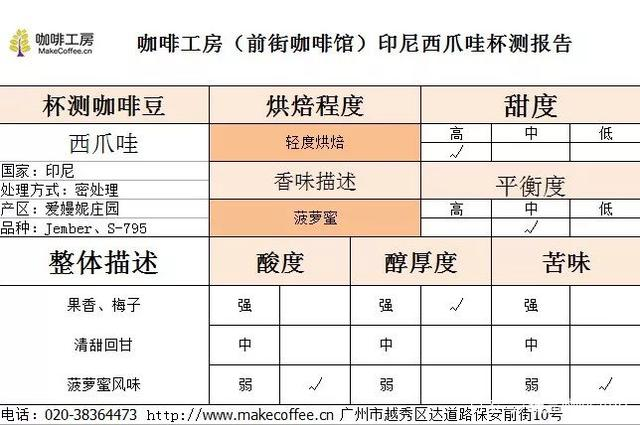
Taste Description: Strong fruit aroma, with plum and jackfruit flavors, clean and sweet aftertaste.
Flavor: Complex floral aroma upon entry, with tropical fruit flavors like mango and jackfruit on the palate, rich mouthfeel, and long-lasting aftertaste.
Cultivation History
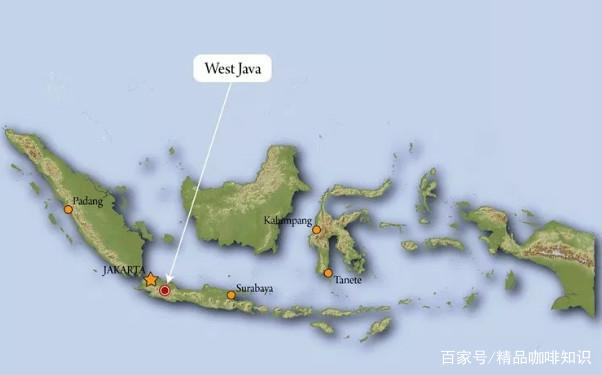
Java has a very long history of coffee production, and West Java was the first place coffee was planted during the Dutch colonial period in Indonesia. The Dutch began planting and exporting coffee trees on Java (then part of the Dutch East Indies) in the 17th century. In the early days of Dutch rule they cultivated Arabica Typica, introduced from Ceylon Island (modern Sri Lanka). In the 17th century the colonial government planted coffee first in Batavia and then southward to Sukabumi, and it spread widely through central and eastern Java, West Java, parts of Sumatra, and Sulawesi, establishing coffee's lofty market standing.
Java's coffee trees were sent to the Netherlands in 1711 and grown in Amsterdam greenhouses, then passed to the French court in 1715. From there, the regions where the Dutch and French cultivated coffee across Asia and the Americas became the New World's coffee. The better-quality Java coffee tends to come from state-owned and private plantations; state plantations, backed by government support, find it easier to sell to Europe and the United States and therefore enjoy greater renown.
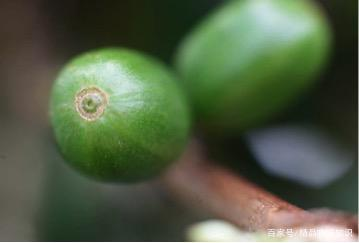
Aromanis Estate
Aromanis is a traditional Indonesian sweet pastry made from the simplest ingredients, flour and sugar. Naming a coffee after it signals that these beans have a texture reminiscent of cotton candy.
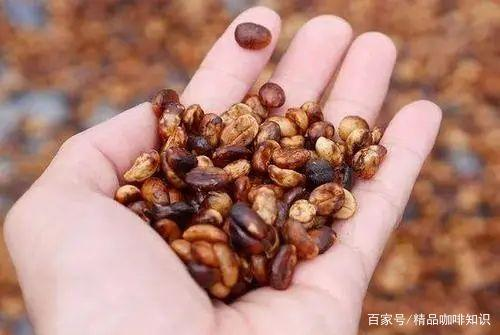
Natural Honey Process
Picking is done by hand to keep the cherries consistent. After picking, the outer skin is removed and the beans are dried naturally with the pulp still attached, a method also known as pulped natural. After roughly one month of natural drying, the beans are washed and otherwise treated, then rested for about half a month before packaging. The whole point of the process is to create a more complex and fuller flavor.
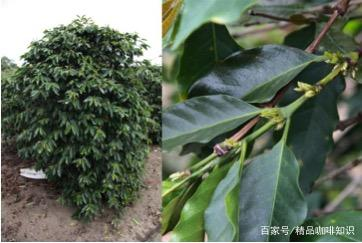
S795 Variety
S795 Local Name: Jember
This variety was bred in India in the 1940s by crossing Kent (a Typica selection that is tall, high-yielding, and highly resistant to leaf rust) with Coffea Liberica. In 1955 the Indonesian Coffee and Cocoa Research Institute (ICCRI) named it Jember, and it is now widely planted in India, Indonesia, Yemen, and Ethiopia. It carries some resistance to coffee leaf rust, though that resistance fades over time. In the cup it offers maple syrup and brown sugar-like flavors.
FrontStreet Coffee West Java Coffee
Region: Mount Tangkuban Perahu, West Java
Estate: Aromanis Estate
Processing: Natural Honey Process
Variety: S795
FrontStreet Coffee Roasting Suggestions
West Java green beans are dense, so heat adjustments demand special care. To bring out fruit and sweetness, FrontStreet Coffee's roaster chooses a medium roast, which lets the green beans express their full character.
Roaster: Yangjia 800N
Heat the roaster to 200°C and charge the beans, opening the air damper to 3. After 1 minute of steaming, drop the heat to 160°C and keep the air damper unchanged. When the drum reaches 165°C, adjust the heat again, down to 130°C. At 5'35", with the temperature at 152°C, the bean surface turns yellow, the grassy smell disappears entirely, dehydration is complete, and the air damper goes to 4.
By the 9th minute, ugly wrinkles and black spots appear on the bean surface and the toast aroma clearly shifts to coffee aroma, the signal we call the prelude to first crack. Listen carefully for the sound of first crack, which begins at 9'21"; hold the small heat steady and open the air damper fully to 5 (adjust heat with great care, never so low that cracking stops). Unload at 198.6°C.

FrontStreet Coffee Cupping Report
FrontStreet Coffee Brewing Suggestions
Dripper: V60
Coffee-to-water ratio: 1:15
Temperature: 89°C
Grind size: BG#6S
FrontStreet Coffee Brewing Method
Use 30g of water for a 30-second bloom, then pour in circles to 125g, wait for the water level to drop, then pour to 225g. Total time: 2 minutes.

Flavor Description
Fruit aroma with plum and jackfruit flavors, and a clean, sweet aftertaste.

FrontStreet Coffee Recommendation
If you enjoy the bold, full-bodied side of Indonesian coffee, Mandheling is the place to start. FrontStreet offers a few ways in, depending on how deep you want to go.
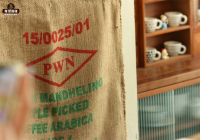
FrontStreet PWN Gold Mandheling
Gold Mandheling is the benchmark for a top-tier Mandheling. FrontStreet's comes from Indonesia's PWN company, which applies exceptionally strict standards: beans of 18 screen or above, with fewer than 3 defective beans in a 300-gram green bean sample, meeting the highest G1 grade. On top of that come three rounds of hand sorting to eliminate every remaining defect, which lifts both the cup's cleanliness and the intensity of its sweetness. PWN mainly supplies the Japanese and American markets, so the amount imported domestically each year is limited. The cup is clean and full-bodied with dark chocolate, caramel, and nut notes, plus the herbal, woody character that wet-hulling gives Sumatra coffee.
FrontStreet Lintong Mandheling
Grown around Lake Toba in North Sumatra, this is the traditional Mandheling heartland, where a mix of plant varieties, a suitable growing altitude, wet-hulled processing, and local microbial fermentation together create the classic profile. Roasted medium-dark, it is rich and intense with low acidity, carrying clove, woody aromatics, and a spice-and-mint quality along with a long, deep sweetness. It suits anyone who likes a heavy, full cup and doesn't care for bright acidity.
FrontStreet Classic Blend
For espresso and milk drinks, FrontStreet's Classic Blend builds on Brazil's creamy, nutty base and adds medium-dark Mandheling, which brings butter, roasted chestnut, and caramel to the front. Mandheling also raises the overall body and lends a distinctive sandalwood, herbal, spice character, while a small amount of Robusta boosts the richness of the crema. It steams milk beautifully for latte art and layers cleanly for a Dirty.
Important Notice :
FrontStreet Coffee is a long-established specialty coffee roaster in Guangzhou China, selling freshly roasted beans from its own farm in Yunnan as well as dozens of carefully selected single-origin beans from around the world for both pour-over and espresso. The products deliver consistently excellent quality and great value, with shipping within 24 hours. Guangzhou's FrontStreet Coffee shop is recommended by many coffee lovers, and the beans are now available online at the Tmall 。
FrontStreet Coffee has moved to a new address:
FrontStreet Coffee Address: 315,Donghua East Road,GuangZhou
Tel:020 38364473
 Scan and follow the En Gafei WeChat official account. Please indicate that the reprint comes from "En Gafei".