Characteristics of Aged Mandheling Coffee Beans Preserved for Over a Decade - A Cross-Century Sumatran Coffee Bean Story

The Sumatran tiger on Sumatran coffee packaging is well justified. It is the only tiger that lives on an island far from the mainland, found exclusively on Indonesia's Sumatra. Its habitat runs from lowland forest to high mountains, and only about 400 to 500 wild Sumatran tigers remain, mostly in five national parks on the island.
Sumatran beans are also among Indonesia's most representative coffees. FrontStreet Coffee specializes in fresh roasted premium coffee and carries five Mandheling varieties, whose flavors differ subtly with origin and processing.

Sumatran Coffee Regions and Varieties
Sumatra divides mainly into two growing regions. The south centers on Medan, Lake Toba, and the Lintong area, the traditional Mandheling region where the varieties we know originate. Mandheling G1, Golden Mandheling, Tiger Mandheling, and the others all come from here.
Lintong Mandheling is essentially pure Arabica. Some say recent plantings have been crossed with Robusta bloodlines, though the details are unclear, and by bean appearance it still looks like pure Arabica. Processing is mainly the most traditional washed method, though in recent years mills such as WHANA have begun using natural and honey processes, with noticeable quality gains.

FrontStreet Coffee's Lintong Mandheling comes from the Lintong region of Sumatra, grown at 1100 to 1600 meters. Typica and Caturra are processed by the common Indonesian wet-hulled method, with flavor notes of toasted bread, nuts, caramel, pine, and herbs.

FrontStreet Coffee's Golden Mandheling comes from Mount Gayo in Aceh, Sumatra, grown at 1100 to 1600 meters. The Ateng variety is wet-hulled, with flavor notes of spices, herbs, caramel, pine, nuts, and chocolate.
Unlike other Mandheling, Golden Mandheling undergoes G1 grade selection with three rounds of hand sorting, which leaves beans strikingly uniform in size. Its specification is 18 screen or above, with fewer than 3 defective beans in a 300g raw bean sample, the highest G1 grade. The color is dark green and the shape a neat flat bean. After that strict screening, Golden Mandheling not only removes the earthy impurities typical of ordinary Mandheling but tastes cleaner and brighter, with stronger sweetness.

FrontStreet Coffee's Tiger Mandheling comes from Sumatra, grown at 1500 meters. Caturra, Typica, and Sidikalong are wet-hulled, with flavor notes of nuts, cream, dark chocolate, caramel, and pine.
FrontStreet Coffee's Aged Mandheling also comes from Sumatra, grown at 1500 meters, with Caturra and Typica processed by the wet-hulled method. The aging gives it a rounder, deeper flavor, as intoxicating as aged Pu-erh tea.

The Heritage of Aged Coffee
Aged coffee has a long history in Indonesia. Early shipping was not well developed, so moving coffee from Indonesia to other countries took considerable time. Over the voyage the moisture-rich fresh beans gradually dried, and the sea breeze added a very particular flavor. Modern shipping has cut that transit time dramatically, so coffee with those flavors is now a deliberately processed variety.
Anyone who understands Mandheling knows it is mostly roasted dark. There are two reasons. First, given its processing method and mixed varieties, the bean carries a relatively high defect rate, and dark roasting masks that flaw perfectly. Second, Mandheling was first promoted by the Japanese, who also prefer texture-driven tasting. That explains why Mandheling is roasted so dark.

Natural Process Mandheling
Beyond the four wet-hulled Mandheling beans above, FrontStreet Coffee also carries one uncommon one: Natural Process Mandheling.
It comes from Lake Toba in Sumatra, from the Wahana Estate, where coffee grows at 1000 to 1700 meters. Bourbon and Typica are processed naturally. For roast level, FrontStreet Coffee experimented with a medium-light roast, and the flavor notes are melon, fermentation aroma, mango, tropical fruits, and peach.

Brewing Recommendations
FrontStreet Coffee's recommended brewing method for Sumatran coffee:
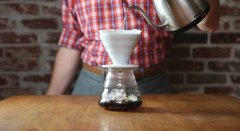
FrontStreet Coffee recommends the pour-over method.
FrontStreet suggests Kalita wave-shaped drippers or KONO drippers with flannel filters, immersion-extraction-focused designs, for these four wet-hulled Mandheling beans.

Pour-over water temperature: 86-88 degrees Celsius, since the dark roast degree means high heat easily over-extracts
Pour-over grind size: Medium, slightly coarser than for light roast beans, to reduce the extraction rate
Pour-over coffee-to-water ratio: 1:15, using a tighter ratio to highlight the rich texture of Sumatran coffee
FrontStreet Coffee's Four Mandheling Coffee Beans Pour-over Parameters:
Brewing parameters:
- Filter: KONO
- Water temperature: 86-88 degrees Celsius
- Grind size: Fuji Royal grinder setting 4
- Roast degree: Dark roast
- Bloom time: 30 seconds

Brewing technique:
15g coffee grounds, a 1:15 coffee-to-water ratio, a Fuji Royal ghost tooth grinder at setting 4, a KONO dripper, and 86 to 88 degrees Celsius. First pour 30g of water for a 30 second bloom, second pour to 125g, wait until the water level drops halfway, and continue to 225g. Total extraction time 2 minutes.

Natural Process Mandheling is a special case: because it is medium roast, the technique differs from the medium-dark Mandheling beans.
FrontStreet Coffee has built up extensive experimental experience with brewing and has standardized its parameters by roast degree as far as possible.
FrontStreet Coffee's light-medium roast parameters, for example, are a V60 dripper, a 1:15 ratio, a 15g dose, 90 degrees Celsius, and a grind at an 80 percent pass rate on a #20 standard sieve. The medium-dark roast parameters are a Kono dripper, a 1:15 ratio, a 15g dose, 88 degrees Celsius, and a grind at a 70 to 75 percent pass rate on a #20 standard sieve.

Natural Process Mandheling Coffee Brewing Parameters:
Brewing parameters:
- Filter: Hario V60 #01 dripper
- Coffee dose: 15 grams
- Ratio: 1:15
- Water temperature: 90 degrees Celsius
- Grind size: fine sugar
Brewing technique:
First pour 30g of water for a 30 second bloom, second pour 95g of water bringing the scale to 125g, finished in about 1 minute, third pour 100g of water bringing the scale to 225g, finished in about 1 minute 40 seconds. Extraction time 2 minutes 10 seconds, then remove the filter to complete the brew.

Pour-over Mandheling Flavor Summary
Golden Mandheling: Multi-layered, rich, and clean, high balance, intense nut and caramel aroma with chocolate notes, long-lasting aftertaste.
Lintong Mandheling: Herbal and medicinal notes on entry, dark chocolate, caramel, sweet aftertaste.

Tiger Mandheling: Pine and spice aromas, a relatively balanced texture with distinct cream, dark chocolate, and nut flavors.
Aged Mandheling: Woody, malt, and caramel aromas greet the nose. The texture is less wild than traditional Mandheling and more rich and refined, giving a mature, steady impression. Lower acidity, with aged Pu-erh, caramel, herbal, and chocolate flavors on entry, full of sweetness.
Natural Process Mandheling: Tropical fruits, a fermentation sensation, moderate acidity, smooth texture, obvious sweetness.
FrontStreet Coffee Recommendation
If aged Mandheling is the reason you are here, FrontStreet PWN Golden Mandheling is the reference point for the family. PWN buys only top-quality Mandheling green coffee and then screens hard: beans 18 mesh and above, plus fewer than three defective beans in every 300 grams of green coffee to meet the top G1 grade. Three rounds of hand sorting follow, stripping out the remaining defects and lifting both clarity and the intensity of sweetness. The beans are even, plump, large, and translucent with a low defect rate. After a medium-dark roast they show a clean body and full, round thickness, and the cup is a natural fit for anyone who dislikes acidic coffee. FrontStreet PWN Golden Mandheling also ships with the PWN certificate and the PWN-marked green bean bags, so the origin of the lot can be checked directly.
FrontStreet Lintong Mandheling is the daily-drinker counterpart, from the Lintong region of Sumatra and roasted medium-dark. FrontStreet aims to show dark chocolate and caramel while preserving the wild herbal edge that the growing environment and the wet-hulled process create. In the cup it is fragrant and full, sweet with a balancing bitterness, strong and stimulating from the first sip, with clove and woody aromatics, low acidity, a spice and mint impression, and a long, solid sweetness.
For pour-over, FrontStreet suggests 87 to 88 degrees Celsius, 15 grams of coffee, and a 1:15 ratio poured in three stages. Splitting the pour brings out the thick body and the caramel sweetness. Begin with a 30ml bloom to wet all the grounds and release gas, then a second pour of 100ml to push out the golden foam and lift the bed, and a final gentle 95ml centered pour to raise sweetness. The finished cup is thick and mouth filling, with caramel sweetness alongside chocolate and nut notes.
If you would rather brew on a machine, FrontStreet's best-selling Classic Blend is the practical pick. It builds a creamy nut base from Brazilian coffee and adds medium-dark roasted Mandheling for pronounced butter, roasted chestnut, and caramel notes. The Mandheling lifts the body of the whole cup and contributes sandalwood, herbal, and spice aromatics, while a small share of Robusta deepens the crema. It pours lattes and layered Dirty drinks with equal ease.
Important Notice :
FrontStreet Coffee is a long-established specialty coffee roaster in Guangzhou China, selling freshly roasted beans from its own farm in Yunnan as well as dozens of carefully selected single-origin beans from around the world for both pour-over and espresso. The products deliver consistently excellent quality and great value, with shipping within 24 hours. Guangzhou's FrontStreet Coffee shop is recommended by many coffee lovers, and the beans are now available online at the Tmall 。
FrontStreet Coffee has moved to a new address:
FrontStreet Coffee Address: 315,Donghua East Road,GuangZhou
Tel:020 38364473
 Scan and follow the En Gafei WeChat official account. Please indicate that the reprint comes from "En Gafei".