
How Many Types of Bourbon Coffee Are There? Getting to Know Red Bourbon, Yellow Bourbon, and Pink Bourbon (Orange Bourbon) Coffee Beans

Arabica is one of the three original coffee species and the highest-quality of them, accounting for 70% of global consumption. Over a long history it has branched into many varieties, the most famous being Typica and Bourbon. Both inherited Arabica's superior flavor - and its delicate, disease-prone nature along with it. Bourbon varieties are named for the color of the ripe fruit: red, yellow, orange, and pink. FrontStreet Coffee's house lineup includes a typical red Bourbon from Brazil's Cerrado region, defined by cocoa and brown sugar notes.
The Origins and Characteristics of Bourbon

Bourbon is also a natural variety, originating in Yemen. Its name comes from where it was first planted, Bourbon Island - now Réunion Island. The story behind it: during the French colonial period the French often shipped this coffee overseas, above all to the United States. Bourbon fruits are small and round, dense in both pulp and seed, and the cup typically shows high sweetness with bright acidity. Yield runs 20-30% higher than Typica, though it is still considered a low-yielding variety and is equally susceptible to leaf rust. Most Bourbon fruits are red, but two natural variations show different colors: Orange Bourbon and Yellow Bourbon. Orange Bourbon tastes sweeter, while Yellow Bourbon has higher acidity.
Historical Background and Spread

Bourbon, like Typica, is an old variety belonging to the Arabica species. It was first cultivated on Réunion, which was called Bourbon Island (le Bourbon) before 1789, and the variety took its name from there. As old varieties go, Bourbon differs from Typica in having broader leaves, denser growth, and higher yield.
Bourbon arose early in coffee history as a mutation of Typica after it was transplanted to Yemen, changing from slender-pointed to round beans. In 1715 the French transplanted Yemen's round Mocha beans to Bourbon Island off the east coast of Africa, renamed Réunion Island after the French Revolution, which is how Bourbon got its name. Bourbon round beans reached Brazil and Central and South America in 1727, and in 1732 the British transplanted Yemen Mocha to St. Helena Island - the island where Napoleon was later imprisoned - also as round beans. Put simply, Bourbon is a coffee tree variety belonging to an Arabica branch, and it typically bears red fruit, known as Red Bourbon, alongside Yellow Bourbon and Orange Bourbon. Yellow Bourbon yields relatively less but is of better quality.

Bourbon, a sub-variety that arose from a mutation of Typica, is one of the oldest surviving coffee varieties alongside Typica. Green fruits turn bright red at ripeness. Compared with Typica, Bourbon has broader leaves and denser growth. Although yield is higher than Typica, the harvest period still runs to 2 years, making it a low-yielding variety of excellent quality - think of the acidity and sweet aftertaste of red wine. The beans are large and uniform, with even color and luster. For ease of harvesting, farmers prune the trees to no more than 150cm.
Spread Routes

Because the Typica introduced to Brazil in 1727 was low-yielding and disease-prone, Bourbon was brought to Brazil around 1860 through Campinas in the south and spread rapidly northward across South and Central America. In Latin America today, although most Bourbon has been replaced by its descendants - especially Caturra, Catuai, and Mundo Novo - it is still grown in El Salvador, Guatemala, Costa Rica, and Peru.
French Missionary Bourbon

In Africa, French missionaries known as Spiritans, from the Holy Spirit Congregation, played an important role in spreading Bourbon. The first mission was established on Réunion in 1841, and a branch followed in Zanzibar in 1859. From Zanzibar, branches were set up in 1862 at Bagamoyo on the Tanganyika coast and at St. Augustine in Kikuyu, Kenya, and another branch opened at Bura in Kenya's Taita Hills in 1893. Each new branch was accompanied by the planting of coffee seeds brought from Réunion.

In 1899, seedlings raised at Bura were taken to another French mission at Santa Cruz, near Nairobi, and introduced to Tanzania's Kilimanjaro region in 1900, where seeds were distributed to local residents willing to grow coffee - this is the origin of "Missionary Bourbon." The Kent variety was introduced in 1920 as well. That is why Tanzanian coffee to this day remains primarily Bourbon and Kent.
Red Bourbon

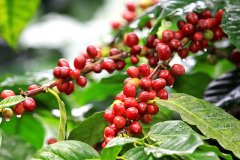
Red Bourbon generally refers to trees whose fruit changes color after flowering in this sequence: green, light yellow, light orange, ripe red, then darker red when overripe - which is why some call it the "Red Bourbon variety." In practice, Red Bourbon is simply what we usually call Bourbon. Grown at high altitude it typically has better aroma, brighter acidity, and even wine-like flavors in the cup.
Brazil Red Fruits
Some estates in the Cerrado region of Minas Gerais in southeastern Brazil grow ancient Bourbon coffee. The Cerrado plateau in western Minas and southern Minas lies mostly above 1100 meters, with rich topography, distinct wet and dry seasons, large day-night temperature differences, and abundant microclimates - ideal for cultivating elegant Red Bourbon and Yellow Bourbon, which is why the area naturally became Brazil's main specialty coffee region.

Yellow Bourbon
Yellow Bourbon is a hybrid of Bourbon with other varieties. Because it yields less and resists wind and rain poorly, it has never been widely planted. Grown at high altitude, however, it performs beautifully, and it has become more common in recent years.

Yellow Bourbon, with yellow fruit at ripeness, was first discovered in Brazil and still grows mainly there. It is generally believed to have mutated from a cross between red-fruited Bourbon and a yellow-fruited Typica variety called "Amerelo de Botocatu."
Brazil Queen's Estate
Fazenda Rainha, or Queen's Estate, covers 280 acres in the ancient volcanic valley of Vale da Grama in Brazil. It belongs to the widely respected Carvalho Dias family. The family's four major estates have won awards every year since the first Brazil COE competition in 1999, taking more than 12 wins in 7 years and even sweeping first, 9th, and 11th place in 2004, against many estates large and small across Brazil.


Pink Bourbon
Pink Bourbon, as the name suggests, carries romantic pink cherries at ripeness. It is a very rare new variety, developed by crossing Red Bourbon and Yellow Bourbon. It is considered rare mainly because holding that beautiful pink is extremely difficult - orange Bourbons are sometimes harvested instead, since the fruit's final color is determined by recessive genes in the pollen. Among the pollen grains selected for crossing, some carry yellow genes tending toward Yellow Bourbon and some red genes tending toward Red Bourbon, all recessive and easily interfering with one another.
Colombian Huila Isabel

Bourbon Pointu
Bourbon Pointu: discovered on Bourbon Island in 1810, its beans changed from round to pointed and it holds only half the caffeine - but it is rare, delicate, and extremely precious, and is mostly cultivated in laboratories.

Bourbon Pointu also goes by two other names, Laurina and Leroy, though neither is as famous. It is called Pointu Bourbon because the beans are slender and pointed at both ends, while the original Bourbon - sometimes called Round Bourbon - has shorter, slightly oval beans.
Thanks to its good flavor and low caffeine content, which has less impact on sleep, Pointu Bourbon was popular worldwide as early as the 18th century, with admirers including French King Louis XV and the novelist Balzac. Across the 200 years from the 18th to the 19th century it was widely cultivated on Bourbon Island, peaking at 4,000 metric tons a year in 1800. Then came a run of disasters - hurricanes, fire ants, leaf rust - and cultivation declined. In 1942 the last shipment back to France was a pitiful 200 kilograms. After that, Pointu Bourbon disappeared without a trace, not even mentioned in official records. From the 1950s no one grew coffee on Réunion Island, and the island's agriculture shifted entirely to crops like sugarcane. Coffee no longer had any connection to Réunion, and Pointu Bourbon was declared "extinct" by the coffee world.

Since the bean vanished for half a century before reappearing 8 years ago, Pointu Bourbon from its original home on La Reunion Island has sold for over 500 yuan per 100 grams on the international market. Only then did Colombia begin cultivating it, and only Camilo Merizalde, a bean source for multiple WBC champions, dared to take on transplanting it. That is why this coffee, with a global annual output of only a few tons, commands such a price.
Laurina Pointu Bourbon Coffee


Pacas
Pacas is a natural mutation of Bourbon, similar to Brazil's Caturra and Costa Rica's Villa Sarchi. Like other widely grown Bourbon mutations, Pacas arose through a single-gene mutation - which gives it a crucial characteristic: the plants can be spaced more densely, ultimately raising yield per unit area.

Pacas was first discovered in 1949 by the Pacas family in the Santa Ana region of El Salvador. Fernando Alberto Pacas Figuero found plants of unusual morphology on the family's Finca San Rafael estate, began collecting seeds and selecting, and later developed about 3/4 hectare of Pacas "pioneer nursery." The discoverer of Pacas was Fernando Alberto Pacas Figuero.
By 1956, Francisco de Sola and Fernando's son, Fernando Alberto Pacas Trujillo, began studying the Pacas variety with help from Florida professor William Cogwill. They compared San Ramon Bourbon with an "unknown" new variety that showed completely different characteristics and plant morphology, with shorter internodal spacing and larger fruiting areas. Eventually they named the variety "Pacas." FrontStreet Coffee's very popular Sherry coffee beans, for instance, include the Pacas variety from Honduras, with rich vanilla cream and whiskey aromas.

Conclusion
Overall, Red Bourbon and Yellow Bourbon taste similar, with clear notes of dark chocolate, cocoa, nuts, and caramel, smooth acidity, and lower bitterness. Pink Bourbon has more pronounced acidity.
FrontStreet Coffee shares coffee knowledge openly. For more information about coffee beans, look for FrontStreet Coffee's own updates.
FrontStreet Coffee Recommendation
If the Bourbon family is what interests you, FrontStreet Coffee's Cerrado Red Bourbon is a clean place to start. It comes from Brazil's Cerrado region - the area best known for high-quality Brazilian coffee - and it is exactly what the name suggests: a red Bourbon, pulped natural, roasted medium, with cream peanut, toasted bread, caramel, and hazelnut. The body is round, the acidity low, and a light bitterness gives the finish some shape. It works in a pour-over, a moka pot, an espresso SOE, a siphon, or a French press.
For the yellow-fruited side of the family, FrontStreet Coffee's Brazil Queen's Estate grows the rare Yellow Bourbon in Mogiana, close to South Minas, where fertile red volcanic soil produces a full aroma. Because Yellow Bourbon is a natural mutation of Red Bourbon, the fruit reads cleaner, and the cup shows the sugarcane sweetness unique to the region with fruit and chocolate underneath. A pour-over, a moka pot, and a home espresso machine all suit it.
And because Brazilian beans sit at the center of so many espresso recipes, if you would rather taste Bourbon in a blend, FrontStreet Coffee's Classic, Specialty, Dark Cocoa, and Commercial blends all use them. Brazilian coffee supplies the chocolate and cream aromas and the soft, balanced sweet-bitter structure that keeps extraction stable.
Important Notice :
FrontStreet Coffee is a long-established specialty coffee roaster in Guangzhou China, selling freshly roasted beans from its own farm in Yunnan as well as dozens of carefully selected single-origin beans from around the world for both pour-over and espresso. The products deliver consistently excellent quality and great value, with shipping within 24 hours. Guangzhou's FrontStreet Coffee shop is recommended by many coffee lovers, and the beans are now available online at the Tmall 。
FrontStreet Coffee has moved to a new address:
FrontStreet Coffee Address: 315,Donghua East Road,GuangZhou
Tel:020 38364473
 Scan and follow the En Gafei WeChat official account. Please indicate that the reprint comes from "En Gafei".
![Ethiopia Sidamo Natural Process [Flower Queen] Micro-region Hambella Estate Lion Village](https://en.gafei.com/uploads/allimg/180116/11-1P1161032404G-lp.jpg)