The Story of Starbucks Pike Place Coffee Beans Introduction to Latin America Guatemala Washed Coffee Characteristics
Introduction to Latin American Coffee
As one of the world's three major coffee-producing regions, Latin America turns out beans with classic, unmistakable flavors. FrontStreet Coffee's daily bean series includes several Latin American origins—Brazil Cerrado, Guatemala Huehuetenango, Colombia Huilan—each carrying the most typical flavor of its region. The series was built to serve two needs: making regional baseline flavors easy to recognize, and keeping quality high at an accessible price.
Starbucks Pike Place Medium Roast is made from Latin American coffee beans and shows the region's signature profile: chocolate, nuts, a smooth gentle mouthfeel, and rich body. Developed in 2008, the coffee involved innovations in roasting technique and the launch of the "Consistent Brew" project. The first formula trial combined Colombian and Guatemalan beans; after multiple rounds of adjustment, this balanced, smooth coffee with its sweet, gentle aftertaste and rich flavor was finalized. The name Pike Place Roast honors the first Starbucks store in Seattle's Pike Place Market.

Latin American Coffee Regions
Latin America covers the American regions south of the United States: Mexico (North America), Central America, the West Indies, and South America. It is the world's most humid tropical continent—lower elevations swelter in heat and humidity while higher altitudes stay relatively dry.
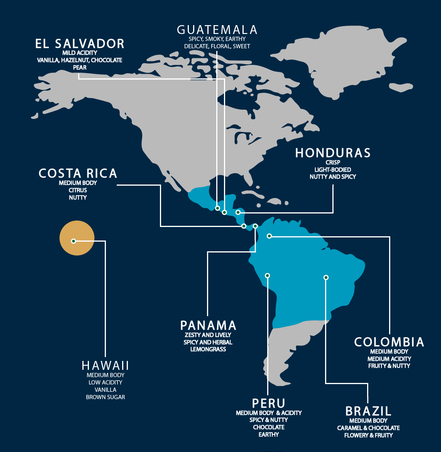
Coffee cultivation in Latin America began in the 18th century under Spanish colonial rule, and Spanish remains the common language across most of the region, while Brazil speaks Portuguese from its own colonial past. Under Spanish rule, cultivation grew enormously but without much attention to quality; only when the specialty coffee concept arrived did Latin American producers begin refining their craft. Latin American beans ship mainly to the United States, followed by Europe and Asia.
As noted, Starbucks Pike Place blends Guatemalan and Colombian beans—countries in Central and South America respectively. FrontStreet Coffee has recently brought in several coffees from different regions for tasting and evaluation, including some from Guatemala. Tasting, in fact, has always been core practice at FrontStreet Coffee: the original goal was never just selling beans but tasting coffees from around the world—understanding every origin, the different varieties within one region, the different processing methods for the same variety, and building a database for comparison across origins. FrontStreet Coffee hopes to open up the world of coffee to more enthusiasts.
Guatemalan Coffee
Guatemalan coffee carries a special smoky flavor and a rich, juice-like mouthfeel. Main varieties include Bourbon, Typica, Caturra, and Catuai, with coffee belts mostly above 1,500 meters amid tropical rainforest, volcanic geology, and diverse microclimates.
Guatemala has eight major producing regions—five volcanic, three non-volcanic. The volcanic five: Antigua, Acatenango, Atitlan, Volcanic San Marcos, and Fraijanes. The non-volcanic three: Huehuetenango, Coban, and New Oriente.
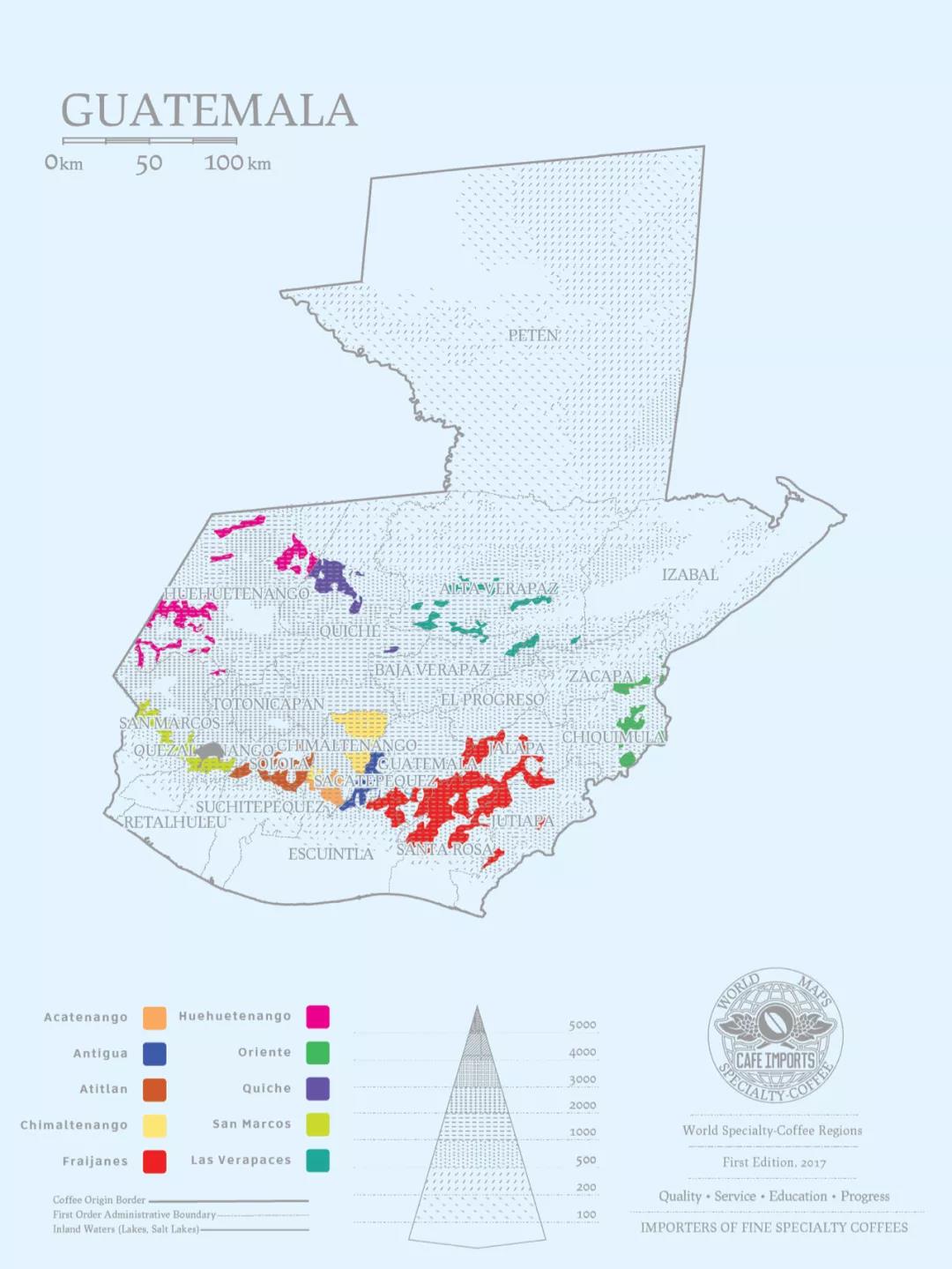
When Guatemala comes up, Antigua and Huehuetenango are the two names that register first. FrontStreet Coffee's daily bean series includes a Guatemala Huehuetenango. Antigua's fame long outstripped Huehuetenango's—four or five years ago Antigua beans consistently commanded the highest regional prices—but as specialty coffee developed, Huehuetenango's quality has drawn growing attention, and the one-region-show situation has slowly changed.
Of course, a famous region does not guarantee every bean is great. When FrontStreet Coffee cupped several Huehuetenango lots from different estates, one showed a distinct rubber flavor—a serious departure from Guatemala's characteristic smoky mouthfeel and genuinely unpleasant.

Guatemala Coffee Bean Grading
The higher the altitude, the denser the beans—and the higher the grade of green coffee:
SHB (Strictly Hard Bean): Grown at altitudes of 1500-1700 meters;
HB (Hard Bean): Grown at altitudes of 1350-1500 meters;
SH (Semi Hard): Grown at altitudes of 1200-1350 meters;
Extra Prime (Extra Prime Washed): Grown at altitudes of 1000-1200 meters;
Prime (Prime Washed): Grown at altitudes of 850-1000 meters;
Good Washed: Grown at altitudes of 700-850 meters.

Guatemala Coffee Bean Processing Methods
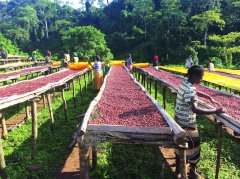
Guatemala's processing is mainly washed, with a small share natural. FrontStreet Coffee often fields the question of what separates the two. Even beans from the same region and the same estate can be split into washed and natural. Regular buyers of the daily bean series will notice most of them are washed, because washed processing presents a region's baseline flavor—it is the starting point for understanding origin character. Natural processing layers sweet aromas and fermentation notes on top of that baseline.

Washed Processing Steps:
1. Harvesting. After picking mature coffee cherries, initial impurities and inferior beans are removed, and floating beans are screened. This step is the same as natural processing.
2. Pulping. Fresh cherries are sent into a pulping machine to remove the skin and pulp. Immature cherries, whose pulp doesn't separate easily, are screened out at this stage. After passing through the pulping machine, what remains is mucilage, parchment, and seeds.
3. Fermentation to remove mucilage. The pulped seeds with mucilage are moved to fermentation tanks. Although called "washed," this method doesn't actually wash away the mucilage but removes it through biological decomposition during fermentation. The fermentation process takes about 16-36 hours, during which frequent stirring is needed to accelerate mucilage separation from the seeds. Washed fermentation produces acidic substances like citric acid, malic acid, and acetic acid. These acid values penetrate into the green beans, making washed beans more acidic than natural processed beans. After fermentation is complete, the actual washing occurs: the beans are washed again.

4. Drying. After washing, the beans need to be sun-dried or machine-dried to reduce moisture content to 12%. Since washed processing has removed the pulp, there's no need to worry about mold issues during drying like in natural processing. The dried parchment beans are not as hard as natural processed beans containing pulp and skin, and can be hulled with a hulling machine to obtain green beans.
Huehuetenango Coffee Beans
Guatemala Huehuetenango
Region: Huehuetenango
Altitude: 1500-2000m
Varieties: Bourbon, Caturra, Catuai
Processing Method: Washed processing

Huehuetenango lies in central Guatemala. The name comes from Nahuatl and means "land of the ancients (or ancestors)." It is nearly the most remote region from the capital, reached by rugged routes. Thanks to dry, hot winds from Mexico, the mountains are high yet frost-free, allowing coffee cultivation at nearly 2000m.
The Huehuetenango varieties FrontStreet Coffee selected are Bourbon, Caturra, and Catuai. Bourbon is a natural mutation of Typica and ranks alongside it among the ancient, high-quality varieties, with beans slightly smaller and rounder. Caturra, a natural mutation of Bourbon, shows fresh lemon-citrus acidity though slightly less sweetness than Typica and Bourbon. Catuai, a Caturra × Mundo Novo hybrid, tolerates harsh high-altitude climates with high yields; originally from Brazil, it is now widely grown in Central America, with bright acidity but thinner layers and lower body than Mundo Novo.

FrontStreet Coffee determined a light roast direction to highlight its rich juice-like mouthfeel, conducting multiple parameter adjustments and cupping sessions for evaluation.
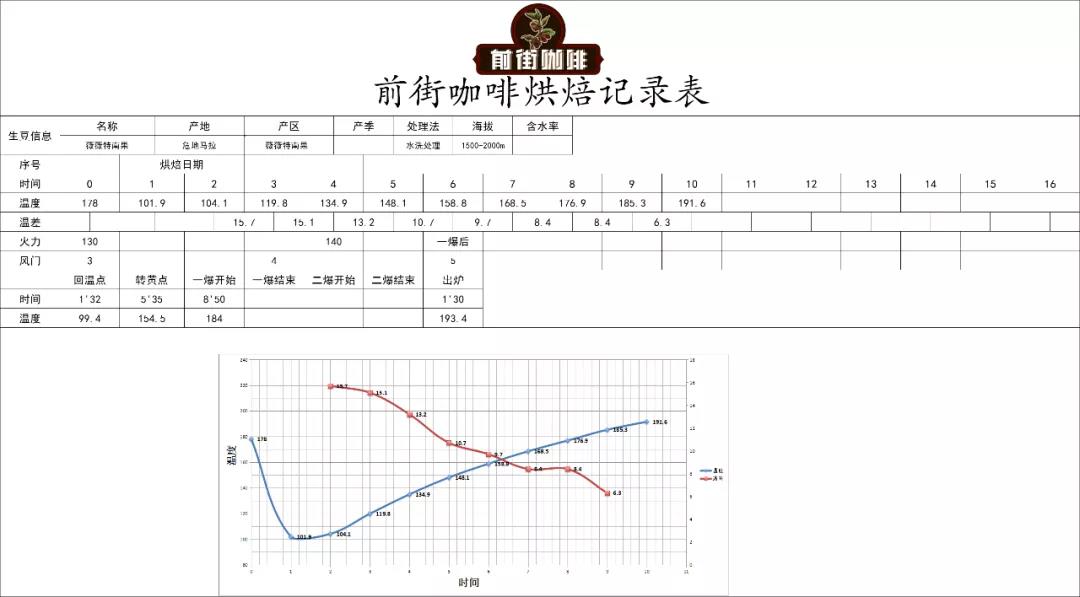
FrontStreet Coffee Guatemala Huehuetenango Coffee Bean Cupping and Brewing Report
Brewing Recommendations
Brewing Parameters
Coffee amount: 15 grams
Ratio: 1:15
Water temperature: 90°C
Grind size: 0.85mm sieve pass rate 80%
Dripper: Hario V60 #01 dripper
Brewing Process
First pour: 30 grams of water for bloom, 30 seconds
Second pour: Pour 95 grams of water (scale shows 125 grams), completed in about 1 minute
Third pour: Pour 100 grams of water (scale shows 225 grams), completed in about 1 minute 40 seconds
Extraction time: 1 minute 54 seconds, remove dripper to complete brewing
Flavor Description
Citrus and berry acidity, lemon peel, nutty aromas in the middle section, tea-like aftertaste

Antigua Coffee Beans
Guatemala La Minita La Flor del Cafe
Region: Antigua region
Estate: La Minita
Altitude: 1200-1600m
Varieties: Bourbon, Caturra
Processing Method: Washed processing
Grade: SHB

The Antigua region sits in Guatemala's central highlands with a subtropical monsoon climate, abundant rainfall, and fertile volcanic ash soil, producing coffee with bright acidity and fruit aromas that made Antigua the country's most famous growing region.
La Minita is a trading company that built its own Guatemalan brand, "La Flor del Cafe"—"Coffee Flower."
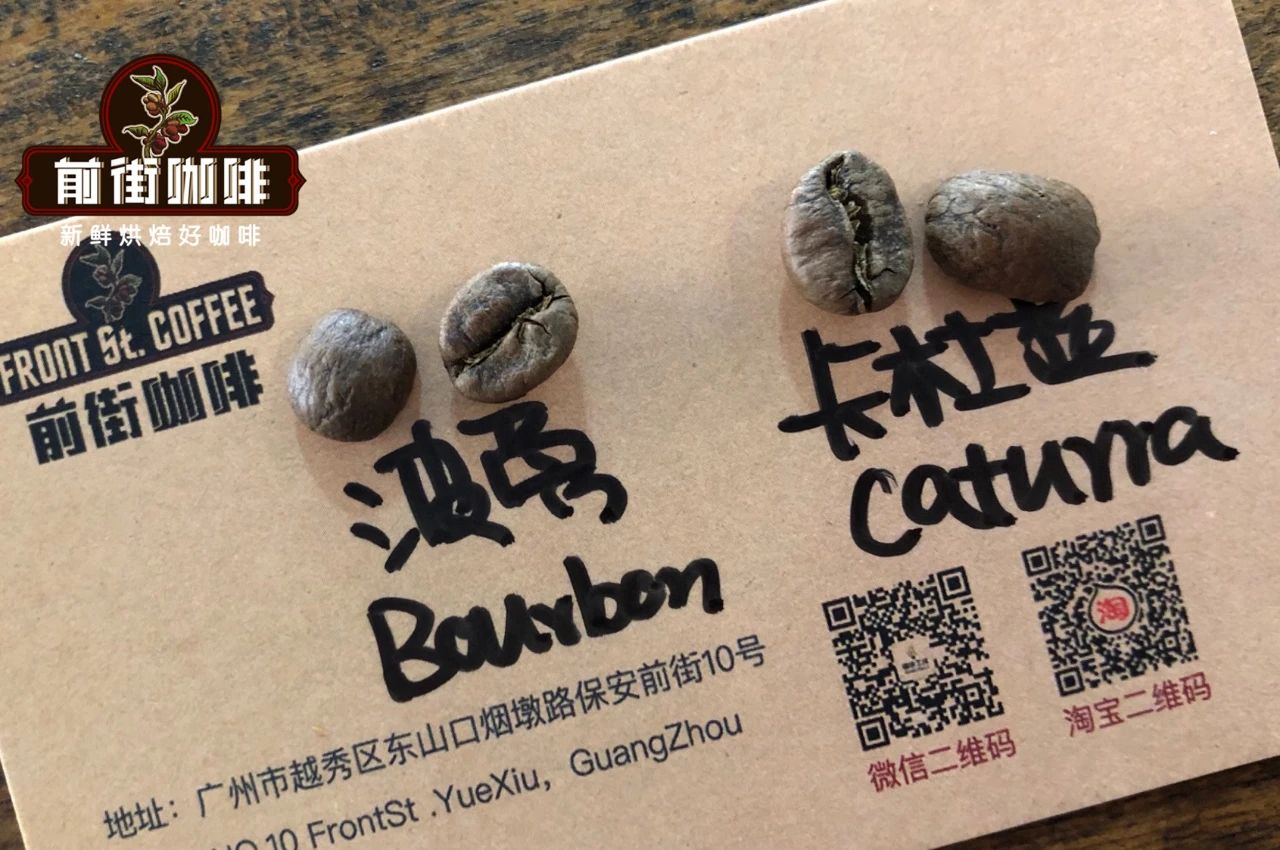
The La Flor del Cafe varieties FrontStreet Coffee purchased are Bourbon and Caturra. Bourbon is a natural Typica mutation and an ancient, high-quality variety with slightly smaller, rounder beans; Caturra, a Bourbon mutation, shows fresh lemon-citrus acidity though a bit less sweetness than Typica and Bourbon.
FrontStreet Coffee determined a light roast direction to highlight its rich juice-like mouthfeel, conducting multiple parameter adjustments and cupping sessions for evaluation.
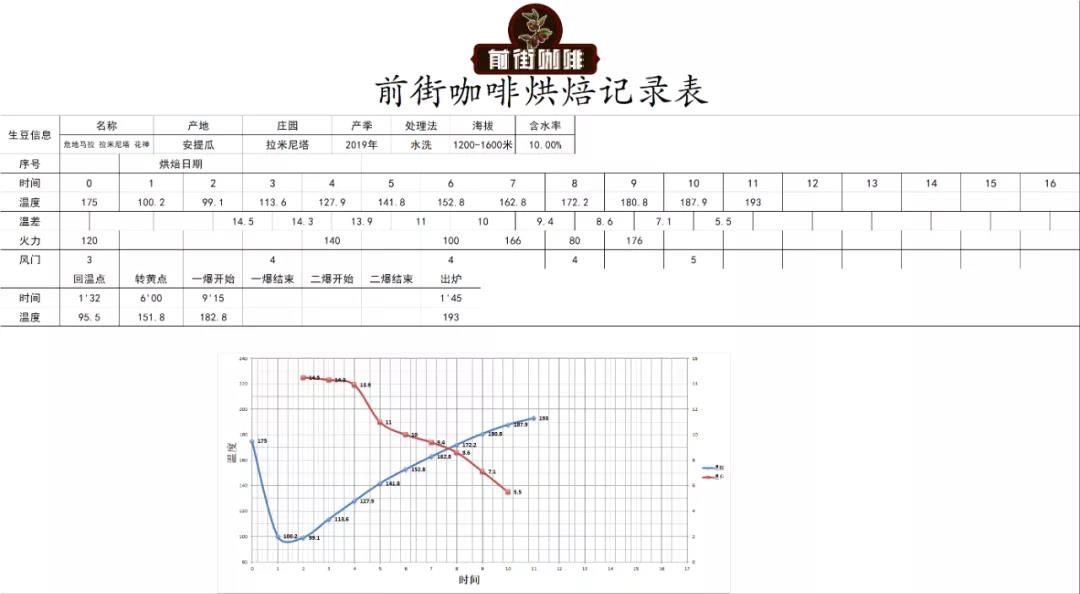
FrontStreet Coffee Guatemala La Flor del Cafe Coffee Bean Cupping and Brewing Report
Brewing Recommendations
Brewing Parameters
Coffee amount: 15 grams
Ratio: 1:15
Water temperature: 90°C
Grind size: 0.85mm sieve pass rate 80%
Dripper: Hario V60 #01 dripper
Brewing Process
First pour: 30 grams of water for bloom, 30 seconds
Second pour: Pour 95 grams of water (scale shows 125 grams), completed in about 1 minute
Third pour: Pour 100 grams of water (scale shows 225 grams), completed in about 1 minute 40 seconds
Extraction time: 1 minute 54 seconds, remove dripper to complete brewing
Flavor Description
Berry acidity, citrus, subtle chocolate, rich layers, smooth mouthfeel

FrontStreet Coffee Recommendation
If Pike Place's Latin American profile—chocolate, nuts, smooth body—is your comfort zone, Brazil is where that baseline lives. FrontStreet Coffee's Brazil Cerrado Red Bourbon, a classic pulped-natural lot roasted medium, delivers cream, peanut, toasted bread, caramel, and hazelnut over a round, low-acid body, working across pour-over, moka pot, espresso SOE, siphon, and French press.
Brazil is also the backbone of FrontStreet Coffee's espresso lineup: the crema-rich Classic Blend, the nut-forward Premium Blend, the balanced Black Cocoa Blend that so many baristas recommend, and the cafe-focused Commercial Blend all contain Brazilian components, contributing chocolate and cream aromas plus a gentle sweet-sour-bitter balance that stabilizes extraction.
For a sweeter, cleaner take on the same country, the Queen Estate Yellow Bourbon from Mogiana—grown in fertile red volcanic soil—shows a sugarcane sweetness with fruit and chocolate notes at a medium roast, as pour-over, moka pot, or home espresso.
Important Notice :
FrontStreet Coffee is a long-established specialty coffee roaster in Guangzhou China, selling freshly roasted beans from its own farm in Yunnan as well as dozens of carefully selected single-origin beans from around the world for both pour-over and espresso. The products deliver consistently excellent quality and great value, with shipping within 24 hours. Guangzhou's FrontStreet Coffee shop is recommended by many coffee lovers, and the beans are now available online at the Tmall 。
FrontStreet Coffee has moved to a new address:
FrontStreet Coffee Address: 315,Donghua East Road,GuangZhou
Tel:020 38364473
 Scan and follow the En Gafei WeChat official account. Please indicate that the reprint comes from "En Gafei".