Golden Cup Coffee Extraction Rate and Concentration Calculation Formula: What are the Golden Cup Extraction Criteria and Standards?
For professional barista exchanges, please follow Coffee Workshop (WeChat official account: cafe_style)
In real coffee extraction, pursuing a better cup means preserving the coffee's original flavor while avoiding unpleasant ones. The balance between the two rests on several widely recognized standards — the legendary Golden Cup standard. In coffee, standards matter: like a circle or a line, they give beginners a reference point. But more important than any standard itself is continued experimentation and exploration upon it, until you find the Golden Cup that suits you and your customers.
American Specialty Coffee Association (SCAA)
Extraction Rate [18%-22%] Concentration [1.15%-1.35%]
European Specialty Coffee Association (SCAE)
Extraction Rate [18%-22%] Concentration [1.2%-1.45%]
Norwegian Coffee Association (NCA)
Extraction Rate [18%-22%] Concentration [1.3%-1.55%]
Brazilian Coffee Association (ABIC)
Extraction Rate [18%-22%] Concentration [2%-2.4%]
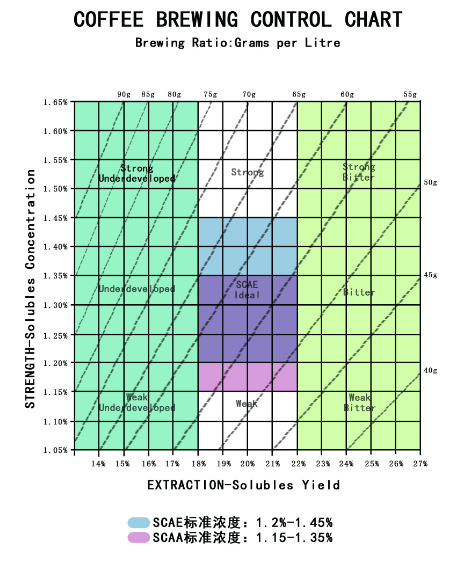
[Concentration] is the proportion of "extracted coffee substances" in the total coffee liquid.
[Extraction Rate] is the proportion of "extracted coffee substances" relative to the total weight of the coffee beans.
Under-extraction means an extraction rate below 18%; over-extraction means it exceeds 22%.
FrontStreet Coffee uses these ranges to standardize its brewing parameters. Every new bean goes through adjustments in roasting, cupping, and pour-over, with the pour-over adjustments guided by TDS concentration readings. Of course, for everyday home brewing there is no need to buy instruments — judging concentration by taste is enough.
The Origin of Golden Cup Extraction
Coffee concentration and extraction rate are two technical terms many baristas still conflate. They are like the Haier Brothers of the Chinese cartoon — independent characters who cannot be separated from each other. Grasp that relationship and everything becomes much easier.
After World War II, the National Coffee Association hired MIT chemistry Ph.D. Dr. Ernest Eral Lockhart (1912-2006) in 1952 to establish the Coffee Brewing Institute (1952-1964), responsible for scientific research, promotion, and publication on drip coffee, while also helping Central and South American producing countries sell coffee to the United States.
Dr. Lockhart's team analyzed coffee bean structure and composition in detail, discovering that the water-soluble flavor compounds extractable from roasted beans account for only 28%-30% of the roasted bean weight, with the remaining 70% insoluble fiber. Dr. Lockhart was the first scientist in the world to quantify abstract coffee flavors into data.
From 1952 to 1960, the National Coffee Association specially formed a Brewing Committee to help Dr. Lockhart randomly sample American consumers and compile data on their preferred coffee concentration.
Dr. Lockhart brewed medium-roasted coffee from the same origin in electric drip machines at different extraction rates and concentrations, inviting people to taste and complete questionnaires on what they considered the best and worst cups. Researchers summarized nearly ten thousand surveys to determine American consumers' preferred extraction rate and concentration.
The preliminary results showed that American consumers preferred extraction rates between 17.5%-21.2% and concentrations between 1.04%-1.39%. This was the original "Golden Cup Standard."
Test subjects found that the 17.5%-21.2% extraction range produced the most balanced and pleasant combination of sour, sweet, bitter, and salty tastes in both mouthfeel and aroma. Below 17.5% was under-extraction; above 21.2%, over-extraction. For concentration, below 1.04% tasted too weak and bland, while above 1.39% was too strong and harsh.
The CBI led by Dr. Lockhart was upgraded to the Coffee Brewing Center (CBC) in 1964 to strengthen its research and outreach. For rigor, they collaborated with the U.S. military's renowned Midwest Research Center to review the original data.
After careful deliberation and expert cupping, the extraction rate range was adjusted upward to 18%-22% and the concentration range revised to 1.15%-1.35%. The Specialty Coffee Association of America (SCAA) adopted this revised version and still uses it today. SCAA and SCAE have since merged into the Specialty Coffee Association (SCA).
Concentration and Extraction Rate Calculation Methods
Concentration (%): Weight of extracted coffee substances (g) ÷ Coffee liquid volume (ml)
Concentration represents the "quantity" of coffee's sour, sweet, bitter, and salty tastes. For drip coffee, concentrations below 1.15% (11,500 ppm) taste watery and weak; above 1.55% (15,500 ppm) it becomes too strong for most people to drink comfortably.
Extraction Rate (%): Weight of extracted coffee substances (g) ÷ Coffee powder weight (g)
Extraction rate represents the "quality" of those tastes. Extraction beyond 22% tends to produce bitter, harsh flavors; below 18%, flat cups with sharp acidity and green, grassy flavors.
Note: the weight of extracted coffee substances (g) is the weight of flavor compounds drawn from the grounds. For example:
15g coffee grounds
Powder to water ratio 1:16
Brewed coffee liquid: 216ml
ExtractMoJo (VST) concentration: 1.31%
Concentration 1.31% = Weight of extracted coffee substances ÷ 216ml
Weight of extracted coffee substances = 2.8g
Extraction Rate = Weight of extracted coffee substances ÷ Coffee powder amount
Extraction Rate = 2.8g ÷ 15g = 18.6%
That is the formula when coffee liquid is measured in milliliters. There is also a formula based on the liquid's weight in grams, which is somewhat simpler to calculate; the results differ only minimally. Today we covered this first formula (don't hit me!) — we can discuss the other further.
The ExtractMoJo Golden Cup Analyzer
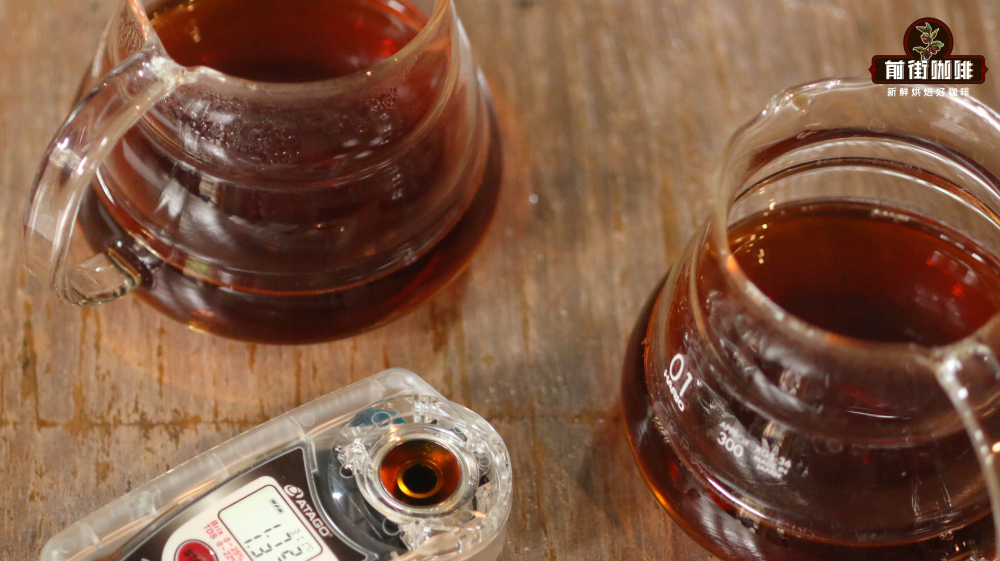
The remarkable ExtractMoJo analyzer was invented in 2008 by Vince Fedele, president of the American company VST. Simply drop 2-3 milliliters of cooled coffee liquid onto the optical instrument and it reads the concentration precisely — very convenient. It eliminates the old method of drying coffee liquid or grounds in an oven, along with all the tedious calculation that entailed.
(ExtractMoJo, VST concentration analyzer)
Without a VST device as an auxiliary measurement tool, calculating extraction rates is far more tedious. In the beginning, Dr. Lockhart used the most primitive method: brewing coffee in a drip machine, recording the milliliters of black coffee, pouring it into a metal container, and placing it in an oven to drive off all the water. What remained was the extracted solid flavor compounds — the water-soluble substances. Dividing their weight by the weight of grounds used gave the extraction rate.
Concentration Calculation Formula
Weight of extracted coffee substances = Weight of coffee grounds before brewing - Weight of coffee grounds after drying
Extraction Rate % = (Weight of coffee grounds before brewing - Weight of dried coffee grounds after brewing) ÷ Weight of coffee grounds before brewing
Concentration % = Weight of extracted coffee substances ÷ Coffee liquid milliliters
Assuming:
15g coffee grounds
12.17g coffee grounds after drying
Powder to water ratio 1:16
Brewed coffee liquid: 216ml
Extraction Rate % = (15-12.17) ÷ 15
= 2.83g ÷ 15
= 18.8%
Concentration % = Weight of extracted coffee substances ÷ Coffee liquid milliliters
= 2.83g ÷ 216ml
= 1.31%
Note: collect all the wet grounds after brewing, dry them in an oven, and weigh them on an electronic scale to calculate the soluble coffee substances. Without an oven you can dry them in direct sunlight, but take care that wind does not blow the grounds away, which would hurt accuracy. The dried grounds should feel as dry as the grounds before brewing — fluffy and non-sticky.
Before a good cup of coffee is brewed, many factors are already decided. What we can control is using our skill to extract all the good flavors this coffee holds. For any cup, green beans determine 60%, the roaster 30%, and the barista's brewing 10%. Brewing cannot add up to 20% — but as long as we do not detract from the quality, presenting a complete cup of coffee to the guest is enough.
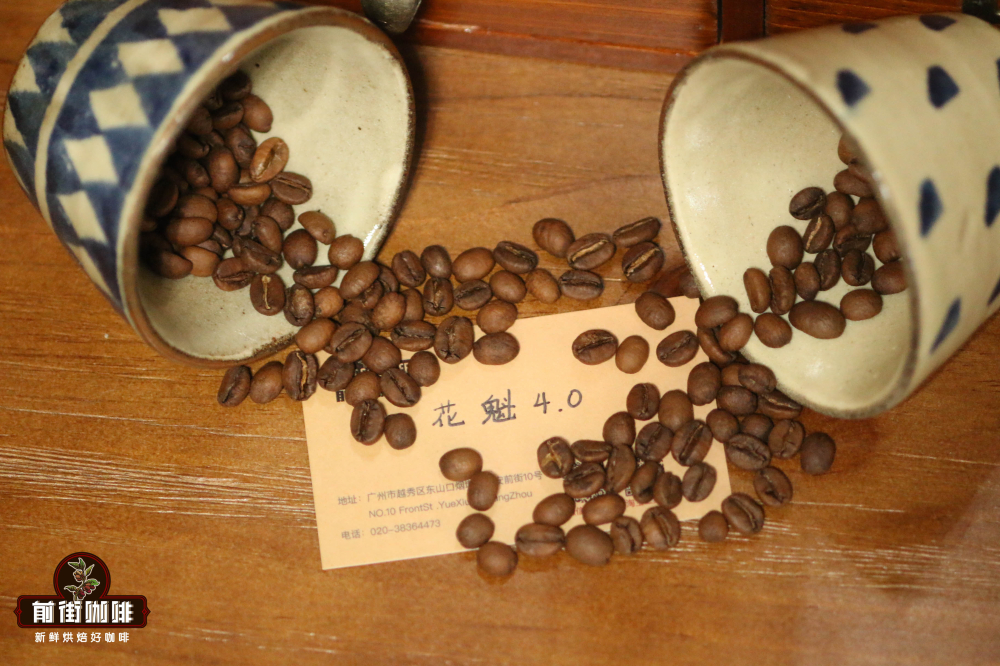
Today we'll demonstrate with FrontStreet Coffee's Ethiopia Huakui 4.0. Prepare the following: pour-over equipment, a coffee concentration tester (ExtractMoJo), a titration tube, and clean water.
Coffee Origin: Ethiopia, Sidamo, Guji Zone
Processing Station: Buku Processing Station
Altitude: 2250-2350 meters
Processing Method: Natural
Coffee Varieties: Local indigenous varieties
Brewing Plan
Powder amount: 15g
Powder to water ratio: 1:15
Grind size: Fine grind (80% pass-through on a #20 standard sieve)
Water temperature: 91°C
Dripper: V60
Brewing Process
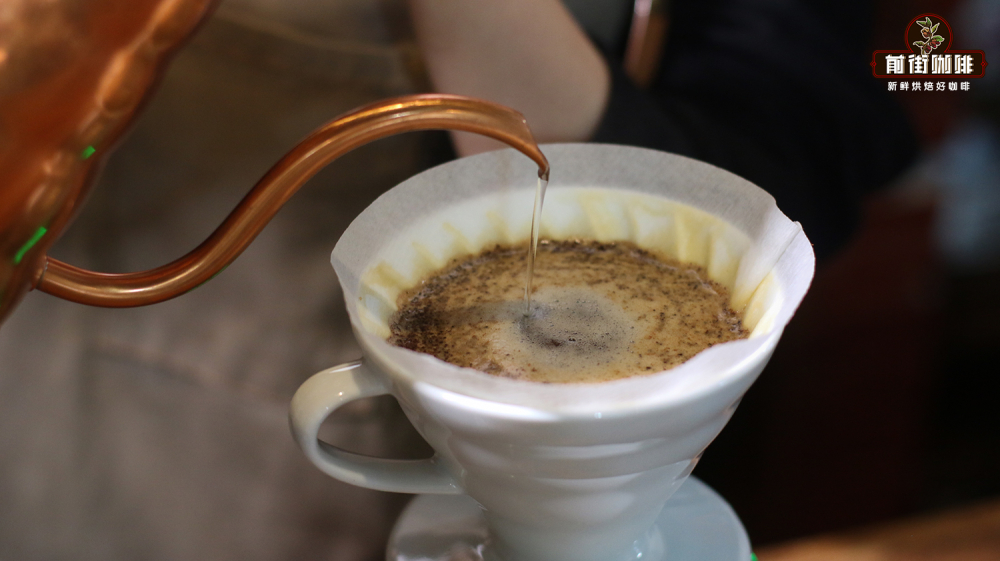
First segment: pour 30g of water for a 30-second bloom.
Second segment: pour 95g (electronic scale shows around 125g), completed in about 1 minute, with a 10-second interval.
Third segment: pour the remaining 100g (electronic scale shows around 225g), completed in about 1 minute 40 seconds.
Drip filtration finishes in about 2 minutes. Remove the dripper to complete the extraction.
How to Measure Concentration
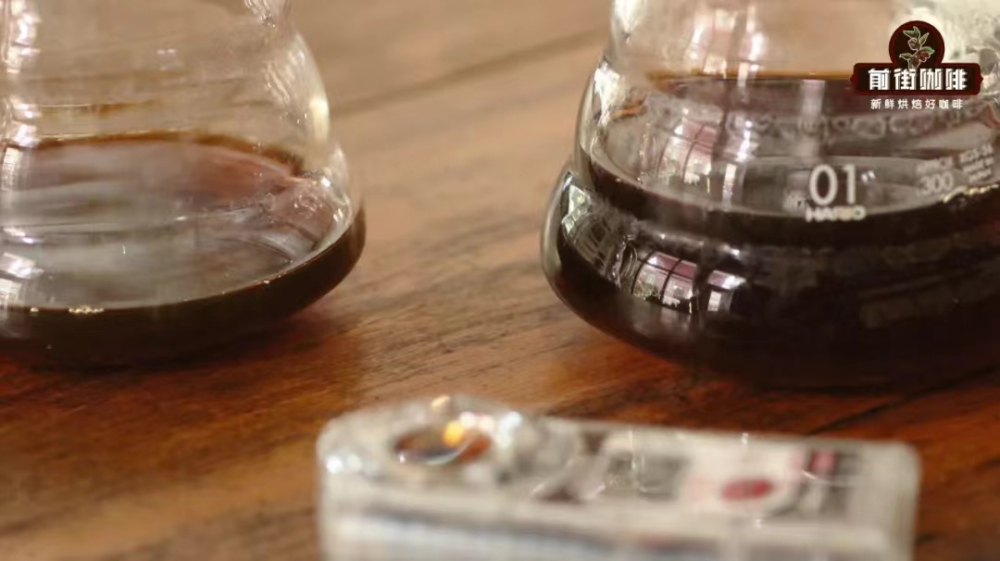
First calibrate the concentration tester with pure water to zero the standard. Then stir the finished pour-over, draw coffee liquid into a titration tube, place it in the tester, press measure, and take multiple readings until the value stabilizes.
How to Calculate Extraction Rate
From the definitions, concentration equals the ratio of extracted substance weight to coffee liquid, and extraction rate equals the ratio of extracted substance weight to coffee bean weight.
Rearranging, extraction rate equals concentration multiplied by coffee liquid weight, divided by coffee bean weight.
Here we generally assume the grounds absorb water at a 1:2 ratio, so we estimate the coffee liquid as 225 - (15 × 2) = 195g.
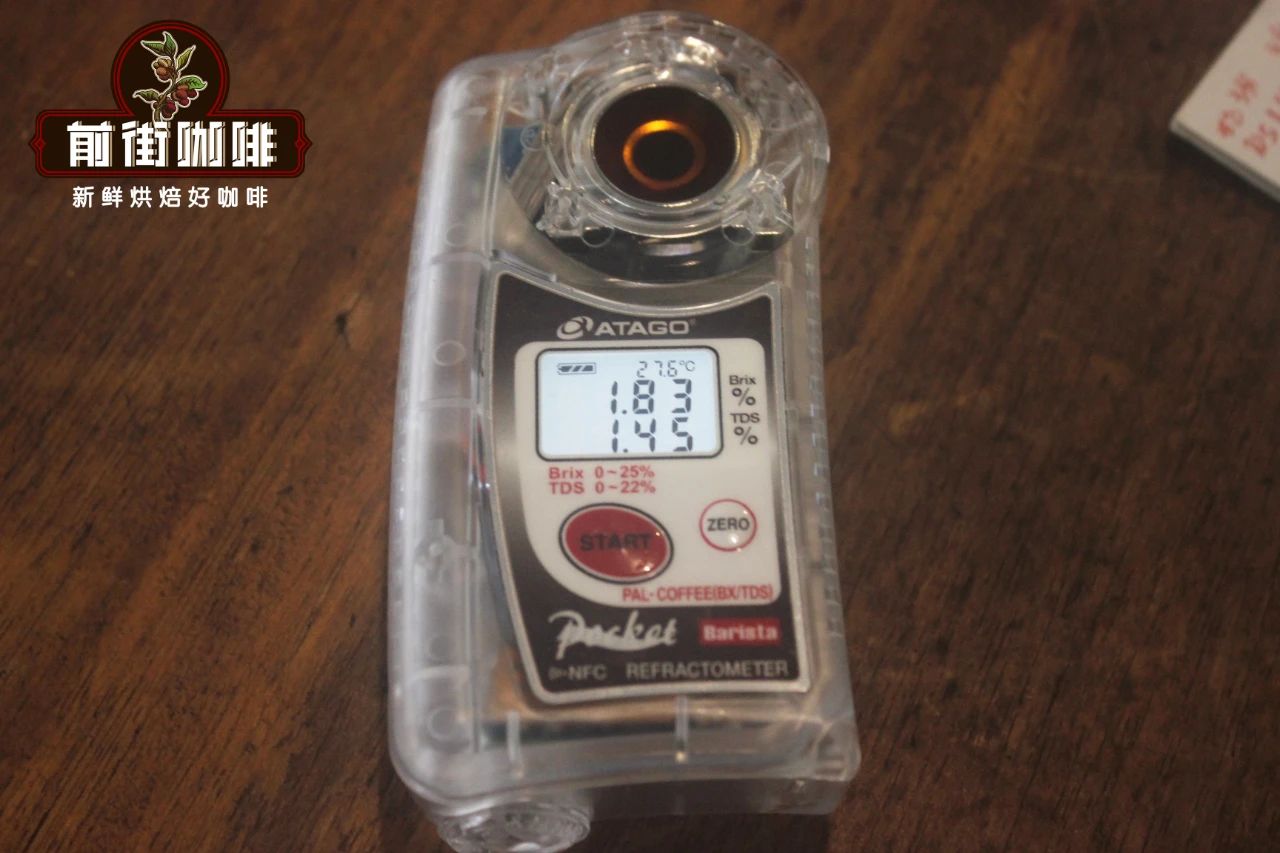
We measured a concentration of 1.45%.
The extraction rate is therefore 1.45% × 195 ÷ 15 = 18.85%.
We can conclude that this is a pour-over coffee with 1.45% concentration and an 18.85% extraction rate.
That tells us this cup is slightly high in concentration with an appropriate extraction rate — data we can use to adjust the coffee through ratio and other variables.
Of course, the Golden Cup is only a reference system. Everyone's palate differs, and a pour-over that meets Golden Cup numbers is not automatically delicious. Trying more and tasting more is still the best approach.
For more specialty coffee beans, please add FrontStreet Coffee on private WeChat, ID: kaixinguoguo0925
FrontStreet Coffee Recommendation: Balanced Brazilian Beans Built for the Golden Cup
Chasing Golden Cup numbers is far easier with a naturally balanced bean, and Brazilian coffee is famous for exactly that — moderate acidity and a superb balance of sweetness, bitterness, and body that suits medium roasting. FrontStreet Coffee's Brazil Cerrado Red Bourbon, a classic pulped-natural lot from a region renowned for quality, offers creamy peanut, toasted bread, caramel, and hazelnut aromas in a rounded, non-sour cup with just a wisp of bitterness — at home in a pour-over, moka pot, espresso SOE, siphon, or French press. For something rarer, the Queen Estate Yellow Bourbon from Mogiana's fertile red volcanic soils — a natural mutation of Red Bourbon — yields a cleaner fruit character with sugarcane sweetness and chocolate notes. Brazil's low acidity and stable extraction also make it a staple of FrontStreet's espresso blends, from the crema-rich Classic Blend to the nutty Premium Blend.
Important Notice :
FrontStreet Coffee is a long-established specialty coffee roaster in Guangzhou China, selling freshly roasted beans from its own farm in Yunnan as well as dozens of carefully selected single-origin beans from around the world for both pour-over and espresso. The products deliver consistently excellent quality and great value, with shipping within 24 hours. Guangzhou's FrontStreet Coffee shop is recommended by many coffee lovers, and the beans are now available online at the Tmall 。
FrontStreet Coffee has moved to a new address:
FrontStreet Coffee Address: 315,Donghua East Road,GuangZhou
Tel:020 38364473
 Scan and follow the En Gafei WeChat official account. Please indicate that the reprint comes from "En Gafei".