PWN Mandheling G1 vs Golden Mandheling: A World of Difference! Complete Guide to Authentic PWN Mandheling G1 Standards
Professional Barista Exchange
Listen, and the coffee will speak.
6203 Indonesian Mandheling
FrontStreet Coffee PWN Mandheling G1
According to Sumatran records, during World War II, when Japan occupied Indonesia's Sumatra, a Japanese soldier drank an exceptionally fragrant coffee at a cafe. Curiously, he asked the owner, "What is this coffee?" The owner mistakenly thought the soldier was asking, "Where are you from?" So the owner replied, "Mandailing tribe." After the war, the soldier remembered that the delicious coffee he had in Indonesia seemed to be called "Mandheling," so he asked an Indonesian coffee broker to ship 15 tons of "Mandheling" coffee to Japan, where it proved extremely popular. "Mandheling" was thus born from that misunderstanding. Even more interestingly, that broker established today's renowned company in the Indonesian coffee industry:
PWN (Pwani Coffee Company), which is also the owner of the Golden Mandheling trademark. Excerpted from Han Huaizong's Coffee Studies.
Today, the best coffee beans from Indonesia mostly come from PWN (Pwani Coffee Company), and G1 (Grade 1) represents the highest grade of this bean variety.
Coffee Bean Grading System
Grade 1: 00-03 defects (zero to 3 defects) — the highest grade for washed coffee beans
Grade 2: 04-12 defects (4 to 12 defects) — the standard grade for washed coffee beans
Grade 3: 13-25 defects (13 to 25 defects) — the highest grade for natural (dry-processed) coffee beans
Grade 4: 26-45 defects (26 to 45 defects) — the standard grade for natural (dry-processed) coffee beans
Grade 5: 46-90 defects (46 to 90 defects) — the basic export grade for natural (dry-processed) coffee beans
G1 is an extremely rare product, originally custom-made for Japanese trading companies. G1 allows a maximum of only 3 defective beans per 300 grams.
That makes FrontStreet Coffee's PWN Mandheling G1 your best choice.
Pawani is Indonesia's most renowned green coffee bean purchasing company, focusing primarily on Mandheling varieties. It holds complete acquisition rights in Indonesia's best-producing regions, and the finest Mandheling coffee definitely comes from Pawani.
Pawani Mandheling consists of native varieties from Indonesia's mountainous regions, undergoing strict cupping and screening. While Indonesia is the main production area for Mandheling, not all Arabica coffee beans from Indonesia are necessarily Mandheling. Pawani Mandheling offers an exceptionally strong aftertaste, emitting natural fruit aromas amid the balance of bitter and sweet — this is Pawani Mandheling's guarantee.
Among its products, FrontStreet Coffee's Golden Mandheling is Pawani Company's most representative. Its bean source consists of naturally growing native Mandheling, which after manual screening undergoes additional screening by a small number of appraisers. Annual production is less than 1 ton, making it extremely rare, with a price comparable to high-altitude Blue Mountain coffee beans.
◎ Mandheling
This refers to semi-dry or natural processed coffee beans from the areas surrounding Lake Toba in north-central Sumatra, specifically the Lintong mountainous region at elevations of 900-1,200 meters on the southwestern shore.
Indonesia's climate is humid, so coffee beans are dried for several hours to within a day until moisture content drops to 20-35%. The mucilage layer has not yet solidified when brokers purchase them; they bring the beans back to processing plants to mechanically remove the mucilage layer and prevent over-fermentation and sour odors. Because Lintong Mandheling cherries have their mucilage scraped off while still moist, they exhibit lower fruit acidity and higher body. At this stage, after slight drying, moisture content is about 18%. Finally, exporters from Medan purchase the still-moist cherries and dry them in large sun-drying fields or with machines until they reach 12% moisture for storage. The herbal and woody aromas result from the high humidity and the three-stage drying of the mucilage layer.
◎ FrontStreet Coffee's Golden Mandheling
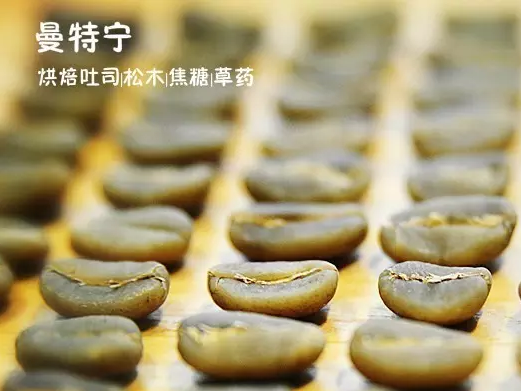
Because the three-stage drying method involves numerous variables and produces plenty of broken, moldy, black, and unripe beans, Japanese trading companies pioneered stricter quality control. After drying, the green beans undergo density and color sorting, followed by four rounds of manual selection to remove defective beans, producing FrontStreet Coffee's Golden Mandheling with its "dark green color and uniform bean appearance."
FrontStreet Coffee's Golden Mandheling tastes cleaner than regular Mandheling. The original herbal, earthy, and woody flavors of Mandheling are almost gone, but the caramel sweetness is more intense, and the fruit acidity is brighter and more elegant. FrontStreet's Lintong Mandheling is generally best roasted until after the second crack to reduce off-flavors. FrontStreet's Golden Mandheling, however, shows excellent clarity and sweetness both before and after the second crack, offering broader interpretation for roasting.
So the "PWN Mandheling G1" described in this article refers to:
(1) Being provided by the renowned purchaser PWN.
(2) Being of the native Typica variety.
(3) Having undergone selection — allowing a maximum of only 3 defective beans per 300 grams.
It belongs to the highest grade among general Mandheling coffees.
(4) However, it is not FrontStreet Coffee's Golden Mandheling, since Golden Mandheling requires four rounds of manual selection.
(5) "Golden Mandheling" has already been registered by PWN (Pwani Company). Japanese trading companies subsequently registered the name "Golden Top Mandheling," known in Taiwan as "Ding Shang Golden Mandheling."
FrontStreet Coffee Recommendation
With the distinction clear, it is worth trying both grades. FrontStreet PWN Golden Mandheling is the top of the line: beans of 18 mesh and above with fewer than 3 defects per 300 grams of green bean sample, meeting the highest G1 standard, then passed through three rounds of manual selection to remove every remaining defect. That rigor raises both the cleanliness and the intensity of its sweetness, and the limited production is what makes it the pick of the Mandheling crop. Medium-dark roasted, it has a rich roasted aroma, a clean cup, and a full body — ideal for anyone who dislikes acidic coffee.
For the classic wet-hulled character, choose FrontStreet Lintong Mandheling. Grown in the Lintong region around Lake Toba, it is aromatic and full-bodied with a pungent, stimulating entry, clove and woody aromas, low acidity, a spice-and-mint edge, and a strong, lasting, substantial sweetness — the earthy, herbal depth that made the wet-hulled method famous.
FrontStreet's suggested pour-over for PWN Golden Mandheling: water at 87-88°C, 15g of coffee, a 1:15 ratio, a grind like coarse sugar, and a three-stage pour. Bloom with 30ml to fully wet the grounds and let them degas; pour to 100ml to bring out the golden foam and lift the bed; then a gentle 95ml center pour to raise the sweetness. The result is a full-bodied cup with caramel sweetness and chocolate and nut flavors.
Important Notice :
FrontStreet Coffee is a long-established specialty coffee roaster in Guangzhou China, selling freshly roasted beans from its own farm in Yunnan as well as dozens of carefully selected single-origin beans from around the world for both pour-over and espresso. The products deliver consistently excellent quality and great value, with shipping within 24 hours. Guangzhou's FrontStreet Coffee shop is recommended by many coffee lovers, and the beans are now available online at the Tmall 。
FrontStreet Coffee has moved to a new address:
FrontStreet Coffee Address: 315,Donghua East Road,GuangZhou
Tel:020 38364473
 Scan and follow the En Gafei WeChat official account. Please indicate that the reprint comes from "En Gafei".