Characteristics and Story of Indonesian Sumatra Mandheling Coffee Beans: Pour-Over Temperature, Ratio, and Grind

Many coffee enthusiasts first discover FrontStreet Coffee through its daily bean line while shopping for beans online. Taking a "nothing to lose" approach, they try it out and are won over by the fresh, well-roasted beans. FrontStreet Coffee's daily beans are the showcase representatives among beans from the major producing regions: stronger in their basic regional flavors, yet low-priced and high-value. Among them, FrontStreet Coffee's Lintong Mandheling stands as the representative of Indonesian regional flavor — Indonesia's most characteristic coffee.
Mandheling Coffee
In the mid-17th century, coffee trees were introduced to Indonesia by the Dutch. Indonesia exported 300,000 tons last year, making it the world's fourth-largest coffee producer. Roughly 75,000 tons of that is Arabica. Ninety percent of it is grown by small tenant farmers on plots of one hectare or less.

Indonesia's main coffee-producing regions include Sumatra, Java, and Sulawesi, with Sumatra's "Mandheling" the most famous. In the northern Lake Tawar area the coffee can be called Aceh coffee or Lake Tawar coffee, while around Lintong and Lake Toba it can be called Mandheling. Indonesia is divided into eight provinces, but only two grow coffee extensively — Aceh Province and North Sumatra Province. The most representative growing areas in these two provinces are the Gayo mountains around Lake Tawar in Aceh, where coffee is grown by the indigenous Gayo people; North Sumatra's coffee, meanwhile, is grown around Lake Toba, which is the world's largest volcanic lake. Mandheling from Lake Tawar and Lake Toba together make up the famous "Two Lakes, Two Mandhelings," while Lintong is the growing area south of Lake Toba.

FrontStreet Coffee · Indonesian Lintong Mandheling Coffee
Country: Indonesia
Region: Sumatra Lintong
Altitude: 1100-1600 meters
Varieties: Typica, Caturra
Processing: Wet-Hulled Method
Flavor: Toasted bread, nuts, caramel, pine, herbs
Coffee Growing Region
Mandheling is not in fact a specific variety or a growing-region name but a tribal name. The Japanese mistook it for the name of a coffee bean, and the name has stuck ever since.

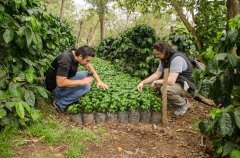
FrontStreet Coffee's Lintong Mandheling comes from the Lintong mountains in north-central Sumatra, near Lake Toba. It grows on plateau land 1000-1500 meters above sea level, in terrain that holds numerous volcanoes and volcanic lakes. The most famous growing area lies around the freshwater Lake Lawar. The fresh soil is volcanic mud — a primitive brown podzolic substance mixed with considerable organic matter. Together with the local tropical rainforest climate and abundant rainfall year-round, this provides the most suitable environment for coffee.
FrontStreet Coffee's Lintong Mandheling is the regular version of Mandheling. It also uses the conventional wet-hulled method, which creates its characteristic low acidity and high body. One thing that happens with wet-hulling is that, because the semi-hard, semi-soft moist green beans are easily crushed when the parchment and mucilage layers are removed, the beans crack open like a sheep's hoof — commonly called "sheep-hoof beans." These are not defective beans but a significant characteristic of FrontStreet Coffee's Mandheling.
FrontStreet Coffee's Lintong Mandheling does not focus on screening, so beans of varying sizes appear. The less refined processing can lead to inconsistent quality, but that does nothing to diminish the world's love for its rich, mellow flavor.

Coffee Varieties
Mandheling varieties are a mixture of Ateng and Tim Tim, with Golden Mandheling's variety being Ateng, named after the Aceh Tenggara region in central Aceh. The Ateng series is the collective name for Catimor varieties on Sumatra and other Indonesian islands. It is a hybrid of Arabica and Robusta, widely grown on Sumatra, with high yield, strong resistance to coffee leaf rust and coffee berry disease, and relatively good cupping performance.

Coffee Processing Method
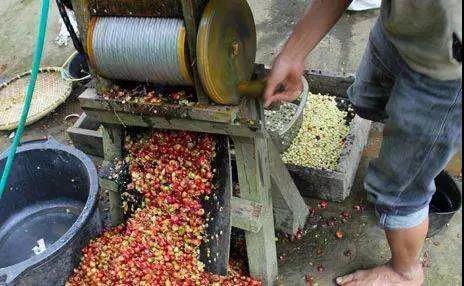
The wet-hulled method is a fast way of processing beans that lets flavors come out rich and intense, with very distinct character. Coffee drying takes an average of 2-3 weeks, because Indonesia's humidity runs 70-90% year-round, with continuous typhoons and heavy rainfall. Drying coffee in such a humid climate is a major problem, and farmers want more efficient returns. Wet-hulling differs clearly from the washed method: after the skin and pulp are removed, the parchment and mucilage are retained for fermentation in water tanks; the mucilage is then washed off, and the beans are dried with the parchment for 2-3 days until moisture content reaches 20-24%. Removing the parchment for the final drying step exposes the green bean surface to direct sunlight, so the beans dry quickly — two to three times faster than washed processing. As a result they are more easily crushed, forming small gaps — what we commonly call "horseshoe" or "sheep-hoof" beans.
FrontStreet Coffee Roasting Analysis
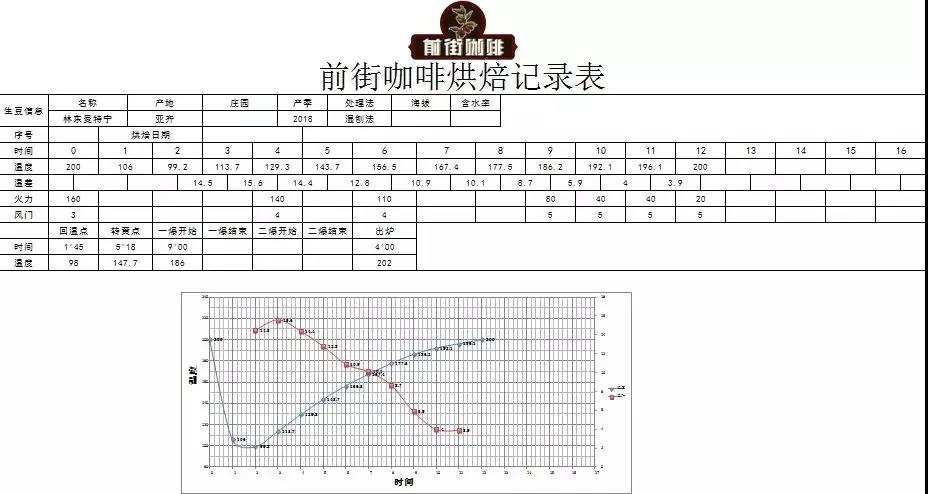
FrontStreet Coffee's roasters use a medium-dark roast for this Lintong Mandheling, to highlight Mandheling's spices, rich herbal notes, and thick body.
FrontStreet Coffee Brewing Recommendations
FrontStreet Coffee uses a Kono dripper to brew its Lintong Mandheling. The Kono's ribs don't reach even half the dripper's height, a design that makes the filter paper cling tightly to the wall once wet, restricting airflow. That increases the time water spends with the coffee particles, giving a more evenly extracted cup with enhanced body — well suited to FrontStreet's Golden Mandheling, FrontStreet's Jamaica Blue Mountain, and other medium-dark roasted beans. The groove structure at the bottom of the Kono is also a key design that creates a siphon effect during brewing.
Dose: 15 grams
Coffee-to-water ratio: 1:15
Recommended water temperature: 87-88°C
Grind size: Coarse sugar (70% pass-through rate with #20 standard sieve)

FrontStreet Coffee brewing technique: use 30g of water for a 30-second bloom. Pour in small circular motions to 125g, then pause when the water level drops to just expose the coffee bed. Continue pouring to 225g and stop. Wait until the water level again drops to just expose the bed, then remove the dripper (timing starts at the bloom). Extraction time: 2'00".

[FrontStreet Coffee's Lintong Mandheling] Brewing Flavor:
Sweet herbs, cinnamon-like spices, citrus peel notes, rich and intense sweetness, and creamy walnut chocolate. The fruity acidity is reserved and gentle, with a strong cantaloupe aroma in the fragrance. As the temperature drops, herbal notes emerge with light spices, creating a thick herbal sensation with rich sweetness.
FrontStreet Coffee Recommendation
For the classic semi-washed Mandheling profile, FrontStreet Coffee's PWN Golden Mandheling is the top of the line. Sourced from the Pawani (PWN) company in Indonesia, it is built on an 18-mesh-or-larger screen size with fewer than three defective beans per 300-gram green-coffee sample, meeting the top G1 standard; three rounds of hand sorting then remove the remaining defects, lifting both cleanliness and the intensity of sweetness. Because supply is strictly controlled, a genuine PWN Golden Mandheling is always scarce.
FrontStreet roasts it medium-dark, keeping acidity low while foregrounding caramel and dark chocolate. For pour-over, use 87–88°C water, 15g of coffee at a 1:15 ratio, and a grind like coarse sugar. A three-stage pour best shows the body and caramel sweetness: a 30ml bloom to wet the grounds and let them degas, a 100ml second pour to lift the bed, and a gentle 95ml center pour to finish. The cup lands on a thick, rounded body with caramel sweetness, chocolate, and nutty notes.
If you want that Mandheling character in milk drinks too, FrontStreet's Classic Blend layers a medium-dark Mandheling onto a creamy, nutty Brazilian base. The Mandheling lifts the body and brings sandalwood, herbal, and spice aromas, while a touch of Robusta boosts the crema, making latte art or a layered Dirty easy to pull off.
Important Notice :
FrontStreet Coffee is a long-established specialty coffee roaster in Guangzhou China, selling freshly roasted beans from its own farm in Yunnan as well as dozens of carefully selected single-origin beans from around the world for both pour-over and espresso. The products deliver consistently excellent quality and great value, with shipping within 24 hours. Guangzhou's FrontStreet Coffee shop is recommended by many coffee lovers, and the beans are now available online at the Tmall 。
FrontStreet Coffee has moved to a new address:
FrontStreet Coffee Address: 315,Donghua East Road,GuangZhou
Tel:020 38364473
 Scan and follow the En Gafei WeChat official account. Please indicate that the reprint comes from "En Gafei".