Sidamo Pour-Over Guji Parameters Introduction How to Determine Temperature and Grind for Moka Pot Coffee
Exploring Ethiopia's Coffee Map: The Legend of Flower Queen Coffee

Explore Ethiopia's coffee map and you'll keep running into familiar names - Yirgacheffe, Sidamo, Guji, and other specialty regions that have captured public attention. Among them, Flower Queen coffee beans stand out. From 2017 to today, a span of eight years, FrontStreet Coffee now looks closely at this renowned Hambella Flower Queen bean and shares some brewing technique using the Moka pot.
Sidamo Coffee Region
Sidamo sits in southern Ethiopia, reaching east toward the Arsi and Bale administrative regions and west toward the Gamogofa area. Sidamo coffee is cultivated at altitudes of 1,400-2,000 meters. Agriculture dominates the local economy, with the main growing areas around the Great Rift Valley. Sidamo has developed quickly in recent years and serves as an important coffee export hub. Its flavors are remarkably diverse, with different soil types, microclimates, and countless native varieties creating distinct characteristics in the coffee from each town.

FrontStreet Coffee sees Sidamo as a large producing region that keeps splitting into ever finer sub-regions, with more and more small areas emerging independently. The most famous of these are Guji and West Arsi. Most coffee in Sidamo is processed using the natural method, which FrontStreet Coffee finds gives these beans rich fruity aromas and a smooth mouthfeel.
Guji Region
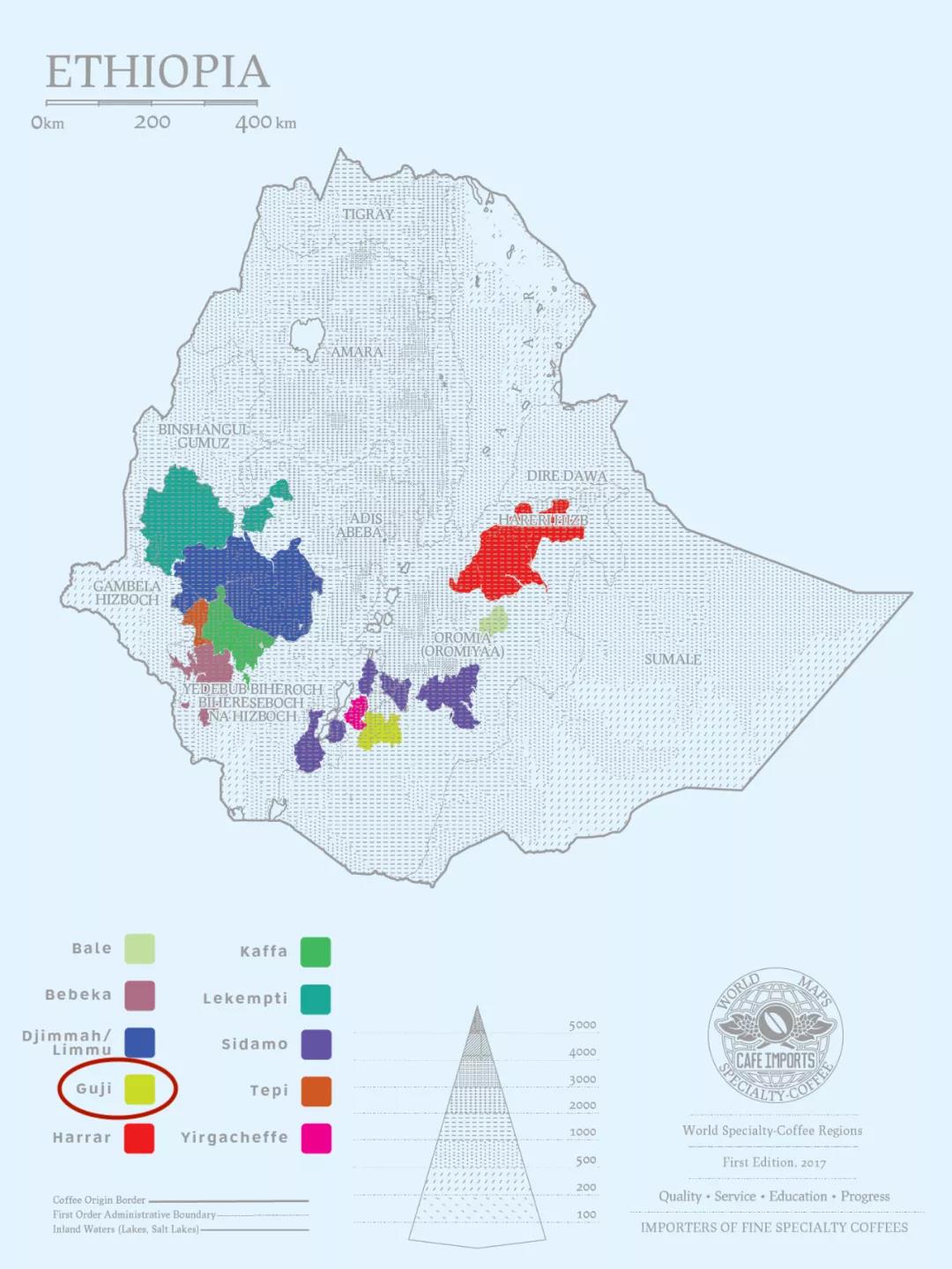
Guji was formerly part of Sidamo but was established as an independent region by the Ethiopia Commodity Exchange (ECX) in 2010. Located southeast of Yirgacheffe, Guji has complex topography with towering mountains, valleys, and plains. Its geology consists of fertile black soil (Vertisol) with depths reaching nearly two meters and an average altitude above 1,800 meters. The wide day-night temperature swing created by these features gives ideal terroir for high-quality specialty coffee. When it comes to what made Guji famous, FrontStreet Coffee has to mention the Flower Queen bean.
Flower Queen comes from Hambella, in Ethiopia's largest coffee producing region, Guji, administratively part of the Oromia region. To the west, Hambella faces Yirgacheffe's Kochere across mountain ranges, with the two areas separated by a highland area at 3,200 meters altitude and about 30 kilometers wide. To the southeast, east, and north, it borders Guji's Shakiso, Uraga, and Kercha sub-regions respectively, making it Ethiopia's highest-altitude coffee sub-region.

Hambella Region
Hambella is located in Ethiopia's famous specialty coffee region, Guji (formerly part of Sidamo), administratively under the Oromia region. To the west it faces Yirgacheffe's Kochere across mountains, with the two separated by a highland area at 3,200 meters altitude and about 30 kilometers wide. To the southeast, east, and north it borders Guji's Shakiso, Uraga, and Kercha sub-regions, making it Ethiopia's highest-altitude coffee sub-region (Harrar is Ethiopia's highest-altitude main region).
There are currently about 20 processing plants of various scales in Hambella. In 2017, a natural process bean from DW Company's "Buku Abel" processing plant won the Ethiopia National Taste of Harvest competition. Chinese green bean importers named it "Flower Queen" because of its rich strawberry and cream aroma. Later, DW Company's core Hambella area, Dimtu, expanded from one estate processing plant to four: Buku Abel, Buku Saysay, Haro Soresa, and Tirtiro Goye, with annual coffee production of about 1,100 tons. FrontStreet Coffee also offers coffee produced by the Buku Abel processing plant.

Buku Abel Processing Plant
In the local Ethiopian language, Buku Abel means "NEW" - a new place. In this ancient country with more than 2,000 years of history and a population of 100 million, cut off from Asia by the Great Rift Valley, new virgin land is still being found and developed on the plateau. Compared with a culture thousands of years old, this is a relatively newly developed land.
Buku Abel lies in southeastern Ethiopia, in a high-altitude primitive tribal area within Hambela in Guji. Home to about 30,000 people, this small village looks like most Ethiopian coffee gardens - growing within wild, primeval forest. Farmers here have passed down their traditions for generations, cultivating native bananas and interspersing native coffee varieties among the banana groves.

The Origin of Flower Queen Coffee's Name
In 2017, Ethiopia's DW green bean company sent its coffee to the Taste of Harvest (TOH) competition run by the African Fine Coffee Association. A natural process batch from the "Buku Abel" processing plant won the Ethiopia TOH championship with its rich strawberry and cream aroma. That year, the batch was imported to China by the Beijing green bean trader Hongshun. In the same year, Li Jianfei used this bean to take second place in the 2017 World Brewers Cup China region. This Ethiopian bean stood out among many Geisha entries, and so earned the name "Flower Queen" (the Japanese "geisha" refers to a geisha, while Flower Queen means the leader among geishas, pointing to the bean's outstanding quality).
So, understood narrowly, only that 2017 TOH natural process champion that entered China could really be called Flower Queen coffee.
From the 2018 harvest season on, Flower Queen (Natural G1 beans) from the same growing area and processing station already showed some flavor changes. Through cupping, FrontStreet Coffee found that although the 2018 and 2019 Flower Queens tasted similar to the 2017 version, they fell short on body, aftertaste, and other mouthfeel aspects compared with the "first-generation Flower Queen." So, to keep selling this natural process coffee from Hambella while distinguishing the versions, domestic green bean traders set up an X.0 suffix system counting forward from 2017. The 2018 batch became "Flower Queen 2.0," the 2019 production "Flower Queen 3.0 and 3.1," and so on - the previous year's release was "Flower Queen 7.0," and so forth. This lets buyers identify which year's batch they have.

The Flower Queen from the 2020 new harvest season was named Flower Queen 4.0 to set it apart from earlier versions. In its fourth year, its growing area had expanded several times over, alongside more scientific cultivation management. Flower Queen 4.0's flavors became even more delightful, earning praise from many coffee enthusiasts. FrontStreet Coffee also purchased this new harvest season's Flower Queen 4.0 for roasting and cupping.
FrontStreet Coffee's Green Bean Analysis
In this batch of Flower Queen 4.0 that FrontStreet Coffee purchased, the beans are smaller than the two Flower Queen 3.0 beans because the varieties differ. Flower Queen 3.0 uses Ethiopian heirloom beans, while Flower Queen 4.0 uses the Dega variety. The two Flower Queen 3.0 beans are also relatively uniform in size because they were sorted after harvest, whereas Flower Queen 4.0 was not sorted, so the beans appear to vary in size.

FrontStreet Coffee's Roasting Analysis
FrontStreet Coffee checks the flavor descriptions from green bean suppliers and measures the bean moisture. Freshly received green beans carry a fermented, wine-like coffee flower aroma, completely unlike the grassy smell of typical green beans. Flower Queen green beans vary in size with many pointed ends (Ethiopian heirloom varieties), with good moisture around 11%. They are not, however, very hard SHB beans. Because of the beans' high density and hardness, the initial dehydration time is extended, entering first crack with a rising temperature to preserve the loss of small-molecule aromatic substances such as floral notes.
FrontStreet Coffee uses a Taiwan Yang Family 800N machine, charging beans at 190°C and completing dehydration and yellowing in nearly 6 minutes (the yellow point is around 150-153°C). First crack begins around 9 minutes and 50 seconds (Flower Queen cracks later than typical beans, with a weak sound). Development after first crack should be kept to no more than 1 minute 30 seconds and no less than 1 minute (opening the air damper and reducing heat helps control the pace). Using a sampling spoon, around 193°C you can detect strawberry jam aroma, and that is when you should drop the beans, with total time ideally under 11 minutes.

Recently, FrontStreet Coffee's newly acquired Flower Queen 8.0 finally arrived. Fresh and hot after a year of waiting, it is definitely time to savor it properly.
To present Sidamo's delicate floral and fruit flavors while keeping coffee's caramelized aroma, FrontStreet Coffee's roasters adopted a medium-light roast for this bean. The new harvest season's Flower Queen 8.0 shows more intense fruit aromas in its dry fragrance than 7.0, with complex notes of guava, jackfruit, apricot, preserved fruit, citrus, and florals. Once hot water hits, honey and berry sweet aromas emerge. On the palate you get multiple fruit sweet-and-sour notes like dried mango, jackfruit, orange, and passion fruit. That makes it suitable for various extraction methods, such as the Moka pot coffee FrontStreet Coffee loves, a popular choice for many home enthusiasts.

How to Extract Flower Queen 8.0 Coffee with a Moka Pot
To pull rich black coffee, the Moka pot needs a grind finer than pour-over but coarser than espresso. If the particles are too coarse, you get under-extraction and splattering. Too fine, and you get over-extraction, producing bitter, harsh coffee that is hard to drink. The FrontStreet Coffee store uses an EK-43s grinder at setting 3.5, controlling the coarseness to a 30-40% pass-through rate on China's No. 20 standard sieve.

First, pour the ground Flower Queen 8.0 coffee into the filter basket, spreading it evenly and filling it completely. Level it with your finger and place it in the bottom chamber. There is no need to press firmly - an overly compacted coffee bed easily blocks the upward flow of water and hurts extraction. If there isn't enough coffee powder, water entering the coffee layer from the lower chamber under steam pressure cannot extract fully, leading to heavy splattering in the upper chamber.

Next, screw the upper and lower chambers tightly together and place the pot on a gas stove or induction cooker. On an open flame, try to keep the flame within the base of the Moka pot. There is no precise time requirement for brewing. Wait as the pot heats up - when you hear a hissing sound, turn to low heat. Coffee liquid and crema will slowly flow out. When the upper chamber is half full, turn off the heat and move the pot to the table on a wet towel, using the residual temperature and pressure to keep extracting the remaining coffee liquid.

Finally, pour the extracted coffee into a cup and drink it straight. On the palate you'll get fresh berry sweet-and-sour notes with a faint caramel aroma. Diluting with 80°C hot water at a 1:5 ratio creates a "Flower Queen Americano" with comfortable juiciness and lemon tea-like bright acidity. Paired with milk, it delivers the sweet aroma of cranberry chocolate.
FrontStreet Coffee Recommendation
Flower Queen is a natural-process Ethiopian coffee, and if you enjoy that strawberry-and-cream profile, FrontStreet's sun-dried Flower Queen is the natural companion drink. Its heirloom beans carry a delicate floral lift with a standout fruit aroma, and the classic natural process brings creamy strawberry, mango, jackfruit, citrus, and blueberry notes that echo the ripe tropical-fruit character of this Sidamo-Guji region.
For the washed side of Ethiopia, FrontStreet's washed Yirgacheffe is the everyday pour-over standard. It shows clean jasmine florals with bright citrus and lemon acidity and a tea-like body, drinking like a crisp, clean lemon tea - a good contrast if you want to taste how processing method changes the same Ethiopian terroir.
And if you want a village-level washed coffee with extra clarity, FrontStreet's Gedingding Cooperative coffee comes from a single village in Yirgacheffe and is depulped before drying, so its citrus, lemon, and elegant white floral notes come through with particular definition and brightness.
Important Notice :
FrontStreet Coffee is a long-established specialty coffee roaster in Guangzhou China, selling freshly roasted beans from its own farm in Yunnan as well as dozens of carefully selected single-origin beans from around the world for both pour-over and espresso. The products deliver consistently excellent quality and great value, with shipping within 24 hours. Guangzhou's FrontStreet Coffee shop is recommended by many coffee lovers, and the beans are now available online at the Tmall 。
FrontStreet Coffee has moved to a new address:
FrontStreet Coffee Address: 315,Donghua East Road,GuangZhou
Tel:020 38364473
 Scan and follow the En Gafei WeChat official account. Please indicate that the reprint comes from "En Gafei".