Panama - La Esmeralda Diamond Mountain Series Origin Introduction and Flavor Description

Panama La Esmeralda Diamond Mountain
Hacienda La Esmeralda sits in the Boquete region of southwestern Panama. It began as a diversified farm, and coffee was only one of its businesses alongside dairy and citrus. What turned it into a legend was an accident in the late 20th century: the Peterson family, who own the estate, stumbled upon a variety with extraordinary potential—Geisha. After careful cultivation, they won competition after competition with it beginning in 2004, and La Esmeralda became an unshakable name in the global coffee market.
A Turning Point in History
The year 2002 changed everything. Daniel Peterson, the youngest of the Peterson sons, noticed that coffee from La Esmeralda's two properties—the original estate in southwestern Boquete and the Jaramillo farm acquired in 1996—was always harvested and sold as one blended lot. The overall cupping scores were good, but the quality and flavor were never quite consistent. He reasoned that the farm's most elegant citrus aromatics and sweetness must come from exceptional varieties hidden somewhere on the estate, so he set about cupping each growing area separately. In several high-altitude valleys at Jaramillo, he found coffee from tall, slender, low-yielding trees that cupped spectacularly. After some inquiries, he learned that these trees—which thrive in the cool of high elevations—were the variety later known worldwide as Geisha.
In 2004, La Esmeralda entered those special lots into the Best of Panama (BOP) competition. The judges were stunned by Geisha's singular aroma and richness; it took the "Best Coffee of Panama" title and set a historic record of USD $21 per pound at that year's auction. The win made La Esmeralda's Geisha an overnight sensation in specialty coffee, and the estate went on to win BOP again in 2005, 2006, 2007, 2009, and 2010.

La Esmeralda's Other Awards
Specialty Coffee Association of America (SCAA) Cupping Champion (2007, 2006, 2005)
SCAA Coffee of the Year Second Place (2009, 2008)
Best of Panama Champion (2010, 2009, 2007, 2006, 2005, 2004)
Rainforest Alliance Coffee Quality Cupping Competition Champion (2009, 2008, 2007, 2006, 2004)
Today, Panama's Hacienda La Esmeralda stands as the most decorated coffee estate in the world.

How Diamond Mountain Fits into La Esmeralda
From its championship streak beginning in 2004 to its independent auctions starting in 2008, the estate has set one eye-watering price record after another. In recent years, though, La Esmeralda has also released more accessible coffees alongside its top lots—one of them being the Diamond Mountain series that FrontStreet Coffee carries.
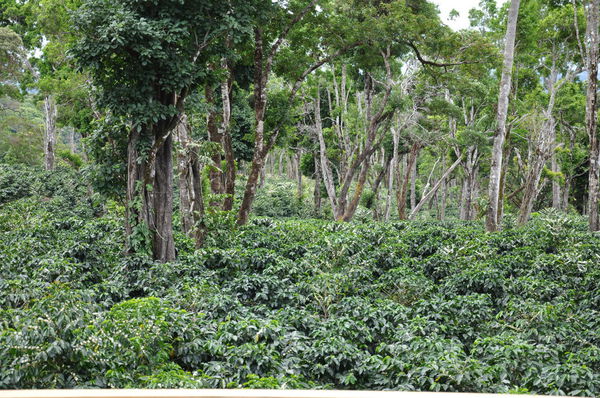
The Diamond Mountain series is grown on the slopes of the Canas Verdes and Jaramillo areas in Boquete, east of Baru Volcano, at altitudes of 1,400–1,600 meters. The plantings there are mainly Typica, Bourbon, and Catuai. Volcanic soil gives the coffee excellent growing conditions, and the surrounding original forest provides ample shade. Those natural advantages yield green beans with rich, complex fruit aromatics along with chocolate and fresh spice notes.

Beyond producing fine coffee, Diamond Mountain follows genuinely sustainable farming. The entire estate holds Rainforest Alliance certification, which protects bird and wildlife habitat from human disturbance, and post-harvest wastewater is recycled and reused to keep the water clean—making the farm a largely self-sufficient ecosystem.
Diamond Mountain: La Esmeralda's Acclaimed Second Brand
The Growing Environment
Diamond Mountain is another star brand under La Esmeralda, built mainly on Catuai. The beans are harvested from Jaramillo and Canas Verdes, two of the estate's four independent farms, where volcanic soil and forest shade create ideal conditions. Thanks to that terroir, the green beans show rich fruit aromatics and sweetness, making Diamond Mountain La Esmeralda's most popular line after Geisha.
The Catuai Variety
Variety shapes flavor more than almost anything else—Geisha owes its popularity entirely to its delicate cup. Diamond Mountain, by contrast, is all Catuai.

The name Catuai derives from the Guarani words "multo mom," meaning "very good," and the variety comes in Yellow and Red forms. Catuai was bred in 1949 by crossing Yellow Caturra with Mundo Novo, initially under the code H-2077. Caturra is a natural Bourbon mutation, while Mundo Novo is a natural Bourbon × Typica hybrid.
Catuai thus combines the strengths of both parents: high yield, disease resistance, and a clean, bright cup. Its yields far exceed Bourbon's, partly because the plants are more compact and can be planted closer together—Catuai planting density is roughly double that of Bourbon.

High yield hasn't come at the cost of flavor. Catuai is the foundation of Diamond Mountain's cup: pleasant citrus acidity, a solid and full body, and the pronounced sweetness typical of Bourbon-descended varieties.
The Extra Edge: La Esmeralda's Processing
Diamond Mountain's quality owes as much to La Esmeralda's mature processing as it does to terroir and variety. The lot we cupped was a natural: harvested cherries go straight to the patios, where they dry evenly with the pulp intact. As with any natural process, the fruit sugars are absorbed during drying, building extra fruit and fermentation aromatics.

Depending on weather and site, the cherries dry on concrete patios for 3 to 5 days at 8 hours per day. Once sufficiently dry, they finish in Guardiola dryers—72 hours of slow rotation that completes the drying and prevents fermentation. Afterwards, machines remove the dried pulp and skin.

The Guardiola is La Esmeralda's preferred drying tool: a horizontal rotating drum that circulates warm air around the beans, wicking away moisture and discouraging mold. Once dried, the beans rest in nylon bags in the warehouse for 30 to 45 days—a step called "reposo" that stabilizes the coffee and improves the cup.
Flavor Description: FrontStreet Coffee's Diamond Mountain
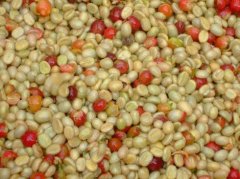
FrontStreet Coffee's Diamond Mountain naturals show a yellowish green with plenty of silver skin on the surface—the Caturra beans curve to a rounded, slender point, while the Catuai beans are flatter-bodied with comparatively slim tips. To protect the red-berry character of this coffee, our roasters chose a medium-light profile. Time to brew a cup and taste it.

FrontStreet Coffee's Diamond Mountain Brewing Recommendations
Dripper: V60 #01
Water Temperature: 90–91°C
Dose: 15g
Ratio: 1:15
Grind Size: Medium-fine (80% pass rate on the Chinese #20 standard sieve)

Brewing Method
Three-pour method. Start the timer, bloom with 30g of water for 30 seconds. When the water level has just about exposed the coffee bed, pour up to 125g; when the bed is about to show again, pour up to 225g and stop. Remove the dripper as the bed is just about to be exposed (timing from the start of the bloom). Total extraction time: 2'00".

In the Cup
Citrus, bright acidity, nuts, honey, a touch of fermentation, a smooth mouthfeel, and a cocoa finish.
FrontStreet Coffee Recommendation
If Diamond Mountain whets your appetite for Geisha, it helps to know the range. Geisha—anglicized from "Geisha/Gesha"—is among the most beloved arabica varieties, prized for its floral perfume and sparkling acidity, but low yields, fragile disease resistance, and demanding cultivation keep its price high. Knowing the product tiers is the key to drinking well without overspending.
At the top sit La Esmeralda's own Geisha lines: the Red Label, officially "Esmeralda Special," grown at 1,600–1,800 meters, cupping above 90 points each batch, with every fully traceable lot drawn from a single plot (FrontStreet Coffee's Red Label comes from the Jaramillo plot); and the Green Label, "Private Collection," a blend of multiple high-altitude plots that showcases the estate's signature Geisha character at a friendlier price. Both deliver Panama Geisha at its finest—orange-blossom honey sweetness, lush florals, juicy fruit, and a tea-like finish—especially as a pour-over. And for a first taste of that legendary flavor, FrontStreet Coffee's entry-level Boquete Geisha offers the classic Panamanian profile of orange aroma, oolong tea body, and delicate fruit acidity at a fraction of the cost.
Geisha also rewards careful brewing. It's a dense, medium-light roast with floral-fruit character that can clog the dripper as it settles, so grind coarser—about a 78% pass rate on the Chinese #20 sieve (close to fine-granulated sugar)—and use 91°C water. FrontStreet Coffee brews 15g with a small Hario V60 at 1:16, using the same three-pour method described above, finishing in roughly 2 minutes 10–20 seconds. If you'd rather explore espresso, the medium-roast Genlana Estate Geisha makes an excellent SOE: 20g in, 40g out, 25 seconds, yielding apricot, caramel, and nut flavors as a straight shot—and orange, nut, and blueberry as a 1:5 americano.
Important Notice :
FrontStreet Coffee is a long-established specialty coffee roaster in Guangzhou China, selling freshly roasted beans from its own farm in Yunnan as well as dozens of carefully selected single-origin beans from around the world for both pour-over and espresso. The products deliver consistently excellent quality and great value, with shipping within 24 hours. Guangzhou's FrontStreet Coffee shop is recommended by many coffee lovers, and the beans are now available online at the Tmall 。
FrontStreet Coffee has moved to a new address:
FrontStreet Coffee Address: 315,Donghua East Road,GuangZhou
Tel:020 38364473
 Scan and follow the En Gafei WeChat official account. Please indicate that the reprint comes from "En Gafei".