Geisha vs Yirgacheffe: The Distinctive Characteristics of Premium Yirgacheffe Coffee

Customers often ask us why Geisha costs so much. It shares citrus and berry notes with Yirgacheffe, the so-called starter bean for beginners, so what really separates the two? In this article FrontStreet Coffee examines the question from every angle — growing regions, history, varieties, flavor, roasting, and brewing — so you can decide for yourself.
The Difference Between FrontStreet Coffee's Geisha Coffee Beans and FrontStreet Coffee's Yirgacheffe Coffee Beans
Geisha coffee takes its name from the variety known in English as Geisha or Gesha. Because it happens to coincide with the Japanese word for a female entertainer, the variety is sometimes understood that way, and Chinese speakers rendered it phonetically as "Guixia," a translation that happens to be both faithful and elegant.

Variety is one of the biggest levers on a coffee's flavor, much as a green apple and a Red Delicious apple taste nothing alike. High-grown Geisha tends to show pronounced floral aromatics and a refined, elegant fruit acidity that outclasses most other varieties. FrontStreet Coffee believes that this elegance of flavor is a large part of why the variety became a worldwide phenomenon.
The Discovery of Geisha
The Geisha variety was first identified in 1931 in the Geisha forest of Ethiopia, then sent to the Coffee Research Institute in Kenya. It reached Uganda and Tanzania in 1936, and Costa Rica in 1953. Panama began growing it in the 1970s, after Mr. Francisco Serracin of the Tumba Seven farm obtained seeds from CATIE in Costa Rica.

In fact, Daniel ran cup after cup across different harvest batches, logging the flavor of each, until one batch finally stood out. Comparing batch by batch was the only way to catch the difference. Once he had isolated it, he traced the batch back to its harvest date and picking area, reviewed the estate records again, and pinpointed the exact plot. Only then did he begin examining the trees one by one — their appearance, leaves, and fruit — and so came upon Geisha. It was not the simple stroke of luck outsiders imagine; the variety took several times the effort and persistence of anything else to surface.
Emerald Manor's Astonishing Auction Records
Much of that reputation rests on an unbroken string of championships. Award-winning competition beans always command a premium, and the winning prices can run dozens of times the market value — but Emerald Manor's record has no precedent. By 2013 the estate had taken fifteen first places across different competitions. Most striking was the natural Geisha lot that won the natural-process category at the 2013 Best of Panama, which sold for $350.25 per pound. Ordinary non-auction premium Panamanian coffee that year fetched around $6 per pound, making the winning lot more than 58 times the price of other specialty coffee.

Geisha Variety
Take Emerald Manor's Red Label as an example. This lot shows a highly recognizable washed Geisha character. The dry aroma carries subtle florals, while the wet aroma after brewing opens into clear fruit and flowers. On the palate there is bright citrus acidity and a medium, tea-like body — it drinks like a cup of jasmine tea.

Panama Emerald Manor FrontStreet Coffee Geisha Red Label Coffee
Region: Panama, Boquete Region
Estate: Emerald Manor, Velo Block
Altitude: 1600-1800 meters
Variety: Geisha
Processing Method: Natural Process
FrontStreet Coffee's Geisha green beans are a beautiful blue-green with a warm, jade-like texture. They smell of fresh grass, peach, and berries, along with the milky-sweet oolong aroma that most coffee beans lack. Aroma and flavor do require some associative imagination, but the light tea note is something anyone can plainly perceive.
To draw out that character and aroma, the beans are roasted to the verge of second crack. The verge of second crack — and the first crack of second crack — are common stopping points precisely because they show a bean at its most characteristic. Roast too light and off-flavors appear; roast too dark and the floral aromatics and fruit acidity disappear. The right point must of course be adjusted to the bean and to the roaster's reading of it.

FrontStreet Coffee Geisha Flavor Profile:
Floral, tropical fruit, and intense sweetness; with the right roast it feels like sipping the fragrance of a fresh bouquet. It began as an ancient native variety of Ethiopia, carried to Costa Rica's coffee experiment garden as a sample and handed to several small farms for trial planting at low volume.
For a long time few people paid Geisha any attention, until one day Panama's Esmeralda (Emerald) Manor separated it out from the other varieties and it took the national coffee championship. Its fruit and floral components closely echoed the Yirgacheffe of Ethiopia, on the far side of the world in Africa. Today some small farms have obtained Geisha seed as well and are eager to try growing their own.

What Grade is Geisha Coffee?
As most people know, the Geisha from Panama's Emerald Manor (Panama Geisha Hacienda La Esmeralda) is the reigning king of specialty coffee, commonly called Red Label Geisha. Its quality is high and, naturally, so is its price. Red Label Geisha is harvested from plots above 1,550 meters and goes to global auction every May.

FrontStreet Coffee Roasting Analysis
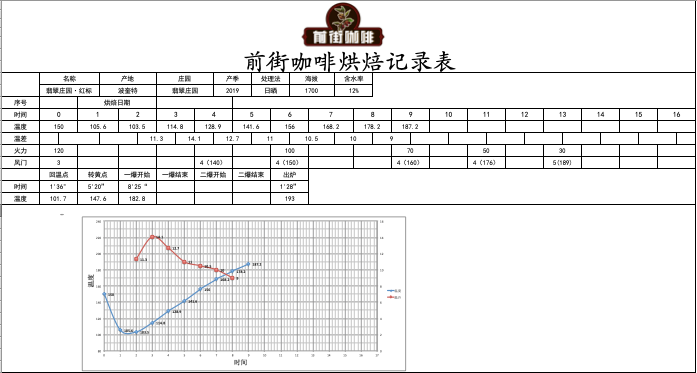
Charge at 150°C, heat at 120, damper at 3. Return to temperature at 1'36". When the drum reaches 140°C, open the damper to 4 and hold the heat. At 147.6°C the bean surface turns yellow, the grass smell disappears entirely, and the batch enters the dehydration phase. At 150°C, drop the heat to 100 and leave the damper unchanged.
At 7'38" ugly wrinkles and dark spots appear on the surface, and the toast smell clearly shifts into coffee aroma — the prelude to first crack. Listen closely for the sound. First crack begins at 8'10", at which point open the damper to 4. Develop for 1'28" after first crack and discharge at 189.5°C.
Today we cupped a batch of FrontStreet Coffee Red Label Geisha, and the aftertaste was extremely sweet.
Cupping results: Lychee, a particularly clear peach-juice texture, fragrant orange, black tea, fruit juice, honey, and a persistent sweetness. Gentle and rounded at first, with strong fruit sweetness and a long finish, like swallowing a mouthful of fresh fruit tea — clean and refreshing. The cooler it gets, the finer the acidity, and the charm lingers, leaving you thoroughly satisfied.
FrontStreet Coffee Brewing Recommendations
Recommended brewing method: Pour-over
Filter: V60
Water temperature: 88-90°C
Coffee-to-water ratio: 1:15
Grind size: Fine grind (80% pass-through rate on China standard No. 20 sieve), equivalent to medium-fine

Brewing technique: Segmented extraction. Bloom with 32g of water for 30 seconds. Pour with a small stream to 125g, then hold. When the water level falls and is about to expose the coffee bed, continue to 228g and stop. Wait for the level to drop and about to expose the bed once more, then remove the dripper. Timing starts from the bloom; extraction time is 1'52".
Yirgacheffe Growing Region Introduction
Ethiopia's FrontStreet Coffee Yirgacheffe is a celebrated specialty coffee region whose cups show elegant floral and fruit aromatics with bright, lively acidity. As coffee's birthplace, Ethiopia's thousand-year farming and processing tradition yields high-quality washed Arabica. A light roast brings out singular lemon, floral, and honeyed aromatics, soft fruit acidity, and citrus, with a fresh, bright mouthfeel. Natural-processed Yirgacheffe adds rich tropical fruit, a sweet full body, rounded gentle acidity, and lingering sweetness.

Yirgacheffe FrontStreet Coffee Natural Red Cherry Coffee
Region: Yirgacheffe
Altitude: 1900-2300m
Variety: Heirloom
Processing: Natural
Grade: G1
About the Red Cherry Project - OPERATION CHERRY RED
The name Red Cherry Project is familiar to many, though few can explain exactly what it is. In 2007, to help Ethiopian farmers earn more and improve local living standards, a Dutch trader named Trabocca launched OPERATION CHERRY RED together with growers. The project exists purely to reward farmers for better-quality beans. At the start of each harvest, Trabocca maps microclimate zones for the picking plan, with 100% ripe red cherries picked by hand, in lots of roughly 1,500 to 3,000 kg.

In 2008 the Red Cherry Project invested $5,000 in new natural drying racks. In 2009 it put in another $8,000 for more racks and shade nets. In 2010 it spent $9,000 on a generator, and in 2011 a further $10,000 to improve local coffee transport roads, making haulage more convenient and efficient. Trabocca also offers interest-free loans for new cherry depulpers and bean sorters. To make procurement easier for suppliers, it invested $14,000 in 2012 to build a high-quality cupping lab in Addis Ababa.
Trabocca supplies financial loans, new equipment, and production know-how to lift farmers' standards, and promises to buy at generous prices as long as the actual quality passes cupping in both the Addis Ababa and Amsterdam labs.

Trabocca sets the bar at 88 points. After processing at origin, Red Cherry Project beans are immediately packed in separate GrainPro inner bags or vacuum boxes and shipped to Djibouti to await sea freight. Through real-time monitoring, safe transport, and prompt, careful handling, they pursue flawless quality. Roasters can buy high-quality beans through the project, which in turn raises Ethiopian coffee quality and prices, letting Trabocca return profits to farmers and keep improving both.

Processing Method
This natural-processed FrontStreet Coffee Yirgacheffe has slightly larger beans with a little less density and moisture. Every coffee from this processing plant can be considered high-quality, specialty-level work, with character that outshines other coffees regardless of processing method. The beans here may well be the best in the whole Yirgacheffe region.
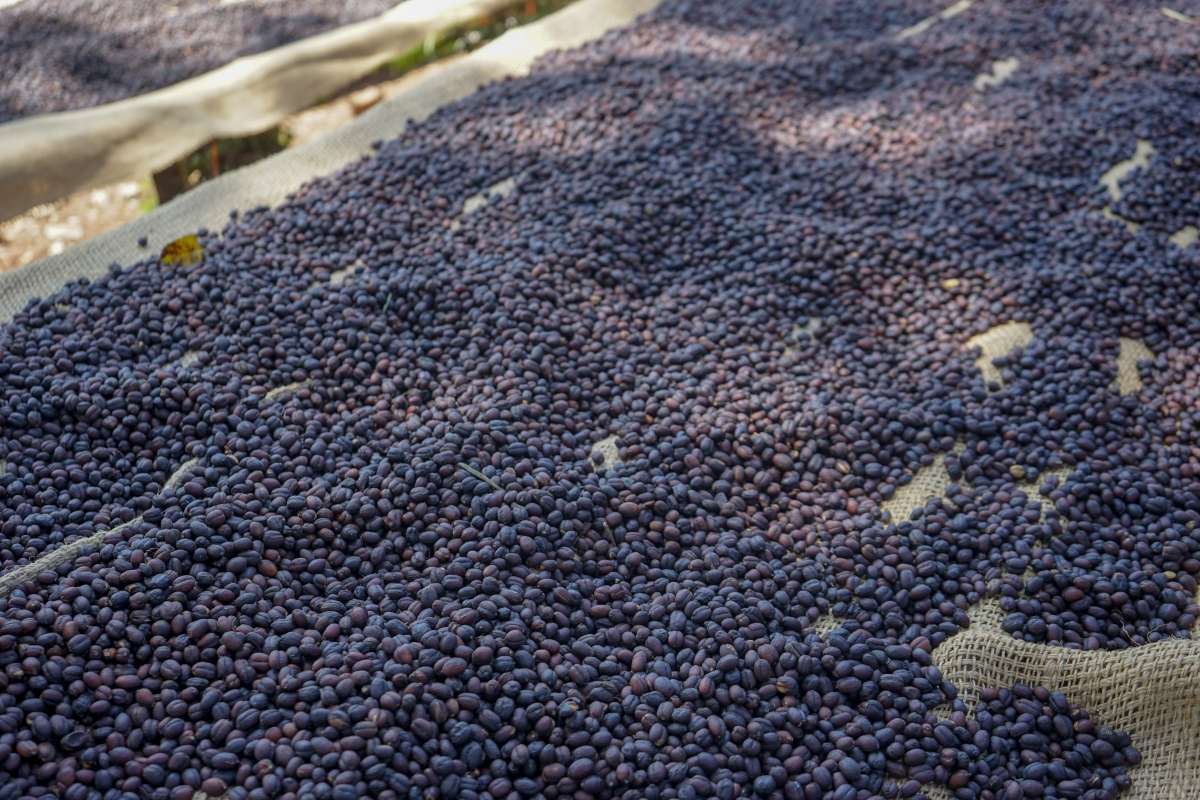
Once the plant selects usable cherries, the fruit and skin are kept whole and the cherries are laid on raised beds for natural processing. It is exactly this labor-intensive raised-bed drying that keeps them off the ground, prevents the earthy off-flavors that can creep into natural processing, and produces exceptionally clean fruit flavors. After more than two weeks of natural drying, the dark brown fruit is professionally stored to let the flavor develop fully. Before shipment the plant removes the beans from the dried cherries, and the sweetness is easy to imagine.

Green Bean Analysis
About Yirgacheffe Grading
According to processing method, Yirgacheffe green beans fall into two main categories.
Natural-processed green beans are graded Gr-1, Gr-3, Gr-4, and Gr-5. Likewise, the top-grade G1 natural Yirgacheffe carries a rich fruit aroma. Opening a bag of freshly roasted G1 natural Yirgacheffe can overturn everything you thought you knew about coffee. Only those who have tasted the highest-grade natural Yirgacheffe will believe that coffee is a fruit.
Exported in ordinary jute bags printed with Trabocca.
Yirgacheffe varieties are local heirloom types, small-bean and fairly round, mostly between 14 and 15 screen size. Yirgacheffe Cherry Red Grade 1 green beans are yellow-green in color, typical of natural coffee, with uniform full beans and few defects.
FrontStreet Coffee Roasting Analysis
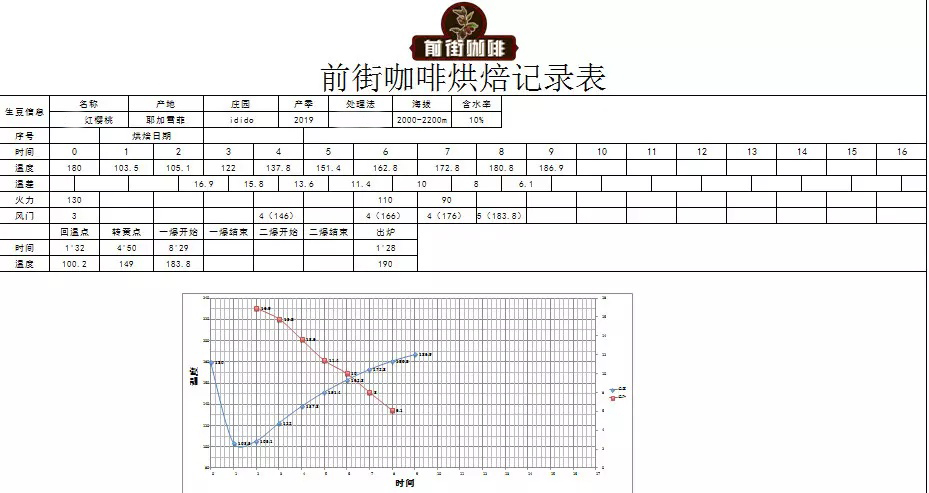
A bean with this much flavor is naturally unsuited to a medium-dark roast, so this Yirgacheffe is given a light, slow roast to express its rounded sweetness and rich floral-fruit aromatics. The beans are relatively small and hold moisture, absorbing more heat during roasting, and the Maillard reaction runs faster. In my first roast I used a higher charge temperature, running 160 heat until the beans had dehydrated and turned yellow, so there was enough heat to carry straight through to second crack. In the second, third, and fourth roasts I used the same 200 charge temperature and the same heat, easing the heat down as needed during the roast.

Yangjia 600g semi-direct flame roasting machine.
Using a fast-stirring profile: charge at 200°C, damper at 3.5. After one minute drop the heat to 160°C and hold the damper. At 148°C adjust the heat once more to 130°C. Roast to 5'03", 151°C, when the bean surface turns yellow, the grass smell vanishes, and dehydration is complete. Adjust heat to 105°C and the damper to 4. At eight minutes, ugly wrinkles and dark spots appear and the toast smell clearly shifts to coffee aroma — the prelude to first crack. Listen closely. First crack begins at 9'07"; reduce heat to 70°C and open the damper fully, taking care not to cut the heat so low that cracking stops. Discharge at 194°C. Yirgacheffe's dry aroma gives off strong fruit — heavy dried fruit, strawberry, mango, and apricot jam. The wet aroma is like sweet syrup, like thick apricot pulp wrapped in rustic honey or chocolate. The entry is gentle, medium-bodied, the acidity not obvious but lively and bright, like fruit black tea.
FrontStreet Coffee Brewing Analysis
For brewing, pour-over and siphon are the best choices. Grinding releases an overwhelming natural fruit aroma with obvious sweetness — gentle, elegant, sweet, and charming. Yirgacheffe throws off extremely complex aromatics and a mouthfeel that is remarkably hard to put into words.
Filter: V60 filter
Coffee grounds: 15g
Water temperature: 91°C
Grind size: Fine grind (78% pass-through rate on a No. 20 standard sieve)
Water-to-coffee ratio: 1:15
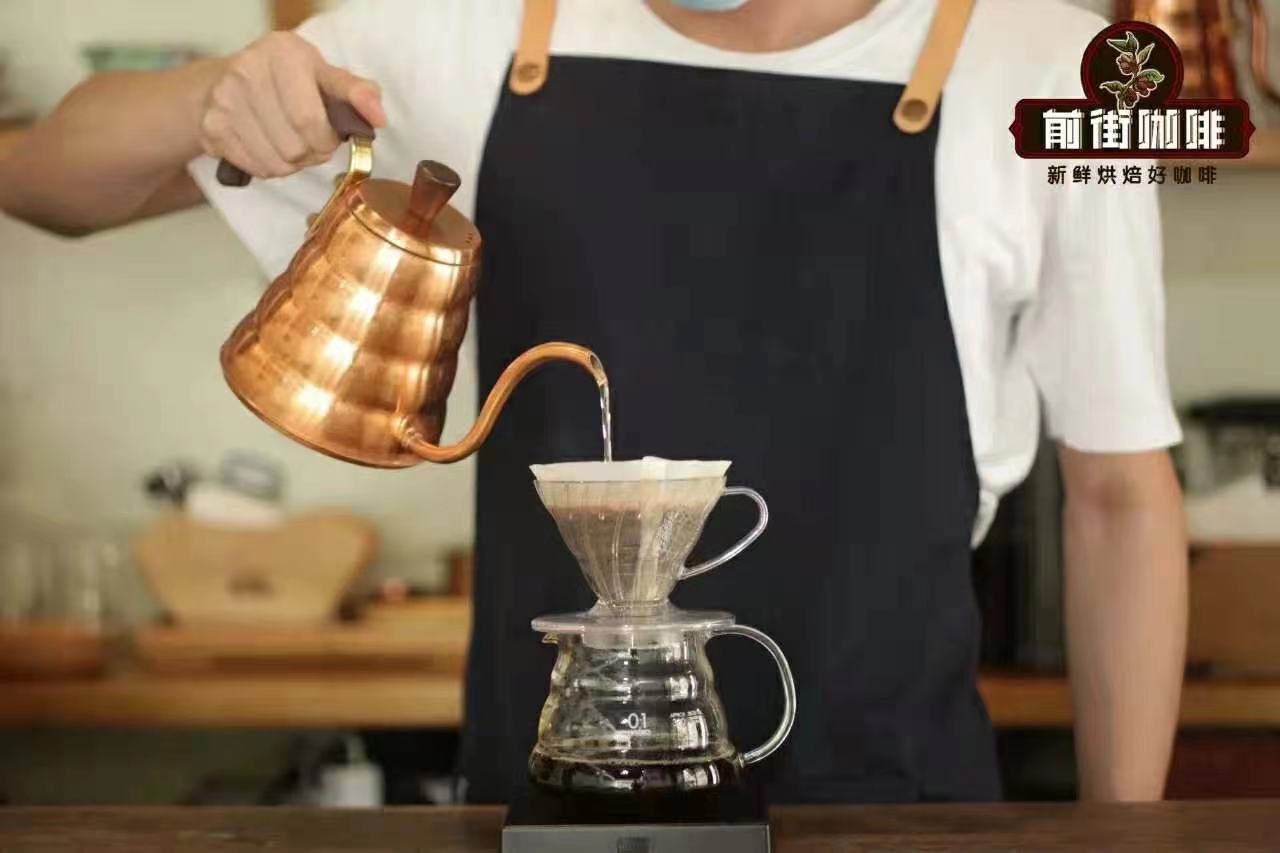
Segmented extraction: bloom with 30g of water for 30 seconds. Pour with a small stream to 125g and hold. When the level falls and the coffee bed is about to be exposed, continue to 225g and stop. Wait for the level to drop and the bed to be about to expose once more, then remove the dripper. Timing starts from the bloom; extraction time is 1'50".

The wet aroma of fermented berry wine makes it hard to believe this is Yirgacheffe, and personally I am not fond of that particular note. Even so, from the exceptionally smooth entry to the delicate body, the emergence of ripe-fruit sweetness is genuinely astonishing — sweeter than any Yirgacheffe I have tasted. The finish is excellent too, fully earning its "fruit bomb" reputation. After a cup, you can count on sweetness lingering in your mouth for half an hour.
FrontStreet Coffee Recommendation
Geisha's fame rests on low yields, weak disease resistance, and demanding farm management, which together keep prices high. To drink it well without overspending, it helps to know the tiers. FrontStreet's Emerald Manor line splits into two grades. The Red Label is formally Esmeralda Special: it grows at 1,600-1,800 meters, every lot must cup above 90 points, each carries its own number, and each batch comes from a single small plot — FrontStreet's Red Label, for instance, is from the Halimiyo block — so buyers can pick the micro-flavor they prefer. The Green Label is Private Collection: rather than stressing plot detail like the Red Label, it blends batches from several plots to express the estate's signature high-altitude Geisha character, and it is friendlier on price, which makes FrontStreet's Green Label a strong value.
New drinkers who just want a first taste of the famous "Geisha flavor" should start with FrontStreet's Boquete Geisha from Panama. As an entry-level Geisha it delivers the classic Panamanian orange-blossom honeyed charm, an oolong tea note, fine fruit sweet-tartness, and distinct layering at a reasonable price. Ethiopia also has its own Geisha estate, Geisha Village, with a stricter grading system than Panama's. It grows three Geisha varieties — Gori Gesha, Geisha 1931, and Illubabor Forest — and grades them as Gold RARITIES, Red GROWERS RESERVE, Green SINGLE-TERROIR, and CHAKA lots. FrontStreet's Gold Label belongs to the Geisha 1931 variety, about 10% of Geisha Village's output, and is the estate's finest non-auction coffee, often chosen by competition baristas; it uses a refined natural process and cups with remarkable complexity. FrontStreet's Red Label is the Gori Gesha variety, about 15% of production, scoring 88 or above on the SCA 100-point scale as a single-terroir series with full traceability for every lot number.
Among Ethiopian options, FrontStreet's Genlana Geisha comes from the Genlana Gesha farm in Yirgacheffe, a rare single-variety estate, with beans from the Genlana processing station founded in 2014 on the border of Kochere and Genlana Abaya, where some 700 hectares are planted and much of the land is still uncultivated, fertile, and shaded. Hand-picked ripe cherries are dried off the ground on raised beds for 14 to 20 days depending on weather, then given a medium-light roast that shows bright citrus acidity, elegant ginger-flower aroma, full ripe-fruit sweetness, and a fine, silky body with the refined finish that marks the Gesha variety. For brewing, use a V60: 15g at 1:16, water at 91°C, ground to 78% pass-through on a China standard No. 20 sieve, roughly fine-sugar texture, then bloom to 30g for 30 seconds, pour in small circles to 125g, wait for the bed to fall halfway, and continue to 225g, for a total extraction of about 2:10 to 2:20.
Important Notice :
FrontStreet Coffee is a long-established specialty coffee roaster in Guangzhou China, selling freshly roasted beans from its own farm in Yunnan as well as dozens of carefully selected single-origin beans from around the world for both pour-over and espresso. The products deliver consistently excellent quality and great value, with shipping within 24 hours. Guangzhou's FrontStreet Coffee shop is recommended by many coffee lovers, and the beans are now available online at the Tmall 。
FrontStreet Coffee has moved to a new address:
FrontStreet Coffee Address: 315,Donghua East Road,GuangZhou
Tel:020 38364473
 Scan and follow the En Gafei WeChat official account. Please indicate that the reprint comes from "En Gafei".