Honduran Coffee Bean Story - Flavor Profile and Brewing Guide for Honduras Sherry Barrel Processed Coffee Beans
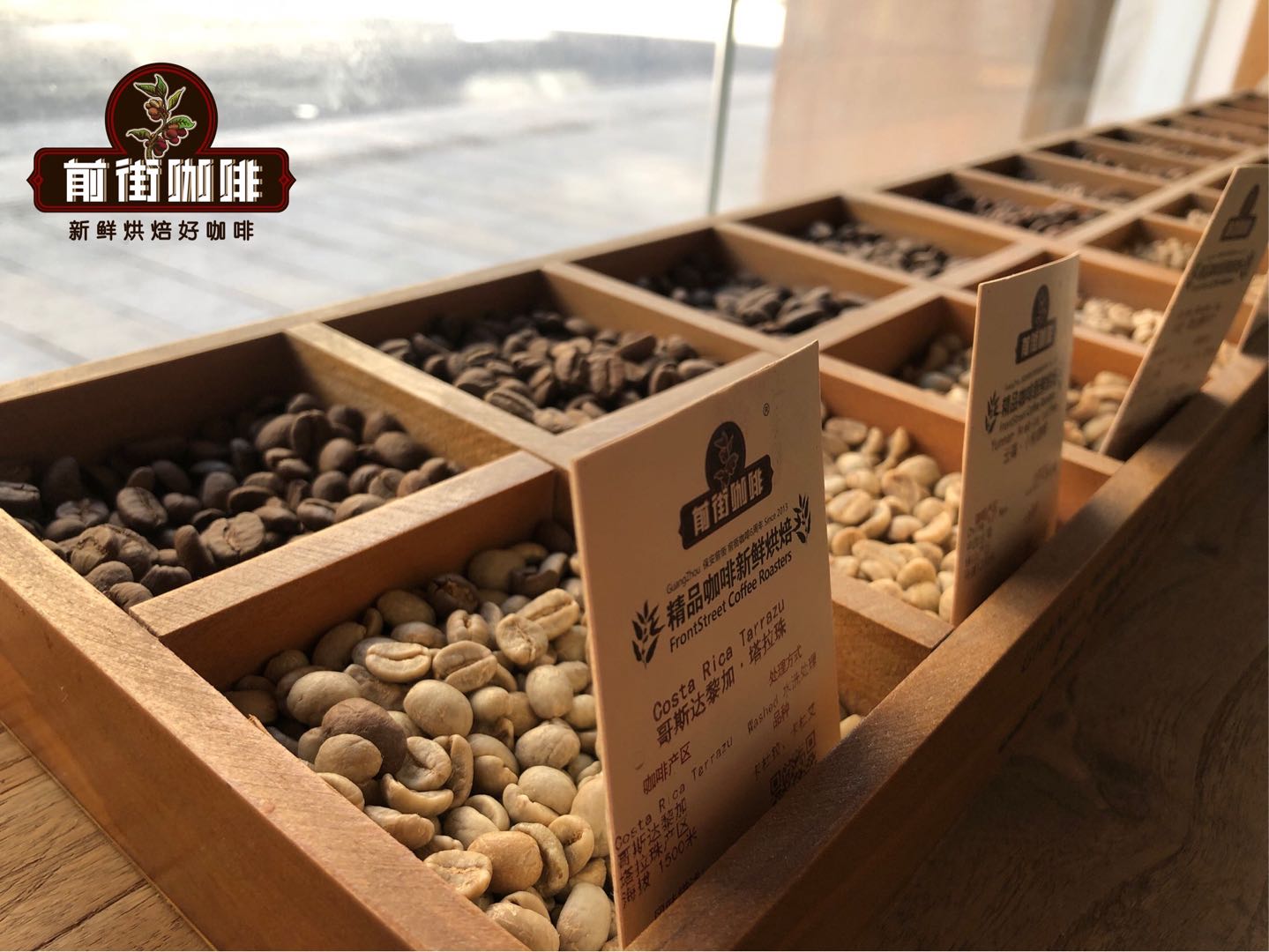
With the arrival of the third wave of coffee, ever more innovative processing methods have emerged, and the most popular in recent seasons are undoubtedly anaerobic and barrel fermentation. FrontStreet Coffee currently carries several anaerobic and barrel-processed beans that are extremely popular with customers. Barrel fermentation is a technique that has appeared only in the last few years, offering flavor and texture experiences unlike anything before it. As the coffee market keeps moving toward processing innovation, barrel processing rides that trend — and FrontStreet Coffee will continue to discover and evaluate distinctive beans to give everyone objective reference data.
Barrel Fermentation Principle
The inspiration for FrontStreet Coffee's Honduras barrel-fermentation beans comes from wine aging technology. During fermentation, the barrel walls allow tiny amounts of air to pass through, causing moderate oxidation of the beans; that measured oxygen intake also accelerates fermentation, smooths tannins, and gradually transforms fresh fruit aromas into the rich, layered fragrances of mature wine. The wood's moderate hardness guarantees waterproofing and storage safety. The barrels also carry tannins of their own, which seep into the green beans during storage, giving the coffee layered complexity and a deep wine aroma. When FrontStreet Coffee recently acquired a batch of its Honduras Sherry whiskey-barrel-processed beans, opening the green-bean bag released an immediate rush of vanilla cream and wine aromas.
FrontStreet Coffee: Honduras Moca Manor Sherry
Region: Intibucá Department
City: Masaguara
Estate: Moca Manor
Altitude: 1500-1700m
Varieties: Caturra, Catuai, Pacas
Processing: Fine washed whiskey sherry barrel fermentation
FrontStreet Honduras Coffee
Honduras lies in northern Central America, bordered by the Caribbean Sea to the north, the Gulf of Fonseca of the Pacific to the south, Nicaragua and El Salvador to the east and south, and Guatemala to the west — a country mainly of mountains and plateaus. Honduras has 280,000 hectares of coffee plantations, primarily smallholdings, with most farms smaller than 3.5 hectares; these small farms account for sixty percent of the country's total coffee production.
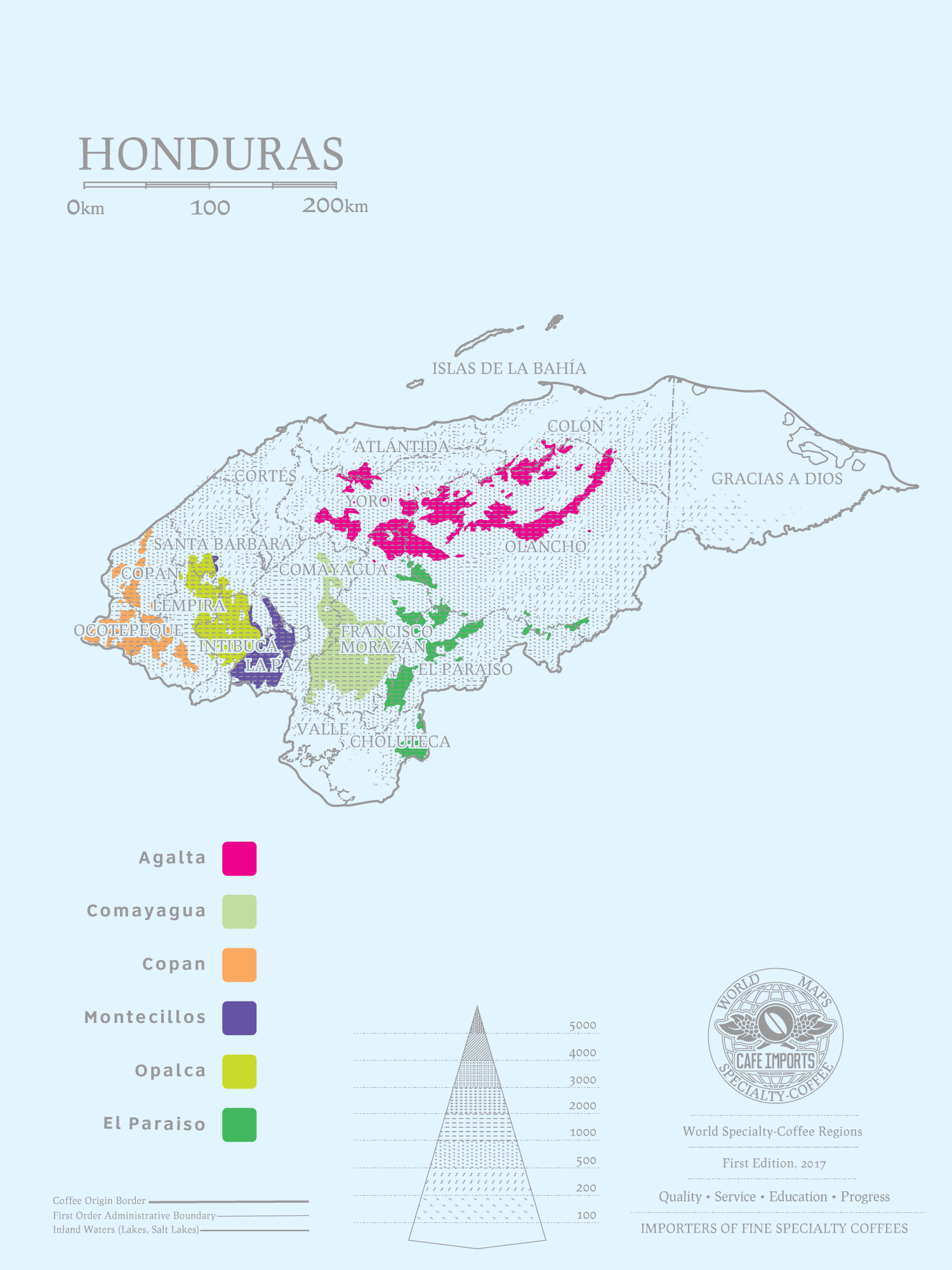
Honduras has six main growing regions — Copan, El Paraiso, Comayagua, Opalaca, Montecillos, and Agalta — with average growing altitudes of 1,000–1,600m and main varieties of Bourbon, Caturra, Typica, Catuai, and Pacas. Moca Manor, however, is not located in any of those six regions: it sits in Masaguara, a municipality in Honduras's Intibucá Department, south of the Jesús de Otoro valley and surrounded by mountains and hills. Coffee growing dominates the local economy, while the valley floor itself is devoted to basic grains and livestock. As for the name: according to Alberto Membre's "Indigenous Place Names," Masaguara means "place of deer."
The Development of Honduras Coffee
Honduran coffee did not have a smooth beginning. Compared with Central American neighbors like Costa Rica, Guatemala, and Nicaragua, its coffee industry developed considerably later.
The main reason was Honduras's lack of transportation infrastructure linking the growing regions with ports, which long held the industry back. After 1970, however, the government created an official coffee institution — Instituto Hondureño del Café (IHCAFE) — dedicated to improving quality. Combined with the fact that coffee trees can be grown throughout the country, Honduras's production surpassed Costa Rica's and Guatemala's in 2011!

Today Honduras faces challenges from leaf rust disease and global warming — major issues for the country.
Honduras Coffee Regional Flavors
Honduras's six major growing regions sit mainly in the west and south: Copán, Opalaca, Montecillos, Comayagua, Agalta Tropical, and El Paraíso. Three of them are the principal producing areas:
Montecillos: home to the highest-altitude estates in Honduras, with bright, richly layered flavors full of intense fruit and sweet aromas and citrus notes.
Copán: chocolate flavors, rich texture, and high sweetness.
Agalta Tropical: balanced honey sweetness and acidity, with chocolate notes.
Broadly speaking, FrontStreet's Honduras coffees show relatively high body and sweetness with fruity notes, sometimes plus nut and toffee aromas — a genuinely multi-layered coffee.
Honduras Coffee Grading
Honduran coffee is graded by altitude and defect rate. The defect-rate grading follows American and European standards, which we won't detail here. The altitude grading is as follows:
Strictly High Grown (SHG): over 1,200 meters.
High Grown (HG): over 1,000 meters.
Central Standard (CS): grown at altitudes over 600 meters.
A bean's information typically displays both the altitude grade and the defect grade to indicate quality. Beyond this system, recent specialty coffee competitions held in Honduras have also helped push higher-quality specialty coffees into the market!
Coffee Varieties (Caturra, Catuai, Pacas)
Caturra is a natural variant of Bourbon, discovered in Brazil in 1937. The plant is more compact than Bourbon, and while it inherits Bourbon's relatively weak disease resistance, its yield is higher. Although discovered in Brazil, Caturra never suited large-scale cultivation there; instead it became widely popular across Central and South America — Colombia, Costa Rica, Nicaragua, and beyond.

Catuai is a man-made hybrid of Caturra and Mundo Novo, with better resistance to natural disasters — particularly wind and rain. The trees are relatively low-growing, and compared with other varieties Catuai fruits attach more firmly and are not easy to harvest. The fruits come in both red and yellow forms.

Pacas is a natural single-gene mutation of Bourbon. Its main advantages are a small tree with higher yield potential that can be intercropped with fruit trees to raise cherry output further. The variety was discovered in 1949 on a farm belonging to the Pacas family in El Salvador's Santa Ana region. In 1960 the Salvadoran Coffee Research Institute (ISIC) began a pedigree selection project for Pacas (selecting individual plants through successive generations, also called single-plant selection). It is popular throughout Central America and widely planted in El Salvador, accounting for about 25% of its production. In 1974 the Honduras Coffee Research Institute introduced the variety and began cultivating it in Honduras.

Processing Method
The FrontStreet Honduras Sherry beans undergo fine washed whiskey sherry barrel fermentation: freshly harvested cherries are first finely washed, then placed in sherry-aged barrels for low-temperature fermentation of 30–40 days (at approximately 15–20°C), followed by shade drying.
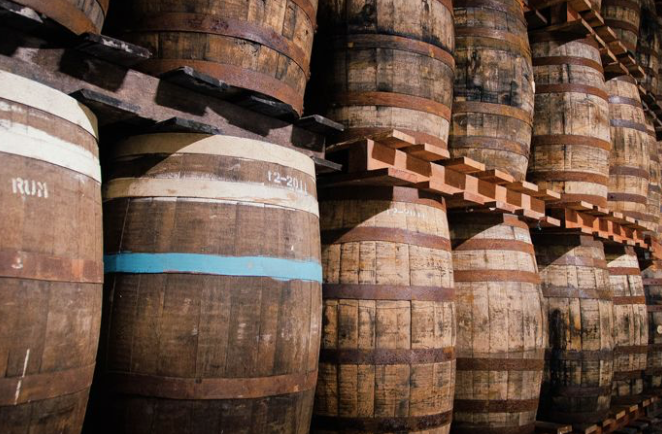
Sherry barrels are those used by sherry wineries in the whiskey industry for aging. Sherry production involves the Solera System, a process of blending and aging sherries of different vintages after fortification — the very thing that forms sherry's distinctive flavor.
Coffee fermented in sherry barrels naturally carries sherry wine flavors, creating an intoxicating, unique taste that has been hugely popular in recent years.
Coffee Bean Roasting
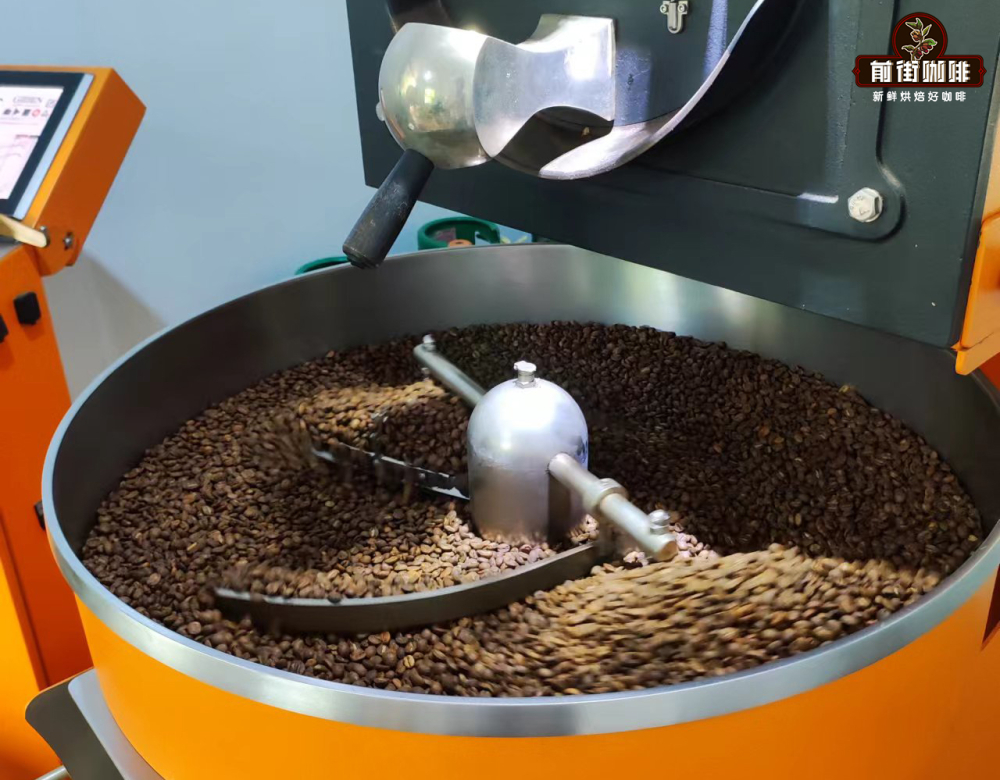
When FrontStreet Coffee receives these barrel-fermented beans they arrive as green coffee, and FrontStreet performs the roasting itself. One thing to note: Honduran coffee traditionally has rich sweetness and moderate texture but lacks an appealing entrance aroma — the barrel-fermentation method was developed precisely to add aroma. To express these beans at their best, FrontStreet chose light roasting as the direction, and to find the best flavor expression, roasted two different curves for comparison. This is the necessary path FrontStreet takes with every new bean: roasting tests the roaster's understanding of the origin, and cupping and pour-over tastings must confirm whether the curve is right. A single coffee may go through multiple evaluation rounds — time-consuming, but necessary. Without repeated trials, FrontStreet Coffee will not put a bean on sale.

Roast Curves
Curve One
Charge temperature: 190°C, Yellowing point: 5'45", 151.8°C, First crack: 9'07", 184.2°C, Development after first crack: 2'10", Discharge at 195°C.
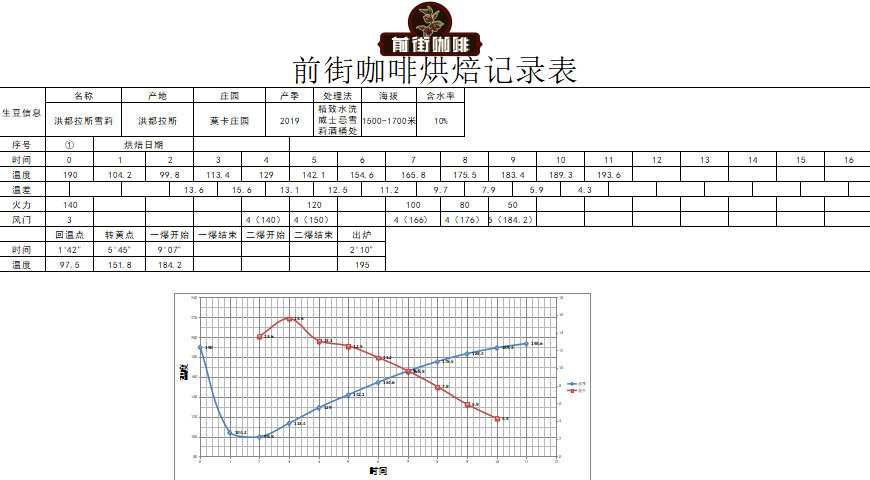
Cupping flavors: Vanilla, honey, citrus, cream, wine-aroma finish, smooth texture, rich flavors, overall balance.
Curve Two
Charge temperature: 190°C, Yellowing point: 5'30", 150.8°C, First crack: 8'38", 184.3°C, Development after first crack: 1'40", Discharge at 196°C.
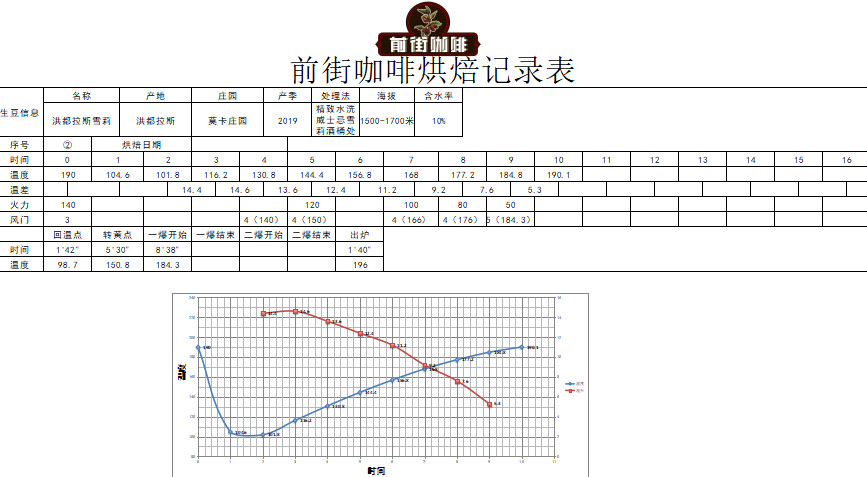
Cupping flavors: Vanilla, cream, syrup, chocolate, fermented wine aroma, rich aroma, thick texture, obvious sweetness — but astringency appears as the cup cools.
After cupping, FrontStreet also runs pour-over tastings to compare both curves. The pour-over parameters: Hario V60 dripper, 90°C water, 1:15 coffee-to-water ratio, EK43s at setting 10 (80% pass rate on the #20 standard sieve). Grind settings vary from bean to bean depending on variety, altitude, processing, and roast, so FrontStreet first sieves every freshly roasted batch to determine the right pour-over grind.

FrontStreet uses a segmented, three-stage pour: 30g of water for a 30-second bloom, a circular second pour to 125g, then, once the water level nearly exposes the coffee bed, a final pour to 225g — about 2 minutes total including the bloom.
FrontStreet Honduras Coffee Bean Barrel Process Flavors:
Curve One
Vanilla and cream aromas at the entrance, citrus and berry acidity through the mid-section, almond and dark chocolate flavors, maple sweetness in the finish, and a vanilla aftertaste — distinct flavors, smooth texture.
Curve Two
Rich vanilla cream aroma at the entrance, gentle citrus acidity in the mid-section, pomelo and syrup sweetness in the finish with a slightly bitter aftertaste — thick texture but with slight astringency and slightly less cleanliness.
Comparing the two curves, FrontStreet found that although Curve Two performs better in aroma, texture, and sweetness — with syrupy notes at the entrance — it is slightly less clean, carries astringency and a somewhat bitter aftertaste, and its flavors feel relatively one-dimensional. Curve One, though a touch softer in aroma and sweetness, shows distinct flavors and a smooth texture, holds its vanilla and cream aromas from entrance to aftertaste, and stays stable from hot to cold with no off-flavors. In the end, FrontStreet Coffee selected Curve One as the roast curve for this batch of Sherry beans. Note that this applies to this specific batch: every new batch goes through the same evaluation, and since batches differ, the previous batch's parameters may not suit the next.
Beyond the V60, FrontStreet Coffee also tried the KONO dripper and Japanese-style iced pour-over for comparison.
KONO
Since this Sherry bean is well balanced with obvious sweetness, FrontStreet chose the KONO dripper. Its shorter ribs let the filter paper cling closely to the wall once wet; with exhaust space restricted, air flow slows, extending the water's contact time with the grounds so the coffee steeps — yielding a more balanced extraction.

Parameters: Water temperature 90°C, coffee-to-water ratio 1:15, BG #5F grind (80% pass rate on the #20 standard sieve), use double the coffee weight in water (30g) to wet the bed for the bloom, ending when the bed shifts from wet to dry — about 30 seconds — then a small-flow center pour to 125g; when the level nearly exposes the bed, continue to 225g and finish, removing the dripper just before the bed shows. (Timing starts from the bloom.) Extraction time: 2'00"
Flavors: Gentle citrus acidity and purple-fruit flavors at the entrance, toffee and vanilla sweetness in the mid-section, wine and chocolate in the aftertaste.
Japanese-Style Iced Pour-Over
Japanese-style iced pour-over is simple: add ice cubes to the sharing pot, brew with hot water, and let the coffee drip directly onto the ice for rapid cooling. FrontStreet uses the V60.
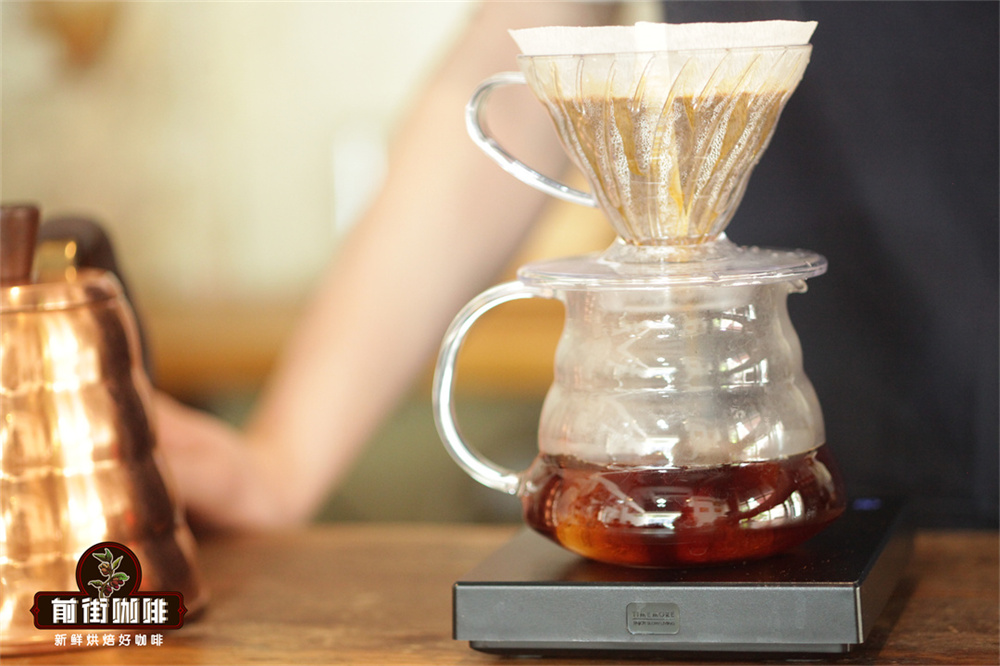
Parameters: Water temperature 90°C, coffee-to-water ratio 1:10 (hot water to coffee), EK43s at setting 10 (80% pass rate on the #20 standard sieve), 100g of ice in the sharing pot. Coffee amount 15g; bloom with 30g of water (double the coffee weight) until the bed turns from wet to dry — about 30 seconds — then pour to 100g; when the level nearly exposes the bed, continue to 150g and finish, removing the dripper once the water has fully drained. (Timing starts from the bloom.) Extraction time: 1'40"
Flavors: Fermented and tropical-fruit notes in the aroma, citrus, vanilla, and nut flavors on the palate, and an oolong-tea aftertaste.
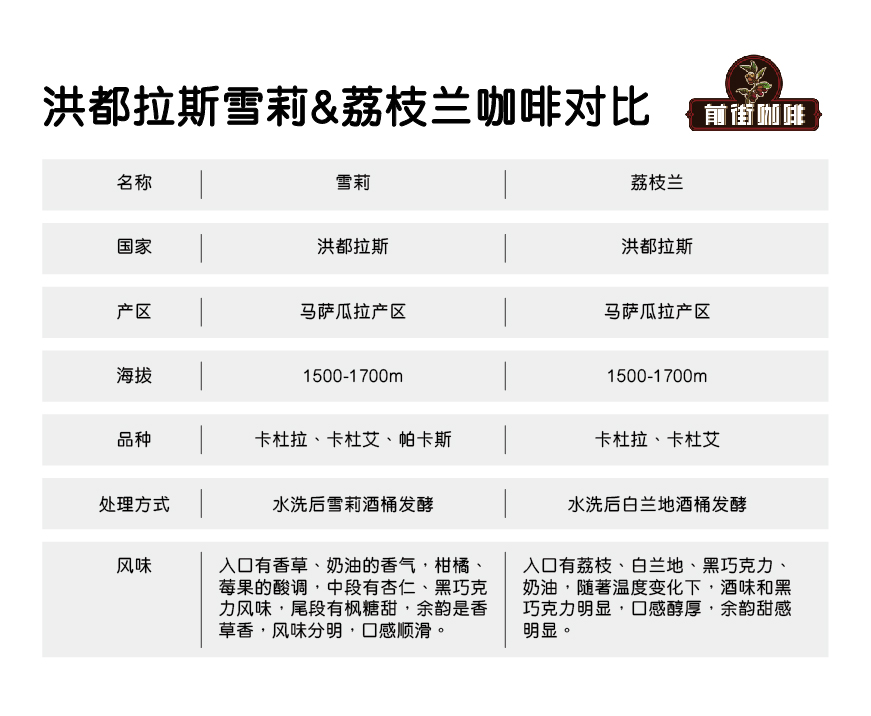
How does the Sherry compare with FrontStreet Honduras Lychee Orchid, another barrel-fermented bean from the same estate? After comparison, FrontStreet found the Lychee Orchid more delicate and fresh while also carrying chocolate and honey-like sweetness. Its entrance offers a clean lychee sweetness — sweet yet clear — interwoven with brandy wine aroma and persistent sweetness in the later section. Beans from brandy barrel fermentation carry gentle lychee and honey sweetness along with a full-bodied brandy note and oak fragrance.
FrontStreet Coffee - Honduras Moca Manor Lychee Orchid
Country: Honduras
Origin: Masaguara
Estate: Moca Manor
Altitude: 1500-1700m
Varieties: Caturra, Catuai
Processing: Fine washed + brandy barrel fermentation
Coffee Bean Processing Comparison
Both of these FrontStreet beans are finely washed before barrel fermentation. The difference: the Sherry beans go into whiskey oak barrels that previously aged sherry for 30–40 days of low-temperature fermentation (about 15–20°C), while the Lychee Orchid beans ferment in brandy barrels. Both are then shade dried until moisture reaches about 11%.
Brandy Oak Barrel Fermentation
Honduras barrel fermentation (brandy oak barrels): after harvest, the cherries are finely washed, then placed in brandy oak barrels for 30–40 days of low-temperature fermentation at approximately 15–20°C, followed by shade drying.
Roasting Recommendations
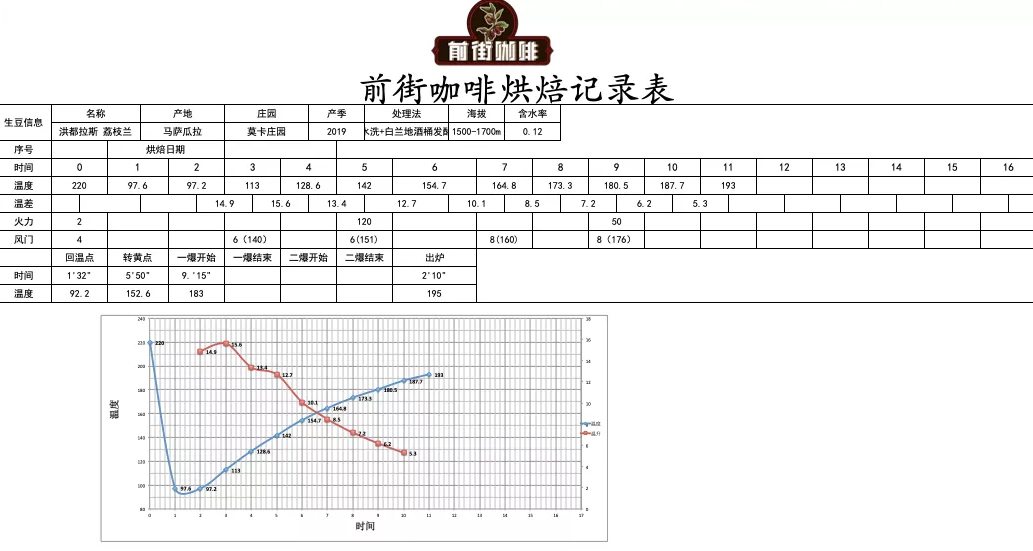
To highlight the Lychee Orchid's flavors and keep the cup balanced, FrontStreet's roasters chose a light roast: Charge temperature 220°C, Yellowing point 5'50", 152.6°C, First crack 9'15", 183°C, Development after first crack 2'10", Discharge at 195°C.
Pour-Over Coffee Flavors:
Lychee, brandy, dark chocolate, and cream at the entrance; as the temperature shifts, the wine and dark chocolate notes grow more pronounced, with a rich texture and an obvious sweet aftertaste.
FrontStreet Coffee Recommendation
If Sherry's vanilla-cream-and-wine character is your style, FrontStreet Coffee's roster of classic full-bodied pour-over beans makes a fine next step. The FrontStreet Brazil Queen Estate is gentler and rounder — pronounced nut, cocoa, and caramel aromas with low acidity and standout sweetness, remarkably stable across pour-over, moka pot, or espresso, and a dependable daily drinker thanks to Brazil's naturally rich crema. The FrontStreet Jamaica Blue Mountain No. 1, grown in the certified Blue Mountain zone at the renowned Clifton estate, ripens slowly in high-altitude mist and volcanic soil into a famously balanced cup: acidity, sweetness, bitterness, and aroma in harmony, with cream, caramel, chocolate, nut, and honey tones and a clean, long finish — medium-dark roasted, with complete origin certification and original shipping barrels available.
For the heavy, wild side of the spectrum, the wet-hulled FrontStreet PWN Golden Mandheling is the flagship of Sumatra's Mandheling tradition: from the PWN company's strict standards — beans of screen size 18 and above, fewer than 3 defects per 300g of green sample for the top G1 grade, plus three rounds of hand sorting — it delivers a clean, full-bodied, dark-roasted cup with deep roasted aromas, ideal for anyone who avoids acidic coffees. Its more rustic sibling, the FrontStreet Lintong Mandheling from around Lake Toba, is fragrant and bittersweet with clove and woody aromatics, low acidity, minty spice, and a strong, lasting sweetness — the taste that keeps old Sumatra hands coming back.
Important Notice :
FrontStreet Coffee is a long-established specialty coffee roaster in Guangzhou China, selling freshly roasted beans from its own farm in Yunnan as well as dozens of carefully selected single-origin beans from around the world for both pour-over and espresso. The products deliver consistently excellent quality and great value, with shipping within 24 hours. Guangzhou's FrontStreet Coffee shop is recommended by many coffee lovers, and the beans are now available online at the Tmall 。
FrontStreet Coffee has moved to a new address:
FrontStreet Coffee Address: 315,Donghua East Road,GuangZhou
Tel:020 38364473
 Scan and follow the En Gafei WeChat official account. Please indicate that the reprint comes from "En Gafei".