Introduction to Ethiopian Gesha Village Coffee Estate Wild Gesha Coffee Beans Gold Label Red Label Chaka Characteristics and Flavor

In everyday coffee talk, when someone says Geisha they almost always mean the Panamanian Geisha championed by Hacienda La Esmeralda. Ever since its singular flavour was pinpointed in 2003, it has gone on to dominate green-bean competitions around the world, BOP included. In FrontStreet Coffee's daily brewing, Panama Geisha reads as rose-like aromatics lifted by citrus — essentially a cup of floral, fruity tea.
Hacienda La Esmeralda stands out for several reasons: it was the earliest to recognise Geisha, it has taken BOP titles year after year, and it built a quality system of its own. A few years later, Gesha Village followed suit with a grading system of its own. FrontStreet Coffee has already traced that history in its article on Hacienda La Esmeralda Geisha. Set beside Panama Geisha, Gesha Village's Geisha shares only the name; it is in fact a completely unrelated variety, a difference you can see in the two beans' appearance. FrontStreet Coffee will treat it separately here as Ethiopia's Geisha.

What Is Gesha Village Coffee Estate?
In 2007, documentary director Adam Overton and his photographer wife Rachel Samuel were filming a documentary about Ethiopian coffee for the government when they came across the Gera coffee forest in the Bench-Maji region. The project did more than reintroduce them to Ethiopia's remarkable land — it planted the idea of building their own coffee estate and brand.
In 2009 they had the good fortune to meet Willem Boot, the well-known owner of Don Mayo and a BOP judge. Willem Boot's plan to return to Ethiopia in search of "Geisha's birthplace" opened a door for the couple. In 2011 they went back to Bench-Maji, where several areas are named Gesha Village and which is also the likeliest region in which to find the original Geisha variety.

Adam accompanied Willem Boot on expeditions into the surrounding forest. Deep in a jungle known as the Gori Gesha Forest they found numerous wild coffee varieties, and the most exciting discovery of all was the original Geisha. They collected seed from the original Geisha trees, screened it, and planted it at Gesha Village. From there they decided to establish the estate on this spot and named it Gesha Village Coffee Estate.
Gesha Village Coffee Estate lies in western Ethiopia, in the Bench Maji region, ringed by dense jungle. The site is beautiful and blessed with a pleasant climate, with views over ancient, expansive forest from the higher ground. Owners Adam and Rachel spent three years searching for the right property before locals led them to Geisha's ancestral forest. It is a two-day drive from the capital, Addis Ababa.

Gesha Village Coffee Estate covers roughly 471 hectares, of which about 320 hectares are planted to coffee in reddish-brown loamy soil. Planting density is held at 7,000 coffee trees per hectare. One plot takes its name, "Oma", from a respected and much-loved religious leader. Gesha Village's beans brim with complex flavour and are extremely rare, and they are frequently chosen by baristas competing internationally. Because the estate protects the local ecology and keeps good relations with nearby residents, it set up the Gesha Village Foundation to give back to the community, supporting education through two schools close to the farm.
Grading System
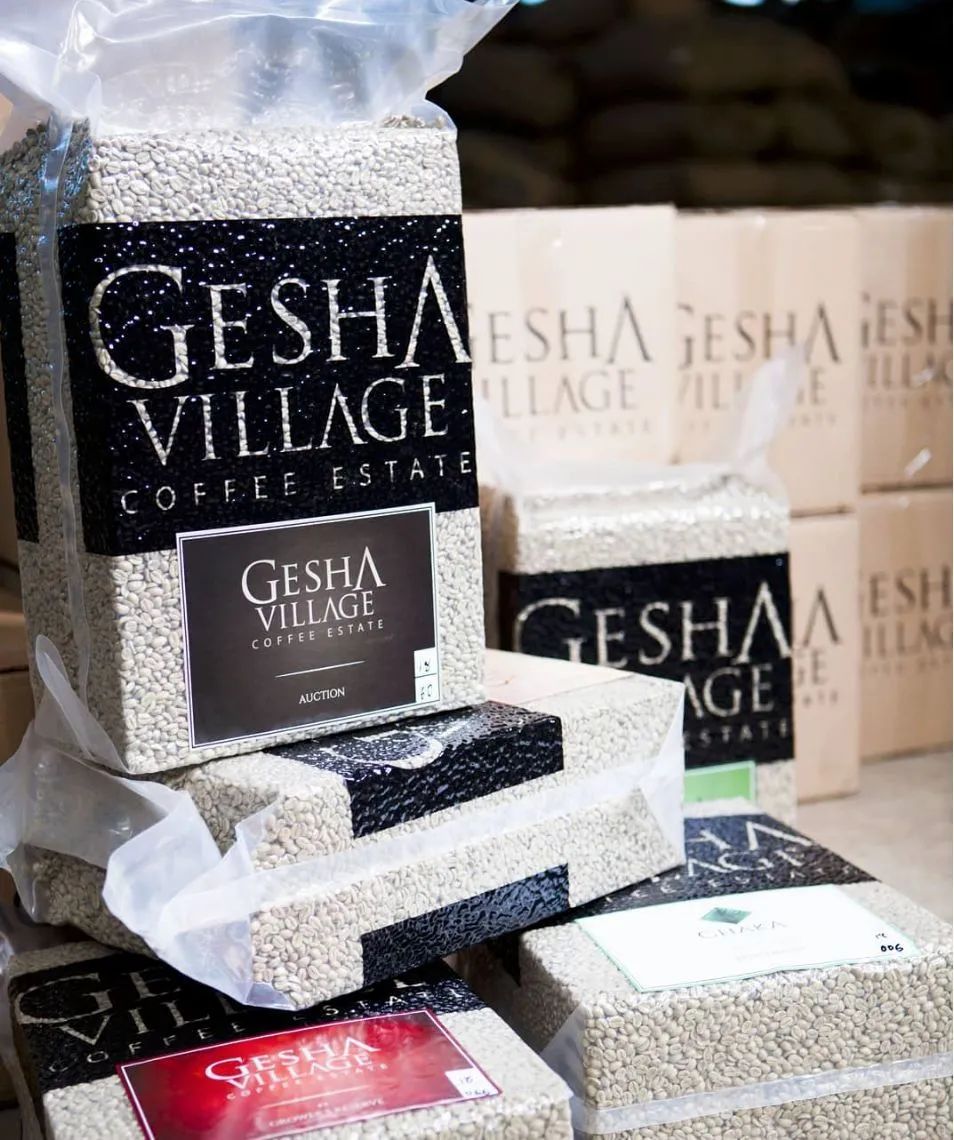
Gesha Village Coffee Estate applies a strict internal grading system: Auction, Gold Label, Red Label, Green Label and the CHAKA batches.

Auction Batches
These make up only 3.7% of Gesha Village's total annual production. They are the estate's most rigorously selected top lots and were available solely through the 2018 Gesha Village Coffee Estate Global Auction. The 2018 auction lots scored between 88.15 and 92.67 points and were split further into Champion's Reserve and Farm Reserve. Gesha Village 2018 Auction Lot RSV.6, for example, belongs to the auction tier.
Gold Label Batches
Gold Label beans account for roughly 10% of Gesha Village Coffee Estate's total annual output, with complex flavours and extreme rarity. Apart from the auction lots, this is the estate's most premium green bean. Many baristas turn to Gold Label for competitions, and quality-focused roasters buy them too. Traceability is complete, and each lot shows a prominent, highly complex flavour.
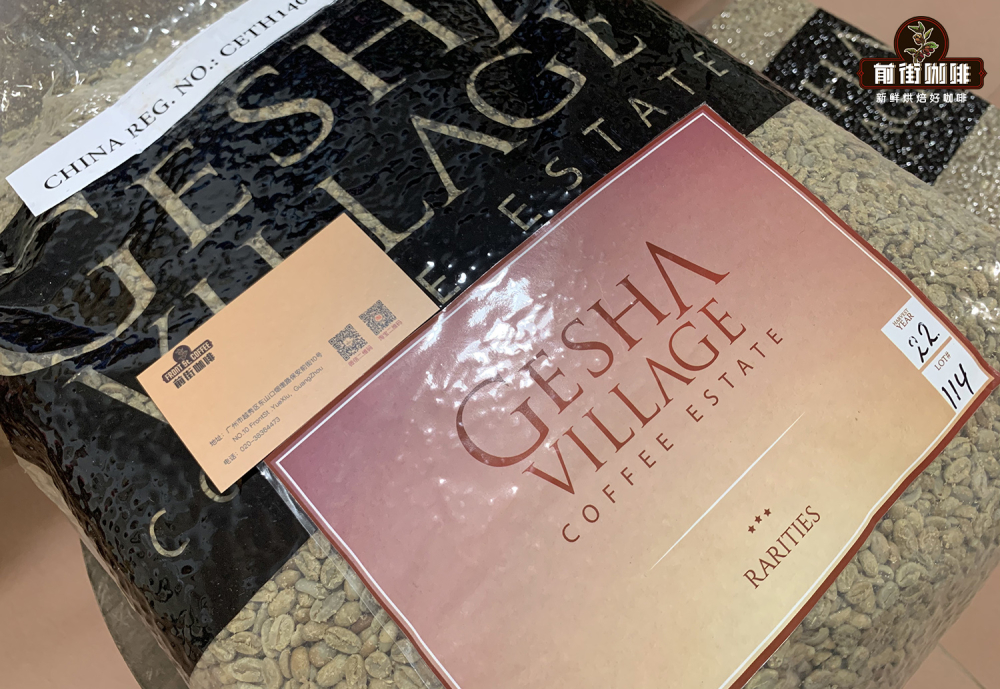
Gesha Village Oma 059 - Gesha Village Oma Batch 059
Grade: Rarities (Gold) Label
Processing: Natural (32 days)
Variety: Gesha 1931
Country: Ethiopia
Region: Bench Maji
Altitude: 1,931-2,040 meters
Water ratio: 1:15 | Grind size: Medium-coarse (80% pass-through on #20 screen) | Water temperature: 91°C | Brewing device: V60
Technique: 30ml water bloom for 30s, pour in stages to 125ml taking 1 minute, then pour to 225ml by 1 minute 50 seconds. Total extraction time: 2 minutes 10 seconds.

Flavor description: Fermented wine aroma, citrus-kumquat acidity, full-bodied berry juice.
Red Label Batches
Red Label beans make up about 15% of Gesha Village Coffee Estate's total annual output. These are fully traceable lots that cup above 88 points (SCA standard) and show typical Gesha Village character. Flavour intensity and complexity sit a little below the Gold Label lots, which makes them an outstanding value single-origin.

Gesha Village Coffee Estate Grower Reserve
FrontStreet Coffee: Gesha Village Red Label Geisha Coffee Beans
Region: Bench Maji
Altitude: 1909-2069m
Variety: Gori Gesha
Processing: Natural
FrontStreet Coffee barista brewing recommendations:
Water ratio: 1:15
Grind size: Fine sugar grind (EK43s setting 10)
Water temperature: 91°C
Brewing device: V60
Technique: 30ml water bloom for 35s, pour in stages to 125ml taking 1'00, then pour to 225ml by 1'50. Total extraction time: 2'10.
Flavor: Coconut, licorice, cream, chocolate, toffee, citrus, almond, strawberry, with fermented aroma. Overall flavor is well-balanced, with rich mouthfeel and prominent nutty flavors.

Green Label Batches
Green Label lots come from a single plot and a single variety at Gesha Village Coffee Estate, and each lot number carries complete traceability information: farm plot name, coffee variety and processing date.

CHAKA Batches
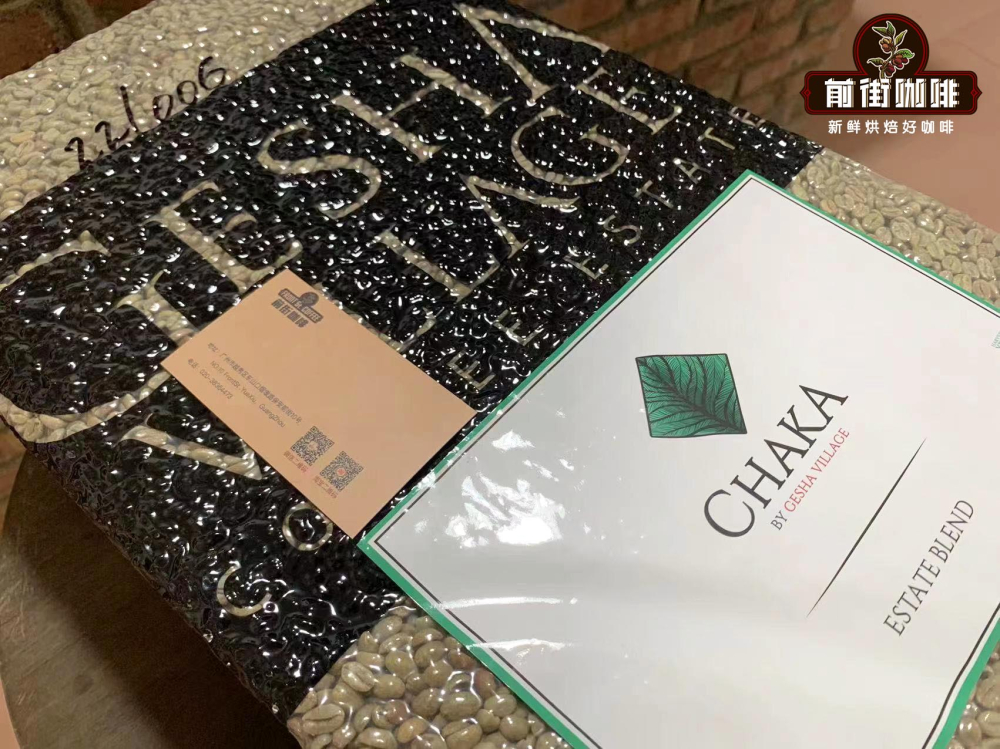
CHAKA lots blend coffee from every estate plot and across the whole production season. They come in both natural and washed forms and draw on three Gesha Village varieties: Gesha 1931, Gori Gesha and Illubabor.
Gori Gesha (GG)
This variety reproduces the genetic diversity found within the Gori Gesha coffee forest.

Gesha 1931 (G31)
A blend of varieties from different forests, very close to Panama Geisha, selected by studying plant morphology, bean appearance, screen size and cup flavour.
Illubabor Forest 1974 (IF)
Discovered on a 1974 expedition to the Illubabor Forest and later developed into a resistant variety by the Ethiopian Research Center.

Gesha Village Coffee Estate CHAKA
FrontStreet Coffee: Gesha Village CHAKA Batch
Region: Bench Maji
Altitude: 1900-2100m
Variety: Gori Gesha, Gesha 1931, Illubabor
Processing: Natural
FrontStreet Coffee barista brewing recommendations:
Water ratio: 1:15
Grind size: Fine sugar (EK43s setting 10)
Water temperature: 91°C
Brewing device: Hario V60
Technique: 30g water bloom for 35s, pour in stages to 125g taking 1 minute 00, then pour to 225ml by 1 minute 50 seconds. Total extraction time: 2 minutes 10.
Flavor: Light fermented aroma, with citrus and grapefruit acidity, creamy, chocolate, and caramel flavors. Gentle flavor profile.

Processing Methods
Gold Label, Red Label and CHAKA are all natural processed.
First, floating debris and impurities are removed. Thin layers are then covered with plastic sheets on African raised beds for sun-drying. While the beans dry on the beds, further screening removes insect-damaged beans and green-coloured coffee beans. Total drying time runs 18-30 days.

Gesha Village Estate Plot Division
Gesha Village's owners use a very detailed plot-numbering system to make later management and flavour traceability easier.
Area and Planting Varieties by Plot in Gesha Village
The western side of the estate sits a little higher, so the OMA, SURMA and SHEWA-JIBABU plots have slightly greater altitude. The south carries more shade cover, while the north receives longer sun exposure. Across the eight plots, estate managers match the most suitable variety to each plot based on microclimate differences such as altitude, soil conditions and shade cover (as shown in the figure above), so that every major plot can develop its own distinct character.
2018 Gesha Village Auction Batches
Gesha Village's auctions began in 2017. Because auction lots and non-auction lots sometimes shared the same batch number on the market, the estate made sweeping reforms that year: every 2018 auction lot was an independent batch. Selection took nearly three months and multiple rounds of repeated cupping to settle on 31 auction lots.
Multiple Rigorous Selections for Auction Batches
The first round opened in late January, with owners Adam and Rachel in Ethiopia, their quality-control team, and Willem Boot's consulting team in the United States cupping the various lots simultaneously after they had rested more than six weeks since harvest. To rule out order effects, every lot had to be cupped at least twice in different sequences to guarantee accuracy.
2018 Gesha Village Auction Batches Adding Screen Size Indicators
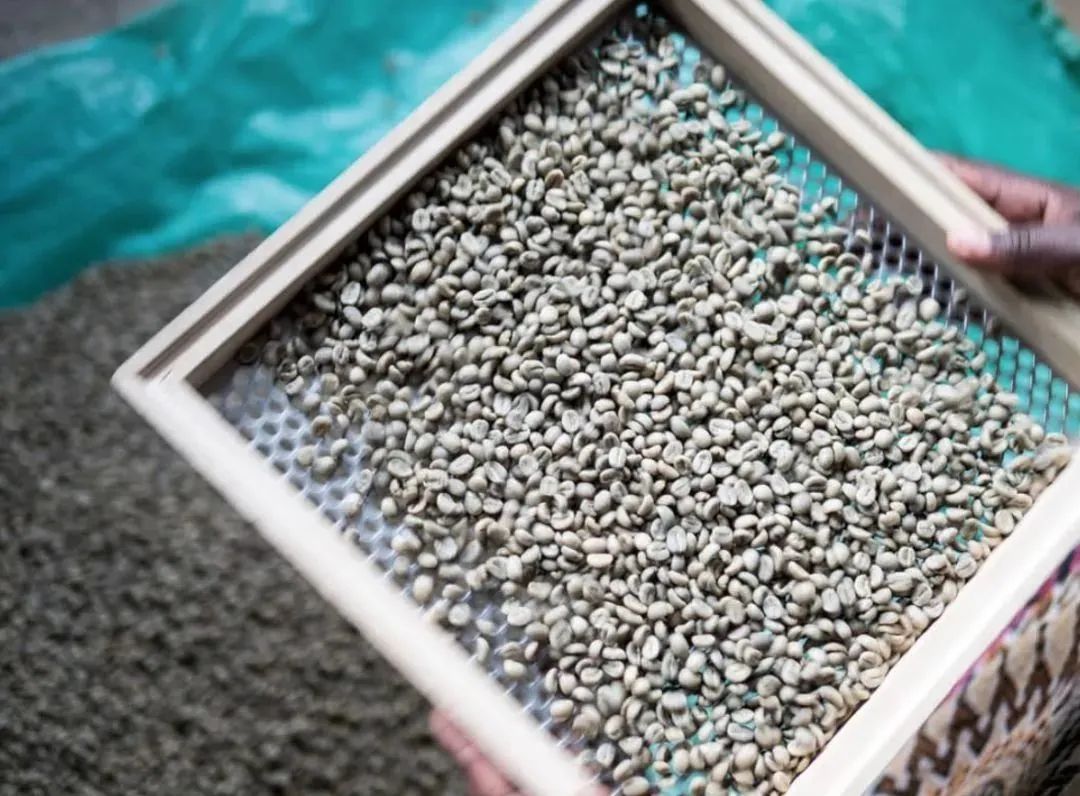
In the end the owners and their team chose the best 31 lots from 117. To push those 31 further, the team ran a fresh round of tests. Comparing different screen sizes, they found that larger beans performed better in the cup, so they decided that auction lots of Gesha 1931 would be screen size 17 and above, while Gori Gesha and Illubabor would be screen size 16 and above. Since Ethiopia's existing screen equipment can only sort beans of 14 and above, owner Adam bought dozens of laboratory screens from the United States and hired many workers to hand-screen the auction beans.
Manual Selection of Coffee Beans
After round upon round of cupping, the 2018 Gesha Village auction lots were finalised, split into Champion's Reserve (7 lots, each just 90kg) and Farm Reserve (24 lots, each just 120kg), 31 in total. Of these, 26 were natural processed, 4 were washed and 1 was honey processed.
Proportion of Different Plots in Auction Batches
Within the auction lots, the share of Gesha Village's three varieties was: Gesha 1931 at 69.1%, Gori Gesha at 27.5% and Illubabor at 3.4%.
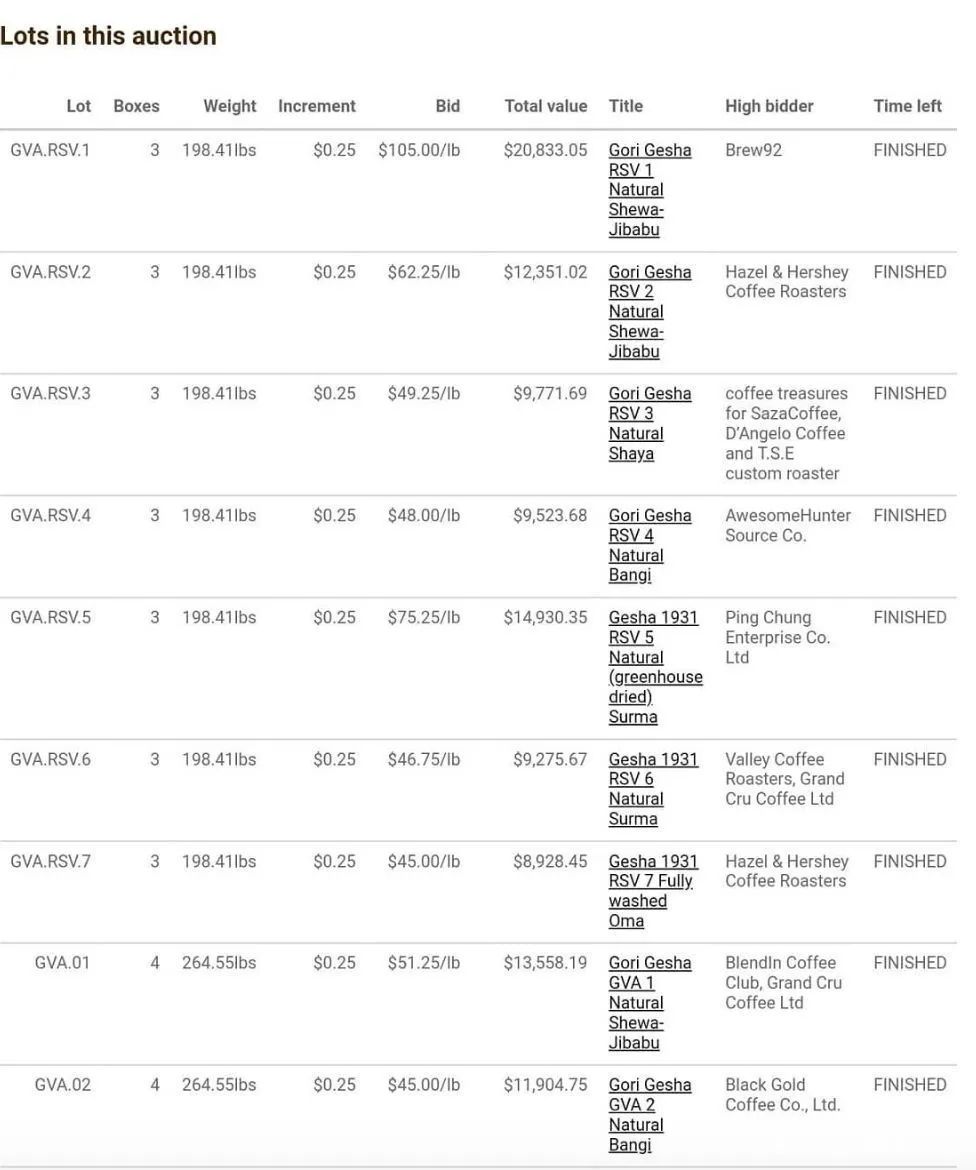
2019 Gesha Village Auction Batches
The 2019 Gesha Village Global Auction opened in June. According to Gesha Village Coffee Estate auction manager Willem Boot, the 2019 quality-control team assessed more than 130 lots and selected those scoring above 88 points for auction: Champion Reserve lots (the 7 highest-scoring), Farm Reserve lots (13 outstanding performers) and Innovators Reserve lots (6 experimental batches using special processing).
Champion Reserve Batches (7 Varieties / 14 Batches)
Champion Reserve brings together the finest lots of Gesha Village's 2019 harvest. Each Champion Reserve lot scored above 90 points and showed extraordinary character in the cup, from stunning jasmine aromatics to the charming, delicate, complex fruit of strawberry, peach and papaya.

Farm Reserve Batches (13 Varieties / 13 Batches)
Farm Reserve lots are the estate's high-end products with excellent flavour, all scoring 88 points or above in the cup. Rich fruit and expressive aromatics define these lots, and they deliver an unforgettable tasting experience.
Innovators Reserve Batches (6 Varieties / 6 Batches)
Innovators Reserve lots use distinctive special processing, applying innovative fermentation and drying techniques that bring extremely complex flavours to the coffee and a profound sensory experience for coffee lovers.

FrontStreet Coffee's Gesha Village Gold Label Roasting Profile
Apart from the auction lots, which are won by bidding (at an uncertain price), the best products are the Gold Label series. FrontStreet Coffee has also bought Gold Label lots from Gesha Village, roasted medium-light. Here is FrontStreet Coffee's roasting profile.

FrontStreet Coffee's Gesha Village Gold Label Cupping Flavor
Within 8-24 hours of the roast finishing, FrontStreet Coffee cups the coffee to pin down the Gold Label Geisha's flavour profile. Here is FrontStreet Coffee's description from cupping these Gold Label beans: white floral notes, lemon, honey, citrus, a juicy sensation and apricot.
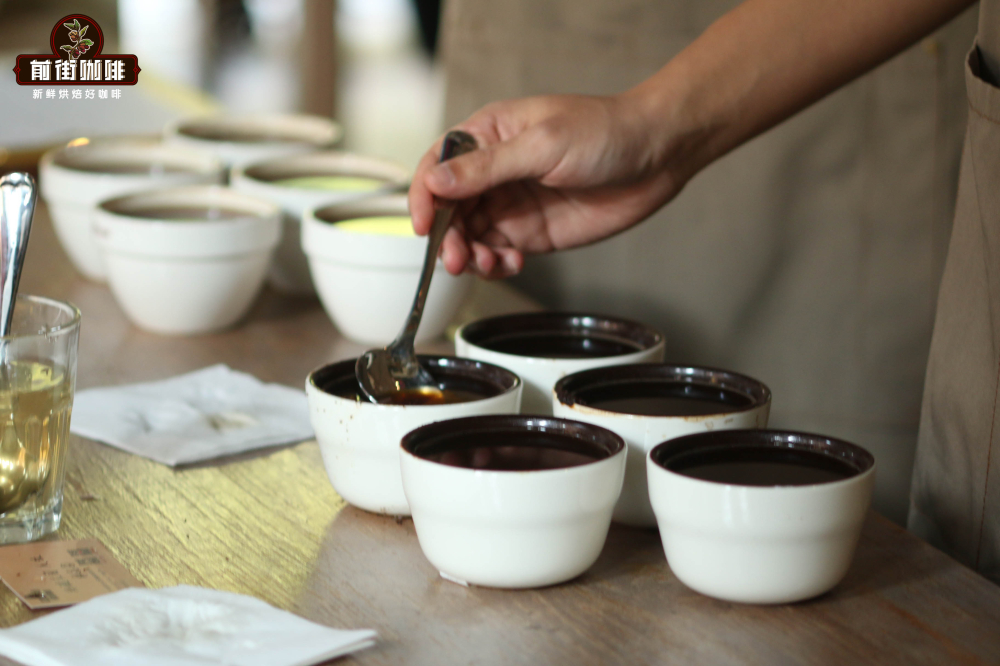
FrontStreet Coffee's Gesha Village Gold Label Brewing Parameters
Coffee grounds: 15 grams
Ratio: 1:15
Water temperature: 90°C
Grind size: 0.85mm (80% pass-through on #20 screen)
Dripper: Hario V60 #01
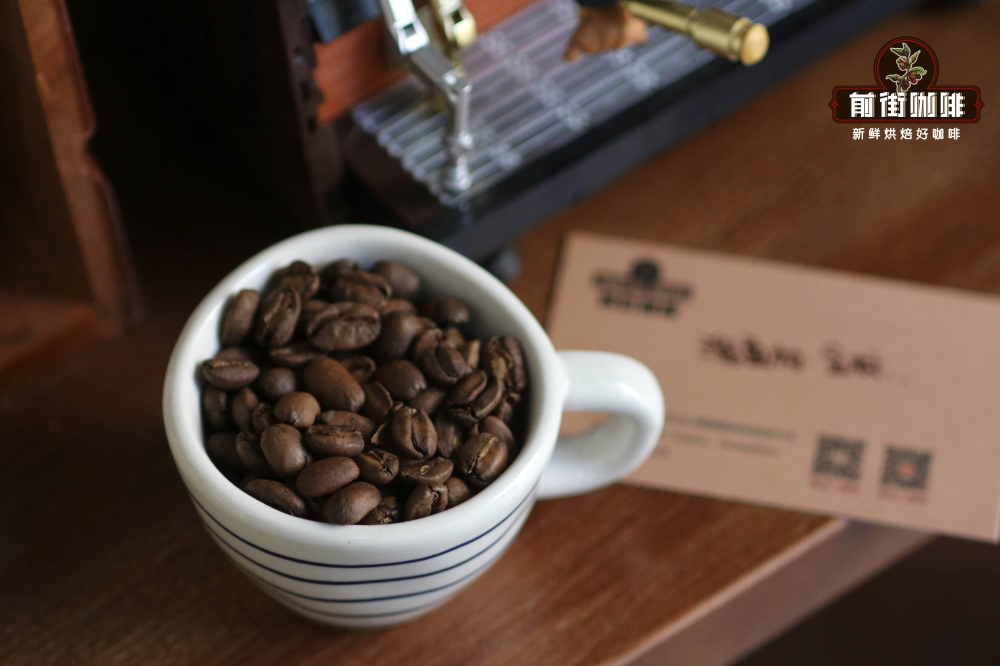
FrontStreet Coffee recommends brewing with freshly roasted beans to coax out coffee's richest flavours. Every bag FrontStreet Coffee ships is roasted within 5 days, because FrontStreet Coffee understands how strongly freshness shapes flavour. FrontStreet Coffee's roasting philosophy, "Freshly Roasted Good Coffee", ensures that every customer who places an order receives the freshest coffee on arrival. The resting period is about 4-7 days, so by the time it reaches you the coffee is at its peak.
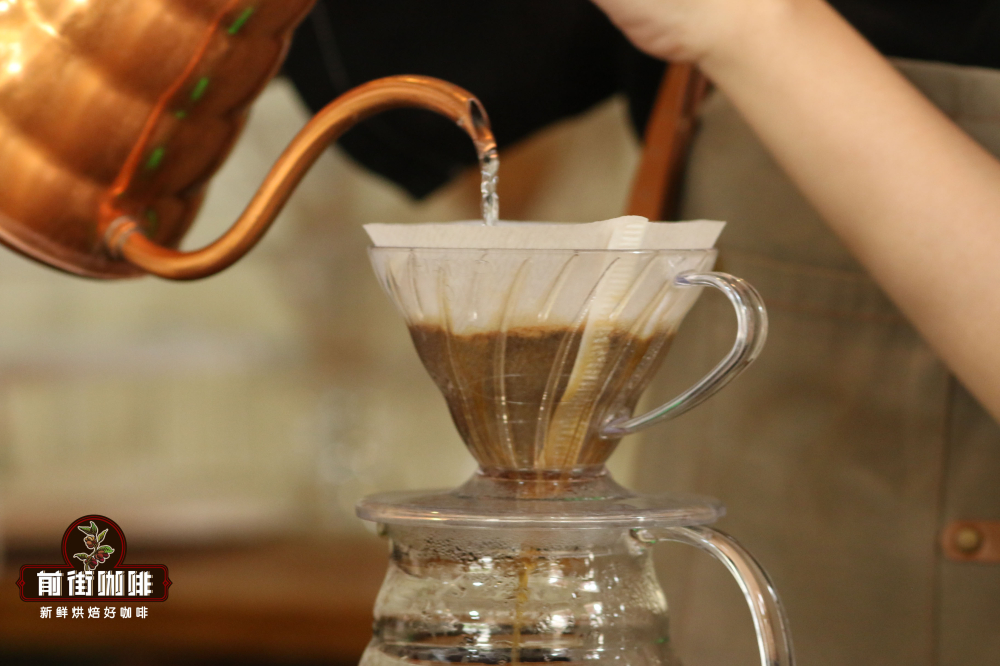
Brewing process: First pour 30g of water and bloom for 30 seconds, second pour 95g of water (scale shows 125g), completed in about 1 minute, third pour 100g of water (scale shows 225g), completed in about 1 minute 30 seconds.
Extraction time: 2 minutes, remove the dripper to complete brewing.
Flavor description: Citrus, floral notes, berries, cream, smooth, medium acidity, medium sweetness, moderate aftertaste.
FrontStreet Coffee Recommendation
FrontStreet Coffee's Geisha range spans both Panama and Ethiopia. On the Panama side come the Esmeralda Red Label (Esmeralda Special) and Green Label (Private Collection) Geishas: Red Label is grown at 1,600-1,800 m, each lot cupping above 90 points and carrying its own lot number, with every bean drawn from a single small plot — FrontStreet's Red Label, for instance, comes from the Jaramillo plot. Green Label blends lots from several plots to express Esmeralda's signature high-altitude Geisha profile; because it is not tied to one plot it costs less, which makes FrontStreet's Green Label excellent value.
For anyone curious about the fabled "Geisha flavour", FrontStreet Coffee usually points newcomers first to the Panama Boquete Geisha, an entry-level Geisha that delivers the classic Panamanian orange-blossom-and-honey character, an oolong-tea finish, and fine, distinctly layered fruit acidity at an accessible price. On the Ethiopian side, the Genlana Gesha Estate is a rare single-variety farm at the meeting point of the Kochere and Genlana Abaya districts; its coffee suits a medium-light roast and shows bright citrus acidity, elegant ginger-lily aromatics and the ripe, full sweetness of the Gesha variety. Once you want to go estate-level, FrontStreet Coffee's Gesha Village Gold Label (the Gesha 1931 variety, about 10% of the estate's output, natural processed) and Red Label (the Gori Gesha variety, roughly 15% of output, scoring 88 or above on the SCA 100-point scale) are the lots to try.
Geisha is a light-to-medium roast, floral-and-fruity style, and its hard, dense bean tends to sink and clog the dripper. FrontStreet Coffee suggests grinding to roughly the texture of fine caster sugar — about a 78% pass-through on a Chinese-standard No. 20 sieve — and brewing at 91°C. A typical FrontStreet pour-over uses 15 g of coffee, a small Hario V60 and a 1:16 ratio, poured in three stages: bloom to 30 g for 30 seconds, then a slow spiral pour to 125 g; wait until the bed has drained halfway, then continue the slow spiral pour to 225 g. Total drawdown runs about 2:10 to 2:20. Geisha also works as an SOE, and FrontStreet's medium-roast Genlana Estate Geisha SOE pulls as dried apricot, caramel and nuts; for an everyday alternative, FrontStreet's Strawberry Candy blend pairs a Costa Rican honey process with Panama Geisha for a cup that carries both delicate florals and sweet fruit, and it suits pour-over, moka pot and espresso machine as well as a clean, cold cold brew.
Important Notice :
FrontStreet Coffee is a long-established specialty coffee roaster in Guangzhou China, selling freshly roasted beans from its own farm in Yunnan as well as dozens of carefully selected single-origin beans from around the world for both pour-over and espresso. The products deliver consistently excellent quality and great value, with shipping within 24 hours. Guangzhou's FrontStreet Coffee shop is recommended by many coffee lovers, and the beans are now available online at the Tmall 。
FrontStreet Coffee has moved to a new address:
FrontStreet Coffee Address: 315,Donghua East Road,GuangZhou
Tel:020 38364473
 Scan and follow the En Gafei WeChat official account. Please indicate that the reprint comes from "En Gafei".