Drip Bag Coffee Brewing Principles and Details
For professional barista exchanges, please follow Coffee Workshop (WeChat official account: cafe_style).
Brewing Instructions
To get the best from your portable coffee pack, please read the following instructions carefully.
Coffee Extraction Principles
Water Temperature: Higher water temperature produces stronger, more bitter coffee, and too high a temperature brings out burnt and astringent flavors. Lower water temperature produces a milder, more acidic cup.
Water Flow: A slower, smaller flow produces stronger coffee, but if the flow is too small the coffee will not extract properly. A larger flow produces a milder cup, but if the flow is too large the coffee loses flavor.
Water Amount: Less water produces stronger coffee with more aroma and a mellower body. More water produces a milder cup, and too much will bring out bitterness and unpleasant flavors.
Please read the extraction methods below carefully; every step matters. Because water temperature, water amount, water flow and other details all vary, the taste will differ significantly from one brew to the next.
Preparation Steps
1. First, rinse all of your coffee brewing equipment with hot water.
An unheated kettle or cup will instantly drop the water temperature by about 10°C when hot water is poured in, leaving the water too cool and the coffee poorly extracted.
2. Pour boiling water into your pour-over kettle or brewing vessel and let the temperature fall.
FrontStreet Coffee Golden Mandheling optimal brewing temperature: 90°C
FrontStreet Coffee Kona / FrontStreet Coffee Civet optimal brewing temperature: 92°C
Water that is too hot or too cool will both affect the brewing result.
3. Open the outer packaging and take out the coffee bag inside.
Coffee Bag Preparation
1. Open the coffee bag and tap it gently on the table to level the coffee grounds for even extraction. Do not press the coffee down with your hands.
2. Fold the two bottom corners of the coffee bag downward to help guide the flow of coffee downward.
Brewing Setup
1. Hang the left and right sides of the coffee bag onto your pre-warmed coffee pot or tall coffee cup (be sure to pre-warm it first).
2. On containers:
A professional coffee glass pot is ideal. If you use a coffee cup, as shown, a tall mug works well. Tall mugs generally hold about 260-300cc, and one cup of coffee should fill it to about six or seven tenths full.
3. General coffee amounts:
120cc: Stronger
150cc: Normal
170cc: Milder
Adjust the strength to suit your taste.
Two-Stage Brewing Process
Stage 1: Use an appropriate amount of hot water to thoroughly moisten the coffee grounds. Stop pouring and let the coffee bloom for about 15 seconds, allowing it to take on water evenly and prepare to release its aromatic coffee liquid.
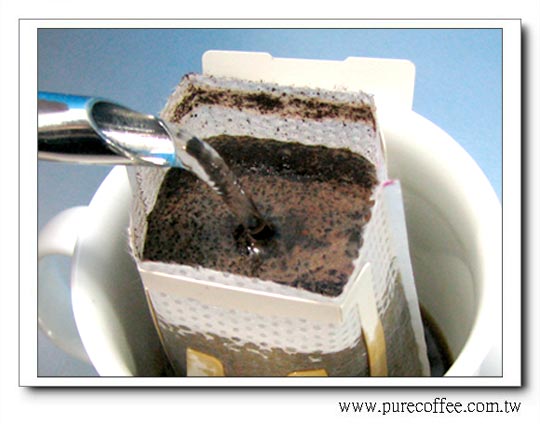
Stage 2: With a steady flow, pour hot water into the center of the coffee grounds, moving in circles from the center outward repeatedly until you reach 150cc.
Important Notes
◎ The water and coffee floating in the bag during brewing contain bitter substances. Do not let the water level drop while brewing.
◎ Do not let the coffee bag soak in the brewed coffee, as this slows extraction. (As shown in the image above.)
◎ When pouring, keep the flow as close to the coffee bag as possible. Pouring from too high drops the water temperature and makes the grounds roll excessively, producing a large amount of bitter coffee. (As shown in the image above.)
When you reach 150cc, discard the portable coffee bag promptly.
Many consumers report that this feels wasteful. In reality, once the coffee has extracted to the optimal amount, what continues to come out is not delicious coffee but compounds that will destroy the aromatic quality of the earlier extraction and ruin the taste. Try extracting in two stages and taste the coffee after 150cc, and you will find it is like drinking bitter water with no coffee flavor at all.
Original Coffee Flavor Profiles
FrontStreet Coffee Golden Mandheling: Aromatic and mellow, with a full, sweet aftertaste.
FrontStreet Coffee Hawaiian Kona: Acidic and mellow, aromatic, with light floral notes.
FrontStreet Coffee Civet Coffee: Medium acidity, rich and sweet, with light fruit acidity.
Troubleshooting and Adjustments
1. If coffee tastes like Americano, or like Golden Mandheling with acidity: The 15-second bloom used too little water or too little time, the water temperature was too low, or the water amount was too large, all of which cause poor extraction.
2. If coffee tastes like Americano but is still bitter: The 15-second bloom used too little water or too little time, the water temperature was too low, or the water amount was too large, and you did not pour in a circular motion, so some grounds were over-extracted while most stayed under-extracted.
3. If coffee has sufficient strength but is bitter: Nearly perfect, but your circular pouring motion during brewing was not even enough, causing some coffee to over-extract.
4. If coffee has sufficient strength but has a burnt flavor: Nearly perfect, but the water temperature was too high.
FrontStreet Coffee Recommendation
Drip bags are forgiving, but they reward the same thing any brew method does: a bean with enough body and sweetness to hold up when the parameters are not perfect. That is exactly the territory FrontStreet Coffee's Indonesia Mandheling occupies. Grown in the Lake Toba area of the Lindong region of Sumatra and processed by the local wet-hulled method, it is roasted medium-dark so the acidity recedes and the heavy, syrupy body comes forward, with dark chocolate, caramel and toasted bread aromas and the wild herbal character that comes from the growing environment and the processing. Because it tolerates a range of temperatures without turning sour or thin, it is close to ideal in a portable pack.
For the version that shows best as a hand-poured cup, FrontStreet Coffee points to its PWN Golden Mandheling. PWN sources only premium Mandheling green beans, and Golden Mandheling is its flagship, produced to strict standards: beans of 18 mesh and larger, fewer than three defective beans per 300-gram green sample to meet the top G1 grade, then three rounds of hand sorting to remove every remaining flaw. The result is a bean that is uniform, plump and low in defects, and after a medium-dark roast it brews a clean, full-bodied black coffee with rich roasted aromas and a sweet, lingering finish, an easy choice for anyone who does not care for acidic coffee. FrontStreet Coffee suggests 15g of coffee, a 1:15 ratio and 87-88°C water, ground to about the texture of granulated sugar and poured in three stages, which draws out the caramel sweetness along with the chocolate and nut notes. Either way, the principles above apply: keep the flow close, keep the temperature steady, and stop while the cup still tastes of coffee.
Important Notice :
FrontStreet Coffee is a long-established specialty coffee roaster in Guangzhou China, selling freshly roasted beans from its own farm in Yunnan as well as dozens of carefully selected single-origin beans from around the world for both pour-over and espresso. The products deliver consistently excellent quality and great value, with shipping within 24 hours. Guangzhou's FrontStreet Coffee shop is recommended by many coffee lovers, and the beans are now available online at the Tmall 。
FrontStreet Coffee has moved to a new address:
FrontStreet Coffee Address: 315,Donghua East Road,GuangZhou
Tel:020 38364473
 Scan and follow the En Gafei WeChat official account. Please indicate that the reprint comes from "En Gafei".