Mandheling Special: Mandheling Origin Information, Roasting, Brewing, Extraction
The "Dual Lakes, Dual Mandheling" Origin
Both Lake Toba in North Sumatra and Lake Tawar in Aceh produce Mandheling coffee, giving rise to the well-known phrase "Dual Lakes, Dual Mandheling."
The shared characteristic of these two Mandhelings is a rich, mellow body, while the difference lies in the cup: Lake Toba's Mandheling is more subdued and deep, even carrying a grass jelly note, whereas Lake Tawar Mandheling has brighter fruit acidity, sometimes with notes of fir or wood.

The Origin of Mandheling
Mandheling is not a coffee bean variety but a general term, or code name.
Mandheling coffee has a long history. In the 17th century, the Dutch first introduced Arabica coffee seedlings to Indonesia. In 1877, a large-scale disaster struck the Indonesian islands: coffee rust disease destroyed almost all the coffee trees. People had to abandon the Arabica they had cultivated for years and introduce Robusta coffee trees from Africa, which had strong disease resistance.
On February 14, 1942, Japanese troops attacked Sumatra Island, and the Dutch surrendered a month later. On March 15, Japanese troops occupied Indonesia. Indonesia had already been colonized in turn by the British and the Dutch, so the Indonesian people had no particularly strong reaction to the arrival of Japanese troops. One day, a Japanese soldier was drinking coffee at a cafe in Sumatra and found the taste excellent. He asked the owner what kind of coffee it was. The owner mistakenly thought the soldier was asking about his ethnicity and replied, "Mandailing people." Thus "Mandheling coffee" was born.
Indonesia consists of 17,508 large and small islands. Its main coffee-producing regions include Java Island, Sulawesi Island, and Sumatra Island. A large portion of the varieties grown are Robusta. Mandheling is also known as "Sumatra coffee" and belongs to the Arabica species (though some are Timor varieties), giving most Mandheling coffee its characteristics of a bitter-rich fragrance, excellent body, and slight chocolate flavor. For this reason, any coffee grown on Sumatra Island, regardless of bean variety, can be called "Mandheling coffee."
Characteristics
FrontStreet Coffee's Lin Dong Mandheling: A rich, solid taste with herbal medicinal notes, pleasant acidity, a strong aftertaste, and a solid, mellow mouthfeel. The aroma is mellow, the acidity moderate, and the sweetness rich and intriguing. Suitable for dark roasting, it emits a rich fragrance.
The Gentleman of Coffee - FrontStreet Coffee's Sumatra Mandheling: Mandheling is a premium coffee bean grown on plateau mountains at altitudes of 750-1500 meters, with the highest quality first-grade Mandheling produced in Takengon and Sidikalang. Because of Mandheling's irreplaceable mellow flavor, Japan's largest coffee company, UCC Ueshima Coffee Co., worked in 1995 with the renowned Sumatra coffee merchant PT Gunung Lintong to operate its first coffee plantation in Asia, a clear sign of how important Mandheling's position is in the coffee world.
Some say Mandheling is heavy and intense, others say it is gentle and easygoing. FrontStreet Coffee's Mandheling has always expressed its most unique sweetness through its most distinctive bitterness, much like the bittersweetness of life. No amount of sugar can mask that bitterness; the first sip makes one gasp. Yet the captivating aroma it gives off makes us uncontrollably infatuated with it. Its bitterness is like the thorns beside a flower, making one self-aware, while its aroma is refreshing. Mandheling's bitterness will not frustrate you; instead, it will leave you feeling clearer-headed. Before you encounter true pain, Mandheling is just an ordinary bitter-tasting beverage, a liquid to refresh you, a tool to make you pause for a moment. When you truly encounter pain, she will smile and tell you: "Because love is refined from bitterness." Letting you calm down and savor it carefully.
Coffee Roasting Process
Coffee roasting involves many steps. This article focuses on commercial roasting machines to observe the roasting stages. The roasting process determines coffee flavor, because active chemical reactions occur within the beans.
Homogenization
- Transferring heat to the interior and exterior of raw beans, preparing all beans for uniform reaction.
Each raw bean is formed from countless cells, which include cell walls, cell membranes, the cell sap filling their interior, and cell nuclei. To meet preservation and distribution needs, harvested raw beans are first dried. During drying, some water in the cell sap and cell walls evaporates, leaving only about 10%-14% moisture. Because of the water loss, cell size naturally shrinks, and raw beans also become smaller. Components like organic acids and sugars within the cells remain, however.
When dried raw beans are heated, heat is transferred to the beans and causes changes. First, the remaining water inside the raw beans turns into steam when heated. When water becomes steam, its volume increases dramatically (about 1700 times), so the pressure inside heated beans also increases.
Increased pressure also raises the boiling point of water, causing steam to become superheated. Think of a pressure cooker to understand the principle of boiling point elevation: on high mountains, because pressure is lower, the boiling point is also lower, making rice cook unevenly. Put a weight on the pot, however, and the internal pressure increases, forcibly raising the boiling point. Pressure cookers are designed on this principle. In a 1-bar pressure cooker, steam temperature reaches about 125°C, and the same phenomenon occurs inside coffee bean cells.
Because pressure increases, the cell volume that had shrunk during drying expands again. The raw material of coffee beans is the coffee cherry, whose cell tissue has the same structure as trees and plants. So when volume expands to a certain degree, the tissue will at some moment burst because it cannot withstand the pressure. At that point, some of the high-pressure steam formed inside the cells is discharged, while another part transfers to other cells. Through this process, steam at the same temperature and pressure is distributed evenly throughout the cells, and this phenomenon occurs almost simultaneously across the entire batch of raw beans.
Generally, raw beans include both large and small beans, each bean has thick and thin parts, and there are both relatively dry surfaces and internal tissues with relatively more moisture. Ignore these complex factors and heat regardless, and small beans will burn first while large beans remain undercooked, or only the surface burns while the inside stays half-cooked. Preparing the entire batch of beans for uniform reaction is therefore essential.
The interior of the beans prepares for uniform reaction through water movement, while the exterior prepares all beans for uniform reaction through heat conduction between beans and convective heat from rotation together. This preparation stage, which enables the whole batch of beans to react uniformly, is called "homogenization."
During homogenization, beans turn coffee-colored and look like dried things. We habitually call this the "dehydration stage," but in reality the amount of water evaporated during this process is trivial compared to the changes in the tissue itself during first crack. "Dehydration stage" is therefore not an accurate description.
First Crack
- Tissue expansion and rupture, with increased aroma from roasting.
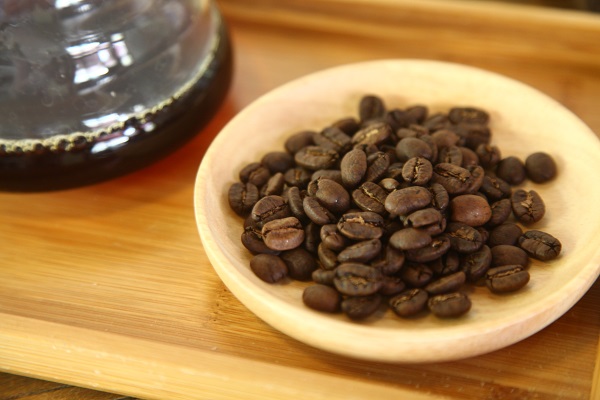
When the homogenization stage ends, the beans are ready to undergo the same reaction simultaneously. Compared to their raw state, the volume of each cell has increased significantly and the overall tissue has become thicker. Continue heating, and volume keeps increasing until, as in the next picture, the central line of the bean cracks. In the raw state the central line is tightly interlocked; because of the increase in volume, the end parts on both sides of the bean crack, producing a sound like breaking branches. During first crack, beans have their tissue crack open like this, and at the same time they begin to discharge large amounts of internal water.
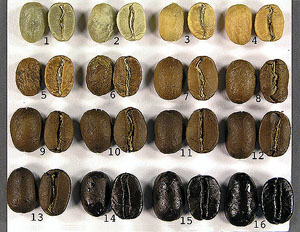
The process up to this point is referred to as the Cinnamon-to-City roasting range. The stage when first crack begins is called Cinnamon, the stage when first crack is about to end is called High, and the period from first crack ending to second crack occurring is called City.
Development Period
- Active chemical reactions occur inside the beans, determining the coffee's flavor.
The period from the end of first crack to the beginning of second crack is called the "development period."
As water is discharged, the pressure on the internal bean tissue decreases and the tissue temporarily stops expanding. Because the beans are in a state where much water has been discharged at this time, heating again means that when steam is produced it will not steal heat away, and the internal heat rises faster than before.
At this time, high temperatures can produce more active chemical reactions, generating gas and continuous tissue expansion. The internal tissue that cracked during first crack becomes more expanded and filled. From the outside, the wrinkles on the bean surface gradually disappear and the beans become larger.
High temperature has now been transmitted to every bean, and the chemical reactions inside the beans reach their peak. Aroma from roasting increases, making this an important period for determining bean flavor. Before the development period, beans are in an "endothermic period"; when the development period begins, beans enter an "exothermic period." In reality, the beans do not emit heat; the name is simply a convenience, because temperature rises much faster during heating than in previous stages. If beans react too quickly they might burn or produce unwanted bad flavors, so heat is usually reduced during this stage.
Second Crack
- Tissue cracks again, producing strong chemical reactions, enhancing coffee's aroma and acidity.
After the development period, once internal tissue has changed and fully expanded, the cracked internal tissue is filled and beans continue to grow larger. At this point you will hear the sound of tissue changing again: second crack. It produces a sound like breaking a matchstick, crisper and higher-pitched compared to first crack.
The pressure inside the tissue now reaches its peak, and gases produced inside the beans begin to discharge to the outside. The capillaries formed while these gases are discharged are related to future coffee extraction. In other words, coffee beans that have only undergone first crack have relatively fewer capillaries formed, making extraction less smooth.
Starting from second crack, bean temperature rises even more dramatically, producing stronger chemical reactions inside and making coffee aroma more intense. At the same time, aromatic substances from roasting also bring out strong bitterness.
Using second crack as a benchmark, a roast degree before second crack is called City, and after second crack is full city. For coffee roasted beyond the full city stage, we habitually use the following names:
Vienna Roast: Intense second crack period (also called espresso roast).
French Roast: The period after second crack ends when oils fully seep to the surface.
Italian Roast: The period after second crack ends when color becomes darker and oils begin to slowly burn.
Roasting refers to the process of heating raw beans. Since raw beans have components similar to wood, if the temperature exceeds wood's ignition point of 250°C, the beans will burn to charcoal. Dark roast therefore refers to roasting until the bean temperature reaches 250°C. If the final roasted product appears completely black rather than reddish-brown, the beans have become charcoal.
[Testing FrontStreet Coffee's Mandheling beans with light, medium-dark, and dark roasts]
Testing Mandheling with light, medium-dark, and dark roasts. The testing method is usually pour-over extraction, single serving, with slight adjustments in grind size and water temperature depending on the roast level.
1. Light roast: Fuji "ghost tooth" grinder setting 3.5, water temperature 90°C, coffee-to-water ratio 1:15
2. Medium-dark roast: Fuji "ghost tooth" grinder setting 4, water temperature 88°C, coffee-to-water ratio 1:15
3. Dark roast: Fuji "ghost tooth" grinder setting 4.5, water temperature 86°C, coffee-to-water ratio 1:15
[Test Results]
1. Light roast: Mandheling at this roast level has heavier fruit acidity and is slightly bitter, with an obvious fruit acidity that is comfortable on entry, creating a mouth-watering sensation on both sides of the mouth, and average smoothness.
2. Medium-dark roast: Very well-balanced, fragrant, rich, and mellow, with more obvious bitterness. Chocolate notes and slight sweetness are more prominent, licorice aroma is obvious, fruit acidity is weak, smoothness is better than light roast, aroma is strong, and fruit acidity is significantly enhanced.
3. Dark roast: Almost no acidity, very heavy bitterness. Roasted over direct fire and slightly mishandled, it can also produce burnt flavors.
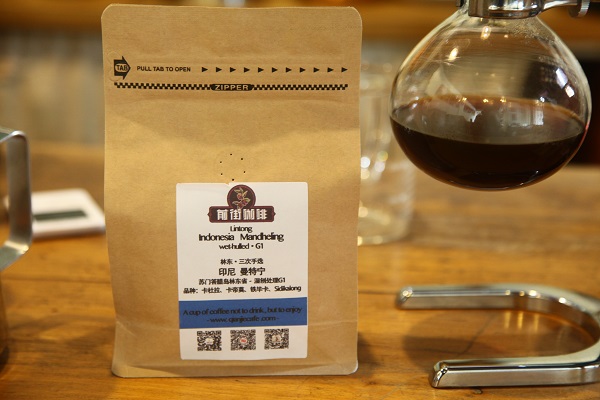
Different Brewing Methods, Different Tastes
Pour-over FrontStreet Coffee Mandheling
Flavor: Multi-layered, clean, balanced, with persistent caramel sweetness in the aftertaste
1. Equipment choice: Hario V60
2. Water temperature: 88°C
3. Grind size: Fuji grinder setting 4
4. Roast level: Medium-dark roast
5. Bloom time: 25 seconds
Specific technique: A "three-pause pour-over" for FrontStreet Coffee Mandheling: 15g coffee, Fuji "ghost tooth" grinder setting 4, V60 dripper, water temperature 88-89°C. First pour 30g water and bloom for 25s. Pour to 104g and pause, wait until the water level drops to half, then pour again. Slowly pour until reaching 220g total, discarding the last 5g. Coffee-to-water ratio 1:15, extraction time about 2:00.
FrontStreet Coffee Mandheling can also be extracted with volcano pour-over, flannel filter, or Kono dripper.
Specific technique: High-temperature extraction, water temperature 90-92°C. Small water flow for the front section, pouring in a coin-sized area, pause, bloom, pause, bloom, keeping the grounds continuously in a blooming state. Bloom time 1:30, then a final large water flow for quick extraction, total extraction time 2:30.
AeroPress FrontStreet Coffee Mandheling
Flavor: Rich, complex, prominent spice notes, fresh forest notes
1. Equipment choice: AeroPress
2. Water temperature: 85°C
3. Grind size: Fuji grinder setting 3.5
4. Roast level: Medium-dark roast
5. Bloom time: 2 times, first 20 seconds, second 50 seconds
Specific technique: AeroPress standard preparation. Recommend 20g of FrontStreet Coffee Mandheling grounds and a coffee-to-water ratio of 1:17. First pour 100g of 83°C hot water, stir 3-5 times to fully wet the grounds, and let sit for 20s. Add the remaining hot water to reach 240g, let sit for 40s, and stir for 5s. At 1 minute 50 seconds, insert the plunger and press down. Total time 2 minutes 5 seconds.
Siphon FrontStreet Coffee Mandheling
Flavor: Round, rich, prominent herbal and bitter notes, with prominent caramel sweetness
1. Equipment choice: Hario siphon
2. Water temperature: 90°C
3. Grind size: Fuji grinder setting 3.5
4. Roast level: Medium-dark roast
5. Bloom time: 30 seconds
Specific technique: Side-heating extraction. Recommend 20g of FrontStreet Coffee Mandheling grounds for 2 servings, coffee-to-water ratio 1:12, water level marking 2. Use delayed addition: wait until bubbles form before adding the grounds, stir 4-5 times, extract for about 30 seconds, then remove the heat. Finally, stir twice and let the coffee liquid flow down naturally.
French Press FrontStreet Coffee Mandheling
Flavor: Balanced, rich, good texture and oils, with slight sweetness
1. Equipment choice: French press
2. Water temperature: 92°C
3. Grind size: Fuji grinder setting 4.5
4. Roast level: Medium-dark roast
5. Bloom time: 2 minutes 30 seconds
Specific technique: 20g FrontStreet Coffee Mandheling coffee beans. Pour hot water (about 92-93°C) into the French press to the 300ml mark, and start timing. Put the lid on, with the filter stopped at the highest position, and wait 2.5 minutes. Press the filter all the way down.
Conclusion
Recommend pour-over and AeroPress methods to showcase FrontStreet Coffee Mandheling's rich and mellow flavors. Siphon and French press methods more easily cause over-extraction. Once over-extracted, you can only taste sour and bitter flavors.
FrontStreet Coffee Recommendation
For a bean that lives or dies on body and sweetness, Sumatra rewards careful sourcing. FrontStreet leans on the traditional Lin Dong growing area and on the PWN standard for its top lot, then roasts both to a medium-dark level so the wild herbal edge stays intact.
FrontStreet Lin Dong Mandheling
A daily-drinker Mandheling from the Lin Dong area around Lake Toba in North Sumatra, the classic Mandheling heartland. Dense vegetation, a suitable planting altitude, the wet-hulled process and the local microbial fermentation all combine here into the archetypal Mandheling profile: intense fragrance, full body, strong flavor, low acidity, and a spicy, minty, deep and lasting sweetness with clove and woody aromas.
FrontStreet PWN Golden Mandheling
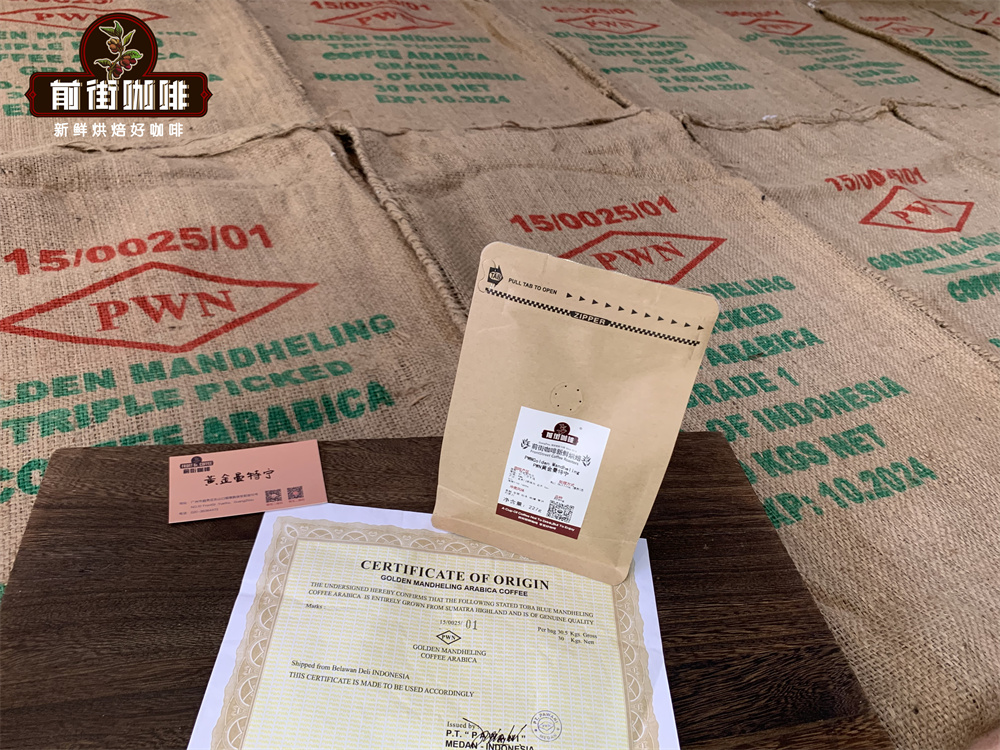
PWN's Golden Mandheling is the reference-grade lot of the category, and FrontStreet's comes from PWN in Indonesia. Only beans of 18 mesh and above are selected, and each 300g green sample must carry fewer than 3 defective beans to meet the top G1 standard, before three rounds of hand sorting remove every remaining defect and lift the cup's cleanliness and sweetness. Expect even, plump, translucent beans, a low defect rate, a clean cup with full body, and a rich roast fragrance: ideal for anyone who does not want acidity. For pour-over, FrontStreet suggests 87-88°C water, 15g of coffee, a 1:15 ratio and a coarse-sugar grind, poured in three stages: a 30ml bloom, then 100ml, then a gentle central pour of 95ml to lift sweetness and bring out caramel, chocolate and nut flavors.
FrontStreet Classic Blend
If you want Mandheling behind an espresso machine, this is the blend. On a base of Brazilian creamy-nut flavor it adds medium-dark-roast Mandheling, making butter, roasted chestnut and caramel especially prominent; the Mandheling raises the body of the whole cup and lends sandalwood, herbal and spice notes, while a small amount of Robusta boosts the richness of the crema. Lattes, latte art and layered Dirty drinks all come together easily.
Important Notice :
FrontStreet Coffee is a long-established specialty coffee roaster in Guangzhou China, selling freshly roasted beans from its own farm in Yunnan as well as dozens of carefully selected single-origin beans from around the world for both pour-over and espresso. The products deliver consistently excellent quality and great value, with shipping within 24 hours. Guangzhou's FrontStreet Coffee shop is recommended by many coffee lovers, and the beans are now available online at the Tmall 。
FrontStreet Coffee has moved to a new address:
FrontStreet Coffee Address: 315,Donghua East Road,GuangZhou
Tel:020 38364473
 Scan and follow the En Gafei WeChat official account. Please indicate that the reprint comes from "En Gafei".