Is Geisha Blend Coffee a Single-Origin Bean? Introduction to Mariposa and Mirasou Geisha Blends

FrontStreet Coffee carries two Geisha blend coffees: the Panama Flower Butterfly, and the Costa Rica Mirasu Estate Strawberry Sugar Geisha Blend. Despite the "blend" label, both are, in fact, single-origin coffee beans.
Geisha's Star Turn in Panama and Costa Rica
The Geisha variety was first identified in 1931 in the Geisha forest of Ethiopia, and was subsequently sent to the Kenyan Coffee Research Institute. In 1936 it reached Uganda and Tanzania, and in 1953 it arrived in Costa Rica.

In 1963, Don Pachi Serracin brought Geisha trees from Costa Rica into Panama. Because yields were low and harvests small, farmers showed little interest in growing it. Everything changed when Daniel Peterson, owner of Panama's La Esmeralda Estate, noticed that beans from Geisha trees originally planted as windbreaks at the highest point of his farm carried the distinctive citrus and floral character of African varieties. He separated out those beans and entered them in the 2004 Panama Cupping Competition, where they became an overnight sensation. From that moment Geisha was unstoppable, taking the championship at the Panama coffee competition year after year. Today, among specialty coffee lovers around the world, Geisha beans are regarded as the ultimate prize.

FrontStreet Coffee · Panama Boquete Flower Butterfly Coffee Beans
Region: Panama · Boquete
Altitude: 1600m
Variety: 70% Geisha, Caturra, Catuai
Processing: Washed
FrontStreet Coffee's Panama Boquete Flower Butterfly is built around 70% Geisha, rounded out with Caturra and Catuai. The trees grow in the Baru Volcano area of Boquete at 1600 meters, on volcanic soil. The mill applies fully washed processing. Panama's distinctive microclimate brings abundant rainfall and a wide day-night temperature swing to this region, and combined with the rich volcanic soil plus careful harvesting and meticulous milling, this FrontStreet Coffee Panama Flower Butterfly performs beautifully in body, acidity, and florality.

FrontStreet Coffee · Costa Rica Mirasu Estate Strawberry Sugar Geisha Blend Coffee Beans
Region: Costa Rica, Tarrazú
Estate: Mirasu Estate
Altitude: 1700m
Variety: Geisha, ET47, SL28, MAICO
Processing: Raisin Honey
The Mirasu Estate Strawberry Sugar Geisha Blend from Costa Rica combines Geisha, ET47, SL28, and MAICO varieties. All of them grow on the same estate, which is what makes this a single-origin coffee: one farm, blended after harvest. Two varieties deserve special mention: ET47 and SL28. ET47 is an Ethiopian landrace variety. In the 1990s, the Costa Rican Coffee Research Institute distributed many introduced varieties to farmers in the Tarrazú region as rust-resistant research trees. SL28 was originally selected to mass-produce beans combining high quality with disease and pest resistance; in some regions the breeding goal was yield alone, with disease resistance a secondary concern. Thanks to its Bourbon genetics, SL28 ultimately yielded less than hoped, but its copper-colored leaves and broad beans deliver wonderful sweetness, balance, and complex, layered flavors, along with pronounced citrus and plum notes.

So do these two "blend" beans count as single-origin coffee? FrontStreet Coffee's view is that the general definition of single-origin coffee is coffee from a single origin — specifically one farm or small growing region. By that standard, the Panama Flower Butterfly comes from smallholder farms within the compact Boquete region, while the Costa Rica Strawberry Sugar Geisha Blend comes entirely from Mirasu Estate — both squarely meeting the definition of single-origin coffee. They are called Geisha blends simply because the variety is not uniform: Geisha makes up the majority, supplemented with other varieties from the same estate.
How These Beans Are Processed
FrontStreet Coffee's Panama Flower Butterfly is fully washed. Selected cherries go into the depulper to strip off skin and pulp; beans still coated with clinging pulp and mucilage are then fermented in water for roughly 24 hours. After fermentation, the parchment coffee is washed in channels of running water to remove every trace of mucilage, then dried in the sun or in mechanical dryers until moisture falls to about 12%. Finally the parchment is hulled off. Washing gives the Flower Butterfly a brighter acidity and showcases the floral character that defines Geisha.
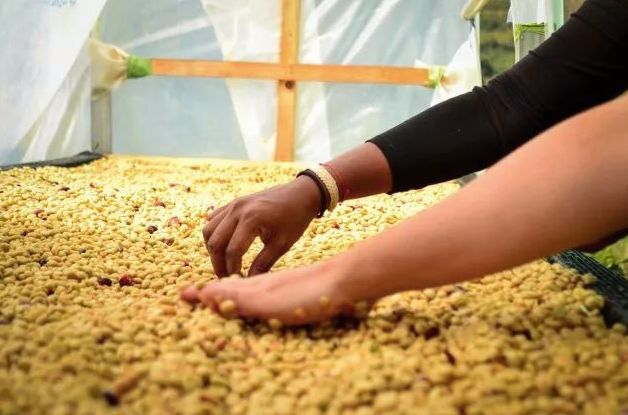
FrontStreet Coffee's Mirasu Strawberry Sugar Geisha Blend, by contrast, is raisin honey processed — 100% of the mucilage retained, with zero water used. This raises the difficulty of honey processing considerably and demands strict timing control. On harvest day, the cherries are poured into large water tanks: ripe, dense fruit sinks, while underdeveloped or overripe cherries float and are skimmed off. The selected cherries first dry on raised beds for at least three days, after which the skin is removed while all the mucilage is left on for further drying. At this stage weather is the make-or-break factor. The fruit must be raked constantly for even drying, yet the raking frequency has to be carefully managed — frequent enough to prevent mold, restrained enough to let the coffee dry slowly and ferment gently without tipping into over-fermentation. The raisin honey method amplifies the sweetness of this Mirasu Strawberry Sugar Geisha Blend.

FrontStreet Coffee Roasting Analysis
Given the uniqueness of the Panama Flower Butterfly's variety composition, FrontStreet Coffee's roaster chose a medium-light profile. The beans are dense and hard, so the roast opens with high heat through the drying phase, then drops the heat before first crack to manage the rate of rise — aiming to protect the delicate small-molecule aroma compounds like florals, so as not to destroy Geisha's signature floral, white grape, caramel, honey, and black tea aromatics.

For a 550g batch: preheat the roaster to 200°C, charge the beans, turn heat down to 160 after 30 seconds, and open the damper to 3. The turning point comes at 1'31"; hold the heat steady. The beans turn yellow at 4'50" and the grassy smell fades — the drying stage is complete — so cut heat to 130 at 165°C and open the damper to 4. Drying ends at 7'50": wrinkles and dark mottling appear on the bean surface and the toast smell shifts into coffee aroma, the prelude to first crack, so listen carefully for the crack. First crack arrives at 8'31"; open the damper fully to 5 and reduce heat to 70. Development after first crack runs 1'28", dropping the batch at 193°C.
FrontStreet Coffee Brewing Recommendations
Brewing Parameters:
Water Temperature: 90-91°C
Grind Size: 20# standard sieve, 80% pass rate (fine-granulated-sugar texture)
Coffee-to-Water Ratio: 1:15
Coffee Amount: 15 grams

FrontStreet Coffee Brewing Method: Start with a 30g bloom pour and rest 30 seconds, then pour up to 95g (scale reads about 125g), finishing within about 1 minute. Once the coffee bed has drained to two-thirds, pour the remaining 100g (scale reads about 225g), finishing around 1 minute 40 seconds. Let the drawdown finish between 1'55" and 2'00", then lift off the dripper to end extraction.
[FrontStreet Coffee Panama Flower Butterfly] In the Cup: Florals, black tea, berries, and citrus, with a light nutty finish. Smooth texture, low bitterness, moderate acidity, and a lingering medium-length aftertaste.
[FrontStreet Coffee Costa Rica Mirasu Estate Strawberry Sugar Geisha Blend] In the Cup: Fresh jasmine fragrance, gentle fruity acidity, an almond aftertaste, and pronounced sweetness.
FrontStreet Coffee Recommendation
If this article has you curious about Geisha's classic character, FrontStreet Coffee suggests starting with the FrontStreet Coffee Boquete Geisha from Panama — an entry-level Geisha that lets you taste the classic Panamanian orange-blossom-and-honey profile, with an oolong-tea feel, delicate fruity sweetness and acidity, and clearly defined layers, all at an approachable price.
For a step up, the FrontStreet Coffee Esmeralda Red Label Geisha ("Esmeralda Special") grows at 1600-1800 meters, and every batch must cup above 90 points, carries its own lot number, and comes from a single small plot such as the Harramuyo lot — perfect for chasing that peak Panamanian Geisha expression. If you would rather explore Geisha at its source, the FrontStreet Coffee Granana Estate Geisha from Ethiopia is a natural-choice natural processed lot: a medium-light roast that unfolds bright citrus acidity, elegant ginger-flower aroma, and the full sweetness of ripe fruit, finished with the silky, refined aftertaste that is the hallmark of the variety.
Important Notice :
FrontStreet Coffee is a long-established specialty coffee roaster in Guangzhou China, selling freshly roasted beans from its own farm in Yunnan as well as dozens of carefully selected single-origin beans from around the world for both pour-over and espresso. The products deliver consistently excellent quality and great value, with shipping within 24 hours. Guangzhou's FrontStreet Coffee shop is recommended by many coffee lovers, and the beans are now available online at the Tmall 。
FrontStreet Coffee has moved to a new address:
FrontStreet Coffee Address: 315,Donghua East Road,GuangZhou
Tel:020 38364473
 Scan and follow the En Gafei WeChat official account. Please indicate that the reprint comes from "En Gafei".