What's the Difference Between Geisha Village Geisha and Regular Ethiopian Estate Geisha?

Most coffee lovers have heard of the celebrated Gesha variety. Gesha rose to fame in Panama, which established Panamanian Gesha and drove up the value of Panamanian coffee. Yet the Gesha variety did not originate in Panama; it comes from coffee's homeland, Ethiopia.
As the birthplace of coffee, Ethiopia is home to a great many wild coffee tree species. Even local Ethiopians cannot tell apart the countless unnamed coffee trees, so they refer to the native beans simply as Ethiopian landraces. The Panamanian Gesha we know today was found in a forest called "Gesha," then sent to Kenya for study and later spread to Uganda, Tanzania, and Costa Rica. Panama's Gesha was introduced from Costa Rica.

Documentary filmmaker Adam Overton and his photographer wife Rachel Samuel established their own estate at Gesha Village, near the Gori Gesha Forest.

Adam followed mule estate owner and BOP judge Willem Boot into the forests surrounding the estate for an adventure. In a jungle magically cloaked in dense forest, they discovered several wild tree species, and their greatest surprise was finding wild Gesha. They later learned that this was the Gori Gesha Forest—the very place where the Gesha variety was first discovered. They collected seeds from the original Gesha trees, screened them, and planted them at Gesha Village. They decided to establish their estate there, naming it Gesha Village Coffee Estate—a 475-hectare coffee farm about 12 miles from the Gori Gesha Forest.

Ethiopia has almost no large estates or estate hierarchies. After Willem Boot and Adam discovered the Gesha Forest, they decided to apply La Esmeralda's business model to this location, making Gesha Village Ethiopia's first coffee estate. Their approach is that every batch, with its own label, can be traced back to detailed information about the beans, and follows a strict grading system: Auction, Gold Label, Red Label, Green Label, and Chaka batches.

Comparison Between Gesha Village and La Esmeralda
Because Gesha Village, like Panama's La Esmeralda, uses a strict grading system and their products are named by label color in China, many consumers confuse the products of the two estates. The most frequent confusion is between the Red Label Gesha and Green Label Gesha from these two estates.
Take the Green Label as an example. FrontStreet Coffee's Green Label from La Esmeralda is a washed batch. La Esmeralda currently defines "Green Label" as Gesha grown at altitudes between 1600 and 1800 meters, chiefly from three farms within the estate: Jaramillo, Cañas Verdes, and El Velo, showing classic Panamanian Gesha character.

By contrast, Gesha Village's Green Label batches are single-plot, single-variety lots from the Gesha Village estate. Many Ethiopian coffees cannot provide detailed variety information, but this Green Label can be traced back to its planting plot, coffee variety, processing method, and other related details. For Gesha Village's Green Label, FrontStreet Coffee has also obtained a natural batch, using a medium-light roast to highlight its floral and fruity aromas.

Gesha Village Natural Process
FrontStreet Coffee's Gesha Village coffee uses natural processing. First, floating matter and impurities are removed, then the coffee is dried in thin layers on African raised beds and covered with plastic sheets. During drying, a second screening removes insect-damaged beans and green-colored beans. The total drying time is 18-30 days. FrontStreet Coffee believes naturally processed coffee has noticeable sweetness, soft acidity, and complex fruit flavors.

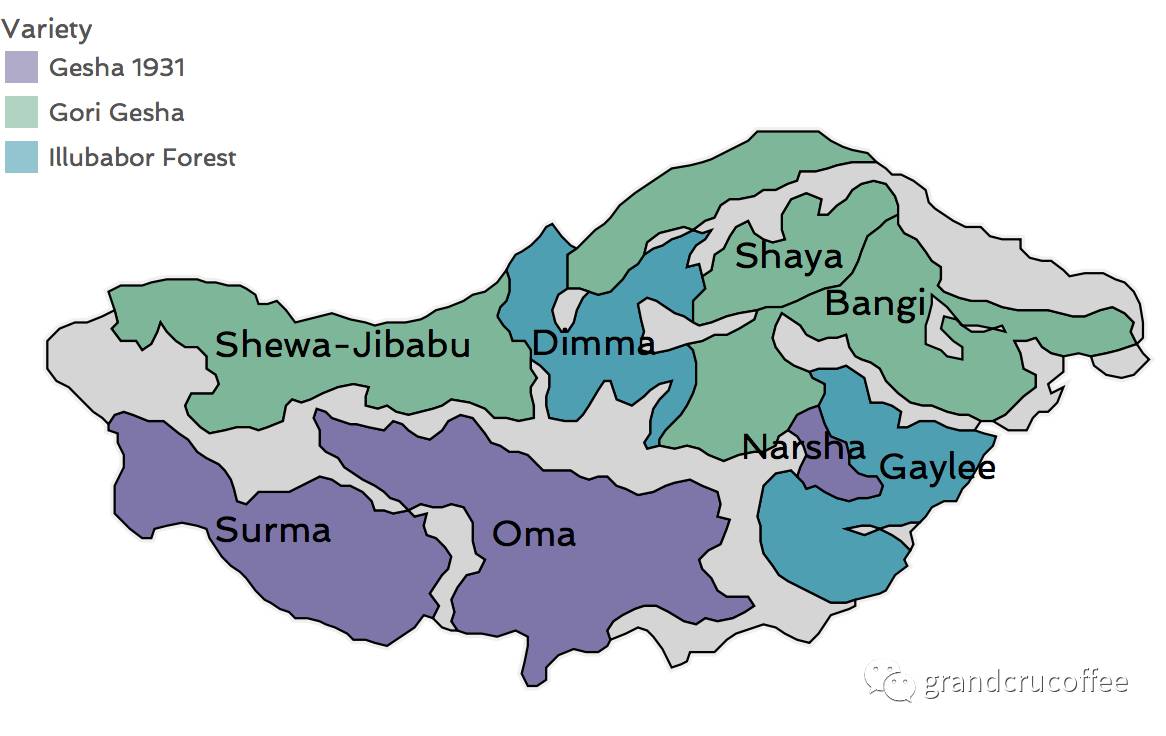
Those familiar with the Gesha story will know that La Esmeralda grows only one Gesha variety—the once-recorded "geisha T2722," a fungus-resistant variety. Gesha Village, however, has two Gesha varieties: one is Gori Gesha, the variety behind FrontStreet Coffee's Gesha Village Green Label, named after the Gori Gesha Forest where it was discovered. The other is Gesha 1931, commemorating the year Gesha was discovered in 1931—this is the variety used for FrontStreet Coffee's Gold Label Gesha.

Cupping Comparison
To draw clearer distinctions between the two, FrontStreet Coffee held a cupping comparison between Panama Green Label Gesha and Gesha Village Green Label Gesha. First, 11.3 grams of each Green Label coffee were ground separately, then hot water at 94°C was poured in. Over those four minutes the wet aroma of the grounds could be assessed. After four minutes the crust was broken, skimmed, and tasting could begin.

Through comparison, FrontStreet Coffee found that Gesha Village Green Label and La Esmeralda Green Label are not very alike, and in fact present completely different styles. La Esmeralda's washed Green Label Gesha has excellent cleanliness with no off-flavors, a very smooth mouthfeel, and flavors dominated by white florals, blueberry, lemon, and tea, with honey and brown sugar sweetness particularly prominent.
Gesha Village's Green Label Gesha, in contrast, leans toward candied fruit and raspberry. Beyond its intense berry aroma, it carries bright cherry and citrus acidity, leaving a lingering faint floral note and a black tea finish after drinking.
FrontStreet Coffee Recommendation
If this comparison has you curious about how the two great Gesha estates differ in the cup, FrontStreet Coffee stocks both sides of the story. For the classic Panama profile, the Emerald Red Label Gesha is picked from a single plot at 1600-1800 meters, each batch cupped above 90 points and given its own number—FrontStreet's Red Label comes from the Jaramillo plot—while the Emerald Green Label Gesha, originally named "Private Collection," blends several plots to showcase La Esmeralda's signature high-altitude Gesha character at a friendlier price. If you want an accessible first taste of the famous Gesha profile, the Boquete Gesha is an entry-level estate-grade Gesha grown at 1600 meters, offering the classic Panamanian orange-blossom honey character with oolong tea and delicate fruit acidity. On the Ethiopian side, Gesha Village Gold Label Gesha, a Gesha 1931 with a refined natural process, shows the complex, layered character that competition baristas come back to, while Gesha Village Red Label Gesha, a Gori Gesha single-terroir lot scoring 88 or above, comes with full traceability from farm block to processing date. For a rare single-variety Ethiopian Gesha, Genlana Gesha from the Genlana station—hand-picked, raised-bed natural-dried for 14-20 days and roasted medium-light—delivers bright citrus acidity, elegant ginger-flower aroma, and ripe-fruit sweetness.
Important Notice :
FrontStreet Coffee is a long-established specialty coffee roaster in Guangzhou China, selling freshly roasted beans from its own farm in Yunnan as well as dozens of carefully selected single-origin beans from around the world for both pour-over and espresso. The products deliver consistently excellent quality and great value, with shipping within 24 hours. Guangzhou's FrontStreet Coffee shop is recommended by many coffee lovers, and the beans are now available online at the Tmall 。
FrontStreet Coffee has moved to a new address:
FrontStreet Coffee Address: 315,Donghua East Road,GuangZhou
Tel:020 38364473
 Scan and follow the En Gafei WeChat official account. Please indicate that the reprint comes from "En Gafei".