Introduction to Award-Winning Panamanian Estates: What's the Difference Between Donkey Estate and Mule Estate?

Anyone familiar with Panama coffee, like the team at FrontStreet Coffee, thinks of Boquete the moment the country's specialty regions come up. After all, the area is home to many outstanding Geisha producers, with famous estates such as Hacienda La Esmeralda, Elida Estate, and Duncan Estate long known as top contenders.
On this fertile land, two estates bear animal names that sound quite similar in Chinese: one is "El Burro Estate" (Donkey Estate) and the other "Finca La Mula" (Mule Estate), which often causes confusion. Today FrontStreet Coffee takes you through both growing areas and into the charm of Geisha.
Geography of Panama's Coffee Region
First, almost every Panamanian estate sits in the western province of Chiriqui, on the border with neighboring Costa Rica, on both sides of the Baru Volcano range. To the west lies Volcan; to the east, Boquete. Although the straight-line distance between them is only 22 kilometers, driving means going around the main range — nearly 100 kilometers and at least an hour and a half.

Boquete is actually the name of a valley, sitting right between Baru Volcano and Jaramillo Mountain in a narrow, elongated zone. The scenery is beautiful, with cool, pleasant dry seasons and continuous light rain in the wet season. Even setting coffee aside, Boquete draws travelers from many countries on the strength of its natural setting. Local residents have made good use of the Rio Caldera, building restaurants, villas, and resorts that make it a favored destination for visitors.
Looking at maps, FrontStreet Coffee notes that Panama sits between two ocean currents, where Caribbean and Pacific air masses converge above 6,500 feet in the Boquete valley, creating unique, variable microclimates. That yields moderate temperature and humidity, and, combined with volcanic soil, lets the cherries grown here develop rich and varied aromatics more easily.

El Burro Estate
El Burro means "donkey" in Spanish, and El Burro Estate belongs to Panama's renowned coffee-producing Lamastus family.

The Lamastus family story began in 1918 and now spans four generations of management: from Robert Louis Lamastus's founding of the first estate, to his son Thatcher and Thatcher's wife Elida, to the better-known Wilford Lamastus, and now to the youngest fourth generation.

After a century of development, the Lamastus family owns three estates: Elida, El Burro, and Luisito. Elida Estate, named after the first-generation matriarch, is not only the earliest established and most famous but also a frequent champion in the Best of Panama (BOP) green bean competition.
As for the origin of the estate's name, FrontStreet Coffee could not find exact official documentation, but it is said that the area was once used for livestock raising, which is why the owner named it "Donkey."

According to the official website, El Burro Estate was established in 1925 and originally owned by Amado Boutet, Thatcher's father-in-law and grandfather of current third-generation manager Wilford Lamastus. A long stretch of low global coffee prices forced the family to sell large parts of their estates. Wilford and his brother Patrick, unwilling to see the family land go, bought it back to keep it running. To make ends meet, Wilford's family took on other work for additional income. After years of effort, they built today's "famous estate," which consistently ranks near the top in major green bean competitions.
El Burro Estate lies southwest of Elida and is one of Panama's southernmost plantations, covering 65 hectares. Because part of the land falls within Baru Volcano National Park, only 30 hectares are used for coffee, with the remaining half surrounded by pristine forest. That has preserved rich biodiversity and created habitat for many rare plants, birds, and mammals. The farm has strictly banned hunting for decades.

El Burro grows two varieties: 50% Geisha and 50% Catuai. The trees grow mainly at elevations between 1,575 and 1,800 meters, averaging 1,675 meters. The high altitude brings significant day-night temperature differences. The area also has fertile volcanic-ash soil, heavy fog in the dry season, and cold nights, with the highest points sometimes dropping below 10 degrees Celsius. Trees planted here therefore need 4.5 to 5.5 years to begin bearing fruit, and cherries ripen about a month later than in lower-altitude areas, letting the beans accumulate more flavor compounds.
To taste competition-level flavor, FrontStreet Coffee also acquired a natural-processed Geisha from El Burro and roasted it medium-light. Brewed, it showed the round acidity of green grapes and apricots, the high sweetness of orange and dried longan, delicate florals, and a slight fermentation note. As the temperature drops, the sweet-sour taste of orange becomes even more pronounced.

Finca La Mula
Compared with El Burro, Finca La Mula has a more precise origin story, and it is deeply tied to Geisha. Rewind first to 2004. In the same year Geisha made its debut, judge Willem Boot tasted Geisha for the first time and was immediately captivated by its delicate orange and honey notes, which inspired his dream of establishing an estate.

Willem Boot is a deeply respected figure in the coffee industry. Born in the Netherlands and raised in the small town of Baarn near Amsterdam, he developed a strong interest in coffee from childhood. Those familiar with Geisha will recognize him — he was the guide who led Geisha Village Estate into the Gesha forest, and he is known as the "Godfather of Geisha."

He roasted his first batch of coffee at age 14, and after earning a master's degree in business economics from the University of Amsterdam, he co-owned and ran a specialty coffee business with his family. In 1989 he moved to San Francisco, USA, and worked at Probat. In 1998 he founded Boot Coffee, consulting for coffee companies, associations, development banks, and governments worldwide. In 2016 he established Boot Coffee Campus, a leading training institution near San Francisco, California, serving the coffee industry across the Pacific region.
Through an introduction from Panamanian estate owner Graciano Cruz, he found a high-altitude area near Baru Volcano ideal for coffee — what we now know as Finca La Mula, which Willem purchased in 2005. Because he first traveled there riding a mule, he named the estate "Mule."

Finca La Mula is located in the southern part of Chiriqui province, Panama. Because it borders Baru Volcano National Park and sits on slopes between 1,700 and 1,800 meters, the soil is rich in minerals. The surrounding area has beautiful natural scenery and a rather pristine jungle atmosphere. These are all advantages for coffee growing, but they also mean that clearing land and planting would be extremely challenging.

With no proper roads reaching the forest, all coffee seedlings had to be mixed by hand and then carried on foot through winding forest paths to be planted. Not until 2007 did Willem and his team manage to plant more than 6,000 Geisha trees on this mere 5-hectare piece of land. Today Willem owns three estates: Finca La Mula, Finca La Cabra, and Finca Sofia. Although Finca La Mula has the smallest area, it has won numerous awards since it began competing in 2014, becoming a high-quality renowned estate that countless Geisha enthusiasts long to taste.
FrontStreet Coffee Recommendation
To taste Panama Geisha at its most celebrated, FrontStreet Coffee offers two lots from Hacienda La Esmeralda. The Red Label Geisha — officially "Esmeralda Special" — is grown at 1,600–1,800 meters, and every batch must cup above 90 points. Each lot carries its own number and comes from a single small plot, so buyers can choose a batch that matches their taste. The Green Label Geisha, originally "Private Collection," is blended from several plots rather than emphasizing a single one; it expresses the estate's signature high-altitude Geisha character at a more accessible price, which makes it excellent value.
If you are new to Geisha and want to sample the famous "Geisha flavor" without overcommitting, FrontStreet Coffee usually suggests the Boquete Geisha. This entry-level Geisha lets you experience the classic Panamanian orange-blossom, honeyed character, an oolong tea-like quality, fine fruit sweet-sour balance, and clear layering at a friendly price.
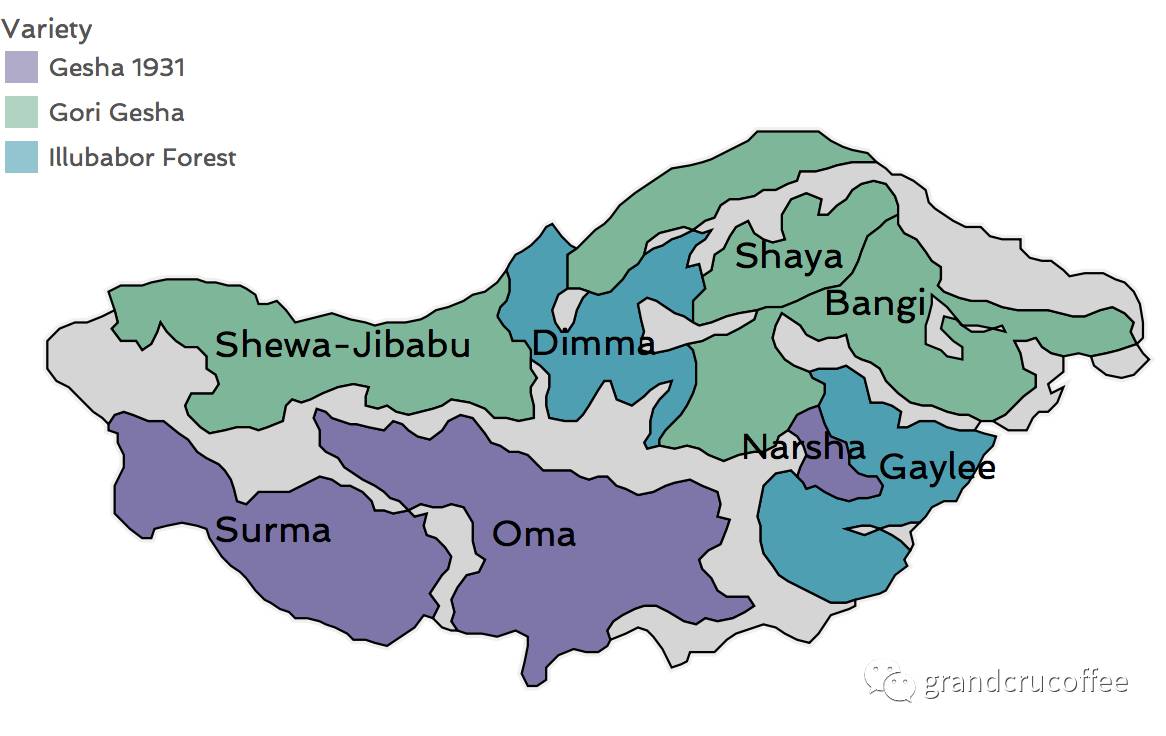
Ethiopia, the birthplace of coffee, has its own Geisha showpiece: Geisha Village. It enforces strict grading and grows three Geisha varieties — Gori Gesha, Gesha 1931, and Illubabor Forest — across tiers including Gold Label (RARITIES), Red Label (GROWERS RESERVE), Green Label (SINGLE-TERROIR), and the CHAKA lots. The Gold Label is Gesha 1931, making up 10% of Geisha Village's total output and its top coffee outside auction, often chosen by competition baristas; FrontStreet Coffee's Gold Label uses a refined natural process for complex, layered flavor. The Red Label is Gori Gesha, 15% of output, scoring 88 points or above on the SCA 100-point scale, and as a single-terroir series every lot carries full traceability — farm block name, variety, and processing date.
Finally, Grana Gesha comes from a rare Ethiopian estate that grows only one variety, on a processing station founded in 2014 at the border of Kochere and Grana Abaya, where coffee covers as much as 700 hectares, much of it uncultivated, fertile, and shaded by trees. Hand-picked whole ripe cherries are dried on raised beds for 14–20 days depending on weather. Roasted medium-light, it shows bright citrus acidity, elegant ginger-flower aroma, the full sweetness of ripe fruit, a fine, silky texture, and the refined finish that is Geisha's signature. For brewing, FrontStreet Coffee suggests 15 g of coffee, water at 91°C, a 1:16 ratio, and a medium-fine grind — roughly fine sugar, about 78% passing a China standard #20 sieve — poured in three stages: 30 g for a 30-second bloom, then a fine circular pour to 125 g, then continuing to 225 g, for a total extraction of about 2'10"–2'20".
Important Notice :
FrontStreet Coffee is a long-established specialty coffee roaster in Guangzhou China, selling freshly roasted beans from its own farm in Yunnan as well as dozens of carefully selected single-origin beans from around the world for both pour-over and espresso. The products deliver consistently excellent quality and great value, with shipping within 24 hours. Guangzhou's FrontStreet Coffee shop is recommended by many coffee lovers, and the beans are now available online at the Tmall 。
FrontStreet Coffee has moved to a new address:
FrontStreet Coffee Address: 315,Donghua East Road,GuangZhou
Tel:020 38364473
 Scan and follow the En Gafei WeChat official account. Please indicate that the reprint comes from "En Gafei".