Yirgacheffe Coffee Bean Flavor Characteristics Roasting Recommendations Origin Information Growing Regions Estate Distribution

Ethiopia: The Birthplace of Coffee
Ethiopia is the earliest known home of coffee, and wild coffee plants still grow in its original forests, where farmers continue to harvest them. It is a country beset by poverty, drought, and civil conflict, yet it remains one of the most important coffee-producing nations in both quality and quantity. Ethiopian coffee divides into two main processing methods: washed (wet) processing and natural sun-dried processing.
Today, virtually every producing region, cooperative, and even small farm in Ethiopia runs both methods side by side—in famous Yirgacheffe as well as across Sidamo. And in Ethiopia's fast-developing coffee industry, different regions create variation not only through processing choice: the same method can yield different aromas and flavors depending on technique, often with surprising results. The washed coffees of Yirgacheffe and Sidamo share a common character—gentle, subtle aromas, soft understated lemon acidity, high flavor consistency, and an appealing mouthfeel. Naturals, by contrast, show strong, prominent aromas with less obvious lemon acidity, complex and varied flavors, and a special talent for floral and fruit expression.
Light Roast (City): FrontStreet Coffee's Natural Yirgacheffe
Hold a handful of FrontStreet Coffee's natural Yirgacheffe beans and you will immediately catch the fermented aroma of plums and strawberries. During roasting they smell of sweet baked biscuits, and after grinding the strawberry-biscuit scent carries across the room. Brewed, the cup opens with a soft, comfortable strawberry fruit-wine aroma; the bright fruit acidity at the front quickly settles so the aromatics can shine. As the coffee cools, the fermented notes of plum and strawberry wine unfold in layers, and the finish fills the mouth with candied kumquat sweetness. Rest the beans for 7-9 days after roast and the strawberry aroma awakens—vibrant and prominent—while the acidity turns smooth and gradual.
Darker Roast: FrontStreet Coffee's Roasting Approach
Ending the roast 20-40 seconds after first crack is FrontStreet Coffee's darkest level for natural Yirgacheffe—just enough to avoid the bitterness that the uneven moisture content of natural beans can cause. Here the coffee smells of chocolate chiffon cake, with the sweetness of tropical fruits like pineapple and mango and a smooth, milky, caramel-like texture. Cooled, FrontStreet's natural Yirgacheffe delivers a refined, sweet chocolate syrup that simply makes you happy.
Kochere: A Prestigious Micro-Region
Kochere is a small micro-region about 25 kilometers southeast of Yirgacheffe town. Its coffee comes from local smallholders—a collective of many individual farming families averaging about 1 hectare each, at growing altitudes of 1800-2000 meters. The varieties are mainly Typica mixed with Heirloom (local native strains).
Thanks to its advanced green-bean washing equipment, the region has long performed at a high level in washed processing, praised for its clean sweetness layered with honey and citrus. The local model is simple: smallholder farmers deliver each harvest of red cherries to a nearby cooperative washing station for centralized processing.
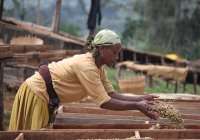
Ethiopia introduced washed processing technology in the 1970s, and today Kochere's green coffee is primarily washed. After the washing station screens and grades the red cherries, they are depulped straight away for washed fermentation. The washed parchment is then rack-dried in the sun; once moisture falls to 12% or below, it goes directly to the Ethiopian Commodity Exchange (ECX) warehouse in Awassa for cupping, grading, and quantity assessment. Washed lots are usually stored in parchment and hulled only just before export.
FrontStreet Coffee's Yirgacheffe Washed Kochere
This lot of FrontStreet Coffee's Yirgacheffe Washed Kochere is rated G1, the highest grade under the ECX. From green bean appearance, consistency, and freshness to dry aroma and flavor, every aspect is excellent. The aromatic expression is extraordinarily rich: Yirgacheffe's regional signature of an elegant, captivating perfume-like florality, floral notes, bright citrus acidity, lemon, berry, and the sweet-tart lift of honey. Jasmine, orange, caramel, grape, vanilla, and honey arrange themselves into a clean, balanced mouthfeel with a lively, layered fruity sweetness in the finish.
The Evolution of Ethiopian Coffee Excellence
In recent years, many emerging micro-regions and cooperatives in Sidamo and Yirgacheffe have begun marketing internationally under their own names—a sign of confidence in their coffee and of their ambition to build brands and loyalty abroad. Farmers insist on harvesting only mature cherries and strictly control every processing step. Whether washed or natural, the results are outstanding, with unexpectedly fragrant aromas and excellent mouthfeel. That, more than anything, is why Ethiopian coffee keeps thrilling enthusiasts year after year.
The Operation Cherry Red project backed by the Dutch government is a case in point: the 2008 Kore lot and the 2009 Carmbela estate lot both poured out magnificent strawberry-biscuit aromas that left a deep mark on the coffee world. In recent years, Ethiopian naturals have only sharpened this signature.
Ethiopian Coffee Grading System
Ethiopian washed coffee is graded G1 and G2 (G1 the highest for washed), and naturals G3 and G4 (G3 the highest for natural). Green beans are sorted into five grades by the number of defects per 300 grams:
Grade 1: 0-3
Grade 2: 4-12
Grade 3: 13-25
Grade 4: 26-45
Grade 5: 46-90
About Yirgacheffe
Yirgacheffe coffee trees grow in the Sidamo region of southwestern Ethiopia. The beans are small to medium, the green coffee a light yellow-green with complete, beautiful shapes—and the region holds a representative place among East African specialty coffees.
Under the current ECX system, the Yirgacheffe area is divided into four sub-regions: Yirgachefe, Wenago, Kochere, and Genlena Abaya. The soil is fertile and average altitudes exceed 1800 meters—a high-growing land of wide day-night temperature swings. Each area's production methods, combined with its unique gardens of native varieties, give every batch its own distinctive flavor profile.
FrontStreet Coffee's Premium Yirgacheffe
FrontStreet Coffee's Yirgacheffe is a premium washed Arabica with unique, bright fruit acidity and sweetness. From the very first sip you feel its fresh, vivid aromatics. This is a coffee of real character: bold florals and lemon acidity, richly layered flavors, and an almost tea-like delicacy—which is why so many people say Yirgacheffe doesn't taste like coffee at all, but like a soft, pleasant fruit tea. It can be elegant or bold, balancing simplicity and complexity with precision, and the Japanese have fittingly called it the "Queen of Coffee."
Yirgacheffe originally made its name—and the bulk of its output—with washed processing, but natural Yirgacheffe has since won the market over with its rich berry sweetness, and rising demand has pushed natural production up sharply.
Yirgacheffe was long the finest source of Ethiopian washed beans. In the past year or two, as naturals from estates like Misty Valley became hugely popular, many farms that once produced only washed coffee have followed suit. The result is a new generation of bolder, more assertive Yirgacheffe naturals that keep breaking every aromatic ceiling for lovers of the style.
Besides being world-famous for the mocha beans of Harar, Ethiopia's washed Arabica from the small, high-altitude area of Yirgacheffe in south-central Sidamo ranks among the finest coffee beans in all of Africa.
The name Yirgacheffe means "single ethnic settlement." The area lies in Ethiopia's south-central Sidamo growing region at altitudes above 2000 meters, the homeland of the Gedegna people, and it is one of the few regions in Ethiopia producing washed Arabica. Roasted to medium, FrontStreet Coffee's Yirgacheffe shows fruit acidity laced with unique notes of floral tea and lemon peel.
Yirgacheffe inherits the mocha bean's uneven particle size, but because the Sidamo region uses washed processing, the beans look far more beautiful than dry-processed mochas—while keeping mocha's floral notes and Yirgacheffe's unique winey mellowness.
Premium Processing: Idido Washing Station
The natural G-1 from Yirgacheffe's Idido washing station represents the highest grade of Yirgacheffe on the market. Yirgacheffe's grading normally separates naturals and washed lots—naturals topping out at G3 or G4, washed mostly at G2. But Idido's owner, Abdullah Bagersh, adopted new methods: after harvest the cherries rest on drying racks for 48 hours with constant hand turning, followed by hand-sorting of defects, successfully producing both natural G1 and the highest washed G1.
Printed on the sacks of his green beans you can see the word "Bagersh." Now in its third generation, the family cultivates in the Aricha area of Yirgacheffe at roughly 6,000 feet (1,800 meters), and the Idido washing station remains exclusively owned by the Bagersh family.
Tasting Notes
Dry aroma: fresh lemon sweetness, citrus fragrance, and a berry-like tartness. With hot water added, notes of milk candy, lemon sweetness with a milky touch, and citrus unfold into long-lasting sweet aromas.
Slurping: clean, with plum aroma, a very refreshing sweetness, and a hint of orange. The aftertaste leaves a lemongrass note behind.
Kochere Regional Details
Kochere lies in the Gedeo zone of southern Ethiopia, an administrative region that also governs the better-known Yirgacheffe. Because Yirgacheffe's coffee has such special, distinctive flavors and is so widely loved, it forms its own category in product classification and has always held a place in the global specialty market.
Yirgacheffe itself is a small town in Sidama province with three neighboring micro-regions: Wenago, Kochere, and Gelena Abaya. Because Kochere's flavors stand nearly on par with Yirgacheffe's, it too is classified within the Yirgacheffe category. In November 2009, Ethiopia rolled out a new trading and grading system, adding Wenago, Kochere, and Genlena/Abaya as named sub-regions—recognition that these three areas' flavors are refined enough to be subdivided further.
About Misty Valley
FrontStreet Coffee's Yirgacheffe bean from Misty Valley takes its lovely name from where it grows. In the small town of Yirgacheffe in Sidama province, coffee trees are planted everywhere. Abandoning the natural method Sidamo used a decade earlier, Misty Valley's farmers turned to washed processing—and made Yirgacheffe famous. Today Yirgacheffe is no longer just a place name but a byword for great coffee.
According to local elders, although Misty Valley's Yirgacheffe is world-famous for washed processing, the area still relies primarily on traditional naturals, because residents believe sun-drying creates a beauty of flavor that defies description. Yirgacheffe's fame is such that Ethiopia has folded its coffee ceremony into banquets for foreign guests: whole or broken beans alike go straight into iron pans for roasting, with no fuss over the supposed sin of over-roasting. Under this traditional, wonderful ceremony, even beans of uneven color can brew an unforgettable cup.
FrontStreet Coffee Recommendation
To get to know Ethiopia, start with FrontStreet Coffee's classic washed Yirgacheffe: white jasmine florals, bright citrus and lemon acidity, and a tea-like finish at a friendly price—the first bean for countless drinkers entering specialty coffee. Yirgacheffe town itself sits in southern Sidama at roughly 1700-2100 meters, with coffee planted above 1800 meters, making it one of the highest coffee regions on earth.
FrontStreet Washed Guodingding Cooperative: Yirgacheffe town breaks down into small sub-regions and even villages, some home to seasoned cooperatives—the most representative being the Guodingding Cooperative from Guodingding village in the Worka area at Yirgacheffe's southeastern tip. Once part of the Worka cooperative under the Yirgacheffe Coffee Farmers Cooperative Union (YCFCU), it went independent as traceability became the pursuit of coffee hunters worldwide. Using the most traditional washing, it shows no traditional bitterness at all—just fresh, bright citrus and lemon acidity wrapped in jasmine fragrance. Brew it with a V60 at 90-91°C, 15g of coffee, a 1:15 ratio, and a fine-granulated-sugar grind: 30g of water for a 30-second bloom, 95g more to reach about 125g by the 1-minute mark, then the final 100g at 225g once the level drops to two-thirds of the bed, finishing between 2:00 and 2:10.
FrontStreet Natural Red Cherry: from the same Yirgacheffe region, this lot is a full-red-cherry natural—only perfectly ripe, defect-free fruit is picked, screened again at the mill, then laid on raised beds and turned every 2-3 hours during the first days to prevent uneven fermentation. After three to five weeks of sun-drying, the dried pulp is milled off and the beans are warehoused. Because the fruit dries with the pulp on, the cup keeps Yirgacheffe's typical character while gaining tropical fruit: citrus-like acidity, a berry juiciness, honeyed sweetness, and a creamy smoothness.
Important Notice :
FrontStreet Coffee is a long-established specialty coffee roaster in Guangzhou China, selling freshly roasted beans from its own farm in Yunnan as well as dozens of carefully selected single-origin beans from around the world for both pour-over and espresso. The products deliver consistently excellent quality and great value, with shipping within 24 hours. Guangzhou's FrontStreet Coffee shop is recommended by many coffee lovers, and the beans are now available online at the Tmall 。
FrontStreet Coffee has moved to a new address:
FrontStreet Coffee Address: 315,Donghua East Road,GuangZhou
Tel:020 38364473
 Scan and follow the En Gafei WeChat official account. Please indicate that the reprint comes from "En Gafei".