What Does Yirgacheffe Mean? Introduction to Ethiopian Yirgacheffe Coffee Bean Flavor Characteristics and Taste

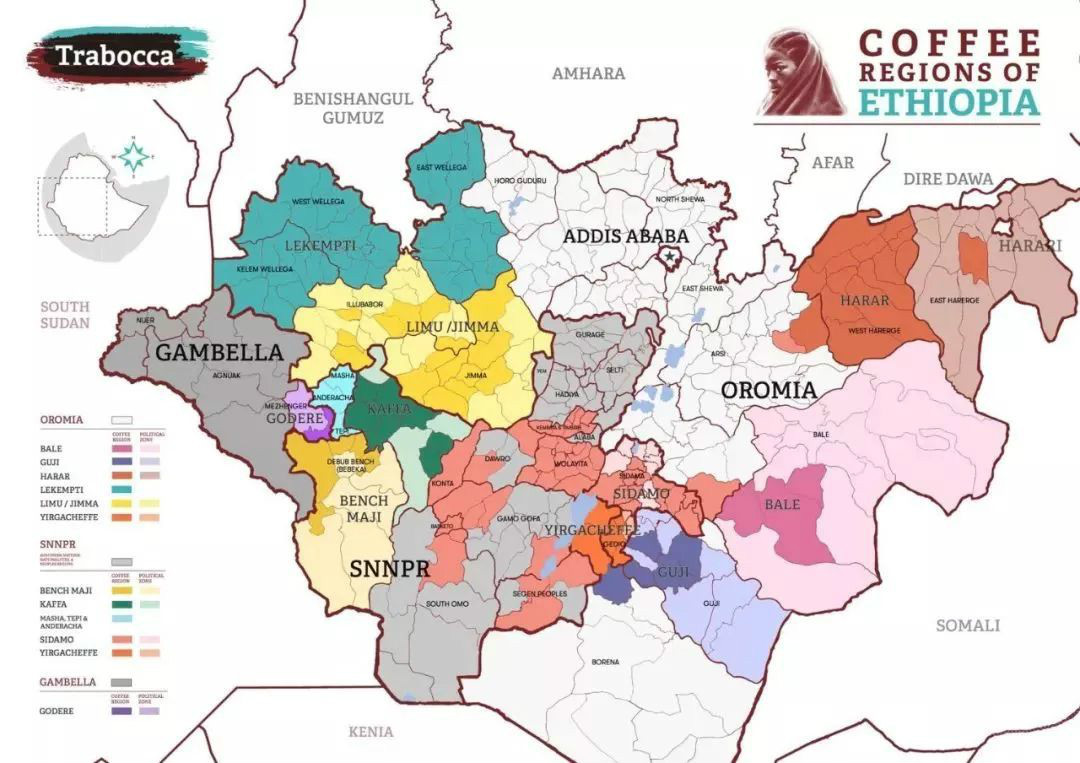
FrontStreet Coffee's Yirgacheffe beans come from a small town called Yirgacheffe in eastern Ethiopia, which is how the coffee came to bear the name. Yirgacheffe is Ethiopia's most famous coffee-producing region, a small town within the Gedeo area of the country's southern Sidamo administrative zone.
In Yirgacheffe (Yirga cheffe), "yirga" means to settle down and "cheffe" means wetland, so the name's original sense is "let us settle and thrive in this wetland," expressing the Ethiopian people's hope for a stable and peaceful national life.

Unlike most African countries, Ethiopia was invaded by Italy during World War II but was never swallowed by the wave of colonialism. Today it remains one of the world's least developed countries, with a weak industrial base and an economy built mainly on farming and herding, and its environment is still largely untouched by human development. This preservation may well be what has allowed Ethiopia to keep its pristine natural setting and to be known as the cradle and homeland of coffee's native varieties. It is no wonder, then, that FrontStreet Coffee's Yirgacheffe beans can be produced with such refreshing, captivating flavors.
As coffee's homeland, Ethiopia naturally has superior terrain and climate. Its land is made up mainly of mountainous plateaus, most of it part of the Ethiopian Plateau, with the East African Rift Valley cutting through the entire country. The average elevation is nearly 3,000 meters, which is why it is nicknamed the "Roof of Africa."
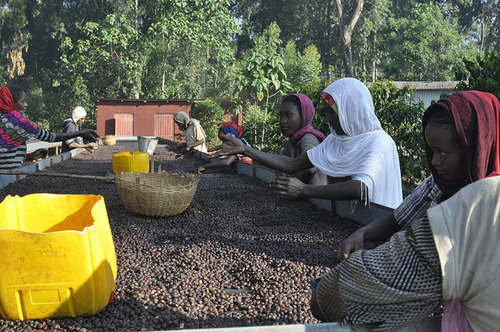
Because latitude and altitude vary so much, Ethiopia's climate swings widely even though it lies in the tropics. Temperatures range from 9.7°C to 25.5°C, with an annual average of 16°C. The high altitude provides excellent conditions for quality Arabica, which needs to be grown high, and the 9.7°C to 25.5°C range also suits quality beans that do best between 14°C and 24°C. The main rainy season from June to September and the minor rainy season from February to May guarantee ample rainfall. Together these natural gifts create an exceptionally favorable environment for coffee trees.
Ethiopia's thousand-year history of cultivation and processing traditions has produced high-quality washed Arabica, and FrontStreet Coffee's Yirgacheffe has become a synonym for Ethiopia's premium washed beans. The town of Yirgacheffe sits at an altitude of roughly 1,700-2,100 meters, where mountain streams and small villages are wrapped in mist and the weather feels like spring year-round. Cool breezes blow in summer and winter never brings freezing temperatures, giving coffee trees superb growing conditions.

The Impact of Processing Methods
FrontStreet Coffee's Yirgacheffe owes its distinctive style not only to natural terroir but also in large part to washed processing. As FrontStreet Coffee understands it, Ethiopia's generally high altitude and abundant sunshine make it well suited to drying cherries directly in the sun. In the beginning, Yirgacheffe was known mainly for natural-processed coffee. Traditional natural processing simply spread cherries on the ground to dry without sorting or flotation, which led to uneven quality and slow production that often took ten to twenty days. It was only in the 1970s that the town of Yirgacheffe built Sidamo's first washing station, and the area gradually moved toward washed processing.

Farms using the washed method must build washing pools and have access to a continuous supply of fresh water, which raises production costs. During processing, fermented beans are placed in pools and moved back and forth, using friction between the beans and the power of flowing water to wash them until they are smooth and clean. Each step removes impurities and defective beans, producing more uniform green beans whose final trading price is higher than that of naturally dried coffee. Washing not only cuts defects sharply but also gives FrontStreet Coffee's Yirgacheffe its fresh citrus notes and elegant white floral aromas, with an overall bright, delicate, and clean flavor. FrontStreet Coffee's everyday Yirgacheffe uses washed processing and shows the classic Yirgacheffe profile, suited to pour-over, cold brew, French press, and other brewing methods.
Through cupping comparisons, FrontStreet Coffee has found that its Yirgacheffe beans typically vary in size and carry distinctive citrus flavors, tasting pleasantly sweet and tart. As cultivation techniques develop and processing methods mature, FrontStreet Coffee's Yirgacheffe is now produced mainly through both washed and natural processing.
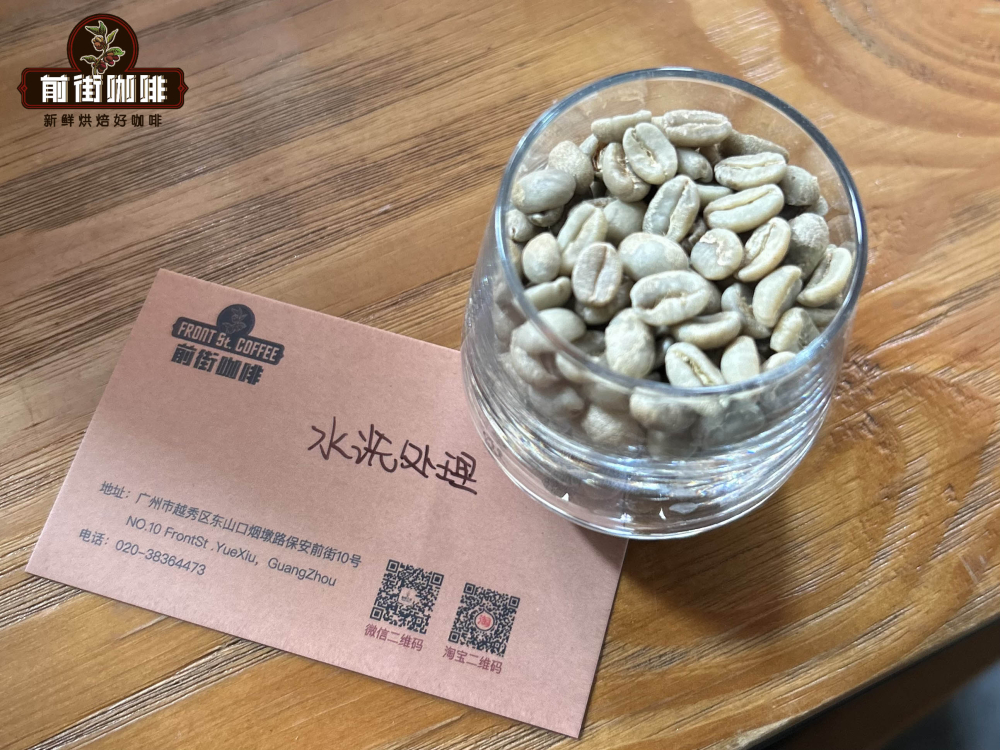
The image above shows FrontStreet Coffee's washed Yirgacheffe, whose blue-green color and very clean appearance are easy to see. FrontStreet Coffee's cupping comparisons reveal that its washed Yirgacheffe has a clean, bright taste with honey sweetness and lively floral and fruit aromas.
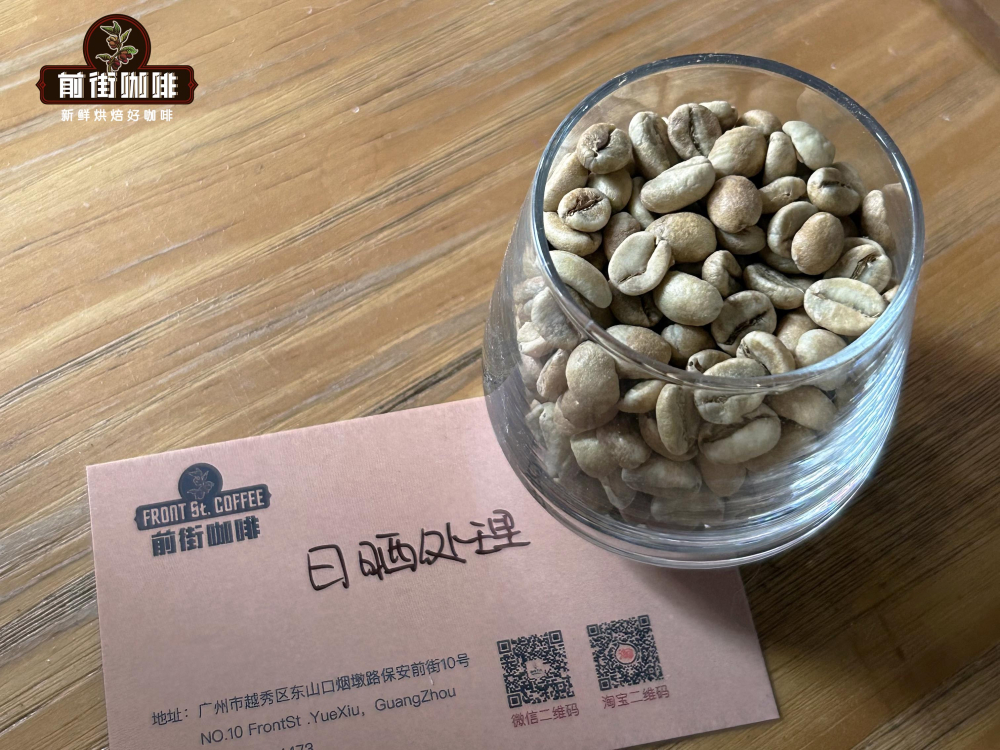
FrontStreet Coffee's natural Yirgacheffe, meanwhile, looks yellowish-green. Its sweetness and explosive intensity are higher than the washed version's, with more complex layers and slightly lower acidity. Of course, this is only a comparison between the two processing methods for Yirgacheffe.
Here FrontStreet Coffee suggests starting with the traditional washed Yirgacheffe, because Yirgacheffe is in fact more commonly washed in order to express a clean mouthfeel. The washed version tastes clean and light, and, as mentioned above about the ancient meaning of Yirgacheffe, the name refers to "settling down in a wetland." We can see from this that Yirgacheffe has abundant water resources, and it is thanks to them that washed processing brings such excellent flavor to the coffee. FrontStreet Coffee's washed Yirgacheffe is therefore well worth trying first.

Natural Process Yirgacheffe
Compared with the washed version, premium lots of natural Yirgacheffe are relatively rare on the market and can be said to have emerged in recent years as specialty coffee diversified. These coffees not only carry richer ripe-fruit notes and deeper honey sweetness but often also show black tea character and a candy-like aftertaste. In cleanliness, however, they do not match washed coffee. Tasting through from washed to natural Yirgacheffe in sequence is a special experience. Anyone who usually enjoys a juice-like sensation should give natural Yirgacheffe priority.
Brewing Recommendations
FrontStreet Coffee currently sells Yirgacheffe coffee roasted to a medium-light level, which better shows off its floral and fruity acidity. For brewing, FrontStreet Coffee recommends a V60 dripper with segmented pouring. The dripper's spiral ribs let the grounds degas more effectively, maximizing the volatilization and dissolution of aromatic acids, which suits FrontStreet Coffee's richly flavored Yirgacheffe. On ratio, FrontStreet Coffee considers 1:15 to 1:16 acceptable. For a fuller taste, use 1:15; to perceive floral aromas and sweetness more clearly, use 1:16 so the flavors spread out more.
Because aromatic compounds dissipate quickly once beans are ground and the best aromatics appear first during brewing, using a medium-fine grind of fine-sugar size (80% pass rate on the China #20 standard sieve) and a higher water temperature with a fast-then-slow pour are all meant to bring out the floral and fruity acidity, giving a berry-like taste that keeps its honey sweetness while avoiding unwanted compounds later in the brew and preserving the coffee's cleanliness.

Dripper: V60
Water temperature: 90-91°C
Coffee dose: 15g
Coffee-to-water ratio: 1:15
Grind size: Fine sugar size (20# sieve, 80% pass rate)

Three-stage pour: wet the coffee bed with twice the grounds' weight in water, forming a dome, and bloom for 30 seconds. Then, with a small stream, pour in circles from the inside out to 125g and pause. When the bed drops to half the dripper's height, continue with the same fine stream for the third stage to 225g. Remove the dripper once all the coffee has filtered through, about 2 minutes. After the coffee flows into the server, remove the dripper, then swirl the liquid in the server to even it out, and you can begin tasting FrontStreet Coffee's Yirgacheffe from high temperature.
FrontStreet Coffee Recommendation
Yirgacheffe is where most drinkers begin their journey into Ethiopian coffee, and FrontStreet's washed Yirgacheffe daily bean is the classic starting point. Familiar for its white jasmine, bright citrus and lemon acidity, and tea-like quality, all at an accessible price, it has become the first specialty coffee for countless newcomers. Because the washed process strips away the fruit before drying, the bean's own aromatics come through clearly, giving a clean, elegant cup that drinks like a refreshing glass of lemon tea.
If you want to taste how precise washed Yirgacheffe can be, look to FrontStreet's Gedingding Cooperative. Gedingding sits at the southeastern edge of Yirgacheffe in the Woka area and was originally part of the Woka cooperative under the Yirgacheffe Coffee Farmers' Cooperative Union, later emerging as a single-origin lot as demand for traceability grew. It carries on the most traditional washed processing, which is why it is often called Yirgacheffe's last pure land: with fresh, bright citrus and lemon acidity and jasmine fragrance, and none of the traditional bitterness, it wins people over at the first sip.
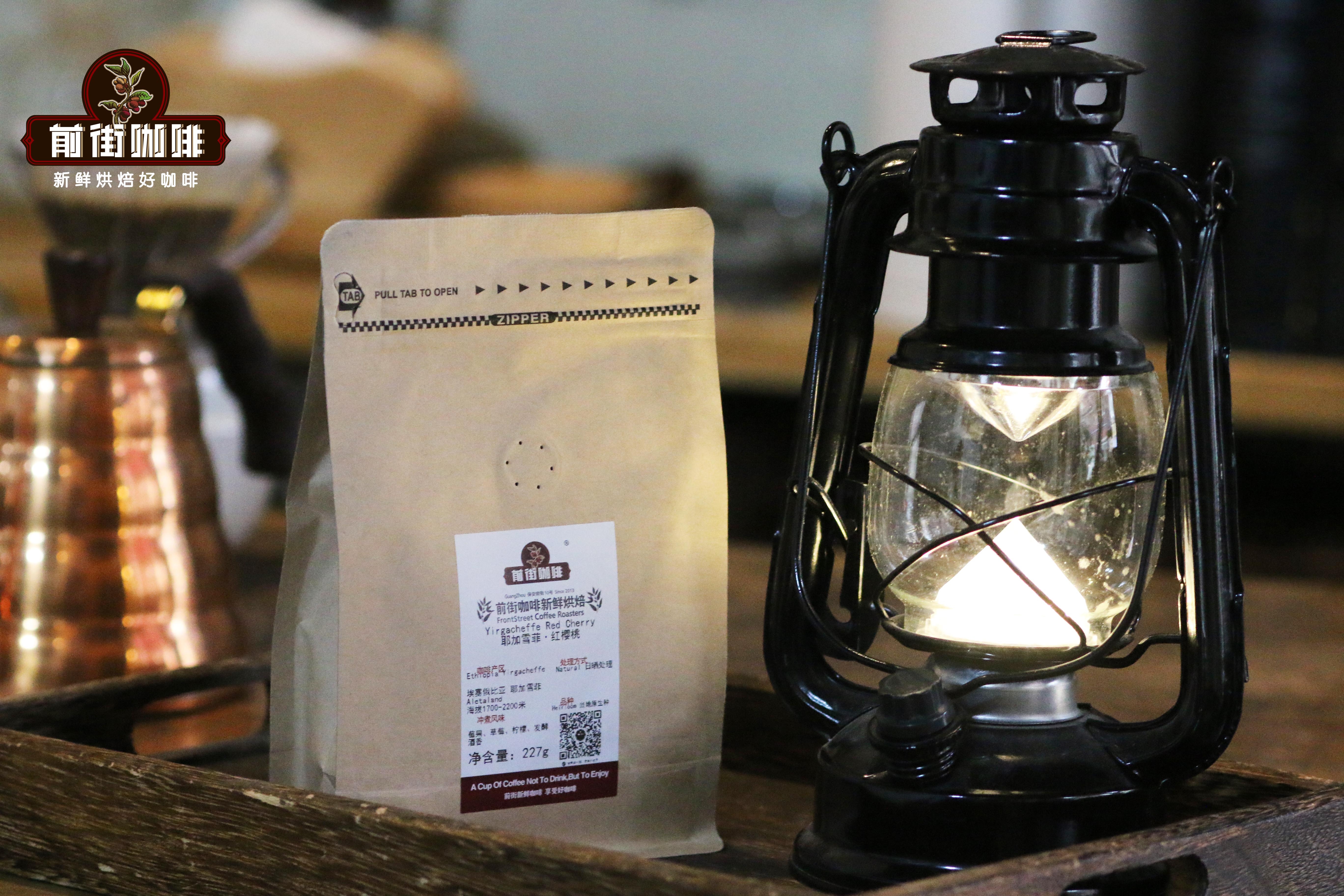
For the natural-process side of the same region, FrontStreet's Red Cherry uses a full-red-cherry natural method, taking only fully ripe, sound cherries. After a first round of sorting they are spread on raised beds to sun-dry, turned every 2-3 hours in the first few days to prevent uneven heating and over-fermentation, and after three to five weeks the dried pulp is removed by machine and the beans are moved into storage. Because the fruit dries on the bean, the cup keeps the classic Yirgacheffe character while adding the tropical fruit of a natural process, with citrus-like acidity, berry juice, honey sweetness, and a creamy smoothness.
Important Notice :
FrontStreet Coffee is a long-established specialty coffee roaster in Guangzhou China, selling freshly roasted beans from its own farm in Yunnan as well as dozens of carefully selected single-origin beans from around the world for both pour-over and espresso. The products deliver consistently excellent quality and great value, with shipping within 24 hours. Guangzhou's FrontStreet Coffee shop is recommended by many coffee lovers, and the beans are now available online at the Tmall 。
FrontStreet Coffee has moved to a new address:
FrontStreet Coffee Address: 315,Donghua East Road,GuangZhou
Tel:020 38364473
 Scan and follow the En Gafei WeChat official account. Please indicate that the reprint comes from "En Gafei".