Introduction to Yirgacheffe Woka Cooperative Coffee Bean Characteristics and Yirgacheffe Coffee Growing Region Distribution

Yirgacheffe is a well-known coffee bean, and for many people it is the entry point into specialty coffee. Mention Yirgacheffe and Sidamo often comes up too, though many drinkers are unsure how the two relate and differ. Both growing regions belong to Ethiopia. Put simply, Sidamo is a province and Yirgacheffe is a town within Sidamo province. Yirgacheffe is a sub-region of Sidamo and one of the highest-altitude coffee growing areas in Ethiopia. Because of its unique flavor, it broke away from Sidamo to form its own style and has become one of Africa's most prestigious producing regions.
While cupping washed Yirgacheffe, FrontStreet Coffee found that its most obvious flavor characteristic is a distinct floral aroma and rich citrus notes. Coffee flavor also varies with brewing temperature, roast level, and other factors, so today FrontStreet Coffee will experiment with Worka.

Bean Information
FrontStreet Coffee: Ethiopia Yirgacheffe Worka
Grade: G1
Variety: Heirloom
Growing Altitude: 1650-1800 meters
Processing Method: Washed

Region Introduction
Yirgacheffe is located in the Gedeo region of southern Ethiopia. This region governs the well-known areas of Yirgacheffe and Kochere, with altitudes ranging from 1700-2100m. It is one of the highest-altitude coffee growing regions in the world and is synonymous with Ethiopian specialty coffee.

In the rift valley, represented by Misty Valley, fog persists year-round, creating a spring-like climate with gentle breezes and cool, humid conditions. Thousands of coffee tree varieties thrive and multiply here, nurturing Yirgacheffe's unique terroir, where floral and fruit aromas intertwine subtly and change unpredictably.
Worka Cooperative
This FrontStreet Coffee bean comes from Ethiopia and is processed by the Worka Cooperative. The Alemayehu Alako farm is a member of the Worka Cooperative. Worka is located in the Yirgacheffe region at an altitude of 1800-2000 meters. The Worka Cooperative was established in 2005 and joined the renowned Yirgacheffe Coffee Farmers Cooperative Union (YCFCU) the same year. It is known for producing high-quality natural-processed Yirgacheffe coffee, and the cooperative has approximately 300 coffee farmers under its umbrella.

Processing Method
This Yirgacheffe Worka coffee from FrontStreet Coffee uses the washed processing method.
Selected coffee cherries are placed in a depulper to remove their skin and pulp. The beans with remaining mucilage are placed in water to ferment for about 24 hours. After fermentation, the parchment-covered beans are moved into flowing water channels to wash away the pulp and mucilage. Once washed, the beans are dried, or dried using drying machines, until moisture content reaches about 12%, and finally the parchment is removed from the green coffee.

Heirloom Varieties
This Worka coffee from FrontStreet Coffee is also of heirloom varieties. Coffee farmers may grow several varieties at once and may select and sell the more outstanding ones separately. What is particularly special about Ethiopia is that here most coffee grows in a wild or semi-wild state in fields, backyards, or under forest. What farmers harvest is actually a large mix of many different natural varieties.
Wild coffee trees especially like to grow under forest. Trees that provide shade for coffee are called shade trees, and this cultivation method is called shade-grown coffee. Its advantage is that it reduces ecological impact, and diverse biodiversity helps suppress pests and diseases. In some regions, local food crops such as bananas are used to shade coffee, serving two purposes at once.

Ethiopia has nearly 2000 recorded coffee varieties, including 1927 native varieties and 128 introduced varieties. Judged by appearance alone, Ethiopian coffee varieties are like a grand garden with everything: long, short, thin, and fat.
Ethiopia (Graded by Defect Bean Percentage)
Before the establishment of the Ethiopia Commodity Exchange (ECX), Ethiopia's coffee export grades were set by the CLU department (Cupping and Liquoring Unit) under the Ministry of Agriculture, mainly grading green coffee beans by the number of defect beans in a 300g sample. The grading standards are as follows.
| Grade | Number of Defect Beans (per 300g) |
|---|---|
| Grade 1 | ~3 |
| Grade 2 | 4-12 |
| Grade 3 | 13-25 |
| Grade 4 | 26-45 |
| Grade 5 | 46-90 |
Generally, washed processed beans fall into G1-G2. Because of technical issues with natural processing at the time, natural-processed green beans had more defects and typically landed in G3-G5. With improvements in natural processing technology, today's natural-processed beans can also achieve G1-G2 grades.

After the establishment of the ECX in 2008, coffee began to be graded using a combination of physical attributes and cupping flavor characteristics.
The ECX defines all coffee into three types by processing method (unwashed and washed):
a. Specialty - few defects, high cupping quality
b. Commercial - does not reach specialty grade, but higher than domestic consumption grade
c. Local/Domestic - many defect beans (unripe), off-season, and poorly stored, resulting in relatively poor flavor
Among these, Specialty and Commercial are for export to international markets. The ECX divides green coffee beans into nine grades based on the total score of physical attributes and cupping characteristics, where physical characteristics account for 40% and cupping quality for 60%.
Physical Characteristics (40%):
Washed processing: Defect count (20%), Appearance size (10%), Color (5%), Odor (5%)
Unwashed processing: Defect count (30%), Odor (10%)
Cupping Quality (60%)
| Grade | Score | Washed | Unwashed |
|---|---|---|---|
| Grade 1 | 91-100 | 91-100 | 91-100 |
| Grade 2 | 81-90 | 81-90 | 81-90 |
| Grade 3 | 71-80 | 71-80 | 71-80 |
| Grade 4 | 63-70 | 63-70 | 63-70 |
| Grade 5 | 58-62 | 58-62 | 58-62 |
| Grade 6 | 50-70 | 50-70 | 50-70 |
| Grade 7 | 40-49 | 40-49 | 40-49 |
| Grade 8 | 31-39 | 31-39 | 31-39 |
| Grade 9 | 20-30 | 20-30 | 20-30 |
G1-G3 are then cupped again according to SCAA standards for a more detailed evaluation of flavor attributes. G1 and G2 scoring no less than 85 points are rated Q1; G1, G2, and G3 scoring between 80 and 85 points are rated Q2; all G1, G2, and G3 scoring below 80 points are rated G3. Q1 and Q2 are classified as specialty grades for export. G4-G9 keep their original grading and are classified as commercial grades for export along with G3.
Roasting Recommendations
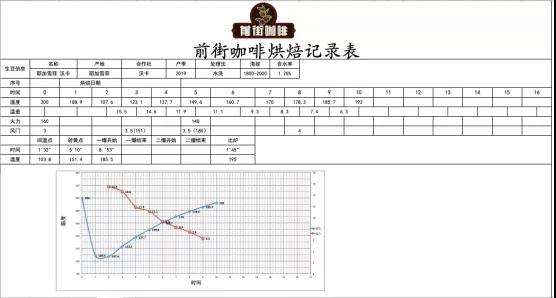
The acidity of Yirgacheffe is its defining feature. To highlight it, FrontStreet Coffee's roaster recommends a light roast.
The rise in temperature is relatively gentle, with a roasting time of a little over 10 minutes, giving enough time and temperature for dehydration so that chlorogenic acid can degrade. If degradation is insufficient, the coffee tastes sharp and acidic, uncomfortable on the tongue and somewhat rough. Continuing to apply heat after first crack also allows the caramelization reaction to continue, producing caramel and other sweet flavors. The sweetness becomes more solid and substantial, while the bright fruit acidity is slightly diminished.
FrontStreet Coffee tested different water temperatures for brewing Yirgacheffe Worka G1 (light roast), presenting different flavors while keeping the other parameters consistent.
Three water temperatures were selected: 86°C, 90°C, and 94°C. Other parameters were kept as consistent as possible, using a Hario V60 dripper, a water-to-coffee ratio of 1:15, 15g of coffee, and a grind size of EK43s setting 10 (Chinese standard #20 mesh sieve pass rate 80%).
The brewing technique was also kept consistent, using a segmented extraction method: 30g of water for a 30s bloom, a small circular pour to 125g, then continuing to 225g when the water level drops to just before exposing the coffee bed, with an extraction time of 2 minutes (timing starts from the bloom).
[86°C Pour-over Flavor]
Entry shows lemon and a tea-like quality. Acidity is obvious, the mouthfeel is round, and the overall layers are relatively thin.

[90°C Pour-over Flavor]
Entry shows lemon, plum, and Tieguanyin tea. Caramel flavors become obvious with temperature change, acidity is bright, and the aftertaste is distinct.

[94°C Pour-over Flavor]
Entry shows lemon and berry notes. Acidity is obvious, body and thickness are enhanced, and the tea-like quality is rich.

From the above, 90°C best represents the bright fruit acidity and refreshing tea quality of Yirgacheffe Worka coffee beans. At 86°C the layering is weak and the flavors are not prominent enough, while 94°C, though it enhances body, lacks brightness in the acidity.
FrontStreet Coffee Recommendation
For anyone new to the Ethiopia region, FrontStreet Coffee suggests starting with the most classic washed Yirgacheffe everyday bean. It is known for white jasmine, bright citrus and lemon acidity, and a tea-like quality, and its friendly price makes it the go-to first specialty bean for many drinkers. Yirgacheffe is a small town in Ethiopia's Sidamo province at roughly 1,700-2,100 meters, and coffee trees are planted above 1,800 meters, making it one of the highest coffee regions in the world. Its characteristic white floral aroma and lemon-citrus acidity have made the name a byword for Ethiopian specialty coffee.
Once you want to go deeper, try FrontStreet Coffee's washed Gediding Cooperative coffee. Yirgacheffe town can be divided into many small areas and villages, some with experienced cooperatives and mature techniques that take the flavor a step further, and the Gediding village cooperative is the most representative. It sits in the Woka area at the southeastern edge of Yirgacheffe, once part of the Woka cooperative under the Yirgacheffe Coffee Farmers Cooperative Union (YCFCU) before being singled out as a single origin by coffee hunters around the world for the sake of traceability. It follows the most traditional washed process and is known as one of the last pristine corners of Yirgacheffe: no traditional bitterness, but fresh, bright citrus and lemon acidity with jasmine fragrance.
For a fruitier profile, FrontStreet Coffee's natural Red Cherry comes from the same region and uses a whole-cherry natural process, picking only fully ripe, unblemished cherries. After a first round of sorting at the processing station, the cherries are spread directly on raised beds to dry, turned once every 2-3 hours over the first few days to prevent uneven heat and over-fermentation. After three to five weeks, the outer fruit is scraped off by machine according to the weather and temperature and the beans are moved to storage. Dried with the fruit intact, the coffee keeps the typical Yirgacheffe character while adding tropical fruit: citrus-like acidity, a berry-juice body, honey sweetness, and creamy smoothness.
Important Notice :
FrontStreet Coffee is a long-established specialty coffee roaster in Guangzhou China, selling freshly roasted beans from its own farm in Yunnan as well as dozens of carefully selected single-origin beans from around the world for both pour-over and espresso. The products deliver consistently excellent quality and great value, with shipping within 24 hours. Guangzhou's FrontStreet Coffee shop is recommended by many coffee lovers, and the beans are now available online at the Tmall 。
FrontStreet Coffee has moved to a new address:
FrontStreet Coffee Address: 315,Donghua East Road,GuangZhou
Tel:020 38364473
 Scan and follow the En Gafei WeChat official account. Please indicate that the reprint comes from "En Gafei".