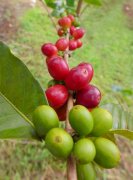
How to Properly Enjoy Costa Rica Tank Manor and the Price of Vera Sarachi Coffee Beans

Costa Rica Coffee: SHB Grading and Growing Conditions
Costa Rica grades its finest coffees as "Strictly Hard Bean" (SHB), with Hard Bean (HB) and Semi-Hard Bean (SH) following in descending order of quality. Strictly Hard Beans are grown at altitudes above 1500 meters, and altitude has always been the clearest marker of quality here: the higher the farm, the better the cup. Steep elevation changes also bring abundant rainfall, which suits the coffee trees well. Because nights at high altitude are cold, the trees grow more slowly, giving the cherries extra time to accumulate nutrients, and that slow ripening translates directly into richer, denser flavor in the cup.
Brewing: Villa Sarchi as a Pour-Over
To brew Villa Sarchi as a pour-over, use 15g of coffee ground to a medium grind size, a V60 dripper, and water at 88-89°C. Start with a 30g bloom and let it rest for 27 seconds, then pour up to 105g and stop. Once the water level drops to roughly half, pour again, slowly working up to a total of 225g and leaving the last of the drawdown untouched. The water-to-coffee ratio is 1:15, with a total extraction time of about 2 minutes.
Famous Growing Regions and the Natural Process
Costa Rica's three most celebrated growing regions are Tarrazú, south of the capital San José, along with the Central Valley and the West Valley. Natural (dry) processing is the most traditional method of all and requires the fewest external resources, yet it is genuinely difficult to execute well because so many variables are beyond the producer's control. Producers like Francesca have introduced real innovations here, for example, borrowing the Brix meter from the wine industry to measure the sugar content of the fruit and deciding the ideal harvest moment and processing route from those readings. Only cherries exceeding 20% sweetness are selected for natural processing. For reference, ordinary fruits typically measure around 14 Brix for apples, 12 for lemons, and 18 for passion fruit, whereas the coffee cherries at La Hajas can reach 21-22%. La Hajas produces natural and honey coffees as well as washed lots, and its varietal lineup includes Caturra, Catuai, and Villa Sarchi, plus small amounts of Kenyan varieties such as SL28 and Obata.
Natural processing is genuinely labor-intensive. Hand-picked, high-sugar cherries are first laid out on African raised beds to sun-dry for about 10 days, then moved into a greenhouse covered with plastic sheeting, where trapped heat continues the drying until the moisture content falls to 11.5%. Drying slowly lets the green beans develop sweetness from within, but it demands constant attention and careful calculation of how often to turn the fruit. When the bright red cherries finally turn black and give off aromas of fruitcake, caramel, and even sherry, the process is complete.
Flavor Profile
Flavor: Lime, caramel, nuts
Mouthfeel: Excellent sweetness, gentle fruity acidity, round and full-bodied with a persistent finish
The Villa Sarchi Variety
Villa Sarchi originated in Costa Rica as a Typica-derived variety. Like Typica, its branches form a 60-degree angle with the trunk and its young leaves are bronze-colored. The variety performs especially well at high altitude, has strong wind resistance, tolerates poor soils, and thrives even better when grown under shade trees. Its most prominent cup characteristic is outstanding sweetness paired with lively, beautiful acidity.
Coffee Details
Costa Rica West Valley Monte Solis El Tanque Villa Sarchi Natural
Country: Costa Rica
Grade: SHB
Region: Central Valley
Roast Degree: Medium roast
Processing Method: Natural
Variety: Villa Sarchi
Estate: El Tanque Estate
Flavor: Lime, caramel, nuts
FrontStreet Coffee Recommendation
If you enjoy the caramel sweetness and nutty depth of this Costa Rican natural, FrontStreet Coffee's Brazil Queen's Estate (Fazenda Rainha) is an easy next step. It shows very low acidity with a smooth, balanced body: rich nut and cocoa aromas, a clear caramel sweetness, and a soft, lingering finish with no astringency. It is the baseline choice for classic, everyday coffee, comfortable as a pour-over, as espresso, or even brewed in a moka pot, and its excellent crema makes it a favorite among drinkers who prefer fuller, heavier cups without sharp acidity.
For brewing gear, the Hario V60 remains the go-to dripper for coffee lovers starting out in pour-over: its 60-degree cone and single large outlet let flow speed depend entirely on your pouring control, which brings out cleaner sweetness and layered aroma. To taste this Costa Rica Villa Sarchi at its best, follow the recipe above, 15g of medium-ground coffee, a 30g bloom for 27 seconds, water at 88-89°C, a 1:15 ratio, and a total pour of 225g in about two minutes.
Important Notice :
FrontStreet Coffee is a long-established specialty coffee roaster in Guangzhou China, selling freshly roasted beans from its own farm in Yunnan as well as dozens of carefully selected single-origin beans from around the world for both pour-over and espresso. The products deliver consistently excellent quality and great value, with shipping within 24 hours. Guangzhou's FrontStreet Coffee shop is recommended by many coffee lovers, and the beans are now available online at the Tmall 。
FrontStreet Coffee has moved to a new address:
FrontStreet Coffee Address: 315,Donghua East Road,GuangZhou
Tel:020 38364473
 Scan and follow the En Gafei WeChat official account. Please indicate that the reprint comes from "En Gafei".