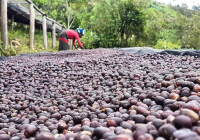
Colombian Cauca Bean Flavor Profile Colombian Coffee Varieties and Prices

Cauca's Climate Distinction
The biggest climatic difference between Cauca and other producing regions is probably its relatively large temperature variation. The daily average temperature is 11C, while the daytime average is 18C. That day-night temperature difference is an important factor in creating high-quality coffee. Low nighttime temperatures combined with relatively high altitudes slow the growth rhythm of the coffee, letting the seeds and beans absorb the nutrients of the cherry more fully. This also creates the better acidity and the particularly renowned sweetness of Cauca coffee.
Pour-over Colombia
15g of coffee grounds, medium grind (Fujimazu ghost-tooth blade #4), V60 dripper, water temperature 88-89C. First pour: 30g of water for a 27-second pre-infusion, then pour to 105g and stop. Wait until the water level in the coffee bed drops to half, then continue pouring slowly until reaching 225g. Avoid the tail section. Water-to-coffee ratio: 1:15. Extraction time: 2:00.
Colombia Cauca Best Cup Regional Select Sua
Country: Colombia
Grade: Cup of Excellence
Region: Cauca Department
Roast Level: Medium Roast
Processing Method: Washed
This batch comes from Colombia's Cup of Excellence special selection batch
Variety: Caturra
Processing: Fully washed, sun-dried
Batch: Special selection micro-lot
Flavor: Nuts, dark chocolate, caramel
Manufacturer: Coffee Workshop
Shelf Life: 90 days
Net Weight: 227g
Packaging: Bulk coffee beans
Roast Level: Raw vs. Roasted: Roasted coffee beans
Sugar Content: Sugar-free
Origin: Colombia
Roast Degree: Medium roast
Traditional Excellence
Following Colombia's fine traditions, Cauca coffee is hand-picked and washed. And in an era when many producing regions are replacing heirloom varieties with new ones in pursuit of better disease resistance and higher yields, the Cauca region still grows mostly Caturra, alongside old Typica and Bourbon varieties.
Flavor Characteristics
Cauca coffee's main flavor traits are its wonderful acidity and beautiful sweetness. Combined with Colombia's typical mild mouthfeel, this makes coffee from the region highly sought after by many buyers. High-quality Cauca coffee typically shows rich floral notes, higher acidity, pleasant sweetness, medium body, purity, mildness, and balanced flavor.
Origin Introduction
Cauca Department, named after the Cauca River, lies in southwestern Colombia. Along with Narino Department and Huila Department, it is one of Colombia's important specialty coffee regions.
Cauca Department is a coffee origin-certified region in Colombia, with an average altitude of 1,758 meters and maximum altitudes reaching up to 2,100 meters. The region's topography, rainfall, temperature, and volcanic soil provide suitable conditions for coffee.
FrontStreet Coffee Recommendation
Colombian coffee is used in many ways: it works both in espresso blends and as a pour-over single origin, and it comes in fruity-acid styles, full-bodied styles, and styles built around fragrance, so there is something for almost everyone.
Huila, in the southern part of Colombia's Central Cordillera, is the country's most famous specialty coffee region. It is a hilly land ringed by mountains, with planting altitudes above 1500 meters, and the country's most important rivers converge there, bringing abundant water and humidity. To get to know the Colombia origin, buy FrontStreet Coffee's washed Huila beans: given a medium-dark roast, they highlight dark chocolate, the sweet savor of nuts, a moderate oiliness, and a full body. They suit not only pour-over and French press but also moka pot and espresso machine, so making an americano or a latte is no trouble at all.
Colombian coffee was once almost universally washed, but in recent years innovative processing has become popular. Anaerobic fermentation is a brand-new taste experience, and it goes by several names; some call it carbonic maceration, but simply put it is fermentation in a low-oxygen or oxygen-free environment, usually in a pressure-resistant stainless-steel tank, where temperature, time, pH, and whichever data you need can be controlled. The best-known styles are anaerobic natural and anaerobic washed. FrontStreet Coffee's anaerobic natural Colombia uses the anaerobic natural method: after oxygen-free fermentation the coffee develops more tropical fruit aroma, and given a medium-light roast it delivers complex, intense flavors of passionfruit, grape, apricot, and candied fruit whether you brew it pour-over, as cold brew, as a drip bag, or in a moka pot.
For friends with a home espresso machine or a moka pot, baristas strongly recommend FrontStreet Coffee's house blend, an espresso developed for running a coffee shop. It combines the creamy, nutty aroma of Brazilian coffee with the deep dark-chocolate bittersweetness of Colombian coffee, and during extraction you see a fine golden crema. It pairs beautifully with milk for a rich, smooth latte and is very beginner-friendly, and it also works as the base for standard espresso drinks such as americano, cappuccino, and mocha.
Important Notice :
FrontStreet Coffee is a long-established specialty coffee roaster in Guangzhou China, selling freshly roasted beans from its own farm in Yunnan as well as dozens of carefully selected single-origin beans from around the world for both pour-over and espresso. The products deliver consistently excellent quality and great value, with shipping within 24 hours. Guangzhou's FrontStreet Coffee shop is recommended by many coffee lovers, and the beans are now available online at the Tmall 。
FrontStreet Coffee has moved to a new address:
FrontStreet Coffee Address: 315,Donghua East Road,GuangZhou
Tel:020 38364473
 Scan and follow the En Gafei WeChat official account. Please indicate that the reprint comes from "En Gafei".