Introduction to Grind Size, Roast Level, and Processing Methods for Paradise Bird Estate Specialty Coffee Beans with Slight Off-Flavors

FrontStreet Coffee suspects this might be a country few people can place on a map, let alone associate with coffee. Papua New Guinea is a small producer, but its coffee quality deserves far more attention than it gets. The most famous offering is PNG AA: a rich, mellow cup with a pleasing aroma, fruit-like sweetness, and a layered, full-bodied taste. Scarce production has pushed prices steadily upward. FrontStreet Coffee carries these beans precisely because they are so representative — the country's top coffee is as striking and precious as its national bird.
Papua New Guinea: Origin and Characteristics
Papua New Guinea is an island nation in the western South Pacific and a member of the Commonwealth. The country's name joins two parts, Papua and New Guinea, and its territory spans roughly 600 islands of various sizes. It borders Indonesia, with Australia to the south. Although tied to the Asia-Pacific sphere, it is geographically an Oceanian nation. The tropical climate brings high temperatures and abundant rainfall, and the volcanic soil is exceptionally fertile. Papua New Guinea is rich in natural resources, yet its economy remains underdeveloped — it ranks among the world's least developed countries. Many mountain communities still live a self-sufficient tribal life, with only the coastal areas relatively more developed. Farms are often carved out of forest land, some lying so deep in the interior that they are nearly cut off from the outside world. As a result, the country has few large plantations: roughly 75% of its coffee comes from small local farms.
Flavor Profile
Papua New Guinea coffee offers high sweetness, a bright, uplifting apricot-like acidity, a balanced and fairly full body, and an overall elegant, clean smoothness with fruit aromatics. Coffees with lively acidity rarely also deliver real body, but the rare virtue of Papua New Guinea coffee is that it manages both a refined medium acidity and an excellent body, finishing with a long aftertaste.
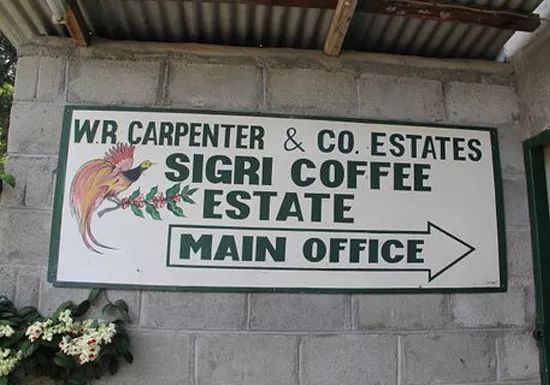
Sigri Estate
Sigri Estate is better known in the market as Paradise Bird Estate, and FrontStreet Coffee uses that name partly because it is the more familiar one, and partly because "Paradise Bird" simply sounds more inviting. Founded in 1950, the estate has operated for more than 60 years and is a pioneer of the local coffee industry. It sits in the Waghi Valley of the Western Highlands Province, in mountain terrain at around 1,500 meters above sea level, with mineral-rich volcanic soil, a cool climate, fertile ground, and plentiful rainfall. Over the decades the estate has maintained consistently high standards in cultivation and processing. During the April-to-September harvest, only fully ripe red cherries may be hand-picked, guaranteeing the ideal balance of acidity and sweetness in the fruit. Cupping takes place daily to ensure the plantation delivers dependable, premium quality — which has made Paradise Bird Estate a classic of specialty coffee. At peak harvest the estate can employ around 6,000 workers, half of whom live and eat in the plantation's own staff housing; it also runs a free clinic and primary schools for employees' children.
Processing Method
After picking, the ripe red cherries go straight to the estate's own washing station. Washing in Papua New Guinea differs from the version practiced in Central and South America: the cherries undergo three fermentation washes, each soak lasting about 24 hours, with fresh water replaced each time to steer the flavor. After washing, the parchment is milled off the green beans and the lots are graded — AA, AB, PB (peaberry), and so on. This meticulous finishing gives the coffee its bright, delicate fruit acidity and clean, lingering sweetness. FrontStreet Coffee has noticed that regions with strict grading systems share one trait: uniform bean size and very few defects. Such beans color evenly in the roaster and taste far cleaner. The clearest comparison is Indonesian Lintong Mandheling versus Golden Mandheling — Golden Mandheling is sorted with extreme strictness, its beans are remarkably uniform, and its cup cleanliness is noticeably superior.
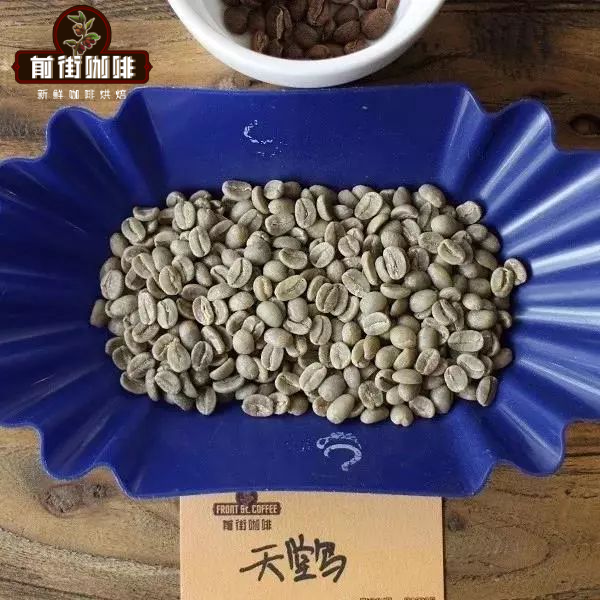
Papua New Guinea Paradise Bird Coffee Bean Specifications
Estate: Paradise Bird Estate
Variety: Typica
Grade: AA
Altitude: 1600-1800 meters
Processing Method: Washed
FrontStreet Coffee Paradise Bird Coffee Bean Roasting Recommendations
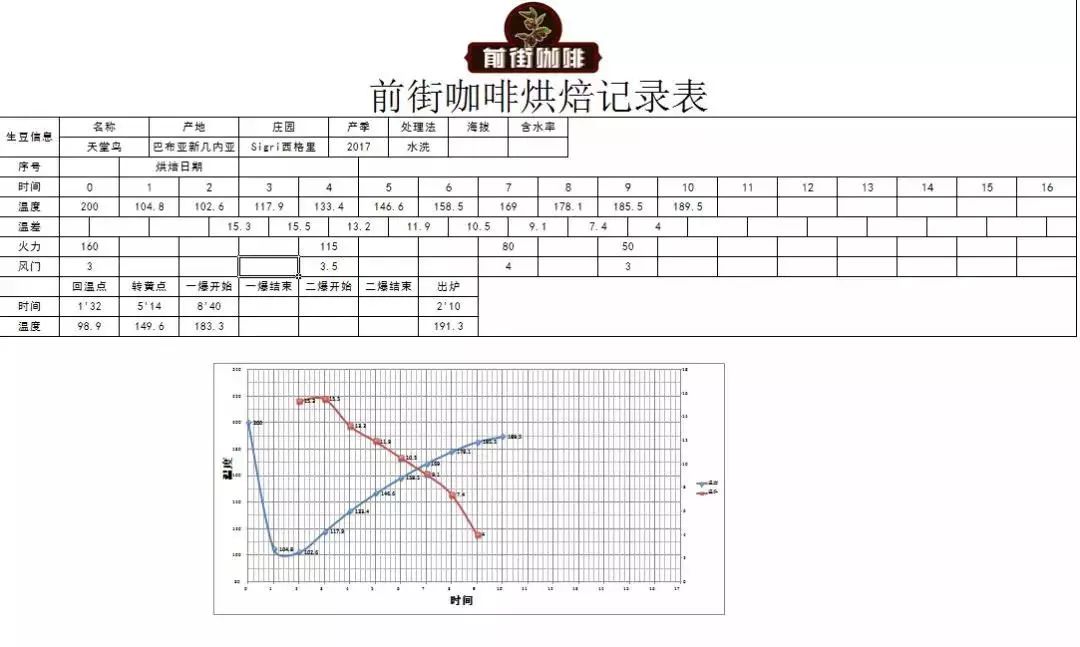
FrontStreet Coffee Paradise Bird Coffee Bean Roasting Curve
FrontStreet Coffee recommends a medium roast, because Typica beans are relatively low-density and unsuited to dark roasting. To highlight the coffee's natural refreshing acidity and fruit aromas, heat management after first crack is the critical stage. Start by assessing the green beans, then decide the approach: this is a washed, low-density bean with 10% moisture and a 17-year crop age. Charge temperature is set according to the current state of the greens.
On a Yangjia 800N with a 550g batch: charge the beans when the drum reaches 200°C, with the damper at 3. After 1 minute, turn the heat down to 160°C, damper unchanged. When the drum reads 160°C, reduce heat again to 115°C. Roast to 5'35" at 152°C, when the beans yellow and the grassy smell has fully faded — drying is complete; raise the damper to 4. At the 9-minute mark, wrinkles and small dark spots appear on the bean surface and the toast aroma clearly turns to coffee aroma — the prelude to first crack. Listen carefully for the crack itself. First crack begins at 8'40"; hold the small heat unchanged and open the damper fully to 5 (heat must be handled very carefully at this stage — not so low that the crack stalls). Drop the beans at 191.3°C.
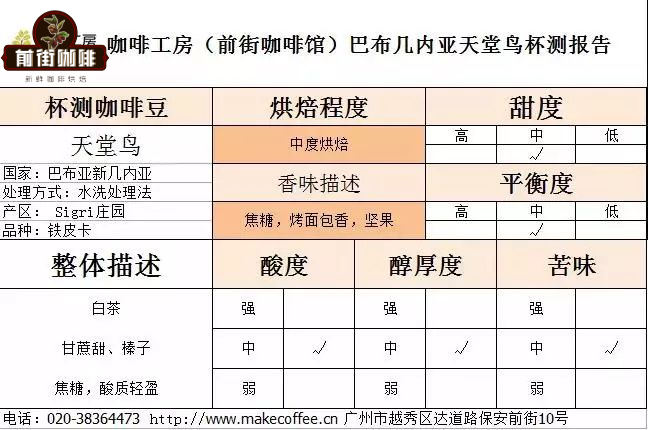
FrontStreet Coffee Paradise Bird Coffee Bean Cupping Report
FrontStreet Coffee Paradise Bird Coffee Bean Brewing Recommendations
FrontStreet Coffee recommends a Kono dripper, whose few ribs sit at the bottom so the filter paper hugs the walls closely, restricting airflow. This slows the flow and lengthens water-to-coffee contact, drawing out more soluble material through near-immersion and enriching the body. The water temperature should be 88°C — deliberately low, to avoid pulling undesirable flavors from the beans, since darker roasts carry more of them. Use 15 grams of coffee at a 1:15 coffee-to-water ratio, ground to a particle size that gives an 80% pass rate on the Chinese standard #20 sieve. Pour in segments: 30g of water for a 30-second bloom, then small circular pours to 125g. When the water level drops and the coffee bed is about to be exposed, pour again to 225g and stop. (Timing starts from the bloom.) Total extraction time is 2 minutes.
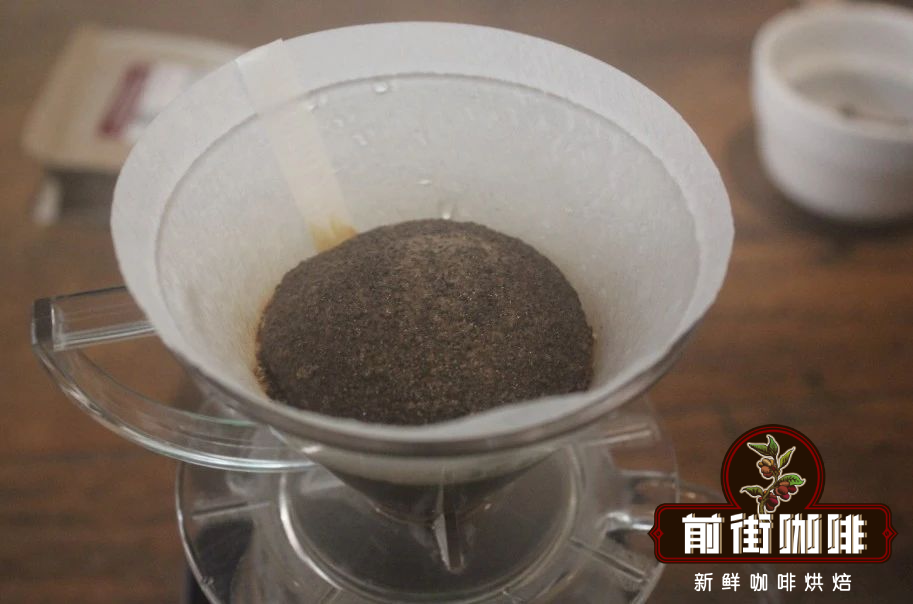
FrontStreet Coffee Paradise Bird Coffee Brewing
Flavor Description
Toast sweetness, nutty sweetness, and a light fruit acidity stack into a pleasant, layered cup with fruit aromatics. The spiced sweetness in the aftertaste is distinctive, and the body is rich and balanced.
FrontStreet Coffee Recommendation
As for top-tier Indonesian coffee, FrontStreet Coffee's PWN Golden Mandheling is the one to reach for. PWN is a trading company specializing in premium Mandheling lots from Sumatra, and "Golden Mandheling" is its flagship: the beans pass strict sorting standards covering density, size, shape, and color, with machine sorting plus repeated hand selection to remove defects. The result is whole, even, luminous beans with far less of the earthy, grassy edge typical of the region.
Freshly roasted, FrontStreet PWN Golden Mandheling offers sandalwood, herbal, and spice notes alongside roasted hazelnut, caramel, and dark chocolate. The cup is clean, sweet, and full-bodied with remarkably rich layers — a superb daily drinker and a generous gift for friends and family.
Important Notice :
FrontStreet Coffee is a long-established specialty coffee roaster in Guangzhou China, selling freshly roasted beans from its own farm in Yunnan as well as dozens of carefully selected single-origin beans from around the world for both pour-over and espresso. The products deliver consistently excellent quality and great value, with shipping within 24 hours. Guangzhou's FrontStreet Coffee shop is recommended by many coffee lovers, and the beans are now available online at the Tmall 。
FrontStreet Coffee has moved to a new address:
FrontStreet Coffee Address: 315,Donghua East Road,GuangZhou
Tel:020 38364473
 Scan and follow the En Gafei WeChat official account. Please indicate that the reprint comes from "En Gafei".