The Enduring Charm of Blue Mountain Premium Coffee Beans: A Cultural and Historical Journey

The endless aroma of coffee soothes the weary hearts of working people everywhere. But while many of us drink it daily, how many truly know what separates Blue Mountain coffee from an American coffee? Let FrontStreet Coffee explain the difference.
FrontStreet Coffee's Blue Mountain Coffee Origin
FrontStreet Coffee's Blue Mountain coffee comes from the eastern mountain ranges of Jamaica. The name "Blue Mountain" describes a spectacular natural phenomenon: the Caribbean Sea surrounds the entire range, and on clear days the sun strikes the water so that the sea's blue glow reflects onto the mountains, staining them their distinctive blue.

The Blue Mountains sit squarely in the coffee belt. Beyond ideal elevation, the range offers fertile volcanic soil — perfect for coffee — and its microclimate may be the decisive factor: the region is humid year-round, wrapped in fog and rain, with average annual precipitation of 1,980 millimeters.

Blue Mountain Coffee Cultivation History
Coffee arrived in Jamaica in the 18th century. In 1717, French King Louis XV ordered coffee planted on the island; by the mid-1720s, Governor Sir Nicholas Lawes had imported Arabica seeds from Martinique and begun promoting cultivation in the St. Andrew region — still one of Jamaica's three Blue Mountain regions today, alongside Portland and St. Thomas. Within 8 years, Jamaica was exporting over 375 tons of pure coffee.

Production peaked in 1932 at more than 15,000 tons. In 1950, the Jamaican government established the Coffee Industry Board, which sets and enforces the country's coffee quality standards — granting official seals to exported raw and roasted Jamaican coffee and ranking among the world's most rigorous national coffee institutions.
Six official marks may today represent Blue Mountain coffee's origin: Mavis Bank Central Factory (MBCE), Mavis Hill Coffee Co-operative (MHCCT), Portland Blue Mountain Coffee Co-operative (PXXSH), Coffee Industry Board (Wallenford), Coffee Industry Board (Jamaica Select), and JAS. By 1969, Japanese loans had financed quality upgrades and stabilized the market, and the coffee now enjoys near-reverent status.

By 1981 Jamaica had cleared an additional 1,500 hectares for coffee, followed by investment in another 6,000 hectares. The true Blue Mountain region, though, remains small — only 6,000 hectares under cultivation — which is why coffee labeled "Blue Mountain" can't all possibly come from there.
Jamaica is also the last country to pack and ship coffee in wooden barrels. Only lots passing the Coffee Industry Board's stringent standards receive the government certificate of authenticity and the right to the "Blue Mountain" name.

Blue Mountain Coffee Flavor Profile
So what makes the flavor so special? FrontStreet Coffee's Blue Mountain beans are exceptional quality, producing a remarkably clean cup. At medium-dark roasts, Blue Mountain shows a balanced sweet-sour-bitter profile with subtle nutty and chocolate notes and a remarkably pleasant aftertaste — available in our Tmall and Taobao stores. It represents the highest quality of an entire era and has truly earned the title "King of Coffee."
That consistency comes from decades of strict export control. What we call Blue Mountain coffee is, as of 2020, a Typica variety processed by the washed method — the most stable and efficient of the traditional techniques. Cherries are floated immediately after harvest, then machine-depulped; fermentation removes the mucilage, after which the beans' moisture drops sharply, shortening sun-drying and cutting the defect rate.

Mature washed processing gives Blue Mountain its clean taste and gentle acidity. Holding to Typica is the other half of the formula: Typica may be the oldest Arabica variety, with more refined flavors than its rivals — but its weaknesses are equally clear, with low disease resistance and very low yields. In yield-driven producing countries it would long ago have been replaced by Caturra or Catuai.

Types of Blue Mountain Coffee
Jamaican Blue Mountain region coffee has three grades: Blue Mountain Coffee, Jamaica High Mountain Supreme Coffee Beans, and Jamaica Prime Coffee Beans. Blue Mountain and High Mountain each split into two sub-grades — in descending order of quality: Blue Mountain No. 1, Blue Mountain No. 2, High Mountain No. 1, High Mountain No. 2, and Jamaica Prime Coffee.

Blue Mountain Grading System
In the grading system, the entire Blue Mountain range reaches 2,256 meters, with areas above 1,700 meters designated as natural ecological reserves where coffee cultivation is prohibited. Under CIB's classification, only coffee grown between 910 and 1,700 meters elevation can be called "Jamaican Blue Mountain Coffee." Coffee grown between 460 and 910 meters can only be called "Jamaica High Mountain Coffee," while coffee below 460 meters is called "Jamaica Prime Coffee."
Jamaican coffee, then, does not automatically mean Blue Mountain coffee. Even today, only coffee from those 6,000 hectares above 910 meters in the Blue Mountain range may carry the name; the other roughly two-thirds of the region's output is classified as High Mountain or Prime coffee.
FrontStreet Coffee's Jamaica Blue Mountain No. 1 Coffee Brewing Guide

FrontStreet Coffee's Jamaica Blue Mountain No. 1 Coffee Beans
Origin: Jamaica Blue Mountain
Estate: Clifton Farm
Altitude: 1,310 meters
Processing Method: Washed processing
Variety: Typica
Roast Level: Medium-dark roast
Flavor Profile: Chocolate, nuts, cream, balanced sweet-sour-bitter profile.
Clifton Hill is Jamaica's oldest coffee-producing area still in normal operation today, and only Clifton Farm in Jamaica has the "Rainforest Alliance" certification. The Blue Mountain region is a small area with only 6,000 hectares of cultivation, making it impossible for all coffee labeled "Blue Mountain" to be grown there.

Clifton Farm is the largest estate in this region, though by international standards, it's still considered small-scale cultivation. Many estate owners are small landholders whose families have worked this land for two centuries. This area is recognized as an exceptionally high-quality Blue Mountain coffee-producing region known worldwide.
FrontStreet Coffee Recommendation
For many coffee lovers, Blue Mountain is the one name you simply can't avoid — in the years before specialty coffee went mainstream, "treating someone to Blue Mountain" was shorthand for the finest coffee there was, and even today it occupies a place no other origin can replace. Strictly speaking, only coffee grown in the designated zone of Jamaica's Blue Mountains and certified by the Jamaican authorities deserves the name Jamaica Blue Mountain Coffee: the range, one of the tallest in the Caribbean at 2,256 meters, is wrapped in year-round mist, and its high altitude, fertile volcanic soil, even rainfall, and mild climate stretch the cherries' ripening so sugars and flavor compounds accumulate slowly. Scarcity does the rest — annual output from the whole region falls short of 2,500 tons, and Japan has historically bought more than seventy percent of it.
Blue Mountain's genius is balance. It has no weak note: neither the aggressive fruit acidity of some African coffees nor the heavy bitterness of a dark roast, but a near-perfect harmony of acid, sweet, bitter, and aromatic — cream, caramel, chocolate, nuts, honey, and the faintest fruit tones, soft and round on entry, richly sweet through the middle, clean and long at the finish. Professionals call it "the specialty coffee easiest for almost anyone to love," and with its Typica variety, washed processing, and rigorous certification, that consistency has held for generations.
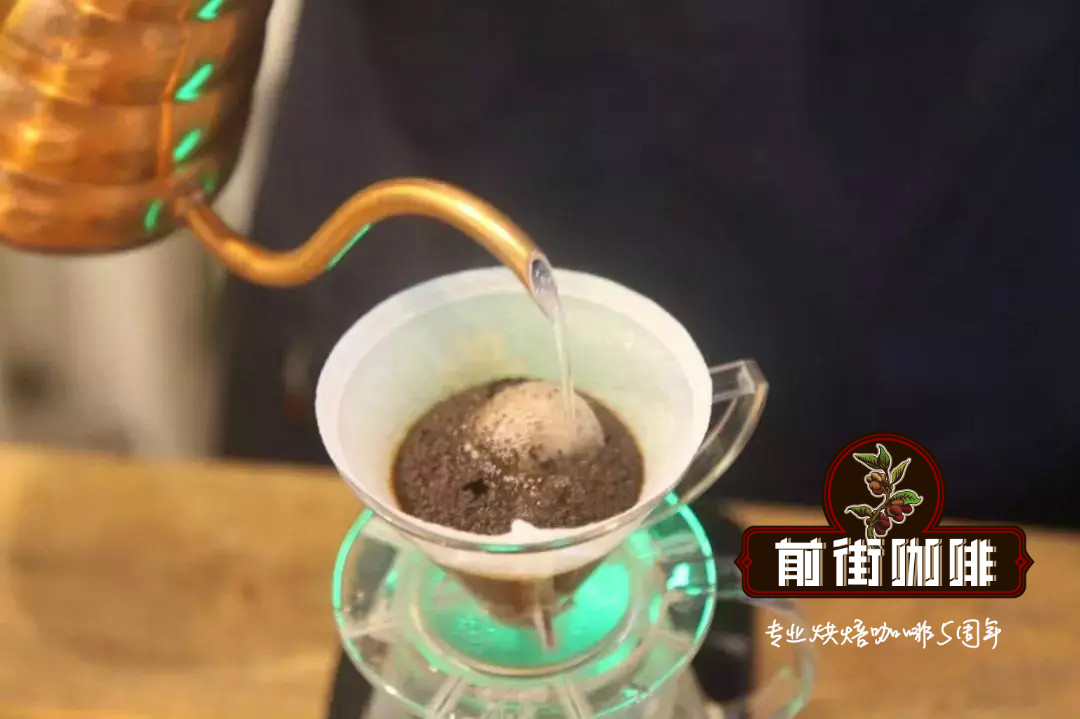
To brew it as it deserves, FrontStreet Coffee suggests a Kono dripper to emphasize that famous body: a 1:15 ratio, 15g of coffee rested 4–7 days from roast date, water at 87–88°C (overly hot water is the usual culprit behind scorched, bitter cups), and a grind slightly coarser than light-roast beans — roughly white sugar. Pour three stages: 30g to bloom for 30 seconds, then to 120g with a slow, vertical, small-circle pour; finish to 225g, moving a little faster to keep fines from clogging the dripper and over-extracting the tail. Rest days aside, our beans ship within 5 days of roasting, so they reach you at full flavor. And when you buy, verify: genuine Blue Mountain carries export certificates and origin documents, travels in the traditional wooden barrels (15, 45, and 70kg), and the green beans are plump, even, slightly upturned at both ends, and green in color. FrontStreet Coffee's Jamaica Blue Mountain No. 1 — Clifton Farm, 1,310 meters, certified, with original barrels on display — is the real thing, ready to prove why this legend has never faded.
Important Notice :
FrontStreet Coffee is a long-established specialty coffee roaster in Guangzhou China, selling freshly roasted beans from its own farm in Yunnan as well as dozens of carefully selected single-origin beans from around the world for both pour-over and espresso. The products deliver consistently excellent quality and great value, with shipping within 24 hours. Guangzhou's FrontStreet Coffee shop is recommended by many coffee lovers, and the beans are now available online at the Tmall 。
FrontStreet Coffee has moved to a new address:
FrontStreet Coffee Address: 315,Donghua East Road,GuangZhou
Tel:020 38364473
 Scan and follow the En Gafei WeChat official account. Please indicate that the reprint comes from "En Gafei".