A Brief Introduction to Yemen's Premium Coffee Bean Varieties: Aroma, Cultivation, and Market Prices
A Brief Introduction to Yemen's Premium Coffee Bean Varieties: Aroma, Cultivation, and Market Prices

Mokha Mattari
Mokha Mattari is a prestigious market name for coffee from the Bani Mattar region (also spelled Bany Mattar) west of Sana'a, Yemen's capital. It's a high-altitude coffee that typically shows superb red-wine aroma, dried-fruit flavors, and a full body, often revealing bittersweet chocolate notes when dark roasted. High-quality Mattari beans are small, with a pronounced sweet liqueur aroma and moderate fermented fruit notes even in their raw state — consistent winners, thanks to their unmistakably Yemeni character.
Mokha San'ani
Mokha San'ani is a broad market name covering coffees from various growing regions west of Sana'a — a blend of tens of thousands of small farms on the slopes near the capital (the left image shows Sana'a). Grown slightly lower than Mattari, it generally has a lighter body, lower acidity, and good fruit aroma, often displaying riper, wilder characteristics than Mattari. In our experience, San'ani quality has swung widely in recent years, with the occasional flat, earthy, or over-fermented inferior lot. Careful cupping and selection is essential work for any coffee merchant — no cutting corners.
Mokha Ismaili
Mokha Ismaili is one of the traditional ancient varieties, a market name for famed coffee from central Yemen, sometimes also described as a botanical classification of traditional Yemeni coffee with outstanding cup quality. Grown at very high altitudes above 6,500 feet, its beans are rounder and smaller than Mattari's, with a full body and high complexity — it frequently outperforms Mattari. This is the rarest and most expensive Yemen Mokha (and Yemen Mokha is already expensive). The finest Ismaili comes from the Hirazi region — less famous than Bani Matar, but reputedly the best-producing area locally — on high mountain slopes reaching a maximum of 8,000 feet!
Mokha Rimi
Mokha Rimi is produced in the Djebel Remi region (also spelled Raimi or Rayma); its quality is comparable to San'ani. It typically carries slightly heavier fermentation, occasionally showing astonishingly rich raisin sweetness. Roasted properly, the beans smell like opening a jar of dense fruit jam.
Mokha Yafeh
Mokha Yafeh comes from Yafeh (also spelled Yaffe) province in southern Yemen. It's an uncommon Yemen Mokha and the country's only "southern flavor." Production is limited, and almost all exports go to neighboring United Arab Emirates, so it rarely appears in the international specialty market.
Arabian Mokha
Arabian Mokha is a single-origin coffee from the Yemeni mountains on the southwestern edge of the Arabian Peninsula, where the land meets the Red Sea. It ranks among the world's finest cultivated coffees, famous for its high viscosity and distinctive, wine-like acidity.
Yemen Mokha expresses different schools depending on its growing region — the chocolate notes and acidity of Mattari Mokha, for instance, versus the wildness and fragrance of Sanani Mokha.
Characteristics of Yemen Coffee
For all its superb quality, smooth texture, and aromatic complexity, Yemen coffee has its shortcomings: inconsistent quality assurance and uncertain grade classification. Traditionally, the best Yemeni beans come from Mattari, followed by Sharki, then Sanani, and all of them are low in caffeine. Dark-roasted Yemen coffee often shows bittersweet chocolate notes — which is why so many of today's chocolate-flavored specialty coffees also carry the "Mokha" name. The aromatics are among the most unique and fascinating in the coffee world: red wine, wildness, dried fruits, blueberry, grape, cinnamon, tobacco, sweet spices, woodiness, even chocolate. Fittingly, the spelling varies as much as the flavor: Moka, Moca, and Mocca are all common, and on Yemeni coffee bags and documents you may encounter as many as four local spellings — "Mokha," "Makha," "Morkha," and "Mukha" — all meaning the same thing.
Yemen Mokha's flavors shift and evolve, which makes coaxing out its best profile a genuine challenge for roasters. Light to medium roasting reveals fruit sweetness, warmth, and gentle natural fermentation notes; dark roasting brings out rich red-wine aroma and a bittersweet chocolate finish.
Flavor: Exotic, slightly winey, spicy and stimulating — unique and unmissable
Recommended Roasting Method: Medium roast
Rating: ★★★ - Excellent
Yemen Coffee Market
Yemen coffee is exported from December through April of the following year. A persistent problem: coffee from the northern regions is often adulterated with inferior beans before shipment from the southern port of Aden. Only coffee shipped from the port of Hodeida can be confirmed as genuinely northern. Most Yemeni coffee grows under entirely natural conditions, mainly because growers lack the capital for anything more.
The trees themselves originated in Ethiopia, and Yemen was the first country in the world to produce coffee as a large-scale agricultural crop. To this day, Yemeni farmers still produce coffee much as they did five hundred years ago: the cherries grow naturally on the trees, without fertilizers or pesticides, fed only by light mountain rain and summer mist. In the dry winters, the ripe cherries are left to air-dry naturally on the branch — a very unusual and rare practice, possible only thanks to Arabia's extremely dry climate and intense sun. In any other coffee region, the same practice would leave the cherries rotting on the tree.
Yemen Coffee Origins
Yemen produces Peaberry beans: smaller and rounder than most coffee beans, pea-like, and sometimes called Mokha beans. Mokha beans resemble Ethiopian Harrar beans — small, high in acidity, laced with a peculiar, hard-to-describe spiciness. Taste them carefully and a trace of chocolate emerges, which is why adding chocolate to coffee felt like such a natural step.
In Yemen, growers plant poplar trees to shade their coffee, and as in centuries past the trees are set out on steep terraces to make the most of limited rainfall and land. Besides Typica and Bourbon, more than ten other coffee varieties from Ethiopia are cultivated here. Authentic "Mokha Coffee" is produced only in the Republic of Yemen, on the southwestern Arabian Peninsula, on steep mountain slopes between 3,000 and 8,000 feet — the world's oldest coffee.
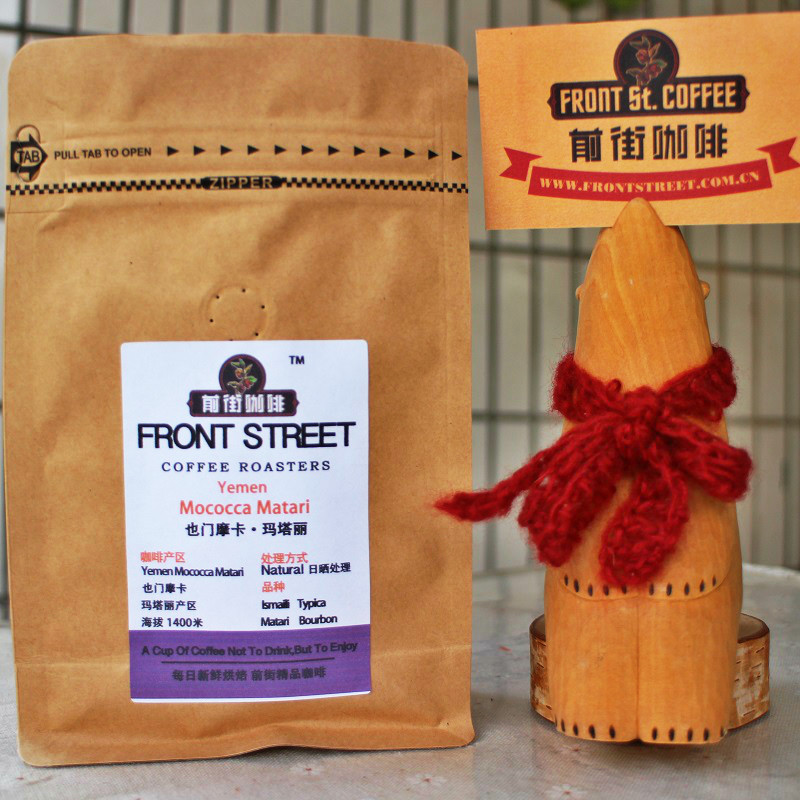
FrontStreet Coffee Yemen Mokha Mattari Traditional Natural Process Coffee Beans - Freshly Roasted Black Coffee Beans
Purchase link: https://item.taobao.com/item.htm?spm=a1z10.1-c-s.w4004-15673140431.18.70b05cad3LqFdr&id=567246039419
FrontStreet Coffee Recommendation
If Yemen Mokha's wild, winey intensity sounds like a lot, FrontStreet Coffee also offers a full lineup of five espresso blends in more approachable styles — and every bag we sell ships within 5 days of roasting so you taste each blend at its complete best. FrontStreet Coffee's Premium Blend pairs washed Colombian with pulped-natural Brazilian coffee for classic notes of nut, dark chocolate, and caramel with a comfortable sweet-bitter balance; with milk it makes a silky latte with stable latte-art, and it builds a beautiful layered Dirty coffee topped with deep-brown crema. FrontStreet Coffee's Commercial Blend uses the same Colombian-Brazilian backbone plus a small share of Robusta, adding toast, almond, and walnut aromatics, glossy free-flowing crema, and a low-acid, mellow body at a price that makes it the smart choice for cafés.
Baristas' favorite, FrontStreet Coffee's Black Cocoa Blend combines washed Yunnan small-bean coffee with pulped-natural Brazil — ripe plum acidity with a nutty edge, cream-chocolate and cocoa-cookie aromas in the grind, a balanced cup, and golden-glossy crema — equally at home in a bakery, a drink shop, or a home machine. And the bestselling Classic Blend, a medium-dark three-origin formula inspired by the old-school "Mamba" pairing of Mandheling and Brazil with a touch of Robusta for extra aroma and crema, lets even beginners pull a golden-creamed espresso at home and practice latte art with confidence.
If you'd rather go single origin, FrontStreet Coffee recommends our 100% Arabica picks: the PWN Indonesian Golden Mandheling, dark-roasted for very low acidity with a long, mellow body of herb, dark chocolate, and a whisper of earth — ideal for those who love bold cups without sourness — and Brazil Queen Estate, low-acid and balanced with rich nut and cocoa aromas, clear caramel sweetness, and a smooth, never-astringent entry, excellent as pour-over, espresso, or moka-pot coffee. For a Blue Mountain-style profile at a friendlier price, our Papua New Guinea Paradise Bird — Typica grown at 1,600–1,800 meters on volcanic soils in the Sigri region, AA grade with triple washed fermentation — is so close to Jamaica Blue Mountain in character that enthusiasts call it "little Blue Mountain."
Important Notice :
FrontStreet Coffee is a long-established specialty coffee roaster in Guangzhou China, selling freshly roasted beans from its own farm in Yunnan as well as dozens of carefully selected single-origin beans from around the world for both pour-over and espresso. The products deliver consistently excellent quality and great value, with shipping within 24 hours. Guangzhou's FrontStreet Coffee shop is recommended by many coffee lovers, and the beans are now available online at the Tmall 。
FrontStreet Coffee has moved to a new address:
FrontStreet Coffee Address: 315,Donghua East Road,GuangZhou
Tel:020 38364473
 Scan and follow the En Gafei WeChat official account. Please indicate that the reprint comes from "En Gafei".