Light and Acidic Flavor Profile of Kilimanjaro Premium Coffee Beans

FrontStreet Coffee's Tanzania Kilimanjaro coffee consists of uniformly large beans with a gray-green color. Compared with other varieties, it has stronger acidity and a sweet, pleasant aroma with exceptional flavor. After a medium roast it releases sweetness and light acidity, while a deeper roast produces a gentle bitterness — making it suitable for blending as well.
Brewing Methods
FrontStreet Coffee's Kilimanjaro coffee is primarily suitable for blending, whether you are building your own blend or crafting various specialty coffee drinks.
Single Origin Preparation
To brew a good cup of coffee, beyond fresh grounds and slightly hard water, you need a set of brewing tools you can handle with ease. Common brewing methods fall into three main types.
Drip Method
Water is poured over the coffee grounds, letting the liquid pass naturally through filter cloth or paper into a container at its own pace. The grounds are essentially not soaked; hot water simply moves slowly through them. Drip cones and electric coffee makers belong to this category — the simplest brewing tools, producing clean, brightly colored coffee.
Immersion Method
The grounds are placed in a pot, soaked in hot water for several minutes, then filtered through cloth or a mesh screen to remove them, leaving a cup of coffee liquid.
Siphon pots, French presses, Belgian coffee makers, and Vietnamese drip brewers all belong to this immersion category. The soaking process creates more complex flavors.
High-Pressure Method
Pressurized hot water penetrates tightly packed grounds to produce a concentrated coffee. Moka pots and espresso machines are the tools of this type.
Quick Brewing Method
An espresso machine offers a relatively quick brewing method and can extract cup after cup continuously. The high pressure emulsifies and dissolves the oils and colloids from the beans; the essence of the coffee is fully extracted under pressure, producing a more concentrated cup with better taste and aroma.
Tanzania's Coffee Industry
Coffee is one of Tanzania's main economic crops, ranking fourth among its export commodities after cotton, tobacco, and cashew nuts. It is exported mainly to Italy, Japan, and the United States and plays an important role in the national economy.
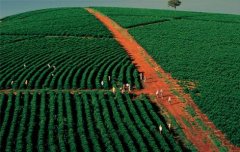
Tanzania's main coffee region lies at the foot of Mount Kilimanjaro, where the soil is rich in volcanic minerals and some coffee trees are over 100 years old. Coffee was first introduced and cultivated by Christians from Kenya. The trees require careful care — weeding, fertilizing, and pruning old branches to encourage new growth and maintain bean quality. Processing plants are located in towns near the mountainside for convenient handling.
Many farm-owning families have lived here for generations as immigrants: farm owners include Indians, Northern Europeans, and British, as well as locals, though most farms are small. Farm and processing plant managers are still mostly local tribal people. Labor is inexpensive in Tanzania, so much of the work of caring for the farms and maintaining the plantations relies on manual labor rather than machines. During the growing season, workers hand-inspect and remove diseased or insect-infested leaves. Tanzanian coffee processing is heavily manual, which also provides jobs and raises family incomes; workers are paid by the quantity of cherries harvested, and women from small farms carry the fruit in handmade sacks to the farms for payment.
Beans from this region are all exported as Kilimanjaro coffee. Besides Mount Kilimanjaro, Tanzania has several other major coffee regions with more small farms — most covering several hundred acres. Some have their own washing equipment and drying grounds, but grading still goes through large processing plants. With its long history of coffee cultivation, even small farms in Tanzania can produce good quality beans.
Tasting Experience
FrontStreet Coffee's Tanzania coffee — especially the Peaberry variety — always leaves a lasting impression. It reflects Tanzania's simple, straightforward, and warm national character: refreshing acidity and medium body complement sweet citrus and floral aromas. This Kilimanjaro coffee tastes excellent hot or iced, and pairing it with oranges or berries further highlights its bright flavors. You come away feeling that different peoples produce distinct coffee flavors, while the same land nurtures both the coffee trees and the people.
Mineral Resources
Tanzania is rich in minerals. As of 2014, proven reserves include gold, diamonds, iron, nickel, phosphates, coal, and various gemstones, ranking fifth in Africa in total reserves. Its natural gas reserves are also enormous: proven reserves reach 44 trillion cubic feet, with estimated total reserves of at least 200 trillion cubic feet.
Gold
Gold has been discovered across many regions of the mainland. The Lake Victoria region is comparable in geology and scale to the major gold-producing areas of Australia, Canada, South Africa, and Zimbabwe, with proven reserves of 18 million ounces and estimated reserves as high as 30 million ounces.
Diamonds
As of 2014, about 20% of the 300 known kimberlite pipes contain diamonds, with proven diamond reserves of 2.5 million tons. In addition, 600 geological features similar to kimberlites, plus alluvial areas along the East African Rift Valley, Lake Rukwa, and the edges of the Selous Basin, also hold diamond deposits.
Gemstones
Ruby, emerald, beryl, tanzanite, garnet, and tourmaline have all been discovered.
Other Minerals
Proven iron ore reserves are 85 million tons, with estimated reserves exceeding 300 million tons.
Proven phosphate reserves are 10 million tons. Estimated kaolin reserves are 2 billion tons; estimated black sand reserves, 47.25 million tons.
Proven natural gas reserves are 44 trillion cubic feet, of which 78% lie in the deep Indian Ocean.
(All data are as of 2014)
Helium
A huge helium field has been discovered in Tanzania's East African Rift Valley, with estimated reserves of up to 54 billion cubic feet.
Administrative Divisions
Regional Divisions
Tanzania has 26 regions and 169 districts — 21 regions on the mainland and 5 in Zanzibar. The 26 regions are:
Arusha, Dar es Salaam, Dodoma, Iringa, Kagera, Kigoma, Kilimanjaro, Lindi, Manyara, Mara, Mbeya, Morogoro, Mtwara, Mwanza, North Pemba, Coastal, Rukwa, Ruvuma, Singida, Shinyanga, South Pemba, Tabora, Tanga, South Zanzibar, North Zanzibar, and West Zanzibar.
Major Cities
Dar es Salaam
Tanzania's largest city and its economic and political center, a coastal city on the Indian Ocean with a population of roughly 6 million (2010) and an average annual temperature of 25.8°C.
Mwanza
The second largest city, with a relatively developed economy, adjacent to Africa's largest lake — Lake Victoria.
Arusha
The third largest city, located 60 kilometers from Africa's highest peak — Mount Kilimanjaro. The surrounding Serengeti and Ngorongoro grasslands host the world's largest annual animal migration.
Capital
Tanzania's official capital is Dodoma, at the eastern end of the southern highlands, at an elevation of 1,115 meters, 400 kilometers from Dar es Salaam — a transportation hub city with a population of 300,000.
For geographical, economic, and political reasons, people outside Tanzania generally assume Dar es Salaam is the capital. In fact it is not: it was the capital of German East Africa from 1891 to 1916 and of Tanganyika from 1961 to 1964, then of Tanzania. In 1974, the Tanzanian parliament decided to move the capital inland to Dodoma. Tanzania's main coffee region remains at the foot of Mount Kilimanjaro, where the volcanic-mineral soil supports coffee trees over 100 years old, first cultivated by Christians from Kenya. Processing equipment there is quite complete, coffee remains an important economic crop, and the local government attaches great importance to the industry.
FrontStreet Coffee Recommendation
However you brew a bright, fruit-forward coffee like this Kilimanjaro, an immersion brewer such as the French press is the easiest tool to master — like brewing tea: add grounds, pour hot water, stir, and press. Because a French press steeps the grounds directly, the cup carries richer oils and a fuller body, though those who dislike sediment may prefer paper-filtered methods.
Note that a light roast in a French press will extract noticeably higher acidity and mute the delicate florals, so immersion suits medium or darker roasts best — FrontStreet Coffee's Strawberry Candy Geisha blend (honey-processed Costa Rica plus washed Panama Geisha) blooms into rose, citrus, grape, and dried blueberry aromas, while the PWN Golden Mandheling, triple hand-sorted and once machine-selected then roasted medium-dark, gives a full-bodied, low-acid cup with spice, caramel, cedar, and dark chocolate. For technique: use a coarse-sugar grind (EK43s at 10.5, or 26 clicks on a C40), a 1:15 ratio (15g coffee to 225g water) for a strength of about 1.1–1.2%, water about 1–2°C hotter than your usual pour-over temperature, and a 4-minute steep before pressing slowly to the bottom.
Important Notice :
FrontStreet Coffee is a long-established specialty coffee roaster in Guangzhou China, selling freshly roasted beans from its own farm in Yunnan as well as dozens of carefully selected single-origin beans from around the world for both pour-over and espresso. The products deliver consistently excellent quality and great value, with shipping within 24 hours. Guangzhou's FrontStreet Coffee shop is recommended by many coffee lovers, and the beans are now available online at the Tmall 。
FrontStreet Coffee has moved to a new address:
FrontStreet Coffee Address: 315,Donghua East Road,GuangZhou
Tel:020 38364473
 Scan and follow the En Gafei WeChat official account. Please indicate that the reprint comes from "En Gafei".