How to Brew Kenyan Coffee Beans Introduction to Kenyan AA Coffee Bean Varieties Flavor Characteristics

Kenyan coffee has long captivated enthusiasts with its rich fruit acidity and full-bodied flavor. Many coffee lovers visit FrontStreet Coffee for single-origin coffee, and when they want something acidic but would rather not drink Ethiopian beans, Kenyan coffee proves an excellent choice. When Kenyan coffee comes up, Kenya AA inevitably follows — but what exactly does AA mean? In this article, FrontStreet Coffee explores what Kenya AA beans are.
Coffee Growing Regions
Kenya lies in eastern Africa, with the equator crossing its center and the Great Rift Valley running north to south. It borders Somalia to the east, Tanzania to the south, Uganda to the west, and Ethiopia and Sudan to the north, while its southeast faces the Indian Ocean. The country has numerous highlands at an average elevation of 1,500 meters. Mount Kirinyaga (Mount Kenya) in central Kenya reaches 5,199 meters with snow-capped peaks, making it Africa's second-highest mountain. Kenyan beans have wonderfully satisfying aromas, balanced and pleasant acidity, uniform particles, and excellent fruit flavors. FrontStreet Coffee has compared Kenyan beans with neighboring Ethiopia's and found that although both emphasize fruity acidity, they present completely different characters — Kenyan acidity is intense and full-bodied, while Ethiopian acidity is gentle and bright. For a first taste of African coffee, FrontStreet Coffee suggests starting with Ethiopian beans before gradually moving to Kenyan ones.
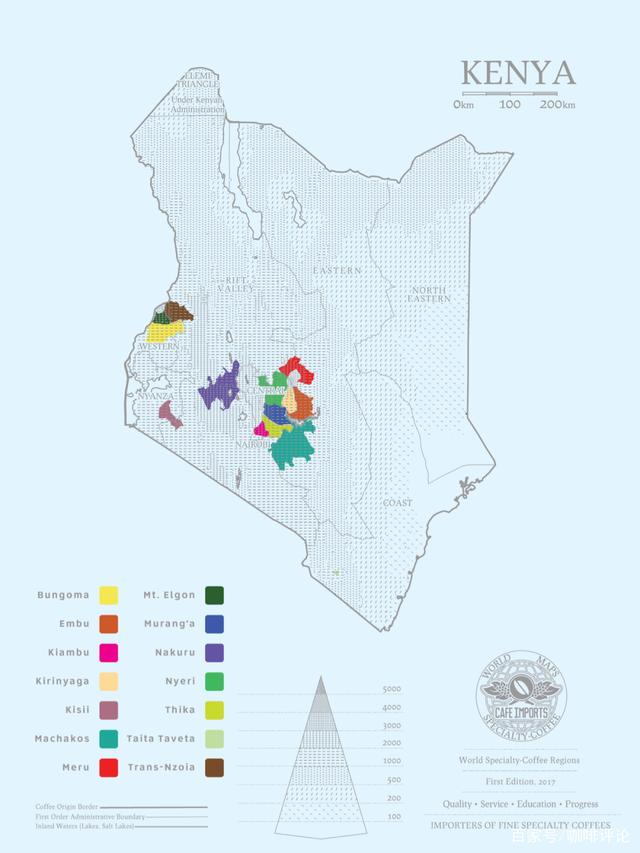
Kenya's growing regions are mainly in the center and west, including Thika, Kirinyaga, Mt. Kenya West, Nyeri, Kiambu, and Muranga. The harvest periods of these six regions run October to December (main season) and June to August (secondary season).
Among them, Thika and Kirinyaga best represent the flavor of Africa's growing regions.
Thika
Thika is a small town near Nairobi, Kenya's capital. There are many coffee fields around Nairobi, and although Thika is an industrial town, it is surrounded by agriculture and waterfalls. The Thika region has about 2,000 farmers. Kenyan Thika cultivation dates to the late 19th century, when varieties were introduced from neighboring Ethiopia to the north. After variety improvements, common varieties now include Bourbon, Kents (SL34, SL28), Typica, and Ruiru 11. Currently about 90% of what is planted consists of SL34 and SL28. The new variety Batian, released in 2007, has not yet been widely cultivated. The region's flavor features bright fruit acidity, full-bodied berry juice, and honey-like sweetness. Elevation: 1,550-1,750 meters. Varieties: SL-28, SL-34.

Kirinyaga
Kirinyaga lies on the slopes of Mount Kenya, adjacent to Nyeri, and is world-renowned for coffee with intense flavor, rich layers, and a robust mouthfeel. Together with Nyeri it is recognized as one of Kenya's two finest growing areas. Most producers here are smallholders who join cooperatives; the cooperatives unify them by providing washing stations where farmers deliver their cherries for processing. The region's flavor features bright fruit acidity with moderate oiliness and delicate sweetness. Elevation: 1,300-1,900 meters. Varieties: SL-28, SL-34, Ruiru 11, Batian.
Nyeri
Located in central Kenya, Nyeri is home to the dormant volcanic Mount Kenya. The region's red soil nurtures Kenya's finest coffee. Agriculture is extremely important here, with coffee the primary crop, and cooperatives of smallholders are more common than large estates. There are two harvest seasons, but main-season coffee is usually higher quality. The region features bright berry juice complemented by citrus and subtle floral aromas; the beans grown here have made Kenyan coffee famous worldwide. Elevation: 1,200-2,300 meters. Varieties: SL-28, SL-34, Ruiru 11, Batian.
Coffee Bean Varieties
Kenya primarily grows SL28, SL34, and Ruiru 11.
SL28 and SL34: these are genetic variants. They account for the vast majority of Kenya's high-quality production, though they are susceptible to leaf rust. SL34 has French Mission, Bourbon, and more Typica lineage. With copper-colored leaves and a broad bean shape, it offers wonderful sweetness, balance, and complex, varied flavors, along with prominent citrus and plum character.
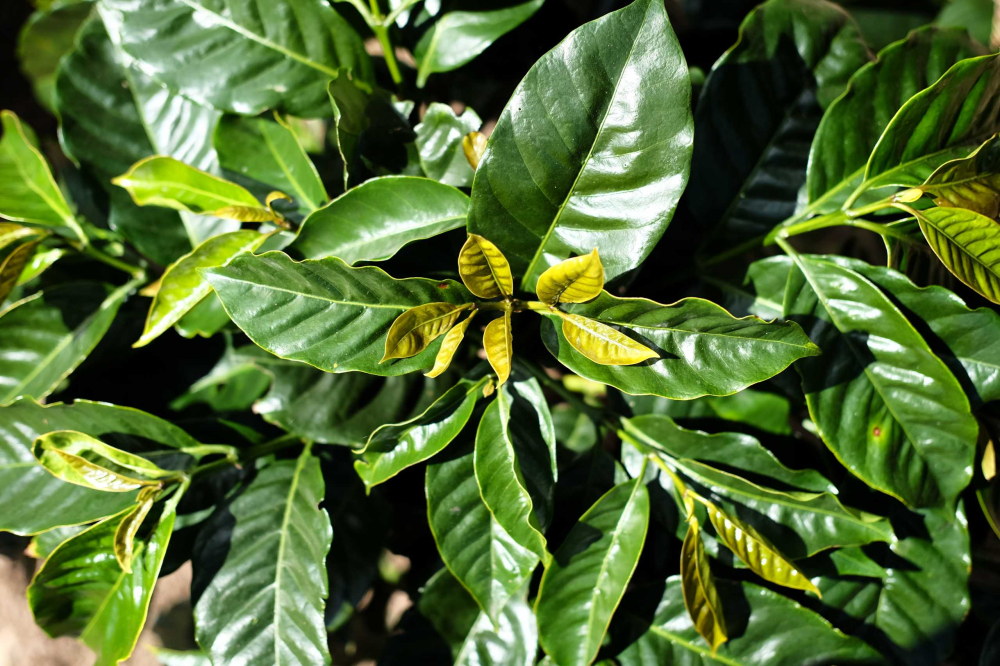
Ruiru 11: in 1985, during a global rust outbreak, Kenya developed this hybrid variety that emphasizes yield over quality. Its flavor quality is far inferior to SL28 and SL34, and it has not gained traction in specialty coffee. Nevertheless, many suppliers, even those importing premium beans, blend this hybrid in to reduce costs.
Kenya AA Coffee Bean Classification
As mentioned, Kenya AA is in fact a classification of Kenyan beans. Kenyan coffee is classified primarily by bean size and is typically divided into eight grades:

- AA Plus (AA+): AA-grade beans with exceptionally excellent cup quality (flavor, mouthfeel).
- AA: Bean size (Screen Size) 17-18.
- AB: Bean size (Screen Size) 15-16, accounting for the majority of production.
- C: Bean size (Screen Size) smaller than AB.
- TT: Lighter-weight beans blown out by air classifiers from AA and AB beans.
- T: Lighter-weight beans blown out by air classifiers from C beans.
- E Elephant Bean: large mutated beans where two beans merge, also known as elephant ear beans.
- PB Peaberry: classified by shape, unrelated to flavor or weight.
Coffee Bean Processing Methods
The traditional washed method is not complicated: flotation → pulping → fermentation → washing → drying → hulling → packaging. Its implementation requires an adequate water supply, however, and because it relies heavily on machinery, producers must have sufficient funds to invest in equipment. The rise of washing coincided with early American plantations established by capital — that is, those with adequate operating funds — combined with inventions such as pulpers and hullers, which together drove the spread of washing throughout the Americas.

Originally, wet processing meant washing the fermented beans once with clean water to remove the mucilage, then sending them straight to the drying grounds for drying and packaging. In Kenya, however, coffee that has been washed once is re-soaked in a pool of clean water, then taken out and washed again before being sent to the drying grounds for dehydration.
Kenya initially moved from conventional washing to "double soaking" not to pursue flavor but because of insufficient local drying space. Kenya follows a typical African cooperative model: during harvest, smallholders deliver freshly picked cherries to processing plants all day long. Pulping and fermentation are relatively simple and quick, but drying each batch of fermented beans takes at least 5 to 7 days. Sometimes, when the volume is too large, there is not enough space to dry the washed beans, so people had to pour the wet beans back into the pools to let them "cool down" and prevent spoilage or contamination until drying space freed up.

This double-soaked washed form is called "Double Washed," also referred to in producing regions as "Fully Washed." Because Kenya was the earliest region where this method became popular and widely implemented, this type of washing is also known as the "Kenyan Process." Later, people discovered that this twice-fermented washing, adapted to local conditions, not only facilitates stable quality control but also imparts a richly layered fruity acidity.

Beyond the two methods above, the most representative Kenyan processing is undoubtedly the K72 washed method. Washing emphasizes control of fermentation time: a 24-hour washed fermentation first, then the removed mucilage is cleaned, followed by another 24-hour fermentation in clean-water pools. Residual components are cleaned again, and the beans go into tanks of clean water for a final 24-hour fermentation, totaling 72 hours. This process gives Kenyan coffee its bright, clean, high-quality fruity acidity. The Asalia coffee regularly offered by FrontStreet Coffee uses this technique, presenting acidity reminiscent of cherry tomatoes and plums when brewed.
Next comes another 24-hour fermentation with clean water, then washing again. After repeating this cycle three times to reach 72 hours, it is called the Kenyan 72-hour fermentation washed method, abbreviated [K72]. FrontStreet Coffee believes that compared with conventional washing, the K72 method further enhances the acidity and cleanliness of the beans.
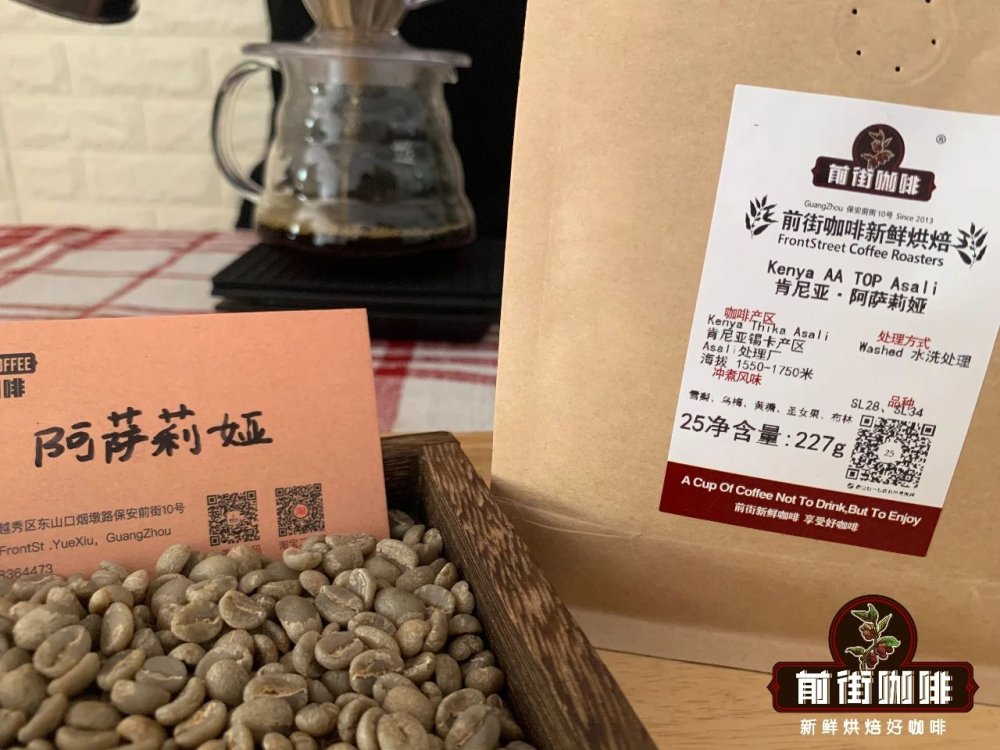
FrontStreet Coffee: Kenya Asalia Coffee Beans
- Region: Kenya Thika
- Processing Station: Asali Honey Processing Station
- Elevation: 1,550-1,750 meters
- Grade: AA TOP
- Varieties: SL28, SL34
- Processing Method: Kenya 72-hour Washed
FrontStreet Coffee Roasting Recommendations
When roasting this Kenyan bean, FrontStreet Coffee sought to highlight its rich fruity acidity and full-bodied berry juice, so it adopted a light-to-medium roast level.
Yangjia 800N: set the roaster temperature to 200°C when loading, the air damper at 3, and heat at 160. Return-to-temperature comes at 1'34". When the roaster reaches 147°C, reduce heat to 130 and open the air damper to 3.5. At this point the bean surface turns yellow and the grassy aroma disappears completely, entering the dehydration stage. When the temperature reaches 171°C, reduce heat to 80, keeping the air damper unchanged.

At 8'28", ugly wrinkles and black spots appear on the bean surface and the distinct toasted-bread aroma clearly turns to coffee aroma, definable as the prelude to the first crack — listen carefully for the sound. At 8'52" the first crack begins; adjust the air damper to 5. After the first crack, develop for 2'10", then unload at 191.6°C.
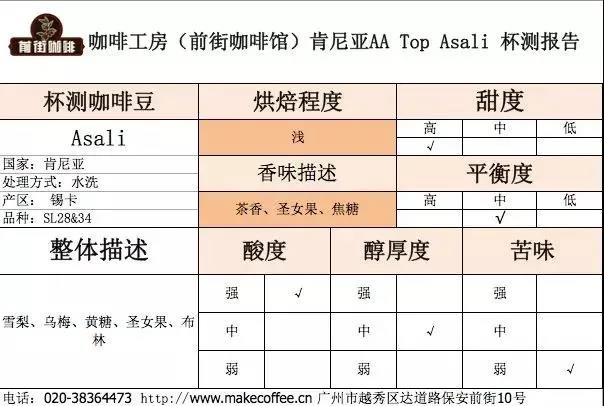
FrontStreet Coffee Cupping Report
FrontStreet Coffee Brewing Recommendations
Because this bean is roasted light-to-medium, FrontStreet Coffee uses a higher water temperature and a faster-flowing dripper, mainly to extract its bright acidity at high temperature while avoiding the over-extraction that high heat can cause — hence the faster-flowing V60.
- Coffee-to-water ratio: 1:15
- Coffee dose: 15g
- Water temperature: 90°C~91°C
- Grind size: Fine sugar size (80% pass-through rate with #20 standard sieve)

First, pour 30g of water for a 30-second bloom, then pour 105g more (the scale showing about 135g), completing the pour in about 1 minute. When the water level drops to 2/3 of the bed, pour the remaining 120g (the scale showing about 255g), completing in about 1 minute and 45 seconds. Finish drip filtration at 2'10", remove the dripper, and extraction is done.

Brewing flavors: the entry presents plum and cherry tomato, with an intense, full-bodied acidity. The mid-section shows prominent sweetness with a juicy quality, while the aftertaste offers berry aromas and brown-sugar sweetness accompanied by a green-tea fragrance.
FrontStreet Coffee Recommendation
Kenya's intense, full-bodied acidity stands apart from Ethiopia's gentler, brighter style, and FrontStreet Coffee's own Ethiopian lineup is the best way to appreciate the contrast. Start with the washed Yirgacheffe — the classic introduction to the region, with a clear jasmine fragrance and bright citrus acidity. Yirgacheffe is a small town in southern Ethiopia, mild all year and mist-wrapped, cool and humid, where thousands of coffee trees thrive and yield that signature blend of floral aroma and fruit acidity, light and elegant with a tea-like body that drinks like a clean lemon tea.
For greater clarity and precision, the washed Godinding cooperative lot is the pick. Godinding sits at the southeastern edge of Yirgacheffe in the Worka area; originally part of the Worka cooperative under the YCFCU alliance, it was established as its own single origin in 2012, with around 300 member farmers, as buyers pursued traceability. Because the fruit is stripped before drying, its inherent aroma reads clearly — citrus and lemon notes with elegant white florals and an overall bright, delicate profile. FrontStreet Coffee's daily bean for the region is a washed Yirgacheffe, roasted medium-light to present jasmine, citrus, lemon's fresh acidity, and honeyed sweetness.
For something with more natural-processed richness, the Red Cherry is made from fully ripe cherries dried whole on raised beds. The fruit is turned every 2-3 hours in the first days to prevent uneven fermentation, and after three to five weeks of sun-drying the hardened fruit is hulled away; the naturally processed beans carry fermented fruit aroma and deep sweetness. Or try the Kaffa Forest from southwestern Ethiopia, a UNESCO biosphere reserve and the acknowledged birthplace of Arabica, where wild trees grow from 1400-2100 m on abundant rainfall and acidic red soil. Roasted medium-light, it shows clear white florals on grinding, bright lemon acidity on entry, sweet orange and bergamot, a melon and nutty sweetness in the finish, and a green-tea-like body.
Important Notice :
FrontStreet Coffee is a long-established specialty coffee roaster in Guangzhou China, selling freshly roasted beans from its own farm in Yunnan as well as dozens of carefully selected single-origin beans from around the world for both pour-over and espresso. The products deliver consistently excellent quality and great value, with shipping within 24 hours. Guangzhou's FrontStreet Coffee shop is recommended by many coffee lovers, and the beans are now available online at the Tmall 。
FrontStreet Coffee has moved to a new address:
FrontStreet Coffee Address: 315,Donghua East Road,GuangZhou
Tel:020 38364473
 Scan and follow the En Gafei WeChat official account. Please indicate that the reprint comes from "En Gafei".