Queen's Estate Red Yellow Bourbon Coffee Beans: Flavor Characteristics and Varietal Story

Introduction to Brazilian Coffee
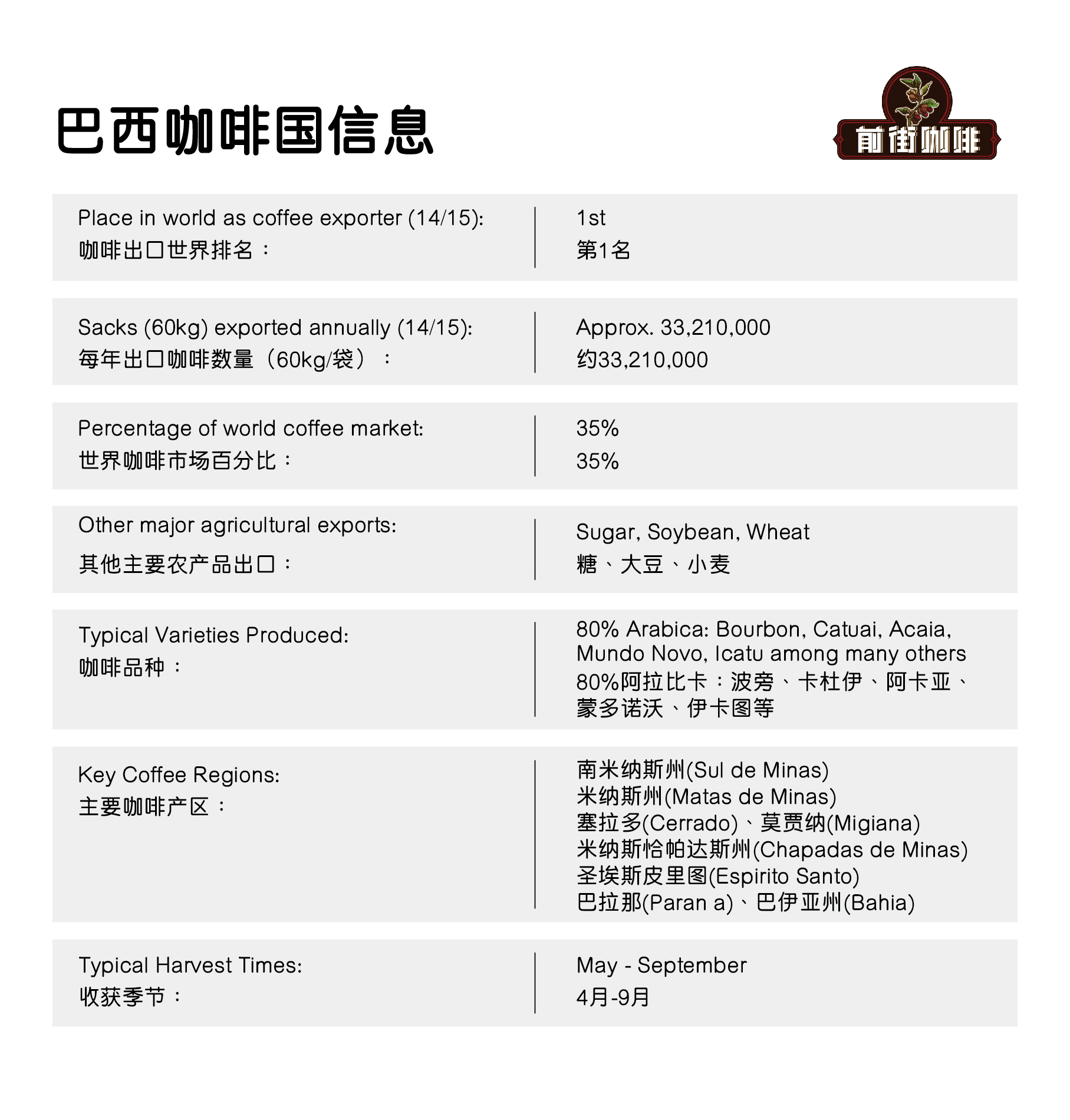
Central and South America is the world's largest coffee-producing region, and its output significantly influences global green coffee prices. Among these countries, Brazil is the largest coffee producer in Central and South America and the world's foremost coffee producer. Brazilian coffee can account for over 30% of global production. When Brazilian output rises, global coffee prices may drop dramatically, which makes Brazil a force to be reckoned with.
Most Brazilian coffees feature gentle, mellow flavors reminiscent of roasted hazelnuts and cream, with low acidity and a subtle yet long-lasting aftertaste. The texture is smooth. FrontStreet Coffee's original mission is to taste coffee beans from around the world, to understand every variety, every growing region and every processing method, and to conduct comparisons and build a visual database. FrontStreet Coffee hopes every coffee enthusiast can gain a deeper understanding of the coffee world and explore its mysteries together with us.

Recent Brazilian Coffee and Pandemic Impact
The title of world's largest coffee producer has brought Brazil considerable economic income, but it also demands significant human resources. Brazil was the last country in the Western Hemisphere to abolish slavery, largely because coffee cultivation and harvesting required massive manpower. Now, affected by the COVID-19 pandemic, Brazil worries that the outbreak will worsen with the arrival of the coffee harvesting season, potentially delaying coffee exports. This year's Brazilian coffee harvest is therefore expected to be delayed.
Benefits of Shade Trees
Because of global climate change, Brazil's coffee-growing areas will shrink significantly in the future. Recent research confirms, however, that shade trees in Brazil help buffer rising temperatures, which is undoubtedly good news for growers. Studies show that planting shade trees over 50% of the cultivation area can retain up to 75% of the region's production capacity.
The Balance of Brazilian Coffee
Compared with other Central and South American countries, Brazil's altitude is relatively low and it lacks microclimates. Under these conditions, the beans grown have a low but smooth enough acidity, prominent nutty flavors, chocolate sweetness and excellent body. Some coffee enthusiasts criticize Brazilian beans for their acidity, considering them too ordinary and lacking distinctive character. This actually shows the nature of coffee culture: praise and criticism go hand in hand. A variety's fame comes from withstanding both compliments and critiques.
Fazenda Rainha (Queen's Farm) Introduction
This coffee comes from Fazenda Rainha (Queen's Farm), a 280-acre estate located in Brazil's ancient volcanic valley, Vale da Grama.

In 2011 the farm took first place in Brazil's Cup of Excellence competition. Fazenda Rainha belongs to the renowned and respected Carvalho Dias coffee family. The family's four major farms have won awards every year since the first Brazilian COE competition in 1999, with more than 12 awards over 7 years. In 2004 they even swept first, ninth and eleventh places. Many large and small farms in Brazil aspire to win awards but find it difficult, yet this family's farms have won multiple awards year after year. Even the Fazenda Rainha lot here has an impressive record: 2nd place in 2000, 3rd place in 2001 and 29th place in 2005. To date, Queen's Farm has won three awards.

The Carvalho Dias family are also founding members of the Brazilian Specialty Coffee Association, and their commitment to coffee quality and environmental protection is evident. On their family farms they use natural waterfalls to develop pollution-free hydroelectric power, becoming self-sufficient in electricity; another of their award-winning farms is named after this waterfall, Waterfall Farm. They have built churches, classrooms, nurseries and medical stations, and they insist on maintaining the original native flora and forest while continuing reforestation. On Queen's Farm, environmental protection is carried through thoroughly. Because of its higher altitude and uneven terrain, mechanical harvesting is impossible, so all fruit is harvested entirely by hand. They cultivate low-yield, high-quality Bourbon varieties, making the estate a representative of Brazil's premium coffee essence.
Brazilian Queen's Farm Coffee Bean Processing System
Mature coffee cherries are hand-picked into cloth bags to avoid contact with the ground. The cherries harvested each day are sent to the farm's processing facility the same day for pulped natural processing. Hand-picking and cloth bags for the harvested cherries avoid earthy flavors and any improper fermentation. When the cherries arrive at the facility they immediately undergo washing: the cherries are cleaned and unqualified or dried fruits, known as bóia beans, are filtered out by size. The qualified beans continue to the pulping process, using a pulper machine.

The farm grows 200 acres of Yellow Bourbon coffee trees. The rolling mountainous terrain prevents large-scale mechanical harvesting, so all coffee here must be hand-picked.
The farm uses pulped natural processing, followed by drying on drying racks and mechanical drying. After mechanical screening, manual screening is also required. The extensive work means farm employees live on the farm year-round, and all employees and their families enjoy housing, healthcare and educational benefits here.
The farm is a member of a medium-sized farm organization in the local Grama Valley, primarily exporting Bourbon-variety specialty coffee. The organization's office is in nearby Pocos de Caldas, and it also has a national-level cupping laboratory with large warehouses. The organization collaborates with local universities and other institutions on research, including Lavras University and the well-known Dr. Flavio Borem from that university's agricultural research center.

Queen's Farm Award Records
- 2014 COE Cup of Excellence 13th Place
- 2013 COE Cup of Excellence 2nd Place
- 2012 COE Cup of Excellence 8th Place
- 2011 COE Cup of Excellence Champion
- 2010 COE Cup of Excellence 20th Place
- 2009 COE Cup of Excellence 6th Place
- 2008 COE Cup of Excellence 14th Place
About the Cup of Excellence (COE)
The Cup of Excellence (COE) program and its trademark are currently owned and managed by the Alliance for Coffee Excellence (ACE), a non-profit organization. ACE collaborates annually with COE competition host countries to complete specialty coffee cupping selection and online auctions, while also recommending and promoting anything related to coffee quality improvement. The goal is to identify models of specialty coffee in host countries and exchange experience for the industry to learn from.
About Bourbon Varieties
Early Typica, before coffee history as we know it, was introduced to Yemen as a variant, changing from slender, pointed shapes to round ones. In 1715 France transplanted round Yemen Mocha beans to Bourbon Island off the East African coast, renamed Reunion Island after the French Revolution, where the variety was named Bourbon. The round Bourbon beans spread to Brazil and Central and South America in 1727. In 1732 Britain also transplanted Yemen Mocha to St. Helena Island, where Napoleon was later imprisoned, and those were round Bourbon beans as well.
Simply put, Bourbon is a coffee variety belonging to the Arabica species branch. It typically produces red fruit and is called Red Bourbon. Besides this there are also Yellow Bourbon and Orange Bourbon. Yellow Bourbon has a relatively lower yield but better quality.
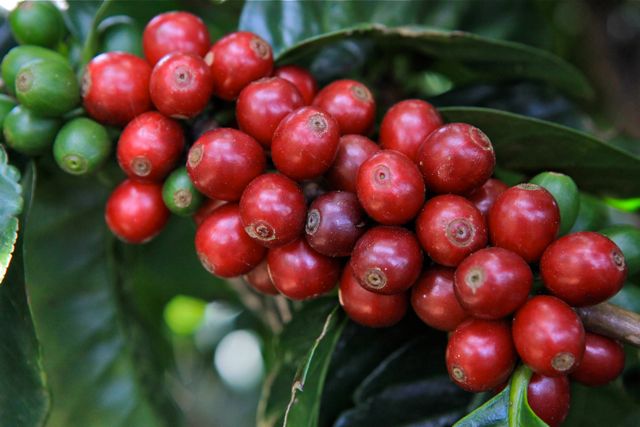
Bourbon is a sub-variety resulting from a Typica mutation, and along with Typica it belongs to the oldest existing coffee varieties. When green fruit ripens it turns bright red.
Compared with Typica, Bourbon has broader leaves and denser growth. Although it produces more than Typica, its harvest cycle is still two years, making it a low-yield variety. It does offer excellent flavor, with wine-like acidity and a sweet aftertaste. The beans are large, uniform in size, evenly colored and glossy. For harvesting convenience, farmers prune the trees so they do not exceed 150cm.
Bourbon's Spread Route
Because of the low yield and disease susceptibility of the Typica introduced to Brazil in 1727, Bourbon was introduced to Brazil around 1860 via Campinas in the south and rapidly expanded north to other parts of South and Central America. Today in Latin America, although most Bourbon has been replaced by its variants, especially Caturra, Catuai and Mundo Novo, Bourbon is still grown in countries such as El Salvador, Guatemala, Costa Rica and Peru.
Yellow Bourbon
Yellow Bourbon is a hybrid of Bourbon with other varieties. Because of its lower yield and weaker resistance to wind and rain, it has not been widely planted. Grown at high altitudes, however, it shows excellent flavor performance and has become more common in recent years.

Yellow Bourbon, with yellow fruit when ripe, was first discovered in Brazil and currently grows mainly there. It is generally believed to be a mutation resulting from hybridization between red-fruited Bourbon and a yellow-fruited Typica variant called "amerelo de Botocatu."
FrontStreet Coffee: Brazil - Queen's Farm
- Region: Mogiana
- Altitude: 1400-1950m
- Variety: Yellow Bourbon
- Processing: Pulped Natural
- Flavor: Naturally sweet and clean; pulped natural processing leaves its acidity gentle and well integrated with sweetness, some lots even showing tropical fruit aromas.

This Brazilian Queen's Farm coffee is 100% Yellow Bourbon, with origins traceable to Bourbon's birthplace, Reunion Island near Madagascar. In the 18th century French explorers first brought coffee there, so the variety also has another name: French Missionary. In the 20th century it was brought to the African mainland and then introduced to Brazil. Its derived varieties now spread across Africa and the Americas. Bourbon grown in Brazil produces yellow fruit due to recessive genes.
This Brazilian Queen's Farm coffee uses Brazil's Cerezadescascado method, a pulped natural processing method similar to honey processing that makes coffee flavors rounder, with an effect between washed and full natural processing. The process first uses a small amount of water to remove pulp and skin, then places the coffee directly on drying racks for sun-drying, constantly turning it to ensure all the coffee contacts sunlight. After several days of drying, mechanical drying finishes the process to reach the appropriate moisture content.

Yellow Bourbon's origins can be traced to Bourbon's birthplace, Reunion Island near Madagascar. Bourbon grown in Brazil produces yellow fruit due to recessive genes. Yellow Bourbon beans are naturally sweet and clean. Pulped natural processing leaves its acidity gentle and well integrated with sweetness, with excellent balance and tropical fruit aromas.
Processed coffee beans have relatively stable properties and can be stored for long periods. Moisture content is relatively low, and the beans are quite large: 98% can reach 16 screen size or above, with half reaching 18 screen size.
Roasting Analysis
The green beans have a solid texture and excellent flavor performance, with slight orange peel and spice notes. Green bean moisture content is 9.9%.

This bean's relatively low moisture content gives it strong heat absorption. FrontStreet Coffee's roasting plan is therefore to start at 200°C, then use high heat with low airflow to speed up dehydration. After the dehydration phase, open medium airflow and medium heat for the Maillard reaction, without rushing the time, and finish near the end of first crack.
- Machine: Yangjia 800N, 550g green beans
- Charge Temperature: 200°C
- First Crack: 9'14", 188.9°C
- Development after First Crack: 1'48", discharged at 197.5°C
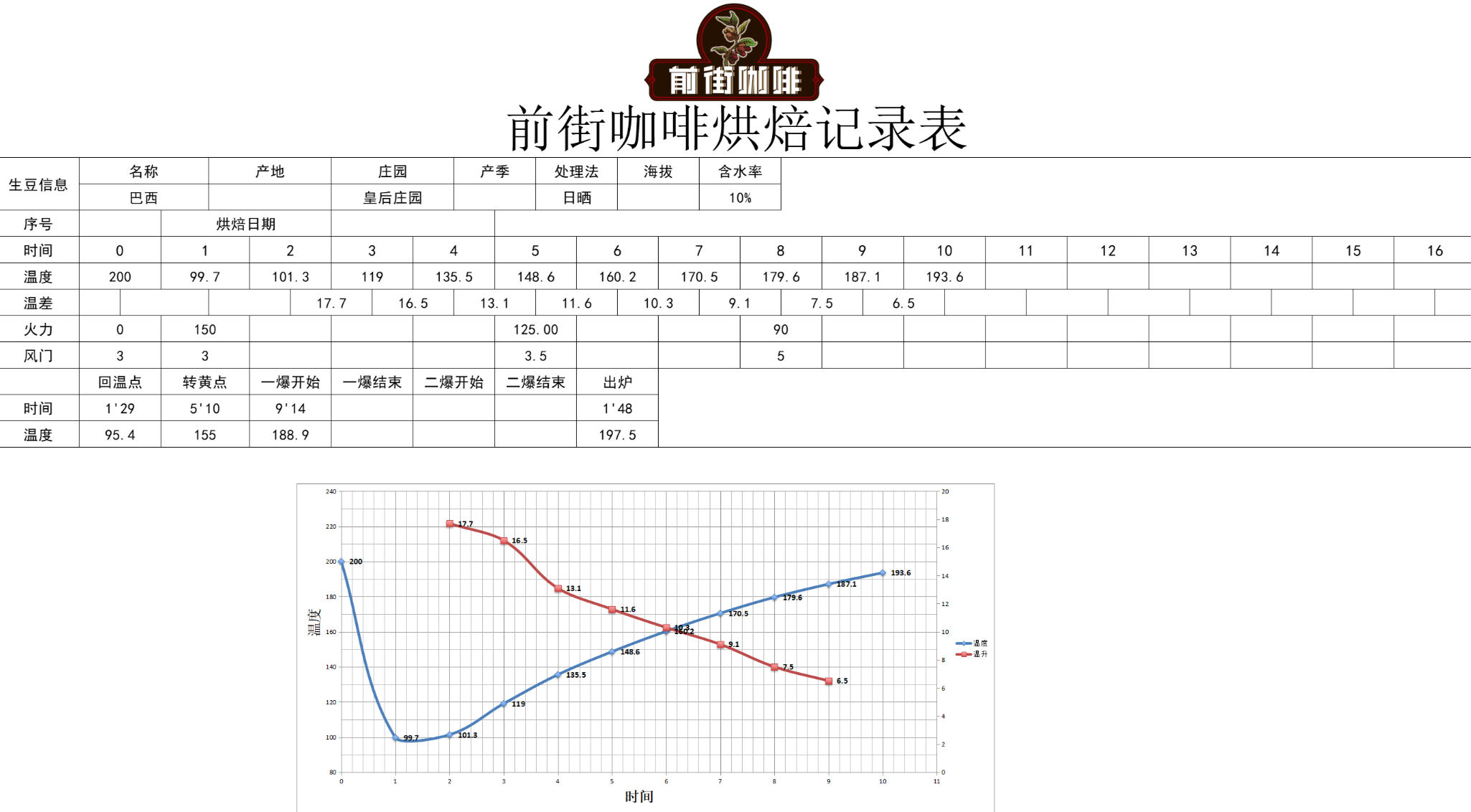
FrontStreet Coffee test-roasted this bean 4 times and finally chose between 1 minute 45 seconds and 2 minutes after first crack as optimal. The flavor has noticeable sweetness that is not monotonous, with subtle lemon aromas in the background that are more prominent in the wet aroma phase. The later stages show distinct dark chocolate flavors, with an overall rounded feeling that embodies Brazilian characteristics while remaining lively.
Brewing Recommendations
- Dripper: Hario V60
- Water Temperature: 90°C
- Coffee Amount: 15g
- Coffee-to-Water Ratio: 1:15
- Grind Size: Medium-fine (BG#6S)
Brewing Technique
Segmented extraction: use 30g water for a 30-second bloom, then continue pouring with a small circular flow to 125g for the first segment. When the water level drops to just above the coffee bed, continue pouring to 225g and stop. When the water level drops just above the coffee bed again, remove the dripper. Timing starts from the bloom. Total extraction time: 2'00".

Flavor Profile
Naturally sweet and clean; pulped natural processing leaves its acidity gentle and well integrated with sweetness, some lots even with tropical fruit aromas, and the abundant aroma during brewing is especially captivating. Fresh sugarcane juice sweetness, black tea, a smooth and pleasant fruit sweetness, distinct nutty flavors, balanced and gentle acidity, a clean and subtle bitterness, rich chocolate aromas and nutty flavors, a bright and refreshing mouthfeel, and a smooth, delicate texture.
Red Bourbon
After Red Bourbon coffee trees flower and bear fruit, the color changes as follows: green, then light yellow, then light orange, then mature red, then a darker red when overripe. It is therefore also called the Red Bourbon variety. In fact, Red Bourbon is what we generally call the Bourbon variety. Bourbon grown at high altitudes typically has a better aroma and brighter acidity, sometimes even showing wine-like flavors.
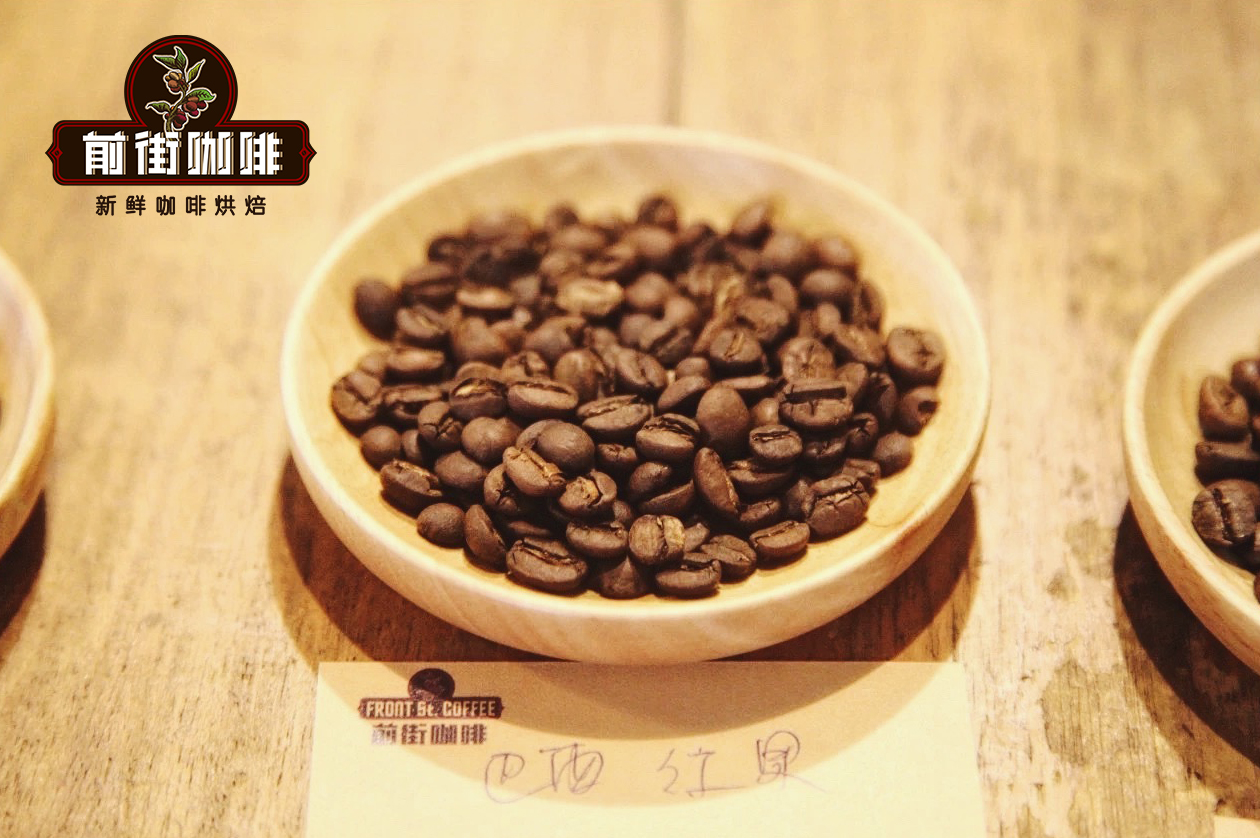
FrontStreet Coffee - Brazil Cerrado Red Bourbon
- Country: Brazil
- Region: Cerrado
- Altitude: 1000 meters
- Variety: Red Bourbon
- Processing: Pulped Natural
- Flavor: Nuts, chocolate, cream, peanut, caramel
Roasting Recommendations
Brazilian coffee beans are known for their body. To highlight this flavor, FrontStreet Coffee uses medium roasting.
- Machine: Yangjia 800N, 550g green beans
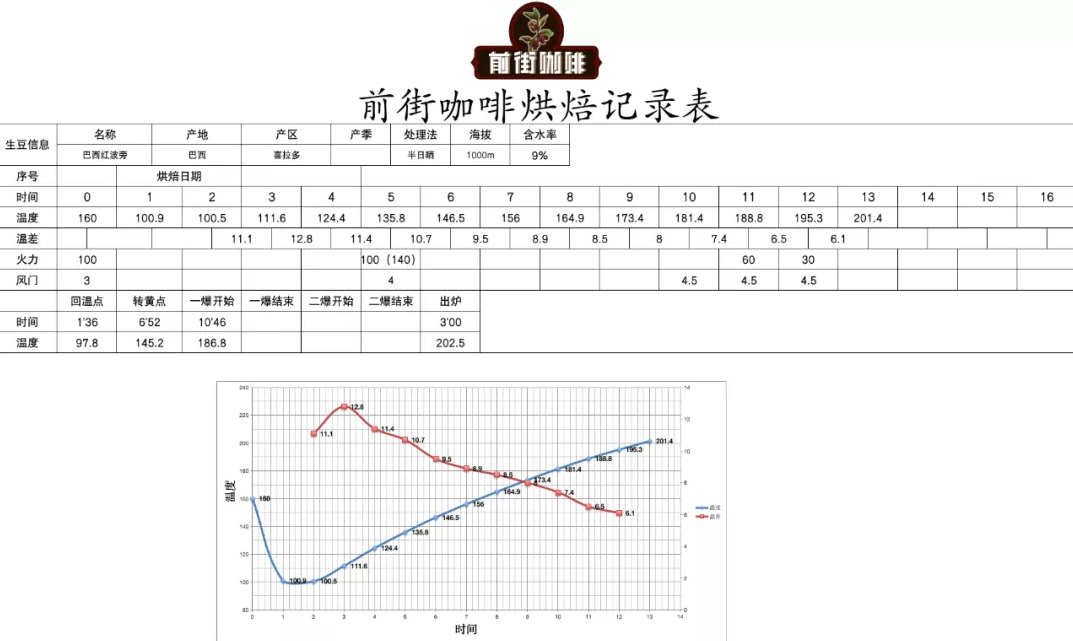
- Charge Temperature: 160°C
- Yellowing Point: 6'52", 145.2°C
- First Crack: 10'46", 186.8°C
- Development after First Crack: 3'00", discharged at 202.5°C
Brewing Parameters
- Dripper: Kono Dripper
- Water Temperature: 88°C
- Coffee Amount: 15g
- Coffee-to-Water Ratio: 1:15
- Grind Size: Medium-fine (70-75% pass-through rate with Chinese standard #20 sieve)
For more deeply roasted beans that highlight body, FrontStreet Coffee chooses the Kono dripper. The Kono has an immersion function, using immersion to extract more coffee substances and enhance body. Its ribs are few and located at the bottom, which lets the filter paper stick closely to the dripper, restricting airflow and slowing the water flow to increase contact time between water and coffee.

A water temperature of 88°C is chosen as a relatively low brewing temperature to avoid extracting excessive off-flavors, since darker roasts tend to increase them.
FrontStreet Coffee uses segmented extraction: 30g water for a 30-second bloom, then continue pouring with a small circular flow to 125g for the first segment. When the water level drops to just above the coffee bed, continue pouring to 225g and stop. Timing starts from the bloom. Total extraction time: 2 minutes.
Flavor Description
The entry shows obvious sweetness with subtle lemon aromas, rich nutty flavors and distinct dark chocolate flavors in the later stages, with an overall rounded feeling.

Overall, the Bourbon varieties, Red Bourbon and Yellow Bourbon, are quite similar in flavor, both showing distinct dark chocolate, cocoa, nut and caramel flavors, with smooth acidity and lower bitterness.
FrontStreet Coffee Recommendation
Brazil's mild, balanced cup makes it an easy place to begin, and FrontStreet Coffee's Cerrado Red Bourbon is a classic single-origin example. Cerrado is a well-known Brazilian region prized for high-quality beans, and this lot is the red Bourbon variety common in South America. Roasted medium, it shows creamy peanut, toasted bread, caramel and hazelnut, with a rounded body, low acidity and a light bitterness. It works not only as a pour-over but also in a moka pot, as an espresso SOE, in a siphon or in a French press.
FrontStreet Coffee's Brazil Queen's Farm single origin comes from Mogiana, close to South Minas, where fertile red volcanic soil lets the coffee fruit absorb ample nutrients and develop a full aroma. The region is split between farms that keep traditional methods and others that have adopted modern, standardized management, which has greatly improved local coffee quality. Queen's Farm is planted to the rare Yellow Bourbon, a mutation of Red Bourbon with a cleaner fruit character, and through pour-over, moka pot or home espresso machine it shows the sugarcane sweetness found in no other region, along with fruit and chocolate notes.
Brazil's low acidity, balanced body and friendly price have also made it a first choice in many espresso recipes. FrontStreet Coffee's Classic Blend with its rich crema, its nut-forward Premium Blend, the balanced Black Cocoa blend that many baristas recommend, and FrontStreet Coffee's Commercial Blend made for coffee shops all contain Brazilian beans. The Brazilian component supplies not only chocolate and cream aromas but also a soft sweet-sour-bitter balance that helps keep extraction stable.
Important Notice :
FrontStreet Coffee is a long-established specialty coffee roaster in Guangzhou China, selling freshly roasted beans from its own farm in Yunnan as well as dozens of carefully selected single-origin beans from around the world for both pour-over and espresso. The products deliver consistently excellent quality and great value, with shipping within 24 hours. Guangzhou's FrontStreet Coffee shop is recommended by many coffee lovers, and the beans are now available online at the Tmall 。
FrontStreet Coffee has moved to a new address:
FrontStreet Coffee Address: 315,Donghua East Road,GuangZhou
Tel:020 38364473
 Scan and follow the En Gafei WeChat official account. Please indicate that the reprint comes from "En Gafei".
Latin American Coffee Beans: Characteristics, Flavors, Producing Countries, and Stories from the World's Three Major Coffee Types and Seven Growing Regions