The Story of the World's Best Hawaiian Kona Coffee - Differences Between Hawaiian Coffee and Blue Mountain Coffee

Hawaiian Coffee
Hawaiian coffee is one of Hawaii's finest agricultural products. With an annual production exceeding 8 million pounds, Hawaii is the only state in the United States that grows coffee. Coffee plants were brought to the islands as early as the 1800s, but production only really began in the early 20th century, mostly on small farms. Kona coffee from the Big Island remains the most famous, yet coffee now grows on every major island across more than 950 farms, with harvested area exceeding 7,900 acres.
FrontStreet Coffee holds that the factors shaping coffee flavor are not limited to variety, processing method and cultivation practice — growing environment, climate and altitude matter just as much. Hawaii's year-round warm, sunny weather, rich volcanic soil, rolling hillsides, gentle trade winds and abundant rainfall combine to make Hawaiian coffee among the world's finest. It is smooth, rich and aromatic, with an enticing nutty flavor and balanced acidity. Everyone interprets taste differently, and what FrontStreet Coffee really wants is to help friends who are new to specialty coffee find a connection between coffee and their own palate.
Let's follow FrontStreet Coffee to explore Hawaiian coffee and the famous Kona.

Although Hawaii is frequently affected by tornadoes, its climate conditions really are well suited to coffee. Rainfall and sunshine are abundant, with no risk of frost damage. There is also a peculiar natural phenomenon known as cloud shade: on most days, around 2 PM, clouds appear in the sky and give the coffee trees the shade they need. FrontStreet Coffee believes these superior natural conditions are exactly why Arabica yields in Kona are higher than on any other plantation in the world while quality stays high. The distinctive growing and climate environment creates a richer flavor. In Latin America, for example, coffee yields 560-900 kg per hectare, while in Kona it yields 2240 kg per hectare.
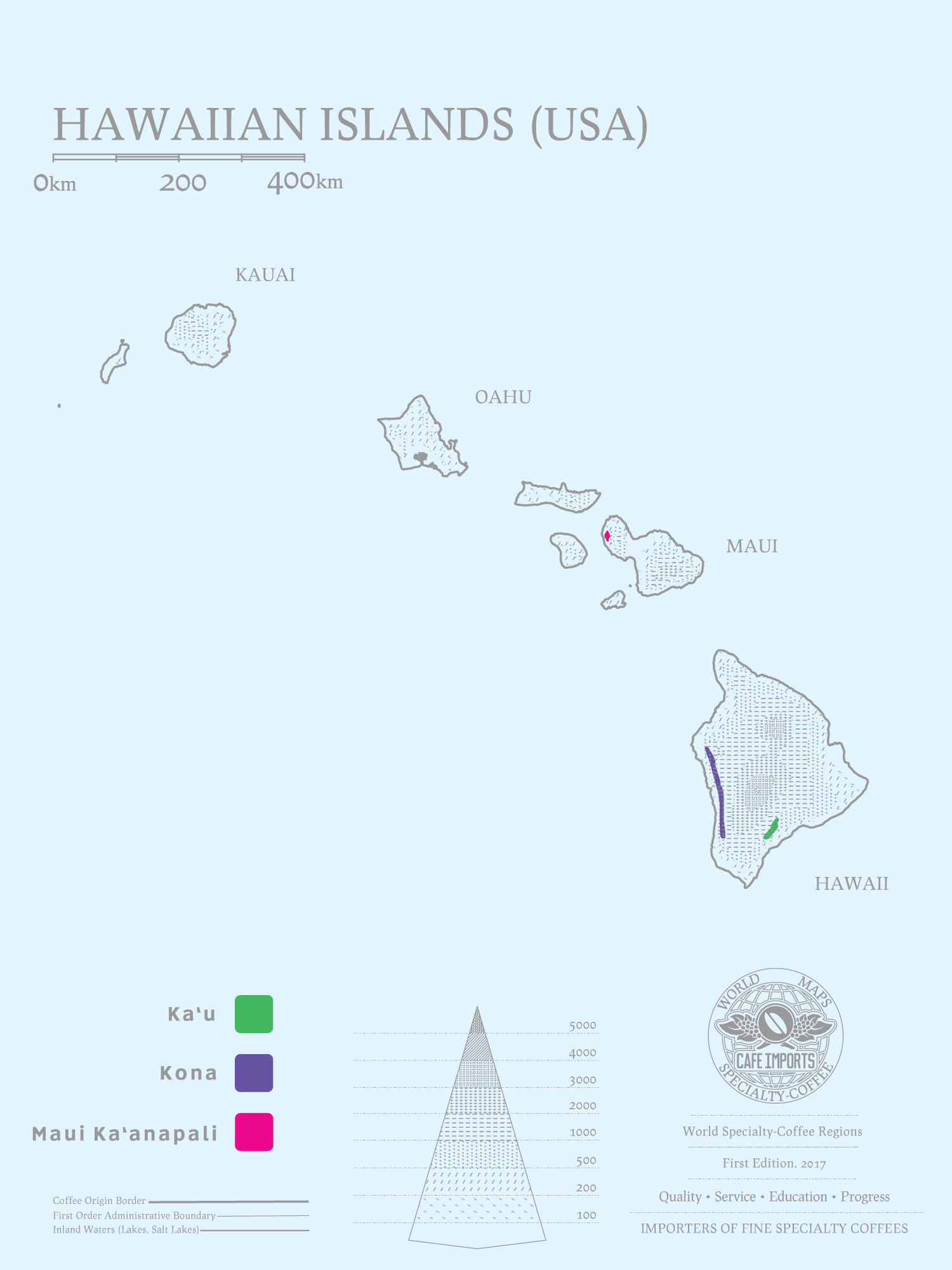
Hawaii is the only US state that grows coffee, and it is grown on five major islands of the archipelago: Oahu, Hawaii Island, Maui, Kauai and Molokai. Coffee from different islands has its own character: Kauai coffee is smooth and mellow, Molokai coffee has high body and low acidity, while Maui coffee has medium acidity but the strongest flavor. Hawaiians are enormously proud of their 100% locally grown Arabica beans.
Kona Coffee
The western and southern parts of the Kona district on Hawaii Island are renowned for Kona coffee. Situated between elevations of 800 and 1100 meters, the area provides the most suitable growing environment for coffee trees, which is why the slopes of Hualalai and Mauna Loa are covered with them.
Kona's unique natural environment has nurtured Arabica coffee and made it one of the world's highest-yielding coffee plantations. Quality is guaranteed, and the coffee grown in this specific environment and climate has a more mellow flavor. Beans from the Kona region are also very attractive to look at — plump and glossy, which earned them the reputation of "the world's most beautiful coffee beans."
Most coffee trees in Kona grow on volcanoes, absorbing the abundant nutrients stored in the soil, and combined with manual cultivation techniques every bean has a distinctive appearance. Kona coffee made from these beans is silky smooth and richly aromatic, with a charming nutty fragrance and moderate acidity — as captivating and layered as the colorful scenery of the Hawaiian Islands.

Kona coffee has always been cultivated on a family-farming model. The harvest runs from late August each year through January of the following year, and farmers pick the ripe fruit in batches and process it into coffee beans. At first only men were allowed to work in the coffee fields, but later women joined as well. Hawaiian family production preferred to rely on family effort rather than hired workers, so it was normal for a Hawaiian family to have eight or nine children at the time. Later, new immigrants continued to arrive from the Philippines, the mainland United States and Europe to work in coffee in Hawaii. Over time, Hawaii developed a social atmosphere centered on family culture while remaining open to outside influences, and that became one of the islands' defining characteristics.
Queen Farm
Queen Farm won the runner-up title at the 2009 and 2011 Gevalia (Hawaii KONA Cupping Competition) awards. 70% of the harvest there is considered top-tier specialty beans, making it a farm renowned for high quality. Even the next grade down of specialty beans has an aroma no less impressive than the top tier, drawing admiration and endless praise from the roasting industry. The Hawaiian Kona coffee introduced by FrontStreet Coffee this time comes from this farm.

FrontStreet Coffee Hawaiian Kona Coffee Beans
Region: Kona Region
Estate: Queen Estate
Altitude: 1100m
Variety: Typica
Processing Method: Washed
Roasting Recommendations
Like Blue Mountain coffee, Kona consists of low-density beans, so the charging temperature cannot be too high. When the sweet aroma is released the color turns light yellow, and with high moisture content the beans need sufficient time for steaming. The roasted beans are clean and crisp with a solid, weighty feel. FrontStreet Coffee suggests not roasting Kona too dark — a medium-light roast is recommended.
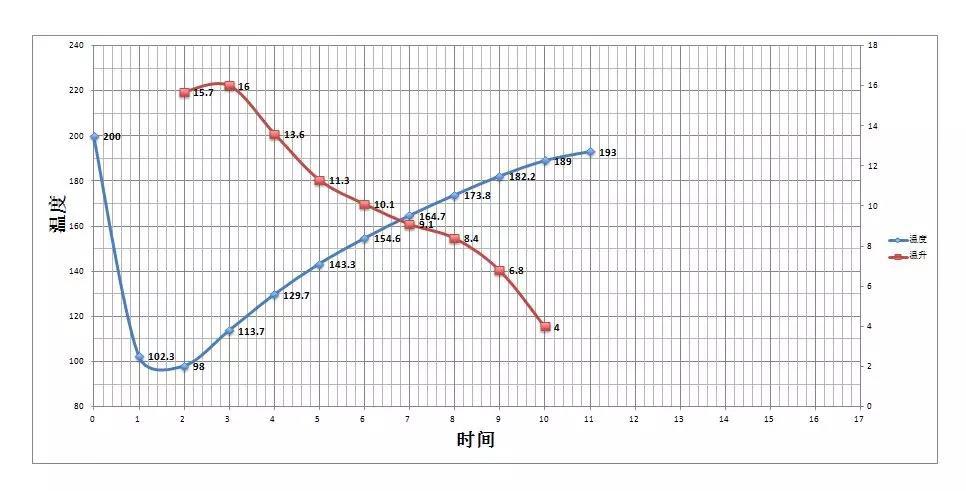
Machine: Yangjia 800N, 550g green beans input
Charging temperature: 200℃
Yellowing point: 5'35", 150.1℃
First crack: 9'30", 187℃
Development after first crack: 1'50", discharged at 193.4℃

Roasting Curve
Heat the drum to 200°C and charge the beans with the damper at 3. After 1 minute, reduce heat to 150 degrees with the damper unchanged. Roast to 5'35" at 150 degrees, when the bean surface turns yellow, the grassy smell disappears completely and dehydration is complete. Adjust heat to 140 degrees, damper to 4.
At 9'30", ugly wrinkles and black spots appear on the bean surface and the distinct toast aroma clearly turns into coffee aroma — this can be defined as the prelude to first crack. At this point listen carefully for the sound of first crack. When first crack begins at 9'30", reduce heat to 70 degrees and fully open the damper (adjust the heat very carefully, not so low that cracking stops), turn off the heat at 182 degrees, and discharge at 193.4 degrees.
Flavor Description
Balanced and smooth osmanthus honey sweetness with an elegant, full-bodied but not heavy mouthfeel. The brewed coffee releases a mulberry aroma that brings a sweet happiness, with a smooth malt aftertaste. Once cooled it becomes like a cup of mulberry tea.
Both Hawaiian Kona and Jamaican Blue Mountain are world-renowned island coffees. They are the same variety, grown at similar altitudes and latitudes, so what are the differences in flavor between them?

Jamaican Blue Mountain Coffee History
The history of Jamaican coffee goes back to the 18th century. In 1717, the French King Louis XV ordered coffee to be planted in Jamaica. In the mid-1720s, Jamaica's Governor Sir Nicholas Lawes imported Arabica seeds from Martinique and began promoting cultivation in the St. Andrew area. Coffee trees were introduced to Jamaica and planted in the Blue Mountains, which were divided into high-altitude Jamaican Blue Mountain coffee, High Mountain coffee and Jamaican coffee at different levels, with the grade determining the price.
The Blue Mountains lie in eastern Jamaica. Because the range is surrounded by the Caribbean Sea, whenever the weather is clear the direct sunlight strikes the azure sea surface and the peaks reflect the brilliant blue light of the water — hence the name. The highest peak of the Blue Mountains reaches 2256 meters (only areas below 1700m can grow coffee; above that is protected forest), making it the highest peak in the Caribbean and a famous tourist destination. Located in the coffee belt, it has fertile volcanic soil, fresh unpolluted air, a humid climate with year-round fog and rain, average precipitation of 1980mm and temperatures around 27 degrees. That climate created the world-renowned Jamaican Blue Mountain coffee, and with it the world's highest-priced coffee.
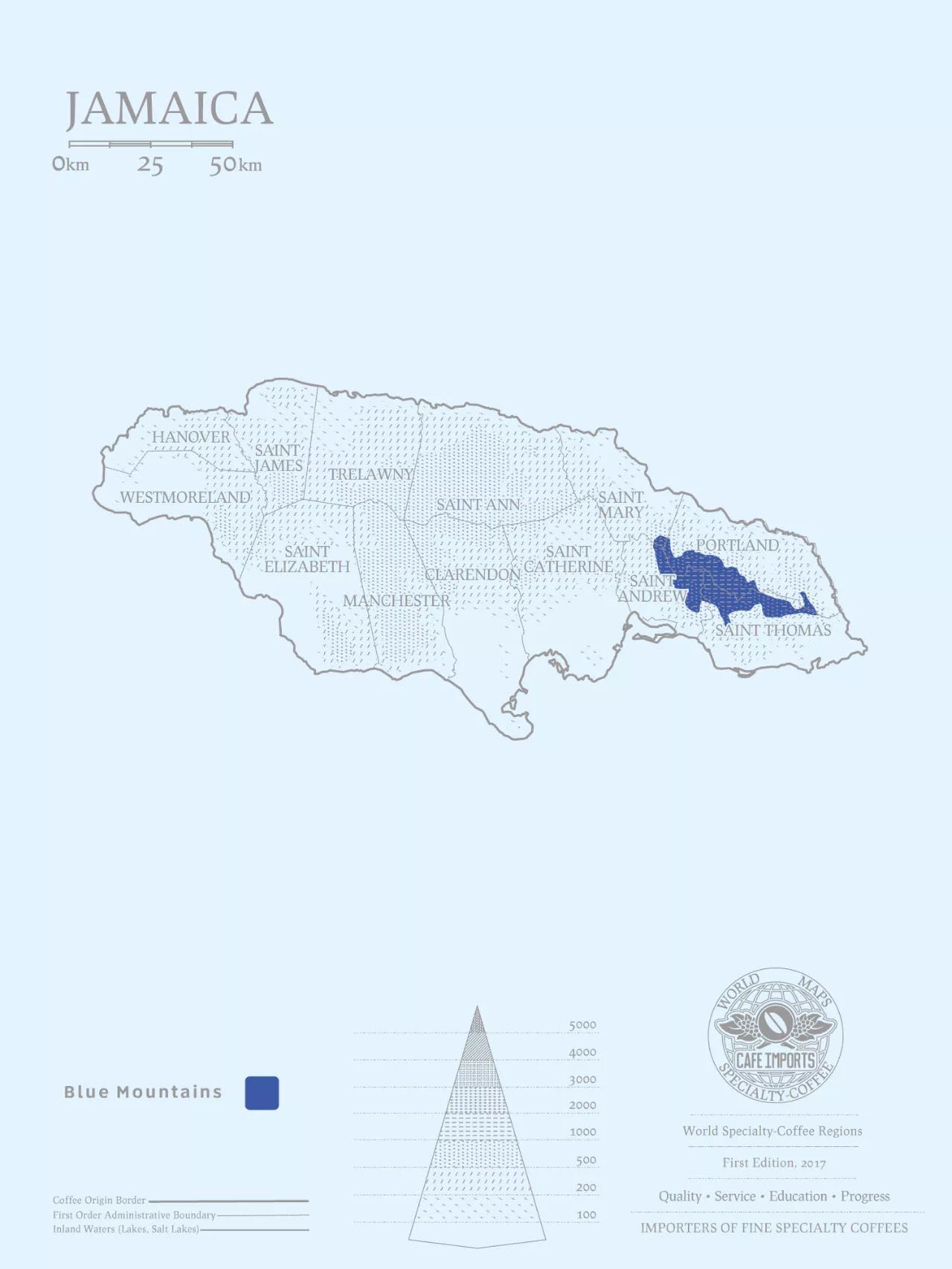
Only Blue Mountain coffee grown above 800 meters is authentic Blue Mountain coffee. FrontStreet Coffee's Blue Mountain coffee on the bean list is grown at 1310 meters and comes from Clifton Estate.
Authentic Blue Mountain coffee on the market today uses the washed processing method, though it will soon no longer be limited to washing alone. After the cherries are picked by hand, an initial screening removes underripe and overripe fruit before pulping, all within 12 hours. Traditional washed fermentation follows, and the beans are then moved to concrete patios for sun drying; the long, slow drying enhances flavor. They are dried until moisture content reaches 11%-13%, then bagged and placed in warehouses to rest and mature. Warehouse temperature is controlled at 24-25°C with dehumidifiers regulating humidity, and only after 2-3 months of stable flavor maturation are the beans shipped.

Four Major Jamaican Blue Mountain Estates
The four major Jamaican Blue Mountain estates are Clifton Estate, Stoney Grove Estate, Gold Cup Estate and RWS Coffee Estate.
Clifton Estate is the only Blue Mountain estate in Jamaica with Rainforest Alliance certification. FrontStreet Coffee's Blue Mountain coffee beans are selected from this estate, with a flavor that achieves perfect balance across acidity, body and aroma and an endless aftertaste. The estate has 200 years of history.
Stoney Grove Estate primarily cooperates with Japanese companies and has low domestic recognition, with only 80 years of history. Its recognition therefore cannot compare with Clifton Estate, and it was later acquired by JCC company.

Gold Cup Estate has an even shorter history of only 20 years, but it actually merged two century-old estates and operates with more advanced management techniques. Gold Cup currently has two brands, "Amber Estate" and "BMCP" from the Blue Mountain Coffee Processors LTD plant, with the independent Amber Estate as its top flagship.
RWS Coffee Estate merged three century-old estates, also for the development of Blue Mountain coffee. RWS refers to its three estates: Resource, Sherwood Forest and Whitfield Hall.

FrontStreet Coffee: Jamaican Blue Mountain No.1 Coffee
Region: Blue Mountain Region
Estate: Clifton Farm
Altitude: 1310m
Variety: Typica
Processing Method: Washed
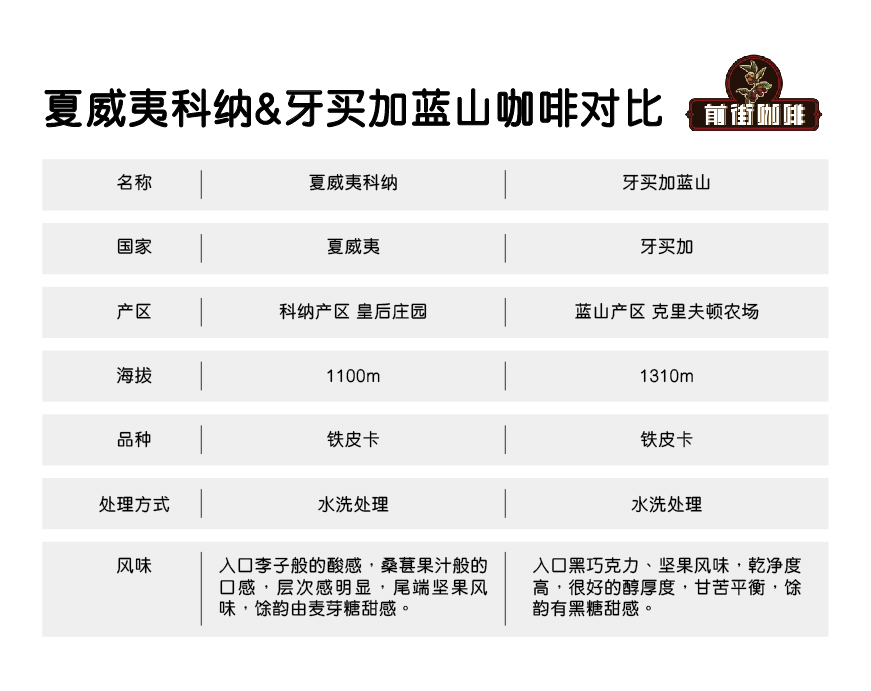
From these two beans we can see that although both are excellent Typica varieties, they are grown in different regions. Because of factors such as climate, soil quality and growing environment, the two taste quite differently. Jamaican Blue Mountain leans toward chocolate and nuts, while Hawaiian Kona carries some sweet-and-sour mulberry notes. Those who prefer a fuller body with nutty flavors can choose Jamaican Blue Mountain, while those who want body but also fruity sweetness and acidity can opt for Hawaiian Kona.
FrontStreet Coffee Recommendation
If the Kona described above appeals to you, the closest comparison on FrontStreet Coffee's bean list is Jamaica Blue Mountain No.1, the highest grade of authentic Blue Mountain. It comes from Clifton Estate in the Blue Mountains, the only Blue Mountain estate with Rainforest Alliance certification and one of the oldest sources of the coffee, grown at 1310m and processed by the traditional washed method. Like Kona, it is a low-density Typica bean, which is why FrontStreet Coffee roasts it medium-dark; at that level the acidity, bitterness, sweetness and body fuse into the strong yet elegant character the coffee is known for, with cream, caramel, chocolate, nut and honey notes unfolding over a soft sweetness and a gentle acidity.
Blue Mountain has a long-standing reputation for rarity, and it is worth understanding why. The whole Jamaican Blue Mountain region produces less than 2500 tons a year, a tiny share of world supply, and Japan has long held a stable trading relationship with Jamaica and historically bought more than 70% of the crop, leaving even less for the rest of the world. Genuine Blue Mountain is easy to screen out at the label: if the packaging puts "Blue Mountain" front and center and then adds words like "blend," "flavor" or "taste," it is not the real thing, and true Blue Mountain never appears as instant coffee. Authentic lots are certified and shipped in the traditional wooden barrels, which come in 15, 45 and 70 kg sizes, and each barrel is itself a mark of the real article.
Pour-over shows Blue Mountain at its most transparent. FrontStreet Coffee suggests a Kono dripper, 15g of coffee and a 1:15 ratio at 87-88°C, with the grind slightly coarser than you would use for a light roast — roughly the texture of granulated sugar — and letting the beans rest 4-7 days after roasting, counting the roast date as day one. Use three pours: a 30g bloom for 30 seconds, then a slow, steady circle to 120g, then continue to 225g with a slightly faster flow and circling motion so the bed does not clog and over-extract. If you prefer something richer, the same beans also work in a moka pot with a slightly finer grind, hot water in the base, medium-low heat, and the pot taken off the heat just before the flow finishes; the chocolate, caramel and nut notes are amplified while the balance stays intact, and it makes an excellent latte or flat white.
Important Notice :
FrontStreet Coffee is a long-established specialty coffee roaster in Guangzhou China, selling freshly roasted beans from its own farm in Yunnan as well as dozens of carefully selected single-origin beans from around the world for both pour-over and espresso. The products deliver consistently excellent quality and great value, with shipping within 24 hours. Guangzhou's FrontStreet Coffee shop is recommended by many coffee lovers, and the beans are now available online at the Tmall 。
FrontStreet Coffee has moved to a new address:
FrontStreet Coffee Address: 315,Donghua East Road,GuangZhou
Tel:020 38364473
 Scan and follow the En Gafei WeChat official account. Please indicate that the reprint comes from "En Gafei".