Rich Nutty Aroma Blue Mountain Coffee Flavor Description - Premium Blue Mountain Coffee Beans Taste Price Characteristics
Jamaica Blue Mountain is one of the most prestigious and rarest coffees in the world. It is renowned for its balanced sweet, sour, and bitter notes and its smooth, full-bodied mouthfeel. Strict, precise regulation gives Jamaica Blue Mountain coffee a quality standard that no other coffee can match. Authentic Jamaica Blue Mountain coffee was introduced to Jamaica in the 1700s. The growing area typically lies between Kingston in the south and Port Antonio in the north. Reaching heights of 2,256 meters, the Blue Mountains are among the highest mountain ranges in the Caribbean. The region enjoys a cool, misty climate with high rainfall and fertile, well-drained soil, making it one of the most ideal coffee-growing areas in the world. It is precisely these conditions that make Blue Mountain coffee one of the finest coffees on earth.
Even so, the market is always flooded with counterfeit Blue Mountain coffee, and imitations are hard to guard against. Faced with a domestic coffee market of varying quality, we must stay vigilant and grasp the relevant knowledge—understanding the distinctive traits of Blue Mountain coffee is the key to telling genuine from fake. First and foremost, note that many beans are actually labeled "Blue Mountain flavored" rather than "Blue Mountain coffee." "Blue Mountain flavored" coffee may contain only a few percent of actual Blue Mountain coffee and cannot be equated with the genuine article.

Eight Methods for Verifying Blue Mountain Coffee
Today, FrontStreet Coffee brings you eight methods for verifying Blue Mountain coffee.
First: Taste the Flavor
For coffee connoisseurs, the taste buds are the most convincing judge of all. Blue Mountain coffee has a smooth mouthfeel that gives a rich, mellow sensation—genuinely well balanced. Fake Blue Mountain coffee, by contrast, is either thin or overly stimulating and never achieves that perfect balance.

Second: Jamaica Coffee Industry Board Certification
As mentioned earlier, authentic Jamaica Blue Mountain coffee is held to strict standards. In Jamaica, only companies confirmed and approved by the Coffee Industry Board are qualified to export Blue Mountain coffee. The Jamaica Coffee Industry Board (CIBOJ) was established on June 2, 1950, under the Coffee Industry Regulation Law of 1948, with the aim of encouraging the development of Jamaica's coffee industry and promoting the welfare of those engaged in it. Its responsibilities include licensing Jamaican coffee processors and dealers, setting or reviewing coffee quality standards, and acting as the sole certifier of Jamaican coffee exports and green coffee beans, while also providing consulting services to farmers and other industry stakeholders.

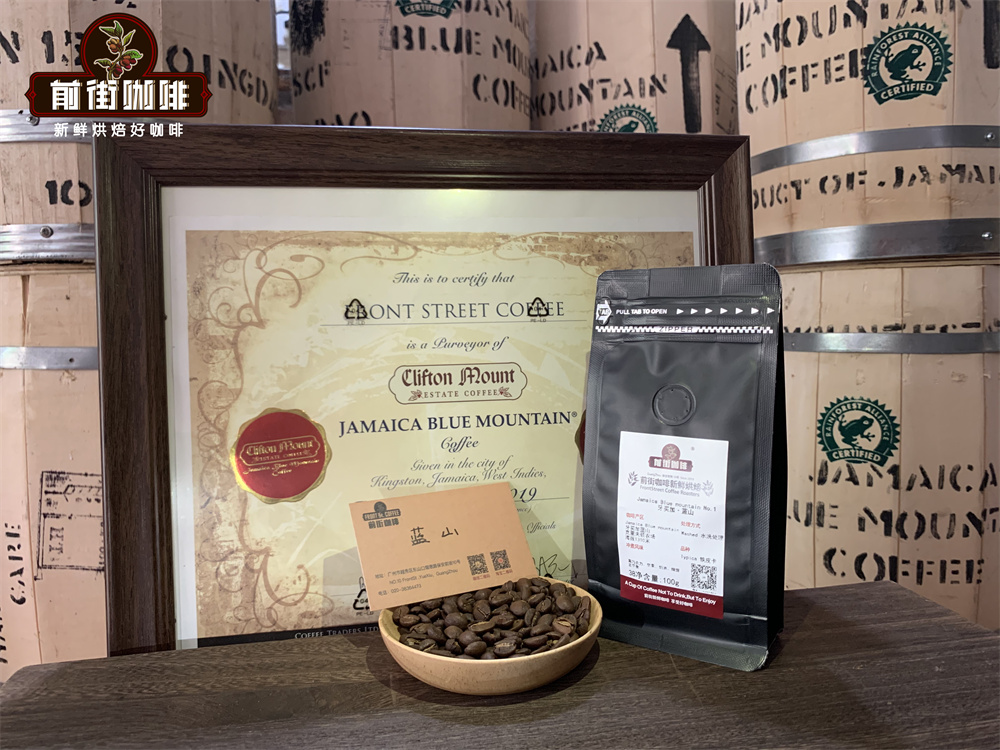
On January 1, 2018, the functions of CIBOJ were taken over by the newly established Jamaica Agricultural Commodities Regulatory Authority (JACRA), which is responsible for the regulation, promotion, standardization, and development of the agricultural products industry. FrontStreet Coffee's Jamaica Blue Mountain coffee certificate is displayed at the store entrance, showing customers this quality marker and helping everyone understand it.
Third: Confirm the Origin
Some readers may think this is a pointless statement—Blue Mountain coffee naturally comes from Jamaica, so why confirm it? True enough, but don't forget that Blue Mountain coffee sold in Asia was once monopolized by Japan's UCC company, so almost all of it carries the UCC trademark, which makes confirming the production area very important.
Fourth: Check the Packaging
Very early on, authentic Jamaica Blue Mountain coffee was packaged in sealed aluminum foil with burlap sacks as outer packaging. In recent years, however, green beans are mostly packaged in original wooden barrels. Jamaica is now the only country in the world that still retains wooden-barrel packaging for coffee. Many counterfeit Blue Mountain coffees on the domestic market also use wooden barrels for one-pound portions, and the barrels are even coated with lacquer. Think about it—coffee is a food that wins on flavor; once contaminated with a paint smell, who could enjoy it? Jamaicans surely wouldn't be so foolish.

Fifth: Check the Grade
Blue Mountain coffee is divided into five grades: Blue Mountain No. 1, Blue Mountain No. 2, Blue Mountain No. 3, Blue Mountain PB, and Jamaica High Mountain coffee. Counterfeit Blue Mountain coffees on the domestic market, however, often carry AAA, AA, A, or G1 grade labels, which are entirely irrelevant and must be fake, since these grades have never existed for Blue Mountain coffee.
Sixth: Examine the Appearance
Authentic Jamaica Blue Mountain coffee beans are green in color, uniform in shape, and medium to small in size. The ends of the beans curve slightly upward. After roasting, they expand in volume and become full and round.

Seventh: Grinding Condition
Blue Mountain coffee grows in medium-to-high-altitude areas, and its green beans have a relatively loose cellular structure. When ground with a manual grinder, there is a distinct crisp feeling, with almost no resistance or stiffness.
Eighth: Identify the Aroma
Blue Mountain coffee has a rich fruity aroma combined with chocolate notes (some also perceive it as creamy). After roasting, Blue Mountain coffee beans have a rich, steady aroma, whereas so-called Blue Mountain coffees blended with other varieties have a light, unstable aroma that lacks depth and fades quickly.
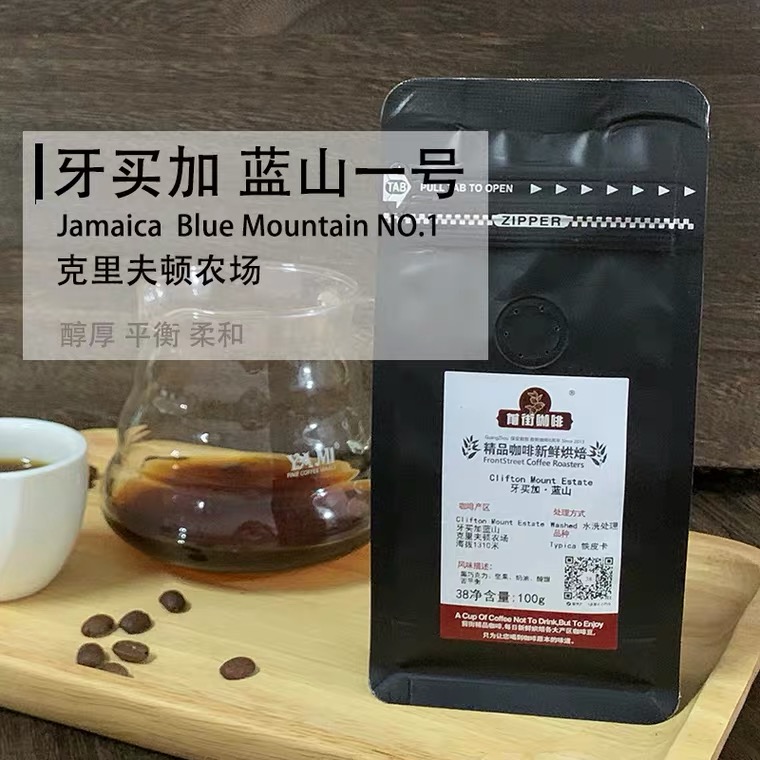
FrontStreet Coffee's Jamaica Blue Mountain No. 1
After introducing the above methods for distinguishing authentic from fake Blue Mountain coffee, FrontStreet Coffee now presents its best-selling Jamaica Blue Mountain No. 1 from Clifton Mountain Estate. Clifton Mountain Estate is currently the largest coffee estate in the Blue Mountain region, though by international standards it is still only small-scale cultivation. Clifton Mountain Estate was established 270 years ago and is said to be one of the oldest coffee estates. It is the only local coffee farm certified by the Rainforest Alliance, which also proves that its estate environment is exceptionally well preserved.
FrontStreet Coffee's Blue Mountain No. 1 has a very clean, mild flavor, with perfect balance among acidity, body, and aroma. It is completely free of bitterness, showing only moderate, well-judged acidity with a persistent fruity finish. The dry aroma features roasted peanut and roasted hazelnut; when wet, it offers oolong tea aromatics. The entry is chocolatey, with a caramel sweetness in the aftertaste. For those who have purchased FrontStreet Coffee's Blue Mountain No. 1, here are FrontStreet Coffee's brewing recommendations.

Brewing Parameters:
Dripper: Kono
Coffee amount: 15 grams
Coffee-to-water ratio: 1:15
Water temperature: 88°C
Grind size: Medium-coarse
A Kono dripper is used because this type of dripper allows for better blooming. During brewing, as the water level rises, it causes the filter paper to adhere closely to the cup wall, so air can escape only through the gaps between the lower ribs and the ridges. The interaction between water and coffee grounds creates a siphon-like effect, making the overall coffee texture much richer and fuller.

Brewing Technique:
Bloom with 30 g of water for 30 seconds, then slowly pour in a small stream from the center outward to 120 g. Wait until the coffee bed drops to the half level, then pour with a larger stream to 225 g. Remove the dripper after all the coffee liquid has flowed into the lower pot to finish extraction. Total brewing time is approximately 2 minutes.
FrontStreet Coffee Recommendation
If what you are after is a genuine, certified Blue Mountain, FrontStreet Coffee's Jamaica Blue Mountain No. 1 is the one to choose. It comes from the long-established Clifton Estate, which began growing and processing coffee in the mid-eighteenth century, around 1750, with its plots and processing facilities sitting at an average elevation of about 4,300 feet (1,310.64 meters)—enough altitude, gentle afternoon cloud cover that shades the slopes, ample sunlight, and mineral-rich soil all extend the ripening of the cherries. The beans are traditionally medium-dark roasted to emphasize a rich, rounded body and the classic bittersweet-to-sweet arc. FrontStreet Coffee recommends a Kono dripper, 15 g of coffee (rested 4–7 days from the roast date), 1:15, and 87–88°C water—higher temperatures are a common cause of scorched, bitter cups, while water that is too cool makes the coffee taste flat. Grind slightly coarser than you would for a light roast, about the texture of white sugar. Brew in three pours: 30 g for the bloom for 30 seconds, add water to 120 g and pause, then continue to 225 g with a faster, lighter stream to avoid clogging the filter bed. The cup is very clean and complex, gentle and mild, with chocolate sweetness and strong body—sweet, acidic, and bitter notes in careful balance, no real bitterness, and a long fruity finish. Clifton is also the only Jamaican coffee estate with Rainforest Alliance certification, and its wooden barrels bear the green tree-frog logo.
Important Notice :
FrontStreet Coffee is a long-established specialty coffee roaster in Guangzhou China, selling freshly roasted beans from its own farm in Yunnan as well as dozens of carefully selected single-origin beans from around the world for both pour-over and espresso. The products deliver consistently excellent quality and great value, with shipping within 24 hours. Guangzhou's FrontStreet Coffee shop is recommended by many coffee lovers, and the beans are now available online at the Tmall 。
FrontStreet Coffee has moved to a new address:
FrontStreet Coffee Address: 315,Donghua East Road,GuangZhou
Tel:020 38364473
 Scan and follow the En Gafei WeChat official account. Please indicate that the reprint comes from "En Gafei".